The Mayans called cocoa “food of the gods” and used it as medicine. Modern research shows cocoa can genuinely boost brain function—but only if you know which kind to eat, how much, and when.
The difference comes down to flavanols. These are plant compounds found in cocoa beans. They’re what make dark chocolate different from a candy bar. Think of flavanols as the active ingredient. Without them, you’re just eating sugar and fat.
In clinical trials, older adults who consumed 900mg of cocoa flavanols daily scored 25% higher on memory tests after just 12 weeks. Young adults reported less mental fatigue during demanding tasks. Brain scans showed increased blood flow to areas that handle thinking and decision-making.
So can dark chocolate actually help your brain? The answer depends on what you’re eating, how much, and what you expect it to do.
How Cocoa Changes Blood Flow to Your Brain in Two Hours
Your brain uses about 20% of your body’s oxygen. When it gets more blood flow, it works better. That’s basic biology.
In 2006, researchers at the University of Reading conducted a study that would change how scientists view chocolate. They gave 16 healthy adults cocoa drinks in a crossover design, with participants receiving drinks containing different flavanol concentrations on separate occasions. The high-flavanol drinks provided substantial increases in cerebral blood flow within two hours. Brain scans showed clear increases in areas that handle thinking and memory.
The frontal cortex got the biggest boost. This is the part of your brain that plans, solves problems, and makes decisions. More oxygen there means better performance on complex tasks.
For practical purposes: if you have a big presentation or need to focus on hard work, eating high-flavanol chocolate 90 to 120 minutes before might help. It’s not magic. It’s just getting more fuel to your brain when you need it most.
But timing matters. The effect is temporary. Two hours later, your brain is working with better blood flow. Six hours later, that boost has worn off.
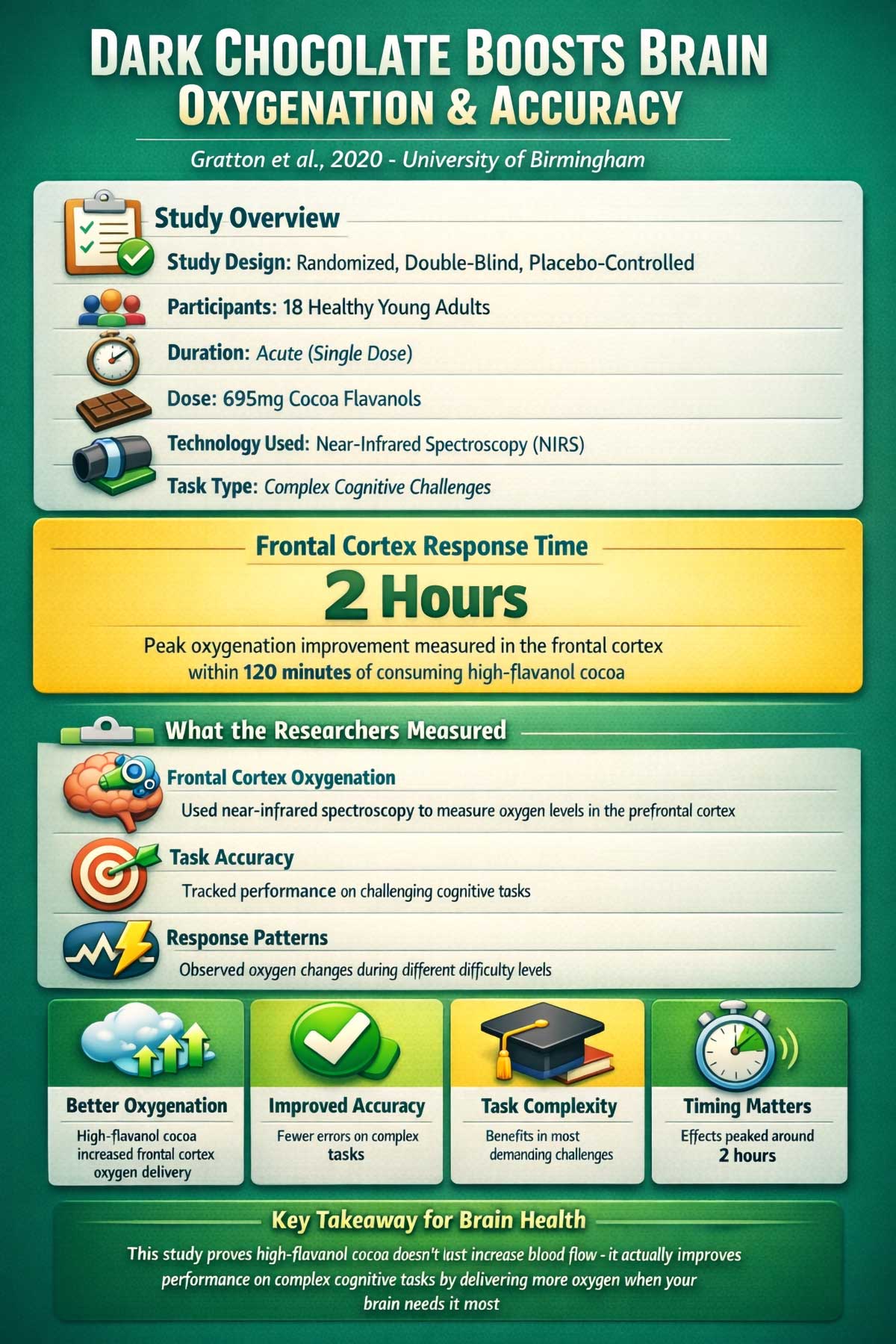
A more recent 2020 study from the University of Birmingham took this research further. Scientists gave 18 healthy young adults a single dose of cocoa containing 695mg of flavanols, then measured frontal cortex oxygenation using near-infrared spectroscopy while participants completed challenging cognitive tasks. The high-flavanol group showed better oxygenation and improved accuracy compared to those who received a low-flavanol control drink. They didn’t just have more blood flow. They actually performed better on complex problems.
Why Dark Chocolate Helps You Push Through Mental Fatigue
Your brain gets tired. After hours of hard thinking, you slow down. You make more mistakes. This happens to everyone.
Researchers at Swinburne University in Australia tested this with 30 young, healthy adults. They gave some people cocoa with 994mg of flavanols. Others got a placebo that looked and tasted the same but had almost no flavanols. Both groups then completed a demanding cognitive battery designed to exhaust mental resources.
The results were nuanced. The flavanol group didn’t work faster or score higher on tests, but they felt less drained by the effort. They reported significantly lower mental fatigue even while doing the same challenging work. Their subjective experience of the difficulty changed.
This is different from caffeine. Coffee gives you a quick spike, then you crash. Cocoa flavanols seem to help your brain handle stress without burning out as fast. You get a steadier baseline instead of peaks and valleys.
Caffeine is a sprint. Cocoa flavanols are more like pacing yourself through a marathon. Both have their place. But for sustained mental work, the cocoa approach might serve you better.
The Memory Benefits for Older Adults
This is where the most compelling evidence comes from.
The Dentate Gyrus Connection
Your brain has a part called the dentate gyrus. It sits inside the hippocampus. Its job is pattern separation. That means telling apart similar memories. Like remembering where you parked today versus yesterday.
This part of the brain shrinks as you age. That’s why older adults sometimes mix up recent events.
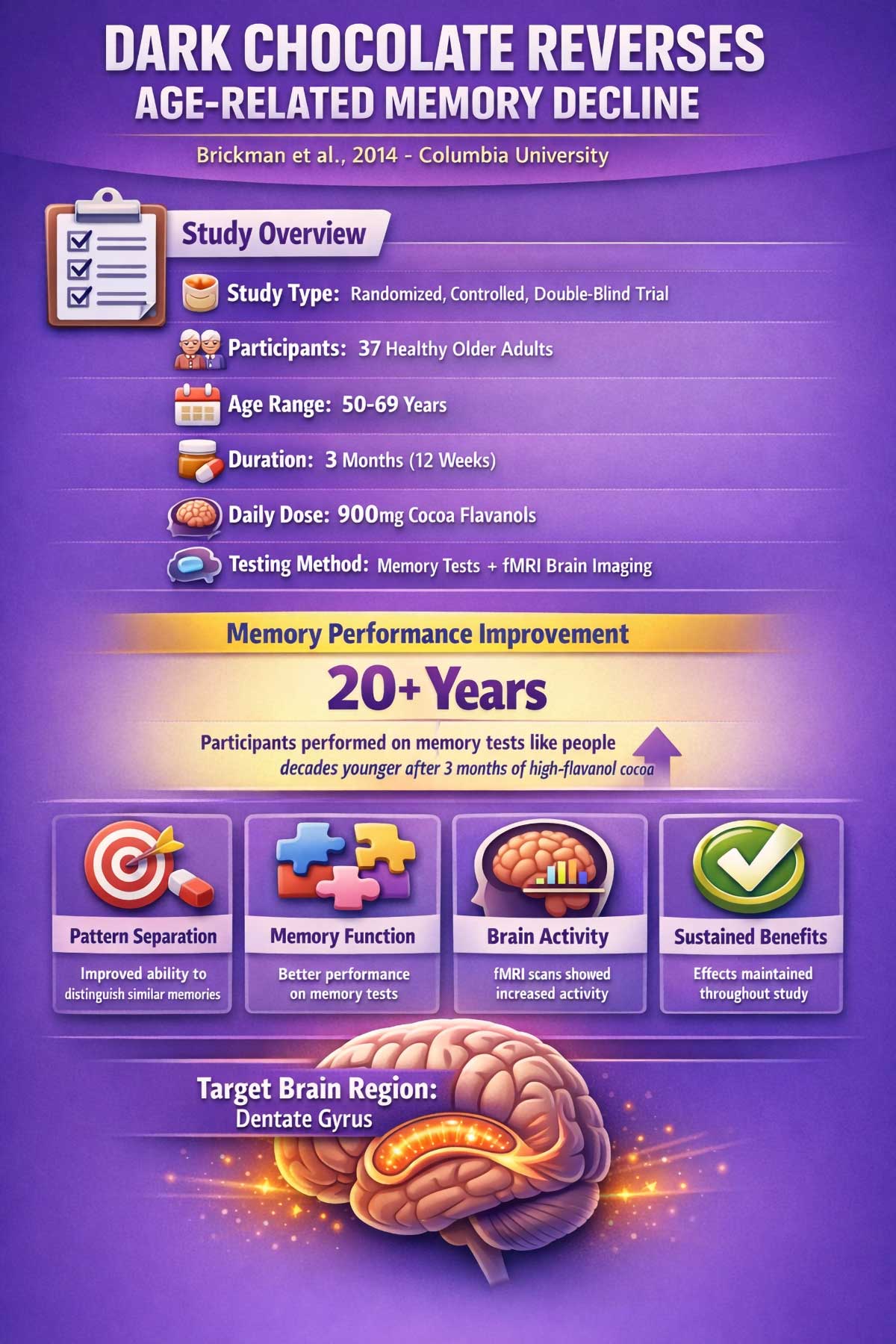
In a 2014 study published in Nature Neuroscience, Columbia University researchers worked with 37 healthy adults aged 50 to 69. Participants received either 900mg of cocoa flavanols daily or a low-flavanol drink for three months. The research team tested memory performance and used functional MRI to measure brain activity in the dentate gyrus.
The high-flavanol group showed significantly improved dentate gyrus function and better performance on a pattern separation memory task. While the improvement was meaningful, individual results varied, and the task was specific to pattern separation rather than all types of memory. Brain imaging confirmed the dentate gyrus was more active. One participant who had struggled to remember recent conversations found herself recalling details she would have normally forgotten.
MCI: When Memory Problems Begin
But the most striking results came from people with mild cognitive impairment. That’s when you notice memory problems, but they’re not severe enough to be dementia. About 15% to 20% of people over 65 have MCI. Many worry it will progress to Alzheimer’s, though not all cases do.
Italian researchers conducted a rigorous trial with 90 elderly subjects who had been diagnosed with MCI. They divided participants into three groups: one received 990mg of cocoa flavanols daily, another got 520mg, and the third received a very low dose. After eight weeks, both high-dose groups improved significantly.
Verbal fluency got better. Participants could name more words in a category when given 60 seconds. Executive function improved. They got faster on the Trail Making Test, which measures mental flexibility and the ability to switch between tasks. The improvements were dose-dependent. More flavanols meant bigger gains.
(Note: Multiple publications from this Italian research group examined overlapping outcomes from their MCI trials, including both cognitive and metabolic markers.)
The Insulin-Brain Link
What researchers didn’t anticipate: insulin sensitivity improved too. Blood sugar control got better. Scientists think this might be part of how cocoa helps the brain.
Your brain runs on glucose. When your body handles glucose better, your brain gets steadier energy. Insulin resistance, which often develops with age, can impair cognitive function. The same Italian study measuring cognitive improvements also tracked metabolic markers. They found that flavanol consumption reduced insulin resistance and improved lipid profiles.
This doesn’t mean chocolate cures dementia. It doesn’t. But for people experiencing early decline, it might slow things down or help them function better.
How Chocolate Affects Your Mood and Long-Term Thinking
Dark chocolate makes people feel good. You probably knew that already. But it’s not just the sugar talking.
Cocoa triggers your brain to release endorphins. These are natural pain relievers. It also affects serotonin, a chemical that regulates mood. This is a real biological effect, not just enjoying a treat.
In studies, people who ate dark chocolate regularly reported lower stress levels. They felt calmer during demanding tasks. The effect built up over time.
A cross-sectional study examined 968 community-dwelling adults from the Maine-Syracuse Longitudinal Study. Researchers assessed chocolate eating habits through detailed questionnaires and administered a comprehensive cognitive function battery. People who reported eating chocolate regularly (at least once per week) scored higher on visual-spatial memory, working memory, scanning and tracking, abstract reasoning, and the Mini-Mental State Examination compared to those who rarely or never consumed chocolate.
This was observational and cross-sectional, so it doesn’t prove chocolate caused the improvement—it’s possible that people with certain lifestyle or health patterns both eat more chocolate and have better cognitive function. But combined with the controlled trials, it adds to the evidence suggesting long-term consumption might support cognitive health.
The key phrase is “long-term.” You need to eat high-flavanol chocolate consistently for weeks or months to see this effect. One piece won’t do it.
A 2017 systematic review and meta-analysis examined all available studies on cocoa flavanols and cognition. The researchers analyzed data from multiple trials involving both healthy adults and those with cognitive impairment. They found that acute consumption primarily benefited attention and processing speed, while chronic consumption over several weeks showed the most pronounced effects in older adults and people with existing cardiovascular risk factors or early cognitive decline. The pattern was clear: the brain benefits accumulate over time.
What About Milk Chocolate?
You might be wondering if milk chocolate works too. It’s sweeter and easier to eat.
The short answer: no.
Milk chocolate contains far fewer flavanols to begin with. Most milk chocolate bars have under 70mg of flavanols per ounce. That’s less than one-fifth of what you need for brain benefits.
But there’s a bigger problem. The milk itself interferes with flavanol absorption. Milk proteins bind to flavanols in your digestive system. This prevents your body from absorbing them properly. The calcium in milk compounds this issue.
Studies comparing dark chocolate to milk chocolate found that the milk version produced almost no increase in flavanol levels in the bloodstream. Even if you ate five milk chocolate bars, you wouldn’t get the same effect as one serving of high-quality dark chocolate.
White chocolate has zero flavanols. It’s made from cocoa butter without any cocoa solids. The flavanols are in the solids, not the fat.
If you want brain benefits, stick with dark.
How Much Dark Chocolate Actually Works
This is where most people get it wrong.
A typical chocolate bar has maybe 50mg to 100mg of flavanols. The studies showing brain benefits used 500mg to 900mg. You’d need to eat five to ten bars to get that dose. That’s way too many calories and too much sugar.
So what do you do?
Start with the percentage. Anything under 70% cacao doesn’t have enough flavanols. The chocolate needs to be at least 70%, and 85% is better.
Check the label. Some brands list flavanol content. Most don’t. If it says “Dutch-processed” or “alkalized,” put it back. That process destroys flavanols. Manufacturers use it because it makes chocolate taste smoother and less bitter. But you’re left with cocoa that has no brain benefits.
The alkalization process uses alkaline chemicals to neutralize the natural acidity of cocoa. This changes the pH and destroys up to 90% of the flavanols. The chocolate looks darker and tastes milder, but the active compounds are gone.
Look for bars that say “non-alkalized” or “natural process.” These keep the flavanols intact. The chocolate will taste slightly bitter with fruity or floral notes. That bitterness is actually a good sign. It means the flavanols are still there.
For dosage, one ounce of 85% dark chocolate might give you 200mg to 400mg of flavanols, depending on the brand and how fresh it is. To hit the 500mg to 900mg range used in studies, you’d need about 1.5 to 2.5 ounces daily.
That’s roughly 250 to 400 calories. It’s also 20 to 35 grams of fat and 10 to 20 grams of sugar. You can’t ignore those numbers.
Flavanol Content Comparison
| Chocolate Type | Typical Flavanol Content | Brain Benefit Potential |
|---|---|---|
| 85% Dark (non-alkalized) | 200-400mg per oz | High |
| 70% Dark (non-alkalized) | 150-300mg per oz | Moderate |
| Dutch-processed dark | 20-50mg per oz | Minimal |
| Milk chocolate | 10-30mg per oz | None |
| White chocolate | 0mg | None |
Daily Dose Calculator
| Your Goal | Recommended Dose | Practical Serving | Calories to Budget |
|---|---|---|---|
| Acute focus boost | 500-700mg flavanols | 1.5-2 oz of 85% dark | 250-300 |
| Chronic brain health | 500-900mg flavanols | 1.5-2.5 oz of 85% dark | 250-400 |
| MCI support | 520-990mg flavanols | 1.5-3 oz of 85% dark | 250-450 |
What to Look for When Buying Dark Chocolate
Brand Comparison Guide
| What to Look For | Good Sign | Red Flag |
|---|---|---|
| Cacao percentage | 70-85%+ | Under 70% |
| Processing | “Non-alkalized” or “Natural” | “Dutch-processed” or “Alkalized” |
| Ingredients | Cocoa, cocoa butter, minimal sugar | Milk powder, vegetable oils, lots of additives |
| Color | Deep reddish-brown | Very dark black (often alkalized) |
| Taste | Slightly bitter, fruity notes | Smooth, no bitterness |
The ingredient list should be short. Good dark chocolate contains cocoa beans (or cocoa mass), cocoa butter, and sugar. That’s it. Some add vanilla or lecithin as an emulsifier. Those are fine.
Avoid chocolate with vegetable oils, artificial flavors, or a long list of ingredients you don’t recognize. These additions dilute the cocoa content and add empty calories.
Pay attention to freshness. Flavanol content decreases over time. Look for a manufacture date or best-by date. Use chocolate within a year of production for maximum benefit.
If you see a white coating on your chocolate, don’t worry. That’s called bloom. It happens when cocoa butter rises to the surface due to temperature changes. It doesn’t affect flavanol content or safety. The chocolate is still fine to eat.
Cost Reality Check
High-quality 85% dark chocolate typically costs $3-6 per 3.5 oz bar. If you’re consuming 1.5-2 oz daily, that’s approximately $1.50-$3.50 per day, or $45-105 per month. Compare this to:
- A cup of premium coffee: $4-6 daily ($120-180 monthly)
- Fish oil supplements: $15-30 monthly
- Prescription cognitive medications: Often much more
For some people, this is affordable. For others, it’s a significant expense. Non-alkalized cocoa powder offers a budget-friendly alternative at roughly $10-15 per pound, which provides about 30 servings of 2-3 tablespoons each (approximately $0.30-0.50 per day).
Brain-Boosting Recipes with Dark Chocolate
Recipe 1: Cognitive Support Smoothie
This smoothie combines multiple brain-supporting nutrients in one glass.
Ingredients:
- 1 tablespoon non-alkalized cocoa powder (100-150mg flavanols)
- 1 oz chopped 85% dark chocolate (200-400mg flavanols)
- 1 cup unsweetened almond milk
- 1/2 cup frozen blueberries
- 1 tablespoon walnuts
- 1/2 banana
- Ice as needed
Instructions: Blend all ingredients until smooth. The banana and blueberries provide natural sweetness without added sugar. The walnuts add omega-3 fats and protein.
Nutritional benefit: 300-550mg total flavanols, plus anthocyanins from blueberries and alpha-linolenic acid from walnuts.
Best timing: Mid-morning, 90-120 minutes before you need peak mental performance.
Recipe 2: Brain Health Trail Mix
Perfect for a portable snack that delivers sustained cognitive support.
Ingredients:
- 1 oz 85% dark chocolate chunks
- 1/4 cup walnuts
- 1/4 cup dried blueberries (no sugar added)
- 1 tablespoon pumpkin seeds
Instructions: Chop chocolate into small chunks. Mix all ingredients in a container. Divide into two portions.
Per serving: Approximately 250mg flavanols, healthy fats, vitamin E, and magnesium.
Store in an airtight container in a cool place. The mix stays fresh for up to two weeks.
Recipe 3: Hot Cocoa for Focus
A warm drink that delivers therapeutic doses of flavanols.
Ingredients:
- 2 tablespoons non-alkalized cocoa powder
- 1 cup hot water or unsweetened almond milk
- 1/2 oz melted 85% dark chocolate
- Optional: cinnamon, vanilla extract (avoid sugar)
Instructions: Heat liquid until hot but not boiling. Whisk in cocoa powder until dissolved. Stir in melted chocolate. Add spices if desired.
Total flavanols: 400-600mg
Best use: Drink 90 minutes before a challenging mental task like studying, taking a test, or giving a presentation.
The cinnamon adds flavor without sugar and may have its own benefits for blood sugar regulation. Vanilla extract provides aroma that enhances the experience.
Making It Work Without Sabotaging Your Diet
The studies show benefits, but they don’t erase calories.
If you add chocolate to your diet without changing anything else, you’ll gain weight. That hurts your health more than the flavanols help.
So you need a plan.
Smart Substitution Strategies
Replace other treats. If you usually have cookies or ice cream, swap them for dark chocolate. You’re trading one dessert for another, not adding extra.
One woman in her 60s who participated in a flavanol study replaced her nightly bowl of ice cream with two squares of 85% dark chocolate and a handful of berries. She lost 8 pounds over three months while still enjoying a treat. Her memory test scores improved too.
Cut back elsewhere. If you want to add chocolate, reduce calories from another source. Skip the cream in your coffee. Choose vegetables instead of rice at dinner. Small changes add up.
Timing Your Intake
Split your dose. Have half an ounce mid-morning and half an ounce mid-afternoon. This keeps flavanol levels more stable throughout the day and feels less like you’re eating a lot.
The mid-morning timing (around 10-11 AM) works well for several reasons. Your cortisol levels have dropped from their morning peak. Your blood sugar has stabilized after breakfast. And you still have a full workday ahead when you could use the cognitive boost.
Avoid eating dark chocolate late in the evening if you’re sensitive to stimulants. Dark chocolate contains caffeine and theobromine. An ounce of 70% dark chocolate has about 20-25mg of caffeine. That’s roughly one-quarter of a cup of coffee.
Theobromine is a cousin of caffeine. Both are methylxanthines, but theobromine is gentler and longer-lasting. While caffeine peaks quickly and drops off, theobromine provides a steadier, milder stimulant effect with a longer half-life (about 6-10 hours compared to caffeine’s 3-5 hours). This is why dark chocolate provides sustained alertness without the sharp spike and crash of coffee.
For most people, this won’t affect sleep. But if you’re sensitive, stick to morning or early afternoon consumption.
Synergistic Food Combinations
Pair chocolate with other brain foods. Walnuts have omega-3 fats that help cognition. Berries have their own flavonoids. A small handful of walnuts, some berries, and a square of dark chocolate makes a snack that compounds the benefits.
Research suggests that combining different types of polyphenols from various plant foods may enhance overall effects. Blueberries contain anthocyanins. Green tea has catechins. Dark chocolate provides epicatechins. Together, they support brain health through multiple pathways.
Watch your overall diet. If you eat processed foods, too much sugar, and not enough vegetables, chocolate won’t save you. It’s a supplement to a healthy diet, not a replacement.
Stay active. Exercise boosts brain blood flow too. Combine it with high-flavanol cocoa and you get better results than either alone. Studies on older adults show that those who both exercise regularly and consume flavanol-rich foods perform better on cognitive tests than those who only do one or the other.
Timeline of Effects: What to Expect and When
Understanding when different benefits appear helps you set realistic goals.
Within 2 Hours (Acute Effects):
- Increased cerebral blood flow
- Better frontal cortex oxygenation
- Improved focus on complex tasks
- These effects are temporary and fade within 4-6 hours
Days 1-7:
- You may notice slightly reduced mental fatigue during demanding work
- Mood might improve subtly
- These early effects are often mild
Weeks 2-4:
- Reduced subjective stress during cognitive tasks
- Better sustained attention over long work sessions
- Effects start to build with consistent daily intake
Weeks 8-12:
- Measurable improvements in memory tests (if you’re over 50)
- Better executive function and mental flexibility
- Improved pattern separation in daily life
- These chronic benefits require ongoing consumption to maintain
After 3 Months:
- Maximum cognitive benefits typically plateau here
- Continued consumption maintains improvements
- Stopping will gradually reduce benefits over several weeks
Keep a simple log if you want to track your experience. Note your daily dose, timing, and any changes you observe in focus, memory, or mental stamina. This helps you determine whether the benefits justify the calories for your situation.
How Dark Chocolate Compares to Other Nootropics
Dark chocolate isn’t the only food or supplement people use for brain benefits. Here’s how it stacks up.
Coffee and Caffeine: Coffee acts faster. You feel alert within 30 minutes. But the effect is shorter. Most people crash after 3-4 hours. Cocoa flavanols take 90-120 minutes to work but provide more sustained support without the jittery feeling or crash. Coffee is better for an emergency wake-up. Dark chocolate is better for all-day cognitive demands.
Blueberries: Blueberries contain anthocyanins, which are different flavonoids than the epicatechins in cocoa. Both help the brain but through different mechanisms. Blueberries seem particularly good for long-term memory and reducing age-related decline. Dark chocolate excels at increasing blood flow and helping with executive function. Eating both gives you complementary benefits.
Green Tea: Green tea combines caffeine with L-theanine, an amino acid that promotes calm focus. The effect is smoother than coffee but still relies on caffeine. Dark chocolate contains minimal caffeine but more theobromine, which is gentler and longer-lasting. Green tea might be better for sustained calm focus. Dark chocolate might be better for challenging cognitive tasks requiring problem-solving.
Fish Oil and Omega-3s: Fish oil works through an entirely different pathway. Omega-3 fats (EPA and DHA) become part of brain cell membranes and reduce inflammation. The benefits take months to appear. Dark chocolate acts faster through blood flow. These aren’t competing options. They’re complementary. Many people use both.
Ginkgo Biloba: Ginkgo is an herbal supplement marketed for memory and cognition. Research on ginkgo shows mixed results, with some studies finding benefits and others showing no effect. Dark chocolate has more consistent evidence from controlled trials, particularly for acute blood flow increases and chronic benefits in older adults.
The advantage of dark chocolate over supplements: it’s a whole food. You get flavanols along with minerals like magnesium and iron. You know what you’re eating. The disadvantage: calories and the challenge of getting therapeutic doses without overeating.
Who Should Be Careful with Dark Chocolate
Dark chocolate is generally safe for most people. But some should use caution or avoid it.
Migraine Sufferers: Dark chocolate contains tyramine, a compound that triggers migraines in some people. If you get migraines, pay attention to whether chocolate is one of your triggers. Not everyone reacts, but it’s common enough to watch for.
People Taking MAO Inhibitors: If you take monoamine oxidase inhibitors (a type of antidepressant), avoid foods high in tyramine, including aged cheese, cured meats, and dark chocolate. The interaction can cause dangerous blood pressure spikes. Talk to your doctor before adding dark chocolate to your routine.
Those Sensitive to Caffeine or Theobromine: Dark chocolate contains both. An ounce of 70% dark chocolate has about 20-25mg of caffeine and 200mg of theobromine. If you’re very sensitive to stimulants, chocolate might make you jittery or interfere with sleep.
If you’re highly sensitive to caffeine, even the 20-25mg in an ounce of dark chocolate might affect you. To test your tolerance: Start with just 0.5 oz (half a serving) in the morning. Wait 24 hours and monitor for any sleep disruption, jitteriness, or increased heart rate. If you tolerate it well, gradually increase to the full therapeutic dose over a week.
People with Kidney Stones: Chocolate is high in oxalates. If you’re prone to calcium oxalate kidney stones, limit dark chocolate consumption. The oxalates can contribute to stone formation in susceptible individuals.
Those with Acid Reflux: Chocolate can relax the lower esophageal sphincter, allowing stomach acid to flow back into the esophagus. If you have GERD or frequent heartburn, chocolate might make it worse. Eat it earlier in the day and not close to bedtime.
Pets: This should go without saying, but keep dark chocolate away from dogs and cats. Theobromine is toxic to them. Even small amounts can cause serious problems. The darker the chocolate, the more dangerous it is for pets.
If you have any health conditions or take medications, ask your doctor before adding therapeutic doses of dark chocolate to your diet. What seems like a harmless food can interact with certain medical situations.
Your Gut Bacteria Matter
Recent research indicates that gut microbiota metabolize cocoa flavanols into smaller compounds that actually enter your bloodstream. People with different gut bacterial compositions may absorb and benefit from flavanols differently. This might explain why some people notice strong effects while others notice little.
While you can’t easily change your gut microbiome overnight, consuming fermented foods and dietary fiber alongside dark chocolate may help optimize flavanol metabolism. Foods like yogurt, kefir, sauerkraut, and fiber-rich vegetables support beneficial gut bacteria that may improve flavanol absorption.
Storage Tips for Maximum Flavanol Content
How you store dark chocolate affects how well it works.
Keep it cool: Store chocolate in a cool, dark place between 60-70°F (15-21°C). The pantry works better than the refrigerator in most cases. Refrigeration can cause moisture condensation when you take it out, affecting texture.
Avoid heat: Heat degrades flavanols over time. Never store chocolate near the stove, in direct sunlight, or anywhere that gets warm. A kitchen cabinet away from heat sources is ideal.
Minimize light exposure: Light exposure can oxidize the fats in chocolate and potentially degrade flavanols. Keep chocolate in its wrapper or in an opaque container.
Use it within a year: Flavanol content decreases gradually after production. For maximum brain benefits, consume chocolate within 12 months of the manufacture date. Check the packaging for date codes.
Don’t worry about bloom: If your chocolate develops a white or gray coating, that’s bloom. It happens when cocoa butter or sugar crystals rise to the surface due to temperature fluctuations. It looks odd but doesn’t affect flavanol content or safety. The chocolate is still fine to eat and will deliver the same benefits.
Freezing is okay: If you need to store chocolate for longer periods, freezing works. Wrap it tightly in plastic wrap, then place in a freezer bag. Thaw slowly in the refrigerator before opening to prevent condensation. Freezing doesn’t destroy flavanols.
The Best Time of Day to Eat Dark Chocolate
Timing your chocolate consumption can maximize benefits and minimize potential downsides.
Morning (6-9 AM): Not ideal Your cortisol levels naturally peak in the morning. This is your body’s wake-up signal. Adding stimulants during this cortisol spike may interfere with your natural rhythm. Wait until your cortisol levels drop.
Mid-Morning (10-11 AM): Good choice Your cortisol has dropped from its peak. Your body has processed breakfast. Your workday is ramping up. This is an excellent time for dark chocolate if you want cognitive support for the rest of the day. The flavanols will peak in your system around noon or 1 PM, right when many people experience an energy dip.
Early Afternoon (1-3 PM): Also good This timing helps combat the post-lunch slump. The slight stimulant effect can help you stay alert. The cognitive benefits will carry you through the afternoon. Just be aware that some people sensitive to stimulants might have trouble sleeping if they eat chocolate after 2 PM.
Pre-Workout: Can help Some research suggests cocoa flavanols might enhance exercise performance through improved blood flow. If you work out in the afternoon, having dark chocolate 60-90 minutes before your session could help.
Evening (After 6 PM): Probably not The theobromine and small amount of caffeine might interfere with sleep in sensitive individuals. Even if you don’t feel wired, it could affect sleep quality. If you want chocolate in the evening, have it right after dinner rather than close to bedtime, and keep the portion small.
Before Cognitive Challenges: Strategic timing If you have a test, presentation, or complex project, eat your dark chocolate 90-120 minutes beforehand. This allows time for flavanols to reach peak levels in your bloodstream and increase cerebral blood flow when you need it most.
Your individual response may vary. Some people can eat dark chocolate at 8 PM and sleep fine. Others feel the effects late into the night. Pay attention to how your body responds and adjust accordingly.
Evidence Quality Summary
Understanding the strength of evidence helps you make informed decisions.
| Claim | Evidence Strength | Best Population | Time to Effect |
|---|---|---|---|
| Increased blood flow | Strong (multiple RCTs) | All adults | 2 hours |
| Reduced mental fatigue | Moderate (limited studies) | Young adults during demanding tasks | Same day |
| Improved memory | Strong (multiple RCTs) | Adults 50+ | 8-12 weeks |
| Better executive function | Strong (RCTs + meta-analysis) | Older adults, MCI patients | 8-12 weeks |
| Mood improvement | Moderate (observational + anecdotal) | General population | Varies |
What the Research Actually Shows: A Summary
Let’s consolidate the evidence to give you a clear picture.
Study Results at a Glance
| Study | Dose | Duration | Population | Main Finding |
|---|---|---|---|---|
| Francis 2006 | 516-994mg | 2 hours | Healthy adults | Increased cerebral blood flow |
| Scholey 2010 | 994mg | Single dose | Young adults | Reduced mental fatigue (no significant performance gains) |
| Desideri 2012 | 520-990mg | 8 weeks | MCI patients | Improved cognition, insulin sensitivity, blood pressure |
| Brickman 2014 | 900mg | 3 months | Ages 50-69 | Better memory and dentate gyrus function |
| Gratton 2020 | 695mg | Single dose | Young adults | Improved frontal cortex oxygenation and accuracy |
| Pase 2013 | Observational | Community adults | Cross-sectional | Regular consumption linked to better cognition |
| Socci 2017 | Meta-analysis | Various | Various | Confirmed acute and chronic benefits across studies |
Important Limitations to Consider:
Most studies were relatively small. The typical trial included 16 to 90 participants. Larger studies would strengthen the evidence.
Some research received funding from chocolate or cocoa companies. This doesn’t invalidate the results, but it’s worth noting. Independent replication is valuable.
Results are more pronounced in older adults than young, healthy individuals. If you’re under 40 with no cognitive concerns, the benefits might be subtle or primarily limited to acute effects.
Individual variation matters. Some people absorb and metabolize flavanols better than others based on gut bacteria and genetics. What works well for one person might work moderately for another.
The studies used controlled doses of flavanols, often in the form of cocoa beverages with standardized flavanol content. Translating this to commercial chocolate bars introduces variability. Flavanol content varies between brands and even between batches.
Your Quick Start Guide
Ready to try this yourself? Here’s a practical plan.
Week 1: Start slow Begin with 1 oz of 70% dark chocolate daily. Choose a non-alkalized brand. Eat it mid-morning. See how you tolerate it. Some people experience digestive changes when adding cocoa. Your gut needs time to adjust.
Weeks 2-4: Increase gradually If you had no digestive issues, move up to 1.5 oz of 85% dark chocolate daily. This provides approximately 300-600mg of flavanols. Track how you feel. Do you notice better focus? Less mental fatigue? More stable energy?
Weeks 5-12: Maintain and observe Keep your intake consistent. This is when chronic benefits start to appear. If you’re over 50, you might notice subtle improvements in memory or mental flexibility. Don’t expect dramatic changes overnight. The effects build gradually.
After 12 weeks: Assess Ask yourself: Do I feel the benefits are worth the calories? Am I managing the added sugar and fat within my overall diet? Has my weight stayed stable?
If the answer to these questions is yes, continue. If you’re gaining weight or not noticing benefits, reassess. Maybe lower the dose. Maybe pair it with other dietary changes. Maybe dark chocolate isn’t the right strategy for you.
Adjustments: Some people find that 1 oz daily is enough. Others need closer to 2 oz to notice effects. Experiment within the range supported by research (1.5 to 2.5 oz of 85% dark chocolate for 500-900mg of flavanols). Find what works for your body and your lifestyle.
What Dark Chocolate Can and Can’t Do for Your Brain
Let’s be clear about what the research actually shows and where the limitations are.
Dark chocolate with high flavanol content CAN:
- Increase cerebral blood flow within 2 hours of consumption
- Help you focus better on complex, demanding tasks when consumed 90-120 minutes beforehand
- Reduce subjective mental fatigue during sustained cognitive work
- Improve memory, verbal fluency, and executive function in older adults after 8-12 weeks of daily use
- Support better pattern separation and dentate gyrus function in people over 50
- Provide measurable cognitive benefits for people with mild cognitive impairment
- Improve insulin sensitivity, which may indirectly support brain health
- Contribute to overall cognitive health as part of a balanced diet
Dark chocolate CANNOT:
- Cure Alzheimer’s disease or reverse moderate to severe dementia
- Make you smarter overnight or dramatically boost IQ
- Compensate for lack of sleep, poor nutrition, chronic stress, or a sedentary lifestyle
- Replace medications for cognitive disorders
- Guarantee the same results for everyone (individual response varies)
- Deliver benefits if it’s milk chocolate, white chocolate, or alkalized dark chocolate
- Work if you’re not eating therapeutic doses (500-900mg of flavanols)
- Maintain benefits if you stop eating it (effects gradually fade)
The bottom line: high-quality dark chocolate with plenty of flavanols can support brain function. The science backs that up. Multiple well-designed studies show real effects. But you need to eat the right kind, in the right amount, as part of an overall healthy lifestyle.
If you’re going to eat chocolate anyway, make it count. Choose 70-85% cacao. Check that it’s not alkalized. Keep portions reasonable. Give it time to work. Budget the calories appropriately.
Just don’t expect miracles from a candy bar. Dark chocolate is a tool for cognitive support, not a magic cure. Use it wisely, alongside other healthy habits like regular exercise, good sleep, social engagement, mental challenges, and a diet rich in vegetables, fruits, whole grains, and healthy fats.
That combination—not chocolate alone—is what really protects your brain as you age.
FAQs
How long does it take to see brain benefits from dark chocolate?
Acute effects like increased blood flow appear within 2 hours of consumption. Chronic benefits like improved memory and executive function take 8-12 weeks of daily consumption to develop. Young adults might primarily notice acute effects, while older adults and those with MCI tend to see more pronounced chronic improvements.
Can I get the same benefits from cocoa powder?
Yes, if it’s non-alkalized natural cocoa powder. You’ll need 2-3 tablespoons daily to match the flavanol doses used in studies. The advantage is fewer calories and less fat than chocolate bars. The disadvantage is the taste. Unsweetened cocoa powder is quite bitter. You can add it to smoothies, oatmeal, or yogurt to make it more palatable.
Does freezing dark chocolate destroy flavanols?
No. Freezing doesn’t significantly affect flavanol content. Heat is the bigger concern. If you need to store chocolate long-term, freezing actually helps preserve it. Just wrap it well to prevent freezer burn and thaw it slowly in the refrigerator.
How do I know if my chocolate is alkalized?
Check the label. It should say “non-alkalized” or “natural cocoa.” If it says “Dutch-processed,” “alkalized,” or “processed with alkali,” put it back. When labels don’t specify, look at the color and taste. Non-alkalized chocolate is reddish-brown and tastes slightly bitter with fruity notes. Alkalized chocolate is very dark (almost black) and tastes smooth with no bitterness.
Can children eat dark chocolate for brain benefits?
Most studies focused on adults. For children, the sugar and calorie concerns likely outweigh potential cognitive benefits. Kids’ brains are developing normally and don’t need the same support as aging brains. Focus on a balanced diet with fruits, vegetables, whole grains, and healthy fats. Save the therapeutic doses of dark chocolate for adults who might actually need the cognitive support.
Will dark chocolate help with ADHD?
There’s no solid evidence that dark chocolate helps ADHD symptoms. The theobromine and small amount of caffeine might provide a mild stimulant effect, but it’s much weaker than medications designed for ADHD. Some people anecdotally report better focus, but this hasn’t been studied systematically in people with ADHD.
Can I eat dark chocolate if I’m trying to lose weight?
You can, but you need to account for the calories. If you add 250-400 calories of chocolate without reducing calories elsewhere, you’ll gain weight. Replace other treats with dark chocolate rather than adding it on top of your current intake. Some people find that the richness of dark chocolate satisfies sweet cravings with a smaller portion than milk chocolate or other desserts.
Is there a best brand of dark chocolate for brain health?
Any brand that is 70-85% cacao, non-alkalized, and made with minimal ingredients works. Some brands specifically market high-flavanol content. These can be good options but tend to cost more. Regular high-percentage dark chocolate from reputable chocolate makers usually provides adequate flavanols. Check for “non-alkalized” on the label and look for a short ingredient list.