The cholesterol number barely changes from the first bite to the last leftover. Researchers say the part that changes is the one nutrition labels never show.
You cook a batch of chicken on Sunday, divide it into containers, and microwave a portion each evening through the week. It feels like the responsible choice. Home cooking over takeout, lean poultry over red meat, leftovers instead of waste.
Scientists who measure the cholesterol in food would point out something disconcerting about that routine. The sequence of cooking, refrigerating, and reheating tends to produce the most harmful form of cholesterol researchers have been able to detect.
The cholesterol in the meat does not increase. Weigh it before and after, and the number a nutrition label would print barely moves. What changes is the shape of that cholesterol, and the altered version behaves very differently once it reaches an artery.
Cooking does not lower the cholesterol in your food
There is a popular belief that grilling or draining or crisping somehow burns the cholesterol away. It does not.
When researchers tracked pork loin through pan roasting, steaming, oven grilling, and microwaving, the fat content shifted as moisture cooked off, but the cholesterol content held steady. That result comes from a 2016 study in Food Science of Animal Resources. The total cholesterol you start with is the total cholesterol you eat.
Instead, heat converts a fraction of that cholesterol into oxidized byproducts. Cholesterol is a fragile molecule with a vulnerable double bond. Heat, oxygen, and time convert it into new compounds called cholesterol oxidation products, or COPs.
It helps to picture oxidation you already know. The brown on a cut apple, the stale smell of cooking oil left too long in the cupboard, or the gray cast on aging ground beef. Each one is oxygen rearranging fragile molecules into something the fresh food did not contain. Cholesterol follows the same process, and heat only speeds the reaction along. The label still reads the same. What that oxidized cholesterol does inside the body is where the concern lies.
What the heat is really doing
Plain cholesterol is not the villain it was once made out to be. The body makes it, needs it, and packs it into cell membranes and hormones. Oxidized cholesterol is a different matter.
Markku Ahotupa, a physiologist at the University of Turku in Finland, has spent years studying how oxidized fats move through the bloodstream inside lipoproteins, the particles that ferry fat through the blood. In a 2024 review in Antioxidants, he argued that these lipid oxidation products, rather than cholesterol on its own, may be doing much of the damage in artery walls, and that the long-held view of cholesterol as the central risk factor is likely to be challenged as the science matures.
That is a measured claim, not a conclusion. Researchers still cannot fully separate the effects of cholesterol from the effects of its oxidized cousins, because the two travel together. What they can say is that oxidized cholesterol drives the inflammation and plaque-building that ordinary cholesterol, left intact, does not.
The food most people associate with cholesterol is the egg, cooked and eaten daily by millions. How it reacts to the heat shapes how much oxidized cholesterol ends up on the plate.
Why boiling beats frying, and fish beats almost everything
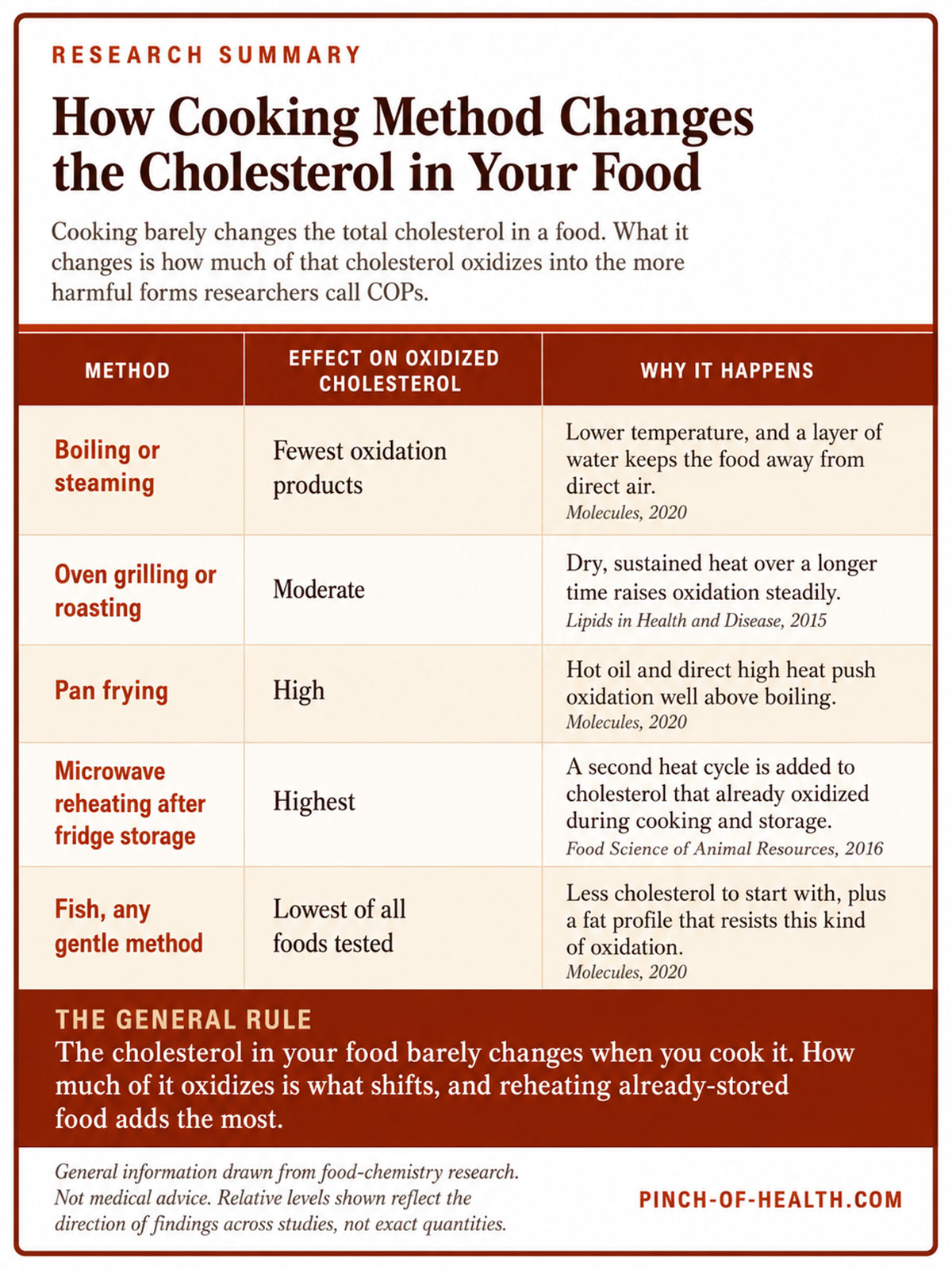
The cleanest comparison comes from a 2020 study in Molecules, where researchers cooked minced beef, chicken sausages, and fish fillets using two methods, boiling and frying, then measured the oxidation products in each.
Frying produced significantly more COPs across every sample. The two compounds that rose most, a triol and 7-ketocholesterol, are among the forms most closely associated with arterial damage. Boiling, with its lower temperature and a layer of water between the food and the air, generated far fewer.
The fish result comes with a caveat worth considering. Fish carries plenty of the fragile, highly unsaturated fat that tends to speed oxidation up, the same kind of fat that pushed COP levels higher in other tests, and yet it produced the fewest oxidation products of anything measured. The likeliest reason is plain arithmetic: fish starts with so little cholesterol that there is not much there to oxidize, and the low starting number is an advantage before the chemistry of heat can get going. Whether something else in the fish also confers a protective effect, the studies do not fully resolve. The recommendation to eat fish holds either way. The reason behind the advice is only half explained.
Processed and minced meats sit at the other end. Grinding exposes more surface area to oxygen, and the more handling and heat a piece of meat has undergone, the more oxidized cholesterol it tends to carry.
The surprising part is reheating
The Sunday meal-prep routine reappears here, though not in its favor. Cooking creates some oxidation. Refrigerated storage adds more. Reheating, especially using a microwave, pushes the total higher still.
In the pork loin study, reheating by pan roasting raised oxidation products to approximately two and a half times the level found in the same meat cooked but never reheated. A separate 2015 study in Lipids in Health and Disease followed processed meats through the same cycle and found that refrigerated storage tended to raise COP levels, with microwaving and oven grilling producing the highest amounts overall.
Cook the meat, store it for several days, reheat it, and the oxidation keeps increasing at each stage, regardless of how the meat was first prepared.
The irony is who this finding implicates. It is not the person living on drive-through window fast food. It is the one who took the advice to heart: bought the glass containers, blocked out Sunday afternoon, cooked the chicken in bulk, portioned it into neat stacks, and felt the small satisfaction of a week of meals prepared in advance.
Meal prep became shorthand for a well-organized life, the habit that fitness forums, busy parents, and anyone trying to eat better all relied on. And it is exactly that ritual (cook once, refrigerate, reheat across the week) that the chemistry singles out. The disciplined habit and the problematic one turn out to be identical.
The microwave deserves a fairer hearing than its reputation gets. It does the most damage when it reheats food that was already cooked and then stored, far less so as a first cooking method, where the results across studies are mixed.
Some perspective is warranted here, because the chemistry can appear more alarming than the evidence justifies. The oxidation products in question are counted in micrograms, a small fraction of the cholesterol already sitting in the food, and the research connecting the COPs on a plate to real events in a human artery is still thin. What the food chemistry does show clearly is direction.
One habit makes more of the harmful form, another makes less. How much that matters for a single person eating ordinary portions across years is the part nobody can yet put a number on. The honest version of this advice is a modest one: these are small, low-cost adjustments that align with the direction the evidence points, worth doing even while the size of the payoff stays uncertain.
How Your Cooking Habits Affect Oxidized Cholesterol
Three quick questions about how you usually handle meat.
Heat and time matter more than the appliance
It is tempting to rank cooking methods from worst to best and tape the list to the fridge. The research resists that. Heat, time, and the kind of fat combine to drive oxidation, which is why a quick hot sear can leave less behind than a long, slow braise. Higher than about 150°C (just over 300°F), and the longer the pan runs, the more of these compounds form. The appliance matters less than how hot the food gets, how long it stays there, and how many times it is reheated.
What lowers the risk
The fix is less drastic than the problem sounds. Antioxidants interrupt the chain reaction that turns cholesterol into its oxidized forms, and a good number of them are already sitting in the spice rack.
A 2018 review in Comprehensive Reviews in Food Science and Food Safety gathered the evidence that natural antioxidants, the polyphenols in herbs, the vitamin E (tocopherols) in certain oils, and the compounds in rosemary, thyme, and garlic, measurably slow cholesterol oxidation during cooking. The effect is not merely theoretical. In one experiment, adding a rosemary extract to refrigerated salmon pâté cut its cholesterol oxidation products from 286 to 102 micrograms per 100 grams.
This is where a marinade earns its place beyond flavor. Rosemary, garlic, lemon, herbs, and an antioxidant-rich oil work as a chemical buffer applied before the heat arrives.
A few practical moves follow from all of this. Cook fresh when you reasonably can, and favor boiling, steaming, and gentle heat for cholesterol-heavy foods. Marinate before high-heat cooking. Treat the cook-store-reheat-repeat cycle as the thing to trim back, not the home cooking itself.
None of this asks you to abandon habits you built for good reasons. Home cooking still beats the alternatives, and leftovers still beat the bin. What the research adds is a dimension your doctor probably has not raised yet, because the trials linking the oxidized cholesterol on your plate to events in your arteries are still being run. The food chemistry is solid. The human endpoint is the open question.
Until that question is settled, the sensible response is not fear of the microwave. It is a small shift in sequence: fewer reheating cycles, more freshly cooked meals, a handful of herbs before the pan comes to temperature. The cholesterol in your dinner was never the whole story. How you treat it on the way to the table turns out to matter just as much.
FAQs
Does how you cook meat affect your cholesterol?
It does not change how much cholesterol is in the meat. It changes the form. High heat, frying, and especially reheating stored leftovers convert part of that cholesterol into oxidized versions called COPs, which are tied more closely to artery damage than plain cholesterol is.
Does reheating food increase cholesterol?
Reheating does not add cholesterol to your food. It does raise the oxidized cholesterol, the form researchers link more directly to artery damage. Cooking, refrigerating, and then reheating, especially by microwave, tends to produce the highest levels of these oxidation products. Eating food fresh, or reheating less often, keeps them lower.
What is the best cooking method if you have high cholesterol?
Boiling and steaming produce the fewest oxidation products, and fish produces fewer than red or processed meat. There is no single perfect method, since temperature, time, and the type of fat all play a part. Cooking fresh and marinating with herbs or olive oil before high heat both help.
Is two eggs a day too much cholesterol?
For most healthy people, the cholesterol in two eggs affects blood cholesterol less than was once assumed, though some individuals respond more strongly than others. How you cook them matters too, because long, high heat raises the oxidized cholesterol in the yolk. Anyone already managing high cholesterol should check with their doctor.
Does cooking remove cholesterol from meat?
No. Cooking can melt off some fat, but the cholesterol content stays close to where it started. What cooking does is oxidize a portion of it, and that oxidized fraction is the part that matters most for your arteries.