You expect protein powder to build muscle. A 12-week trial used Greek yogurt instead. The results weren’t even close. Most people who want to build muscle go straight for protein powder. It’s the obvious choice. Shakers, scoops, and post-workout shakes have become gym-bag staples. But what if a tub of plain Greek yogurt sitting in your fridge right now could do just as much — maybe more?
A clinical trial put that idea to the test. The results were hard to ignore.
A 12-Week Trial That Changed the Conversation
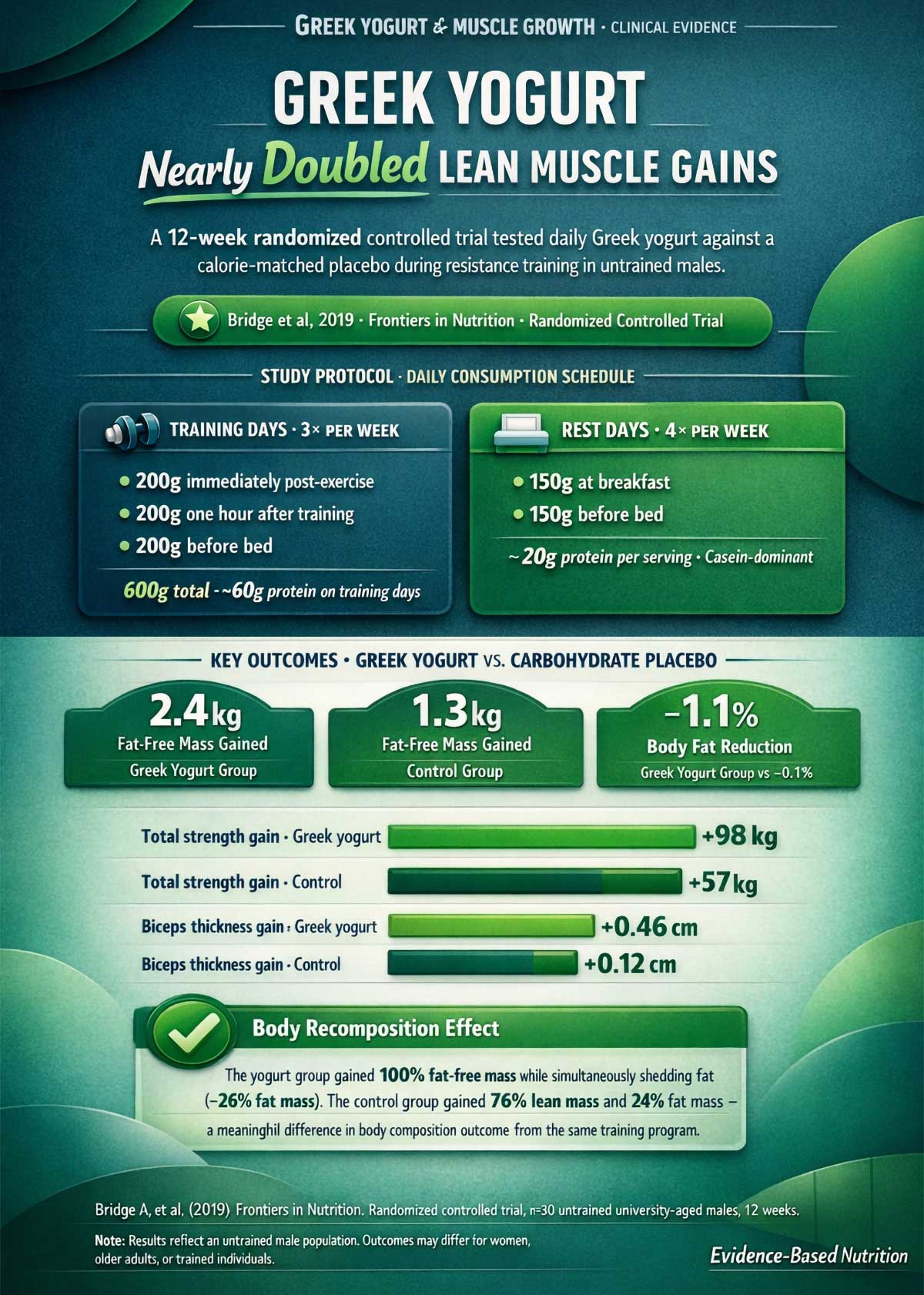
In 2019, Bridge and colleagues ran a tightly controlled, 12-week study on 30 untrained, university-aged males. All participants followed a combined resistance training and plyometric program, three sessions per week. One group added Greek yogurt to their daily diet. The other got a carbohydrate-matched placebo — same calories, same training, different food.
The Greek yogurt group ate 200g servings three times per day on training days: once right after exercise, once an hour later, and once before bed (600g total on training days, equivalent to about 60 grams of protein from this source alone). On rest days, they had two 150g servings — one at breakfast and one at bedtime. Each serving delivered around 20 grams of protein.
What happened over those 12 weeks surprised even the researchers.
The Numbers That Stand Out
The yogurt group gained 2.4 kilograms of fat-free mass. The control group gained 1.3 kilograms. That’s nearly double the lean muscle — from food, not supplements.
Strength gains told the same story. The Greek yogurt group added a combined +98kg across key lifts. The control group added +57kg. The yogurt group also saw measurable changes in muscle thickness, with biceps growing 0.46cm compared to just 0.12cm in the control group.
These aren’t marginal differences. They’re the kind of results people spend months chasing.
Building Muscle While Losing Fat at the Same Time
Here’s where it gets interesting.
The yogurt group didn’t just gain more muscle. They also lost body fat. Their body fat percentage dropped by 1.1%. The control group lost barely anything — just 0.1%.
When researchers looked at where the weight gains were coming from, the split was striking. The Greek yogurt group gained 100% fat-free mass and actually shed fat at the same time. The control group gained 76% lean mass and 24% fat mass.
This kind of outcome — gaining muscle while losing fat — is often called body recomposition. It’s considered one of the harder things to achieve, especially in a caloric surplus. Yet Greek yogurt, eaten consistently on a structured schedule, produced exactly that.
Why Dairy Protein Outperforms the Alternatives
Not all protein is equal. The type of protein in Greek yogurt matters.
Greek yogurt is casein-dominant. Casein is a slow-digesting protein. Unlike whey, which floods your bloodstream with amino acids quickly and then clears out, casein releases amino acids gradually over several hours. Think of it as a steady drip versus a quick burst. That slow release keeps muscle protein synthesis elevated for longer — especially useful at night, when your body is repairing tissue from the day’s training.
A 12-week study by Hartman and colleagues compared fat-free milk (also casein-rich) to soy protein and a carbohydrate control in 56 young male lifters. The milk group showed greater Type II muscle fiber growth — the fast-twitch fibers most responsible for size and strength — compared to both the soy and control groups. They also gained more lean mass overall. Soy protein, despite being isocaloric and providing the same total nitrogen, simply didn’t match dairy’s effect on muscle fiber growth.
Dairy’s edge comes largely down to its amino acid profile, and one in particular stands out: leucine.
The Leucine Trigger
Leucine is the amino acid that activates the muscle-building pathway known as mTORC1. Think of it as the “on switch” for muscle protein synthesis.
Research suggests you need at least 2 grams of leucine per serving to reliably trigger this pathway. A standard 150–200g serving of Greek yogurt clears that threshold. It also brings a full spectrum of essential amino acids along with it, giving the body everything it needs to build and repair muscle tissue.
A detailed review by Reidy and Rasmussen (2016) examined how dairy proteins stimulate muscle protein synthesis at a molecular level. They confirmed that the leucine content in dairy — combined with its complete amino acid profile — effectively activates the mTORC1 and S6K1 signaling pathways. These are the same pathways that resistance training stimulates mechanically. Dairy protein and lifting work on the same system, from different angles.
The Probiotic Edge: What the Gut Has to Do With It
Greek yogurt contains live cultures — probiotics — that support gut health. The Bridge et al. trial didn’t measure this specifically, but emerging research suggests that better gut health and reduced systemic inflammation may support faster recovery between training sessions. Improved gut function can also affect how efficiently the body absorbs nutrients, including protein.
That said, the direct link between Greek yogurt’s probiotic content and muscle recovery in a resistance training context is still an area that needs more investigation. Think of it as a potential bonus rather than a proven mechanism — one worth watching as the research develops.
How Much Protein Do You Actually Need?
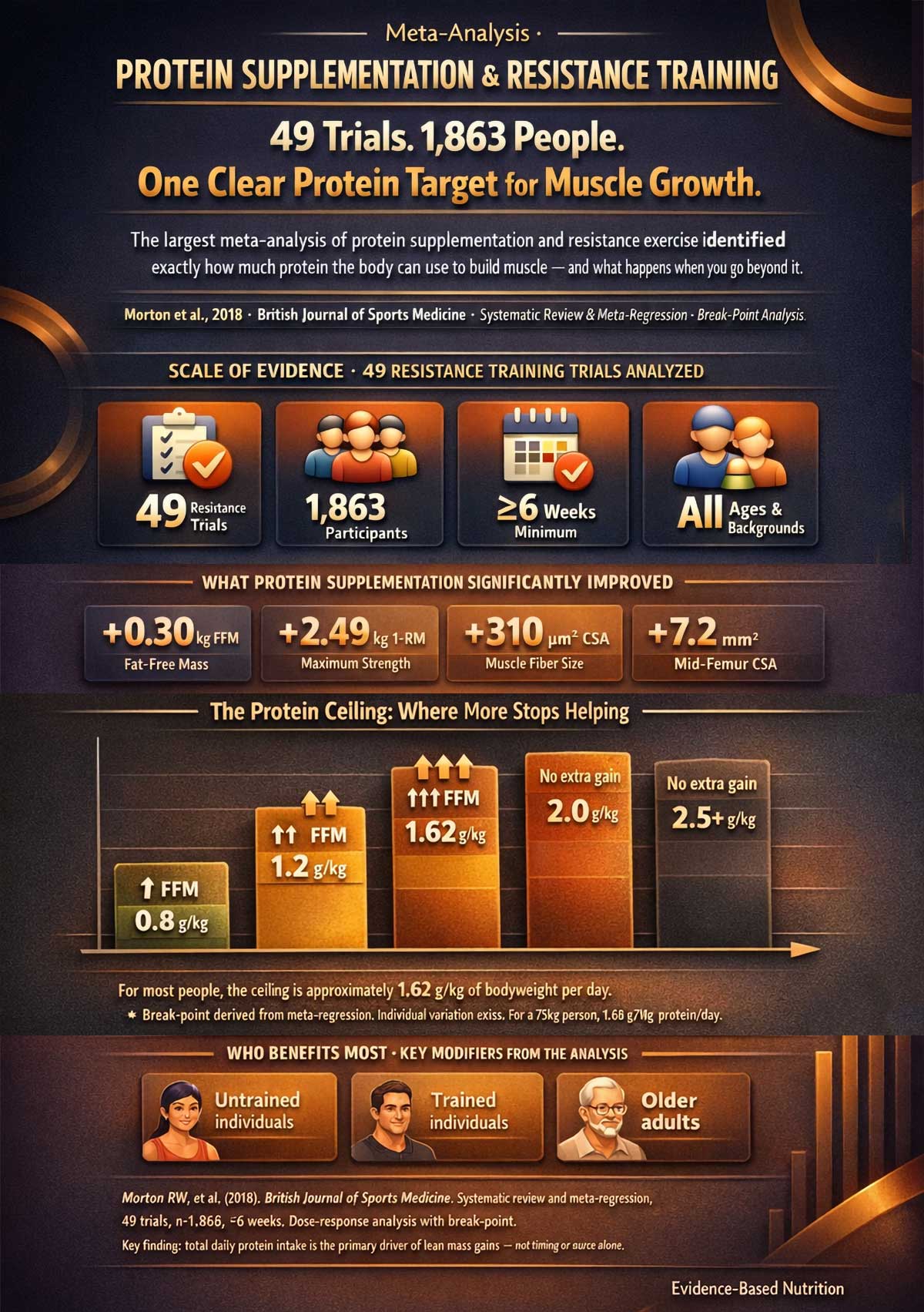
A 2018 meta-analysis by Morton and colleagues is one of the most thorough examinations of protein and muscle growth ever published. It pooled data from 49 resistance training trials involving 1,863 participants.
The findings were clear. Protein combined with resistance training significantly improved lean mass gains, strength, and muscle fiber size. But there was a ceiling: intakes above 1.62 grams of protein per kilogram of bodyweight per day showed no additional benefit for fat-free mass gains.
That number is your practical target. For a 75kg person, that’s about 121 grams of protein per day. Three servings of Greek yogurt alone gets you around 60 grams — halfway there, from a single food source.
The Daily Protocol: When and How Much to Eat
The Bridge et al. trial used a specific schedule that’s worth paying attention to, because timing wasn’t arbitrary. Here’s how it breaks down:
On training days:
- 200g serving immediately after your workout
- 200g serving one hour after training
- 200g serving before bed
On rest days:
- 150g serving at breakfast
- 150g serving before bed
The post-workout window matters because muscle protein synthesis is elevated after training. Hitting it with amino acids starts the repair process early. The bedtime serving takes advantage of casein’s slow-digesting nature — it keeps amino acids circulating overnight while you sleep and recover.
The 150–200g range per serving hits that ~20g protein sweet spot. More isn’t always better. Your body can only use so much protein at one time for muscle building.
Choosing the Right Greek Yogurt
Not every tub on the shelf is equal.
Plain vs. flavored: Flavored Greek yogurts often carry 10–20g of added sugar per serving. That sugar adds calories without adding protein, which works against fat loss. Plain Greek yogurt gives you the same protein with a fraction of the sugar.
0% vs. 2% fat: The fat-free version is slightly higher in protein per gram, making it more efficient. But 2% fat can support hormonal health for some people, since dietary fat plays a role in hormone production. If you’re in a caloric deficit, 0% makes the math easier. If you’re at maintenance or in a slight surplus, 2% is a solid choice.
Strained vs. unstrained: True Greek yogurt is strained, which removes excess liquid and concentrates the protein. Some products marketed as “Greek-style” are thickened with additives rather than being properly strained, and their protein content reflects the difference.
A quick check: look for at least 15–17g of protein per 150g serving. If it’s lower than that, it’s probably not doing the work you’re hoping for.
On cost, Greek yogurt generally runs comparable to a per-serving cost of protein powder — sometimes cheaper, depending on the brand and where you buy it. For a whole food that also delivers calcium, probiotics, and B vitamins, that’s solid value.
Greek Yogurt vs. Protein Powder: Do You Have to Choose?
You don’t. Greek yogurt and whey protein serve different roles.
Whey is fast-digesting. It’s ideal immediately post-workout when speed of delivery matters most. Greek yogurt — with its casein-heavy profile — is better suited to the hours when you need sustained amino acid availability: the hour after training, before bed, or at breakfast on rest days.
The Bridge et al. study used Greek yogurt across all three of those windows and got results that outpaced a calorie-matched control by a wide margin. You could structure your nutrition similarly, using whey right after training and Greek yogurt for the follow-up servings. Or, as the trial showed, Greek yogurt alone across all windows works fine.
Is Greek Yogurt Enough on Its Own?
The Bridge et al. trial tested Greek yogurt specifically and found it beat a carb control convincingly. That matters. But the broader picture from Morton et al. is also worth keeping in mind: once you hit roughly 1.6g of protein per kilogram of bodyweight per day, total intake matters more than whether that protein comes from Greek yogurt, whey, chicken, or eggs. Greek yogurt is simply one highly effective — and practical — way to hit that target.
A Few Things Worth Keeping in Mind
The Bridge et al. study was conducted on untrained, university-aged males. That’s worth acknowledging. Results may differ for women, older adults, or people already experienced in resistance training. The study also measured lean mass and muscle thickness using established methods, but it didn’t directly measure muscle protein synthesis rates at a cellular level — so some of the underlying mechanism remains inferred.
Individual results within the yogurt group also varied, as they do in any trial. The 2.4kg average is a group outcome, not a guarantee for every person. Factors like total diet, sleep quality, training effort, and genetics all play a role.
Still, the consistency of the data — across lean mass, strength, body composition, and muscle thickness — is difficult to dismiss.
Conclusion
Greek yogurt isn’t a miracle. But the evidence behind it is more solid than most people realize.
A 12-week clinical trial showed that eating it consistently — on a simple schedule tied to training days and rest days — nearly doubled lean mass gains compared to a calorie-matched control. The yogurt group also lost fat at the same time, something the control group didn’t manage. Strength improvements were significantly higher. Muscle thickness measurements backed it up.
The science points to a few key reasons: casein’s slow-release profile, leucine’s role in activating muscle protein synthesis, and dairy’s well-documented advantage over plant-based proteins in head-to-head trials.
The Morton et al. meta-analysis of 49 trials confirms the broader picture — protein works, and 1.6g per kilogram of bodyweight per day is the target. Greek yogurt is one of the simplest, most cost-effective ways to get there.
Try swapping one protein shake for a Greek yogurt bowl for the next 12 weeks. Track how your body changes. The research suggests you might be surprised by what you find.