Ask most people whether more of a good thing is better, and they will say yes without stopping to think about it. A twelve-month clinical trial out of Pennsylvania State University tested that assumption on an unlikely subject: prunes. Women who ate twice as many did not end up with stronger bones than the ones who ate half as many, and a striking number of them quit before the study even finished.
The study results were simple: eating five to six prunes a day can help preserve bone density in postmenopausal women, and the underlying research holds up. But the part about why less turned out to beat more says something more useful about how prevention actually works once it leaves the lab.
The Study That Explains the Dose
The trial tracked 235 postmenopausal women for a full year at Pennsylvania State University, led by exercise physiologist Mary Jane De Souza. One group ate no prunes. A second group ate 50 grams daily, about five to six prunes. A third group ate 100 grams, roughly ten to twelve.
All three groups took the same calcium and vitamin D supplements throughout the study. Only one thing distinguished them: the amount of dried fruit on their plate.
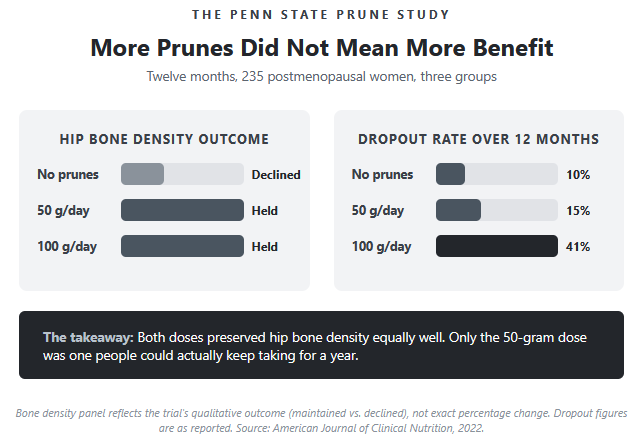
By the twelve-month mark, women eating no prunes had lost bone density at the hip. Women eating 50 grams held steady. So did the women eating 100 grams, at least on paper.
That last part is where the story gets complicated.
Compliance in the 100-gram group collapsed. Forty-one percent of that group dropped out before the study ended, compared with 15 percent in the 50-gram group and 10 percent among women eating no prunes at all. Gas and bloating were the most common complaints, according to De Souza’s team, published in the American Journal of Clinical Nutrition.
Fifty grams turned out to be the amount people could actually sustain for a year. That is a different kind of finding than “prunes help bones,” and arguably a more useful one for anyone trying to build a lasting habit rather than follow a protocol for six weeks.
What’s Actually in a 50-Gram Serving
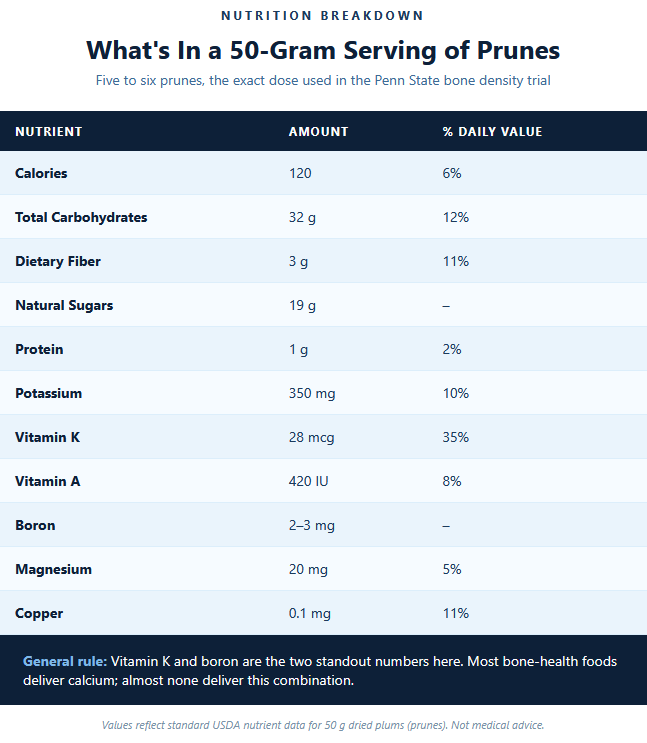
Five to six prunes contain about 120 calories, 3 grams of fiber, and a nutrient profile that looks almost engineered for bone maintenance: vitamin K, potassium, boron, copper, and magnesium, all in a single handful.
Vitamin K does the most specific work. It activates a protein called osteocalcin, which is what actually binds calcium to the bone matrix. Think of osteocalcin as the fastener, not the material. There is rarely a shortage of calcium in the average American diet. There is often a shortage of the mechanism that puts it to use.
How Prunes Actually Protect Bone
Boron is the least familiar name on that nutrient list, and arguably the most interesting. In a series of metabolic ward studies dating back to the 1980s, nutritional biochemist Forrest Nielsen and colleagues found that postmenopausal women given a boron supplement excreted markedly less calcium and magnesium in their urine within about eight days, published in the FASEB Journal. Less lost in urine means more available for bone.
Prunes are one of the more concentrated food sources of boron, at 2 to 3 milligrams per 50-gram serving. Potassium plays a related but separate role, buffering the acid load created by a typical high-protein, high-sodium diet so the body pulls less calcium out of bone to compensate.
Chronic inflammation accelerates bone breakdown by speeding up the cells that dismantle bone tissue faster than new bone can replace it. Prunes are unusually rich in chlorogenic and neochlorogenic acid, polyphenols shown to lower inflammatory markers linked to that process, according to a review by nutrition scientist Taylor Wallace published in Nutrients.
The same antioxidant compounds appear to protect osteoblasts, the cells responsible for building new bone, from oxidative damage.
There is also a newer, less settled piece of the puzzle. Fiber and polyphenols in prunes feed gut bacteria that produce short-chain fatty acids, compounds with anti-inflammatory effects that some researchers believe extend into bone tissue itself.
The gut-bone axis is a real and active area of research. It is also one of the least mature parts of this evidence base, and worth treating with more caution than the boron and vitamin K findings.
The Research Behind the Headline Study
The Penn State trial was not the first to test this idea. A decade earlier, researchers at Florida State University ran the study that got scientists interested in prunes specifically, rather than dried fruit in general.
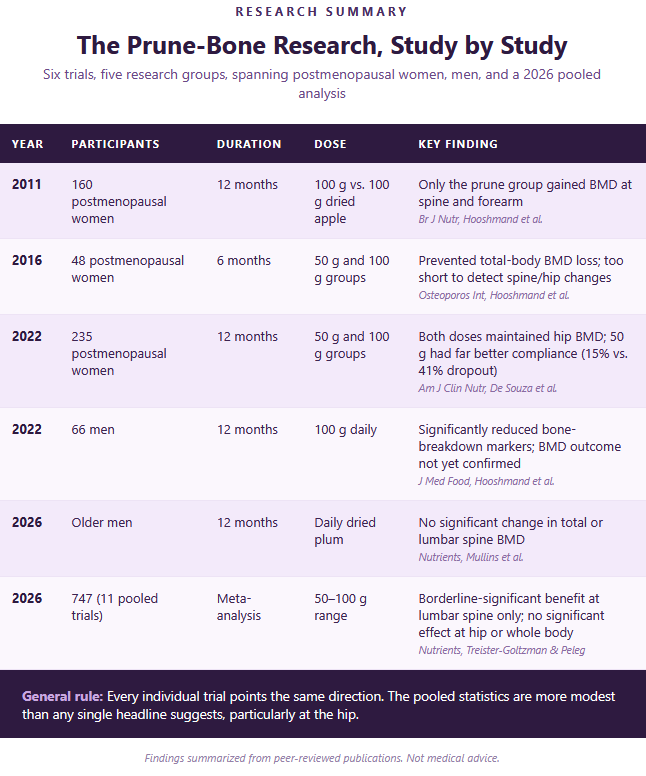
In a 2011 trial published in the British Journal of Nutrition, 160 postmenopausal women were split into two groups: one ate 100 grams of prunes daily, the other 100 grams of dried apples. Both groups took the same calcium and vitamin D. Only the prune group gained bone density at the spine and forearm.
That comparison mattered because it ruled out the simplest explanation, that any dried fruit would do the job. Something specific to prunes, not just fiber or natural sugar, was doing the work.
A follow-up study from the same research group in 2016, published in Osteoporosis International, tested 50-gram and 100-gram doses directly against each other over six months. Both doses prevented total-body bone density loss and improved biomarkers of bone formation, though six months was not long enough to detect changes at individual sites like the spine or hip.
Not every attempt to pool this research together has concluded as clearly.
The most recent meta-analysis, published in Nutrients in 2026 by researchers Yulia Treister-Goltzman and Roni Peleg, combined eleven trials and found only a borderline-significant benefit at the lumbar spine, with no significant effect detected at the hip, forearm, or whole body. The authors described the evidence as preliminary, not proven.
That is a more modest claim than “prunes protect your bones,” and it is closer to what the honest state of the research actually supports. The individual trials point the same direction. The pooled statistics have not yet caught up to a clean verdict.
What About Men’s Bones?
Almost everything above comes from research on postmenopausal women, and that is not an accident of study design. Osteoporosis research has historically focused on women, even though one in four men over 50 will break a bone due to weakened bone density.
The men’s research that does exist is thinner, and it does not point in one clear direction.
A 2022 trial from San Diego State University tested prunes in 35 men over three months and found the effects minimal, a result the researchers noted was inconsistent with findings in postmenopausal women.
A separate 12-month trial from the same research group, following 66 men, found a more encouraging pattern: daily consumption of 100 grams of dried plum significantly reduced two markers of bone breakdown, TRAP5b and CTX, at three, six, and twelve months, published in the Journal of Medicinal Food.
Then, in 2026, a full year-long randomized trial measuring actual bone density in men found no significant change at the hip or spine.
Researchers still do not agree on why the biomarker improvements have not yet translated into measurable bone density gains in men. Three studies, three different pictures, and no consensus yet on which one reflects what long-term supplementation would actually do.
The honest summary is that prunes probably help men’s bone turnover somewhat, given enough time. Whether that adds up to meaningfully stronger bones is not yet something the research can confirm.
Who Should Pay the Most Attention
Postmenopausal women remain the group with the clearest evidence behind them, particularly in the five years immediately following menopause, when bone density can drop by up to 20 percent as estrogen’s protective effect fades.
Men over 65, people with a parent or grandparent who had osteoporosis, and anyone on long-term corticosteroids for conditions like asthma or rheumatoid arthritis all carry elevated risk worth addressing earlier rather than later. Vegans and vegetarians may benefit specifically as well, since plant-based diets can fall short on boron, vitamin K, and potassium without deliberate planning.

How Prunes Stack Up Against Other Bone-Supporting Foods
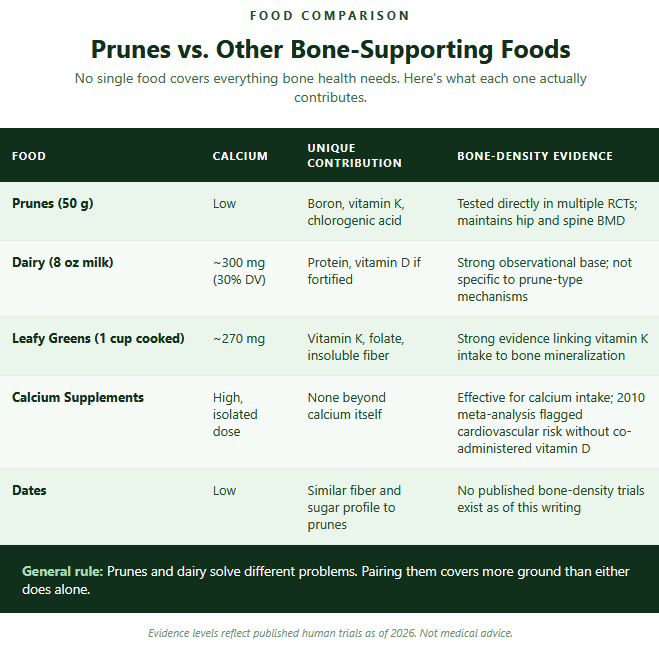
Prunes are not a replacement for calcium-rich foods, and no researcher studying them claims otherwise. An 8-ounce glass of milk still delivers roughly 300 milligrams of calcium, about 30 percent of a day’s needs, which prunes simply do not match.
What prunes add is different: boron, specific polyphenols, and a whole-food package that a 2010 meta-analysis in The BMJ suggests isolated calcium supplements may not replicate as safely.
That review, led by researcher Mark Bolland, found that calcium supplements without co-administered vitamin D were associated with a modest increase in cardiovascular risk, a finding that has shifted how many clinicians think about supplementation versus food-based sources.
Dates are the closest nutritional cousin most people ask about. They offer similar fiber and a comparable natural sugar content, but they have not been tested in a single published bone-density trial. Prunes have been tested against dried apples specifically and won. Until dates get the same scrutiny, the honest comparison is closer to “untested” than “equal.”
Where Do You Actually Stand?
The research above describes group averages. Individual risk depends on age, weight, family history, and habits that vary a lot from person to person. The calculator below asks for those specifics and returns a personalized starting point, not a diagnosis.
Bone Health Risk Calculator
Assess your personal bone health risk in 2 minutes
Your Bone Health Assessment
Your Personalized Action Plan
Building the Habit Without Digestive Backlash
Jump straight to six prunes a day and a gut unaccustomed to that much fiber will likely complain. Start with two or three for the first week, add water alongside them, and increase gradually over two to three weeks.
Eating them plain gets old fast for most people, which matters more than it sounds like it should. A habit that feels like a chore rarely survives past the first month.
Bone-Boosting Breakfast Bowl
Layer a cup of Greek yogurt with six chopped prunes, two tablespoons of walnuts, a tablespoon of ground flaxseed, and a drizzle of honey. The yogurt supplies roughly 200 milligrams of calcium and 15 grams of protein. The walnuts add fat that helps the body absorb vitamin K from the prunes.
Savory Prune and Herb Chicken
Brown four chicken breasts, then simmer them for 15 minutes in a pan with a dozen chopped prunes, minced garlic, rosemary, balsamic vinegar, and a splash of chicken broth. The natural sugars in the prunes caramelize into a sauce good enough to spoon over rice or quinoa.
The Complete Picture: Calcium, Vitamin D, and Everything Else That Matters
Prunes work as reinforcement, not foundation. Adults still need 1,000 to 1,200 milligrams of calcium and 800 to 1,000 IU of vitamin D daily from food, sunlight, or supplements, with women over 50 and men over 70 at the higher end of that range.

Weight-bearing and resistance exercise matter equally. A randomized trial by researcher Christel Vainionpää, published in Osteoporosis International, found that high-impact exercise increased femoral neck bone density by roughly 1 percent over a year in premenopausal women, with no equivalent change in a non-exercising control group.
Smoking accelerates bone loss by interfering with calcium absorption and breaking down estrogen faster than the body can replace it. Heavy alcohol use has a similarly direct, toxic effect on the cells that build bone. Both matter more than any single food choice ever will.
Common Mistakes Worth Avoiding
Eating twenty prunes on a Sunday and none for the rest of the week will not replicate the benefit seen in trials, all of which used daily, sustained intake. Prunes also work best alongside calcium, vitamin D, and exercise rather than as a substitute for any of them.
Jumping straight to a full daily dose overwhelms a gut unused to that much fiber, and skipping water while doing it makes constipation more likely, not less. The fiber needs liquid to do its job.
Anyone on warfarin should talk to a doctor before changing prune intake, since the vitamin K content can interact with how the medication works. This does not rule prunes out. It means the change should be gradual and disclosed to whoever manages that prescription.
A Weekly Plan Worth Trying
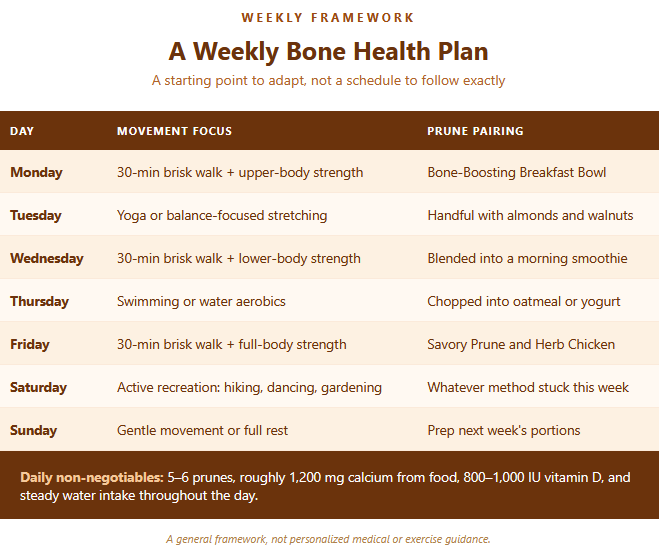
There is no single right way to hit these targets every day. The framework below is a starting point, not a mandate.
What the Evidence Can, and Can’t, Tell You
Multiple randomized trials, run by different research teams at different universities, agree that prune consumption preserves bone density better than no intervention at all. That kind of independent replication is a meaningfully strong signal in nutrition research, where it is often absent.
What the evidence cannot yet say is just as important. Nobody has run a trial past twelve months, so whether the benefit holds at five or ten years is genuinely unknown. Nobody has tested prunes head-to-head against prescription osteoporosis medication. The minimum effective dose below 50 grams has never been studied at all.
Those are not small gaps. They are the honest edges of what a promising body of research has actually established so far.
The natural sugar in prunes, about 19 grams per serving, worries some readers watching blood sugar. Prunes carry a glycemic index of 29, a low figure by USDA nutrition data, largely because their fiber slows sugar absorption. People with diabetes should still monitor their own response and loop in their doctor before making the change, since individual variation is real.
See a doctor before starting if a fracture has already occurred from a minor fall, if height has dropped by more than an inch, or if osteoporosis is already diagnosed. Prunes support bone health. They do not replace the medical care that active bone loss requires.
The Real Lesson Is About Dose
The most useful finding in all of this research is not really about prunes. It is about dose. Twice the intervention did not produce twice the benefit. It produced the same benefit and a worse dropout rate, a pattern that shows up across far more of preventive medicine than the marketing for any single food ever admits.
Five to six prunes a day sits at the point where biology and daily life actually overlap. That is a rarer thing to find in nutrition research than it should be, and probably worth more attention than the headline number ever gets.