People with the best self-control use the least willpower. That’s not a paradox — it’s a system. And you can build it too.
You resist the second slice of cake. You white-knuckle it. You feel proud.
Then, twenty minutes later, you eat three slices.
Sound familiar? That’s not weakness. That’s your brain working exactly as it’s designed to. The problem isn’t you — it’s the strategy. Most advice about self-control tells you to push harder, try more, and dig deeper. But the science tells a very different story.
The Myth That Started It All
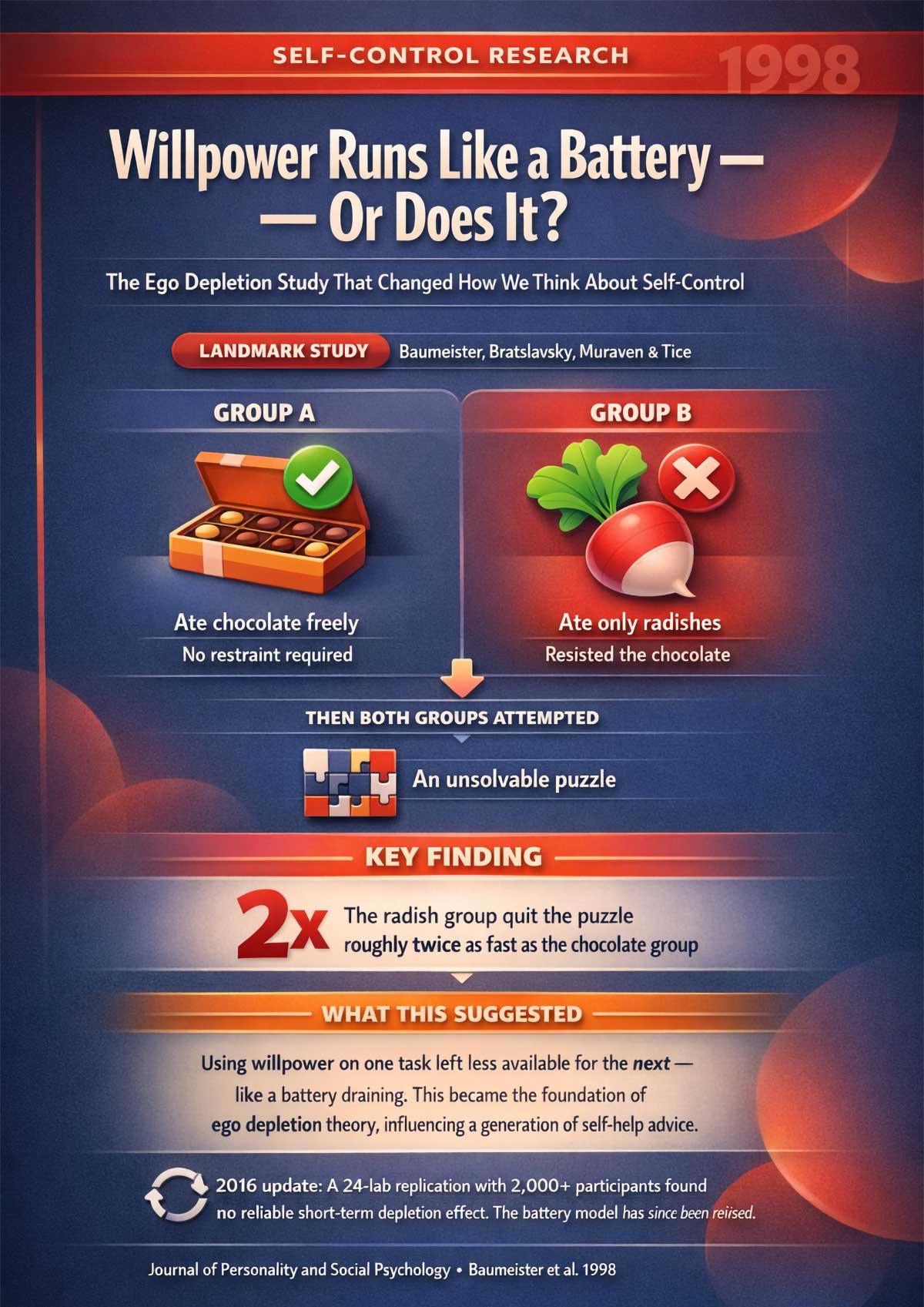
In 1998, a group of researchers ran a now-famous experiment. One group of people had to eat radishes while ignoring tempting chocolates. Another group could eat freely. Afterward, both groups were given an impossible puzzle to solve.
The radish group gave up much faster.
Roy Baumeister and his colleagues published those findings and launched what became known as “ego depletion” theory — the idea that willpower runs like a battery. Use it up on one thing, and you’ll have less for the next.
That idea spread everywhere. Books, coaching programs, and health articles all told you to “conserve your willpower.” It shaped how millions of people think about self-control to this day.
There’s just one problem. It doesn’t hold up.
Large-scale replication attempts — including a registered study across 24 labs with over 2,000 participants — found no reliable evidence that short bursts of self-control drain your ability to keep going. The “battery” idea, at least for everyday tasks, is not what the science now supports. What researchers did confirm is something more interesting: that sustained mental effort over many hours produces fatigue, much like physical work. But the dramatic depletion effect after a few minutes of resistance? That doesn’t replicate.
So if your willpower isn’t running out like a battery — why does it keep failing?
What’s Really Going On: The Attention Trap
Here’s where it gets counterintuitive.
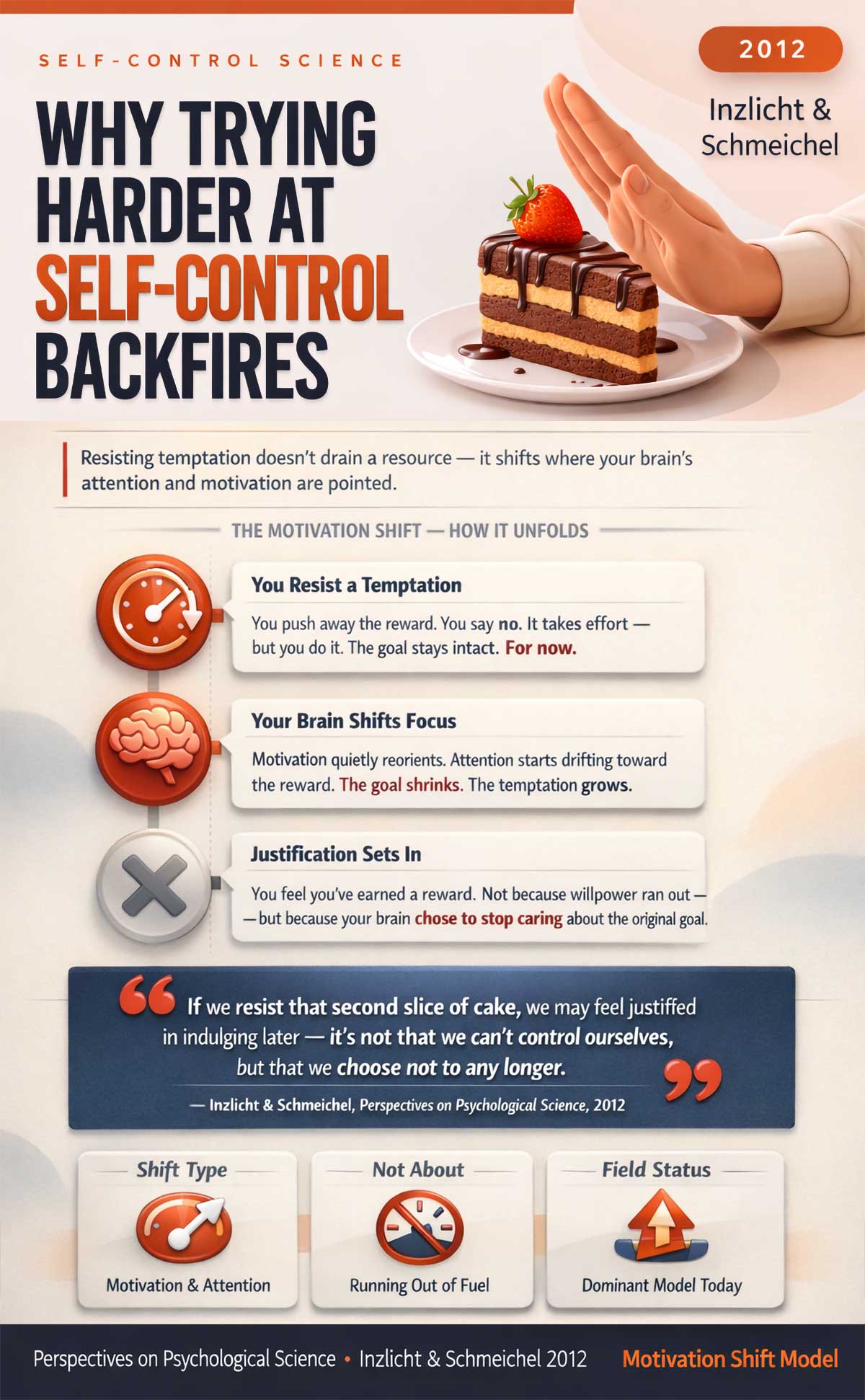
Michael Inzlicht and Brian Schmeichel published a 2012 paper in Perspectives on Psychological Science that reframed the whole conversation. Their model explains that exerting self-control at one moment creates a shift — not in your fuel levels, but in your motivation and attention. After resisting something, your brain doesn’t run out of gas. Instead, it slowly stops caring about the goal and starts caring a lot more about the reward.
Think about the cake example again. When you resist that second slice, you may feel a quiet sense of justification building. I’ve been so good. I deserve this. Meanwhile, your attention drifts right back to the thing you were trying to avoid. The cake gets more vivid in your mind, not less.
Inzlicht and Schmeichel describe it clearly: resisting a temptation can shift motivation so that you feel entitled to indulge later. And your attention hijacks your original goal by locking onto reward cues instead.
This is the trap. The harder you try to not do something, the more your brain focuses on it. It’s not a failure of character. It’s a predictable, well-documented neurological response.
The implication is uncomfortable but important: the solution to self-control isn’t trying harder. It’s stopping the need to try in the first place.
Why “I Can’t” Makes It Worse
The language you use about self-control matters more than most people realize.
Researchers Vanessa Patrick and Henrik Hagtvedt studied the difference between telling yourself “I can’t do this” versus “I don’t do this.” People who used “I don’t” framing — identity-based language — were significantly better at resisting temptations. “I can’t eat sugar” positions you as a person being denied something. “I don’t eat sugar” positions you as a person who has already decided.
That shift changes what your brain has to do. “I can’t” triggers resistance. “I don’t” reduces the need for it.
This connects directly to the research on motivation quality. Muraven and colleagues, cited in the APA’s willpower report, found that people who felt forced to exert self-control — to please others, meet external expectations, or avoid social consequences — experienced faster perceived depletion. People who acted from internal motivation, doing something because it aligned with their own values and goals, sustained their effort much longer.
Trying harder for someone else’s reasons is exhausting. Trying harder for your own burns cleaner.
Your Beliefs About Willpower Become Your Reality
Here’s one of the most striking findings in this whole field.
In 2010, Veronika Job, Carol Dweck, and Gregory Walton published a study in Psychological Science showing that beliefs about the nature of willpower directly shape outcomes. People who believed that willpower was a limited resource — the battery model — showed signs of depletion after demanding tasks. People who believed willpower was not a limited resource? They performed just as well after taxing situations as before.
Same task. Same effort. Different belief. Different result.
This is what’s called a self-fulfilling expectation. If you believe you’re running low, you act like it. You give yourself permission to stop. The belief creates the experience.
What does this mean practically? It means that every time someone tells you “willpower is finite, so use it wisely,” they may actually be causing the depletion they’re warning you about. Walking into a difficult moment telling yourself “I only have so much energy for this” is a setup for failure — not because the statement is physically true, but because your brain responds as though it is.
The High Performer’s Secret: Use Willpower Less
Here’s the part that most self-improvement content misses entirely.
If trying harder is unreliable — and the evidence says it is — then how do people with excellent long-term habits actually do it?
They don’t use much willpower at all.
A 2013 study by Wendy Wood, Jeffrey Quinn, and Deborah Kashy in the Journal of Personality and Social Psychology found that when people’s conscious willpower was low, the ones with strong habits automatically shifted toward habitual, goal-aligned behavior. Their good routines kept running on their own. They didn’t need to fight temptation in the moment because their environment and their habits had already made the decision for them.
Think of it like this: a river doesn’t decide to flow downhill every day. It flows because of the shape of the terrain. High performers build terrain that makes good behavior the path of least resistance.
This is called habit architecture — and it’s what separates people who consistently behave in line with their goals from people who are constantly exhausted by the effort of trying to do so.
Stop Trying. Start Designing.
A 2024 paper by Wendy Wood and David Neal in Current Opinion in Psychology puts it plainly: successful long-term self-regulation relies on habit design, not willpower intensity. They estimate that roughly 65% of daily behavior is habitual — running automatically without conscious decision-making.
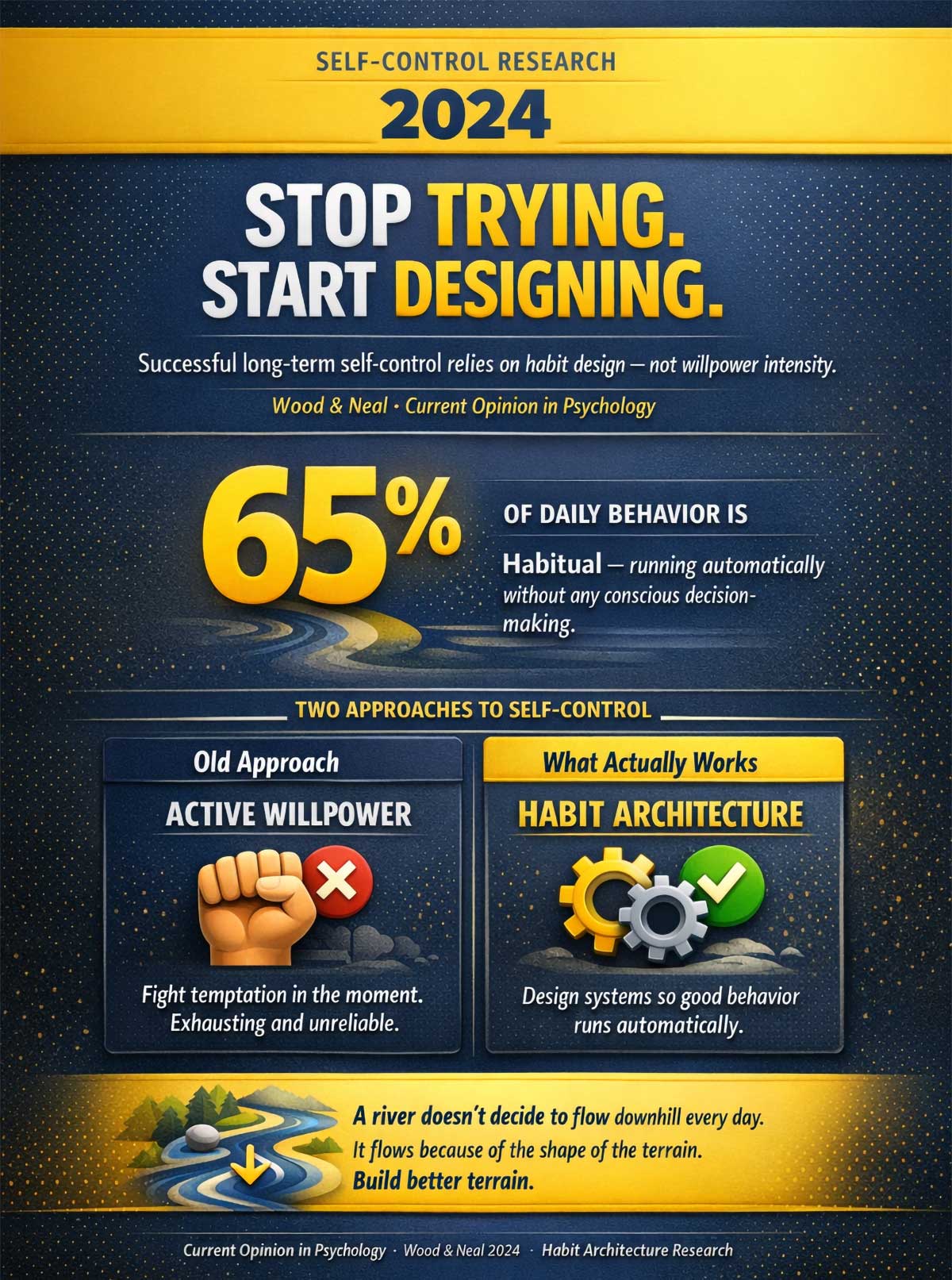
That’s not a small number. It means that for most of your day, your habits are doing the heavy lifting. If those habits align with your goals, you’re in good shape. If they don’t, no amount of white-knuckling will overcome them in the long run.
The goal, then, isn’t to build a stronger will. It’s to build a smarter system.
Here are four strategies that the research actually supports:
1. If-Then Planning
Also called “implementation intentions,” this strategy was studied extensively by Peter Gollwitzer and has a strong track record. The idea is simple: before a high-risk moment arrives, you map out exactly what you’ll do when it does.
“If I feel the urge to scroll my phone before bed, then I’ll plug it in across the room and open my book instead.”
The evidence behind this is striking. In one well-known line of research, people who wrote out specific if-then plans for when and where they would exercise were two to three times more likely to follow through than people who simply intended to. Same goal. Radically different result — because the decision was made before the moment of temptation, not during it.
You’re not relying on in-the-moment willpower. You’re making the decision in advance, when your motivation and attention aren’t being pulled in conflicting directions. The behavior becomes almost automatic — a planned response to a known trigger, not a battle.
2. Temptation Bundling
Behavioral economist Katherine Milkman developed this approach and tested it at the University of Pennsylvania. In one study, gym attendance increased significantly among participants who could only access gripping audio content — addictive podcasts and audiobooks — during their workouts. The want and the should fused into one event, and behavior followed.
The idea: pair something you want to do with something you should do.
Only listen to your favorite podcast while exercising. Only watch that show while folding laundry. Only get your favorite coffee on days you work on your hardest task.
This works because it reduces motivational conflict. Instead of your brain weighing “reward now” against “goal later,” it gets to have both at the same time.
3. Strategic Delay, Not Total Denial
Telling yourself “I can’t have this” triggers resistance and, as Inzlicht’s research shows, redirects attention toward the reward. But telling yourself “I can have this — just later” is surprisingly effective.
Researchers have found that delay reframing reduces the pull of immediate temptation without the backlash that flat-out denial creates. You’re not fighting the desire. You’re rescheduling it. Often, later never comes — and even when it does, the urge has weakened.
4. The Environment Audit
This is the most underused strategy and arguably the most powerful. Look at your environment and ask: what decisions am I forcing myself to make that I could just eliminate?
Put fruit on the counter, not cookies. Put your running shoes by the door. Put your phone in another room when you work. Use a smaller plate. Set a savings transfer to run automatically on payday.
Each of these small changes removes a “decision point” — a moment where willpower would otherwise need to show up and possibly lose. The Nobel Prize-winning work of Richard Thaler and Cass Sunstein on “choice architecture” shows that how options are arranged determines what people choose, far more than their internal resolve.
You don’t need more discipline. You need fewer decision points.
The Long Game: Effort Sprints Don’t Build Lasting Change
There’s an important distinction the “try harder” approach ignores.
Brief acts of self-control — a few minutes of resisting something — do not reliably deplete you, as the large-scale replications showed. But hours of sustained cognitive effort? That does create real fatigue. This is simple exhaustion, and it’s been understood for a century.
What this means is that short sprints of willpower aren’t building your long-term capacity. You can’t “train” your willpower by white-knuckling it through difficult moments over and over again. What actually builds lasting behavior change is reducing the frequency of those battles through systems, habits, and environment design.
The person who “has great self-control” isn’t winning a thousand daily fights. They’ve restructured their life so that most of those fights never happen.
Conclusion
The conventional advice on self-control tells you that success comes from pushing harder against your impulses. The evidence says otherwise.
Resisting temptation shifts your attention toward rewards, not away from them. Believing willpower is limited makes it act limited. External pressure depletes faster than internal motivation. And the people with the strongest track records of self-discipline are, quite often, the ones using conscious willpower the least.
What actually works is building systems that run without effort. Planning responses to triggers before they fire. Pairing obligations with rewards. Auditing your environment to cut out unnecessary friction and decision-making.
Next time you find yourself white-knuckling it past that second slice of cake — stop. Not because you’re weak. Because you’re using the wrong tool. The goal was never to fight harder. It was to stop needing to fight at all.