Physical therapists say most hip routines are too long to stick with. The one that actually works takes under 2 minutes.
Your hips are quietly failing you. Not all at once. Not with a dramatic injury. Just a slow, steady weakening that sneaks up over years of sitting. And if you’re over 50, you’ve probably already felt it. Maybe it’s that nagging lower back ache. Or the way your feet scuff the ground when you walk. Or how much effort it takes to get up from a chair.
The good news is that you don’t need a gym, a trainer, or even 30 minutes a day to fix it.
The Hidden “Engine” of Aging: Why Your Hips Are Failing You
Think of your hip flexors as the engine under the hood of your body. When that engine runs well, you walk tall, climb stairs easily, and feel steady on your feet. When it weakens, everything downstream suffers.
The two main players are the psoas and iliacus muscles. Together, they form what’s called the iliopsoas. This muscle group connects your lower spine to your thigh bone. It’s responsible for every step you take.
Here’s the problem. The average adult now sits for 9 to 10 hours a day. Every hour spent seated shortens and weakens the psoas. The muscle stops being asked to work through its full range. Over time, it forgets how to fire properly. This is what physical therapists call “sitting disease,” and it hits hardest after 50, when the natural rate of muscle loss speeds up.
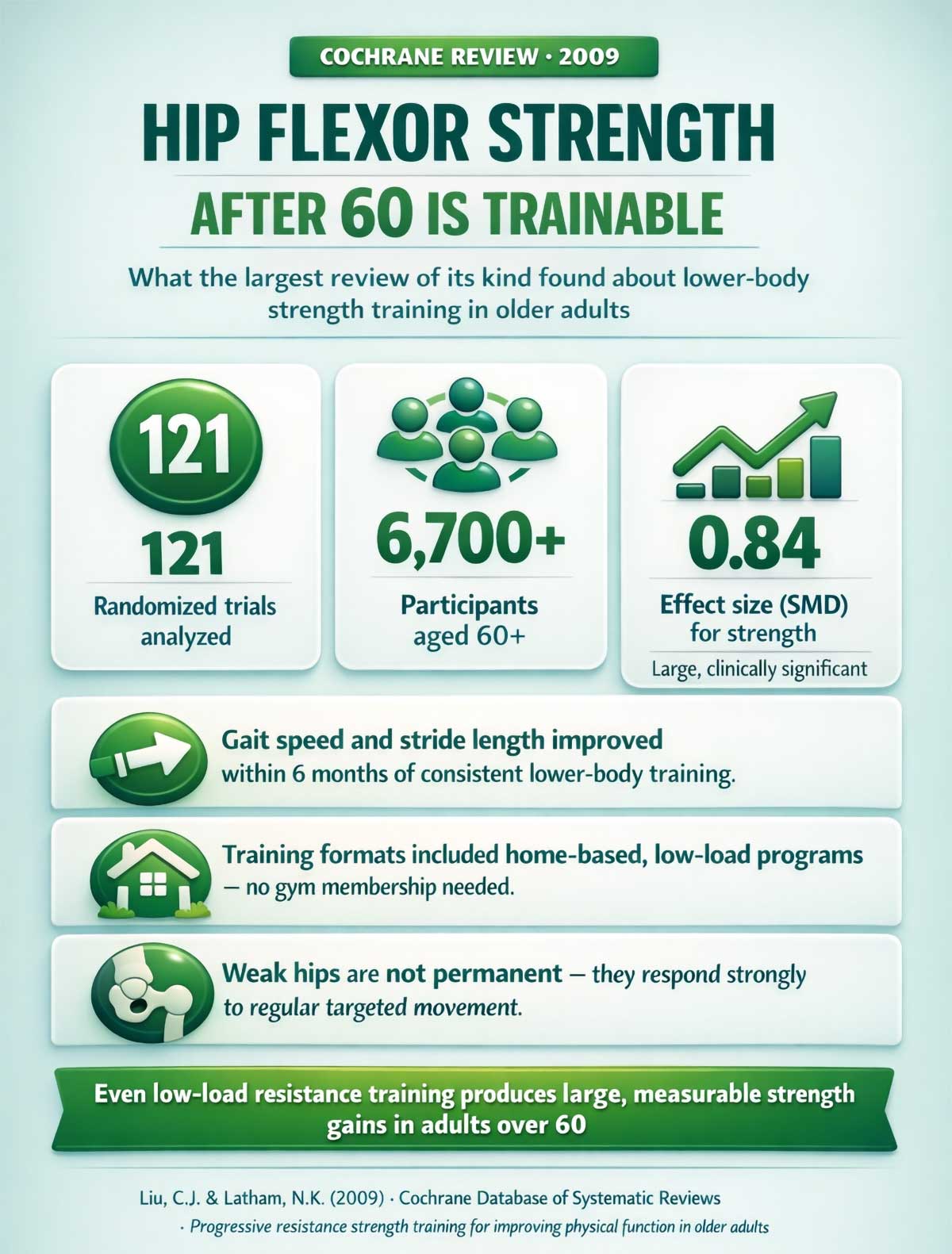
Researchers have documented just how quickly this decline affects daily movement. A landmark Cochrane review by Liu and Latham (2009), which analyzed over 6,700 adults aged 60 and older across 121 trials, found that progressive resistance training produced strong gains in lower-body strength, with effect sizes averaging 0.84. More importantly, meaningful improvements in gait speed and stride length appeared within just six months of consistent training. The takeaway: weakened hip muscles are not a permanent condition. They respond well to targeted effort.
The Symptom Check: More Than Just Tightness
Weak hip flexors don’t just make you feel stiff. The effects show up in ways most people never connect to their hips.
Lower back pain is the most common sign. When the psoas weakens, the lower spine loses support and begins to compress. The muscles around it overwork to compensate, leading to that familiar dull ache.
A shuffling gait is another red flag. When hip flexors can’t lift the leg properly, the foot drags slightly with each step. You may not even notice it until someone points it out, or until you trip on a curb.
Difficulty climbing stairs is also a direct sign of hip flexor weakness. The iliopsoas drives the knee upward during each step. When it’s weak, you lean forward and push off the handrail just to make it up the stairs.
From “Hip Workout” to “Daily Movement Snack”
Most fitness advice for this problem tells you to do a 15-exercise circuit three times a week. That approach is too much. Research consistently shows that for adults over 50, the biggest barrier to progress isn’t effort. It’s starting. A routine with 10 exercises feels overwhelming before you even begin.
The shift in thinking here is simple: stop thinking about a “workout” and start thinking about a “movement snack.” One focused movement, done daily, beats a complex routine done occasionally. Always.
The One Habit: The Standing Psoas March
Physical therapists consistently point to one movement above all others for rebuilding hip flexor strength in older adults: the Standing Psoas March.
It needs no equipment. No gym membership. No floor mat. You can do it while brewing coffee, brushing your teeth, or waiting for the kettle to boil. That low barrier to entry is not a compromise. It’s the point.
Why Standing Beats Floor-Based Exercises
A lot of hip flexor exercises for seniors involve lying on the floor. Leg raises, flutter kicks, supine marching. These are fine in theory. But for adults over 50, getting down to and up from the floor is a barrier that stops many people from even trying.
More critically, standing hip flexor work trains the body the way it actually uses those muscles: upright, in motion, against gravity.
De Vreede and colleagues (2005) compared functional task training with traditional resistance exercises in women over 70. Their finding was striking. The group doing upright, real-world functional movements improved their daily mobility more than the group doing conventional gym-based exercises. Functional, equipment-free training produced greater practical gains, especially in those who were more frail.
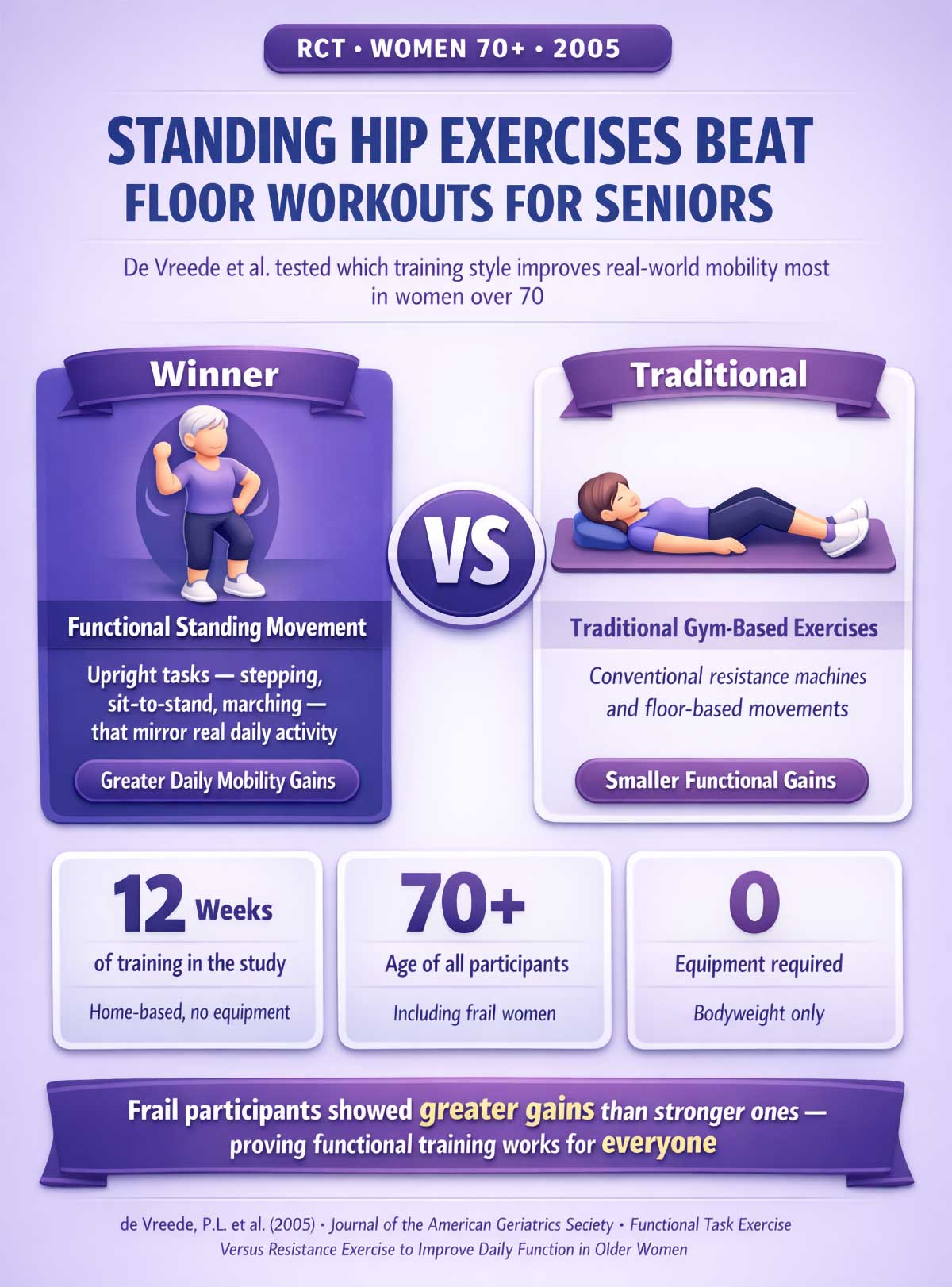
Standing hip work is also more neurologically demanding. Your brain has to coordinate balance, posture, and movement simultaneously. This double-duty is exactly what walking requires, which is why standing hip exercises transfer so directly to better gait.
How to Perform the Perfect Psoas March
The Setup
Stand near a wall, counter, or sturdy chair. You may hold it lightly for balance, but don’t lean on it. Feet are hip-width apart. Chest is up. Core is gently braced, as if you’re about to take a light punch to the stomach. Chin is level, not jutting forward.
The Movement
Slowly lift one knee upward. The key here is height. You want the thigh to rise until it’s at least parallel to the floor, or ideally slightly above it. This ensures you’re activating the psoas, not just the rectus femoris (the big quad muscle at the front of the thigh, which kicks in at lower lift angles).
Hold at the top for a breath. Then lower the foot back down with control. Don’t drop it. The lowering phase matters.
Alternate legs with each rep. Keep the movement deliberate. This is not a fast march. Think slow, controlled, intentional.
The Secret Cue
Coaches and physical therapists often use a two-part cue that makes this movement click: “Drive the heel down, pull the knee up.”
When you lower the leg, actively press your heel into the ground. This loads the glute and hamstring of the standing leg. It also stiffens your trunk, which keeps your posture stable during the lift.
This eccentric loading of the standing leg is what makes this exercise so effective. You’re not just building the lifting side. You’re building the stabilizing side at the same time.
The 60-Second Science: Why “Daily” Trumps “Intense”
Neuromuscular Re-education
A muscle that has been sitting idle for years doesn’t just lack strength. It lacks communication. The nerve pathways between the brain and the hip flexors become underused and sluggish. Physical therapists call this “inhibition.” The muscle is there. It just doesn’t respond well anymore.
Daily repetition is the specific solution to this problem. Each time you perform the Standing Psoas March, you send a signal down that nerve pathway. Repeat it enough times, and the pathway becomes sharp and reliable again. This is neuromuscular re-education, and it only happens through consistent, frequent practice.
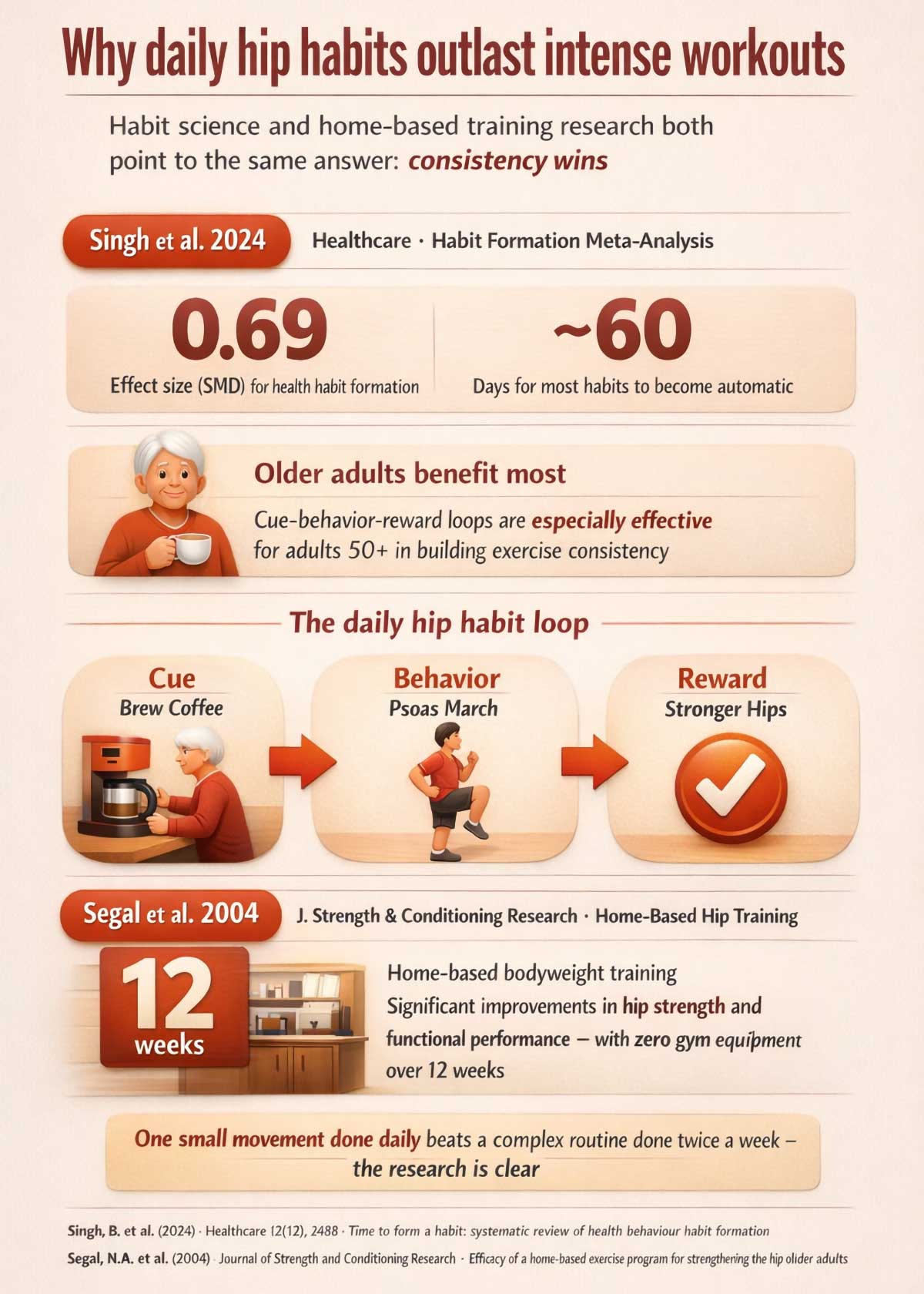
A 2024 meta-analysis by Singh and colleagues, published in Healthcare, found significant improvements in habit scores across health behaviors, with a moderate-to-large effect size of 0.69. The research confirmed that consistency and repetition accelerate habit formation, with most behaviors becoming automatic within roughly 60 days. Older adults showed particular benefit from simple cue-behavior-reward loops, such as “make coffee, do the march.”
Strength Without Bulk
There is a common misconception that low-load exercises don’t build real strength. They do. Especially in older muscles.
A meta-analysis by Borde and colleagues (2015) analyzed multiple randomized controlled trials in adults over 65 and found that even lower-intensity resistance training produced significant strength improvements. The optimal dose they identified was 2 to 3 sets with 7 to 9 repetitions. Elastic band training in the same review showed an effect size of 1.30, among the highest recorded. The conclusion: you don’t need heavy weight or intense effort to build functional strength in older joints.
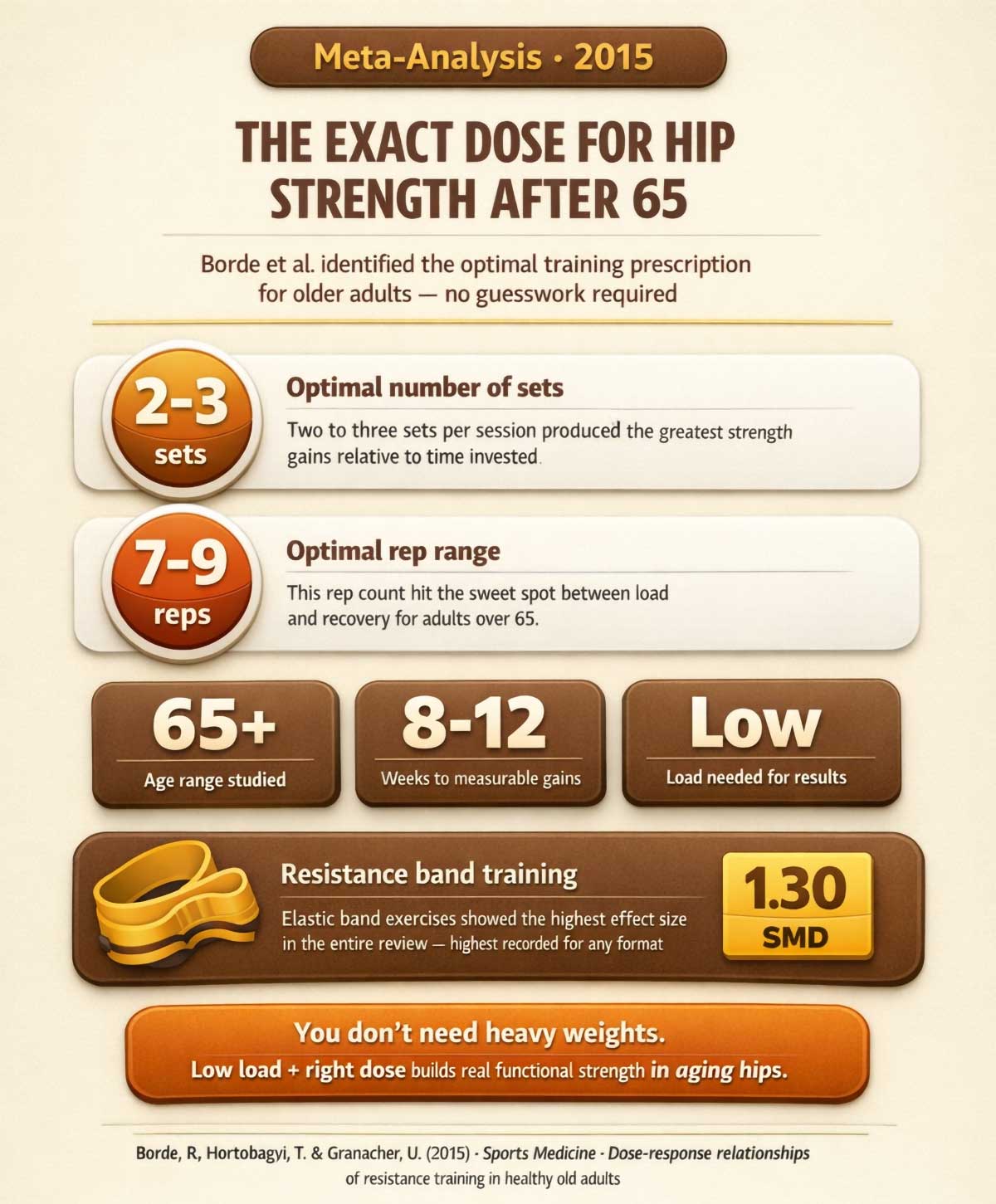
This is the concept of “functional torque.” Low-load, high-frequency movement builds the type of usable hip strength that improves real-world tasks like walking, stair-climbing, and rising from a chair.
The Dose
Two to three sets of 10 to 12 reps, done daily. That’s it.
Skelton and colleagues (1995) showed measurable strength gains in older adults, including very old women, using basic progressive movements done consistently over 12 weeks. You don’t need intensity. You need regularity. Within 8 to 12 weeks of daily practice, most people see clear, measurable changes in functional hip strength.
The 7-Day Quick-Start Progression
You don’t need to be perfect on day one. The first week is about learning, not loading.
Days 1 and 2: The Awareness Phase
Hold the wall with both hands. Move slowly. Focus entirely on finding the muscle. Can you feel the front of the hip engaging as the knee rises? That sensation is your psoas waking up. Don’t worry about height or speed yet. Just find the muscle and say hello to it.
Two sets of 10 reps per side. Rest between sets.
Days 3 to 5: The Resistance Phase
Now add a 2-second hold at the top of each rep. When your knee reaches its highest point, pause. Hold it there. Breathe. Then lower slowly.
This “time under tension” is a powerful tool for building strength without adding load. It forces the muscle to sustain effort rather than just flick through a movement.
A study by Bean and colleagues (2004) in older adults with mobility limitations found that task-based, low-intensity functional training produced meaningful improvements in leg power and walking ability. Time under tension, applied to functional movements, drives real-world results.
Two to three sets of 10 to 12 reps per side. Continue using wall support as needed.
Days 6 and 7: The Integration Phase
Now try it with no hand support.
This is harder than it sounds. Without the wall, your glutes, core, and hip stabilizers all have to work together to keep you upright during the march. This is the full version of the exercise. It trains hip flexion and single-leg balance simultaneously.
Start with just one set without support, then use the wall for the remaining sets if needed. By the end of week one, you’ll have built a repeatable daily habit and begun training your nervous system in a meaningful way.
Beyond the March: Small Lifestyle Tweaks for Hip Longevity
The Glute Bridge Counter-Move
The Standing Psoas March works the front of the hip. To balance that work, you need something that activates the back: the glute bridge.
Lie on your back with knees bent and feet flat on the floor. Press through your heels and lift your hips off the ground until your body forms a straight line from shoulder to knee. Hold for 2 seconds. Lower slowly. Repeat 10 to 15 times.
This movement keeps the hip from becoming “front-heavy.” Strong glutes are essential for hip extension during walking. Without them, the psoas does more than its share of the work and tightens further. Segal and colleagues (2004) demonstrated significant improvements in hip strength and functional performance through exactly this type of home-based, bodyweight lower-body training over 12 weeks. No gym required.
Hydration and Your Hip Fascia
Here’s something most hip flexibility articles skip entirely: your connective tissue.
The fascia surrounding the hip flexors is largely made of collagen. Staying well hydrated supports the elasticity of connective tissue and may help reduce fascial stiffness. That morning tightness you feel in your hips after a night of not drinking? Part of that is likely fascial, not purely muscular.
After 50, the body’s natural hydration efficiency declines. Aim for at least 8 glasses of water per day. This simple habit directly supports the elasticity of the tissue that wraps your hip muscles and allows them to move freely through their full range.
Cadore and colleagues (2013) found that combining low-load strength training with functional movement improved both lower-body strength and stability, even in frail adults in their 90s living in care facilities. If this approach works for that population, it works for active 50-year-olds at home. Staying hydrated is part of that broader functional maintenance picture.
Success Metrics: How to Know It’s Working
You don’t need a clinic to measure progress. Three simple, real-world tests will tell you everything you need to know.
The Stair Test
Do you feel lighter when climbing stairs? Do you need the railing less? Can you take stairs with an alternating pattern (rather than one step at a time with two feet) more easily than before?
If yes, your hip flexors are getting stronger. The iliopsoas is the primary driver of leg lift during stair climbing. Improvement here is one of the first places people notice the change.
The Stride Length Test
Walk at your normal pace down a hallway. Now ask yourself: has your stride lengthened? Does your gait feel more fluid, less shuffling? Do you cover ground with less effort?
Gait speed and stride length are among the most sensitive indicators of lower-body strength in older adults. Liu and Latham’s (2009) Cochrane review specifically noted gait improvements as a key outcome measure of lower-body strengthening programs. A longer, more confident stride is a direct sign that your psoas and glutes are working as a team.
The Chair Rise Test
Sit in a firm chair with your arms crossed over your chest. Now stand up without using your hands.
Could you do it? Was it easier than a few weeks ago? The chair rise requires hip flexor power, quad strength, and core stability working in concert. A 2014 systematic review on home-based resistance training for older adults (PubMed ID: 25109883) confirmed that structured home programs improve lower-body strength and daily functional ability, with outcomes comparable to supervised center-based programs. The chair rise is a practical, daily measure of that progress.
The Takeaway: Consistency Beats Intensity
You don’t need more exercises. You need one good one, done every single day.
The Standing Psoas March is backed by a clear body of evidence showing that daily, low-load, functional movement builds real strength in older adults. It fits into your morning routine. It requires nothing but a wall and a minute of your time.
Start today. Two sets. Ten reps per leg. Wall support as needed.
By week three, the movement will feel familiar. By week eight, you’ll feel the difference. Not just in your hips. In every staircase, every walk, and every time you stand up from a chair.
References
- Bean, J. F., et al. (2004). A comparison of leg power and leg strength within the InCHIANTI study: which influences mobility more? The Journals of Gerontology.
- Borde, R., Hortobagyi, T., & Granacher, U. (2015). Dose-response relationships of resistance training in healthy old adults. Sports Medicine.
- Cadore, E. L., et al. (2013). Multicomponent exercises including muscle power training enhance muscle mass, power output, and functional outcomes in institutionalized frail nonagenarians. Age.
- de Vreede, P. L., et al. (2005). Functional tasks exercise versus resistance exercise to improve daily function in older women. Journal of the American Geriatrics Society.
- Liu, C. J., & Latham, N. K. (2009). Progressive resistance strength training for improving physical function in older adults. Cochrane Database of Systematic Reviews.
- Segal, N. A., et al. (2004). Efficacy of a home-based exercise program for strengthening the hip in older adults. The Journal of Strength and Conditioning Research.
- Singh, B., et al. (2024). Time to form a habit: a systematic review and meta-analysis of health behaviour habit formation and its determinants. Healthcare, 12(12), 2488.
- Skelton, D. A., et al. (1995). Strength, power and related functional ability of healthy people aged 65-89 years. Age and Ageing.
- Systematic review: Home-based resistance training for older adults (2014). PubMed ID: 25109883.