Most guides stop at the two-week mark, but that’s not where the research ends. Here’s what actually happens as you continue drinking hibiscus tea through week six.
What happens between day one and day fourteen (which changes are visible, which ones are not, and why some people see a clear response while others do not) does not make it into the abstract.
The Tufts University trial published in the Journal of Nutrition in 2010 found something the summary statistics do not communicate well: participants starting with higher blood pressure readings responded considerably more than those in the lower end of the pre-hypertension range. Same tea, same dose, same duration. The numbers at the end of six weeks looked quite different depending on where people started.
About 119.9 million American adults have blood pressure that qualifies as high, according to the CDC. Many are looking for something credible to add to what they are already doing. Whether hibiscus fits that role depends partly on how long they are willing to commit, and what to do when the first two weeks do not give them the numbers they were hoping for.
What the Research Shows About Timing
The direct answer, based on the available evidence: most people with mildly elevated blood pressure who drink two to three cups of hibiscus tea daily can expect to see some movement in systolic blood pressure within two to six weeks. Two weeks is a realistic checkpoint, not the finish line. The largest and most consistent responses appear between weeks four and six.
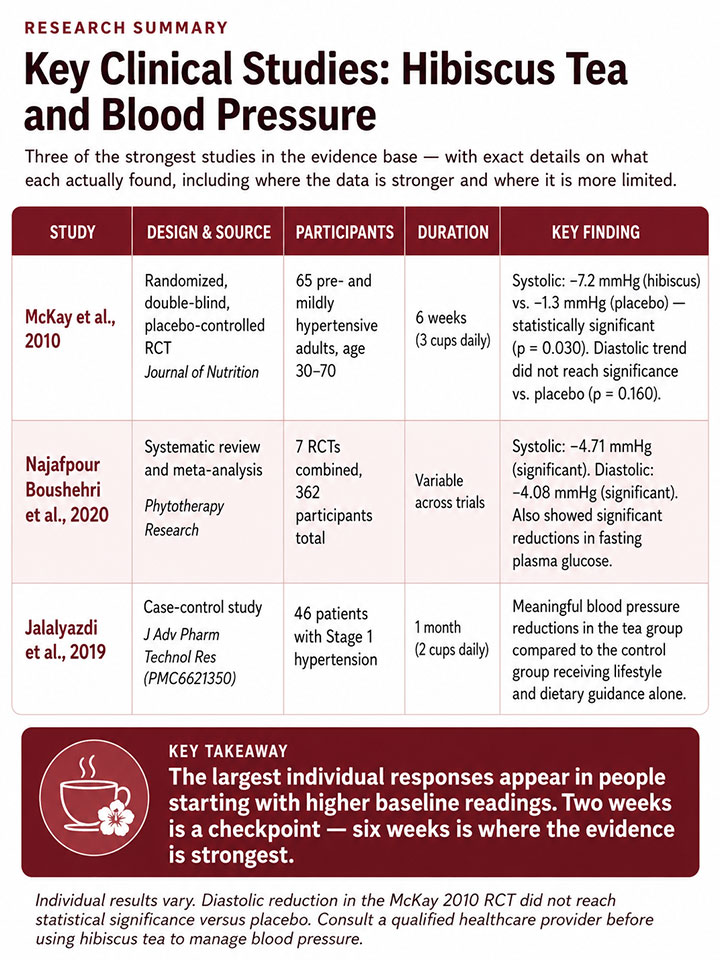
The most cited human trial on this question comes from Diane McKay and her team at Tufts, published in the Journal of Nutrition in 2010. Sixty-five pre- and mildly hypertensive adults drank three 240mL servings of hibiscus tea daily for six weeks.
Systolic blood pressure dropped by 7.2 mmHg in the hibiscus group versus 1.3 mmHg in the placebo group, a statistically significant difference. Diastolic pressure also trended lower in the hibiscus group, but that difference did not reach statistical significance compared to placebo, which is worth noting if you are tracking both numbers closely.
Researchers wanted to know how these findings held across a broader population. A 2020 meta-analysis in Phytotherapy Research by Najafpour Boushehri and colleagues combined seven randomized controlled trials covering 362 participants.
Here, both systolic and diastolic reductions were statistically significant, averaging 4.71 mmHg and 4.08 mmHg, respectively. A 2019 study by Jalalyazdi and colleagues in the Journal of Advanced Pharmaceutical Technology and Research reached a similar conclusion in a study of 46 patients with stage 1 hypertension who drank two cups of sour tea daily for one month alongside lifestyle guidance.
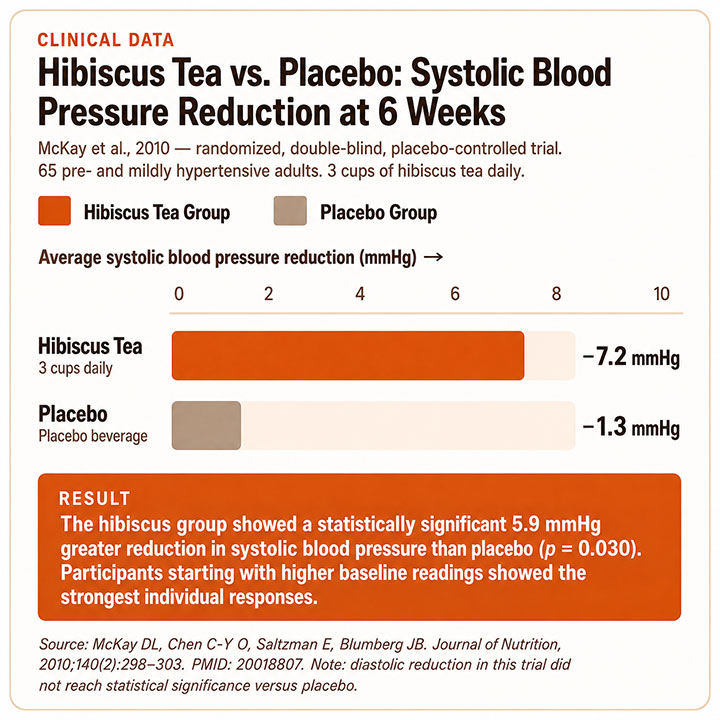
The finding that carries the most practical weight for individuals sits in the Tufts data and recurs in other studies: people with higher starting readings respond more. If your systolic is consistently at or above 145 mmHg, you are in a meaningfully different category from someone sitting at 128. The two-week window is more likely to show measurable change in the first group than in the second.
Day by Day: What to Expect
Days 1 to 3
The most likely experience in the first three days is almost nothing, and that is expected. Anthocyanins from hibiscus enter circulation within hours of drinking the tea, but the vascular adaptations those compounds drive take longer to accumulate.
What some people notice in days one through three is a mild increase in urinary output, particularly if they are not used to significant fluid intake at set times of day. That is the beginning of the tea’s diuretic effect, and it tends to normalize within the first week.
Blood pressure readings at the end of day three are, for almost everyone, the same as on day one. Measuring daily in the first week tends to produce discouraging or misleadingly optimistic numbers that reflect the natural variability in home monitors and the time of day more than any effect of the tea. The readings on day three are not the data. The trend across six weeks is the data.
Days 4 to 7
By the end of the first week, the tea’s ACE-inhibitory effects start to accumulate. Angiotensin-converting enzyme constricts blood vessels by converting a hormone called angiotensin I into angiotensin II. Hibiscus appears to modestly slow this conversion.
Vessels stay slightly more relaxed than they would otherwise be. Some people notice a subtle shift in how they feel during this phase. The heaviness that sometimes follows a salty meal does not seem to linger quite as long, or they feel slightly less bloated after eating. Others notice nothing at all.
Whether you perceive any change in week one depends largely on where your blood pressure started. People with readings above 140 to 145 mmHg systolic at baseline are more likely to notice early shifts than those near the lower boundary of pre-hypertension. The mechanism is working either way.
Days 8 to 14
Week two is where most guides declare that hibiscus tea has reached its full effect. That framing oversimplifies the research. What the McKay trial actually found is that statistically significant differences between the tea and placebo groups emerged at the six-week endpoint, not earlier. The two-week mark is a meaningful checkpoint, but the direction of the trend matters more than any single reading on any particular morning.
If your numbers have moved at all in week two, even slightly, that is information worth tracking. If they have not moved at all, that is also useful information, and it warrants a closer look at brewing concentration and tea quality before drawing conclusions.
For people whose blood pressure was meaningfully elevated at baseline, this window sometimes shows a consistent pattern rather than dramatic drops: mornings that look more uniform, spikes after high-sodium meals that are smaller and shorter. That regularity is what the research is actually describing when it reports average reductions of 7 mmHg in systolic pressure.
For some participants in these trials, the drop was larger. For others, it was minimal. Both outcomes are real, and the reasons for the difference are not yet fully understood.
How to Make Hibiscus Tea for High Blood Pressure
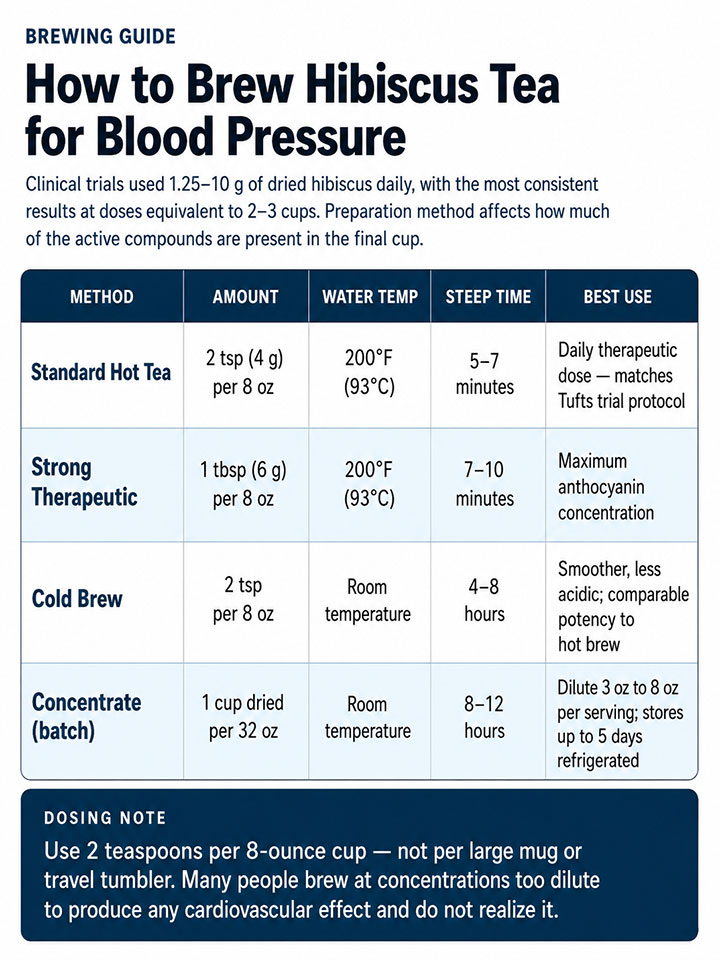
The clinical trials that showed meaningful blood pressure changes used between 1.25 and 10 grams of dried hibiscus calyces daily, with the most consistent results at doses equivalent to two to three cups of tea brewed to standard concentration. Preparation method affects how much of the active compounds are present in the final cup.
Spreading intake across the day maintains more consistent blood levels of anthocyanins than drinking three cups at once. A practical approach: one cup in the morning after eating, one in the early afternoon, and one in the early evening. Finish the last cup at least two hours before bed, as the mild diuretic effect can interrupt sleep otherwise.
Water temperature is less important than commonly suggested. Hibiscus anthocyanins are reasonably stable at normal steeping temperatures. Bringing water to a full boil and letting it cool for 30 to 60 seconds before pouring is practical and does not meaningfully reduce the active compound content. Steep for five to seven minutes for a standard cup, and up to ten minutes for a more concentrated therapeutic dose.

Three Hibiscus Blends Worth Making
Three blends worth adding to the rotation, each with a different character depending on what you want from a cup.
Hibiscus and Ginger
Combine two teaspoons of dried hibiscus with half a teaspoon of freshly grated ginger in eight ounces of hot water. Steep for seven minutes and strain. The ginger sharpens the hibiscus tartness in a way that makes the finished cup feel deliberately medicinal rather than incidentally herbal. Whether that is appealing depends entirely on what you want from a hot drink. It is not a subtle flavor.
Hibiscus and Hawthorn
Use one teaspoon of hibiscus and one teaspoon of dried hawthorn berries in eight ounces of water, steeped for ten minutes. The hawthorn softens the acidity slightly and adds an earthier base note. The result is less aggressive than plain hibiscus, closer in character to a fruit tisane, and more drinkable for people who find the standard version too sour to finish a full cup.
Hawthorn berries have their own evidence base for cardiovascular health, particularly in trials focused on cardiac function. Whether combining the two compounds produces any additive blood pressure effect has not been tested in controlled human trials, so treat this blend as a palatable daily option rather than a studied combination.
Cold Brew Concentrate
Place one cup of dried hibiscus in four cups of cold water and refrigerate for a minimum of four hours, or overnight. Strain and store for up to five days.
The cold brew version is a noticeably different drink from the hot-steeped version: less assertive, smoother, without the tartness that can build up when you are drinking two to three cups of the hot version across a day. It works well diluted one-to-one with sparkling water in warm weather.
One three-ounce pour of concentrate diluted to a full eight-ounce cup delivers roughly the same anthocyanin content as a standard hot brew.
Safety and Medication Interactions
At typical doses of two to three cups daily, hibiscus tea is well-tolerated by most healthy adults. The interaction picture changes significantly for people already managing blood pressure with medication, and that is the area that warrants the most care.
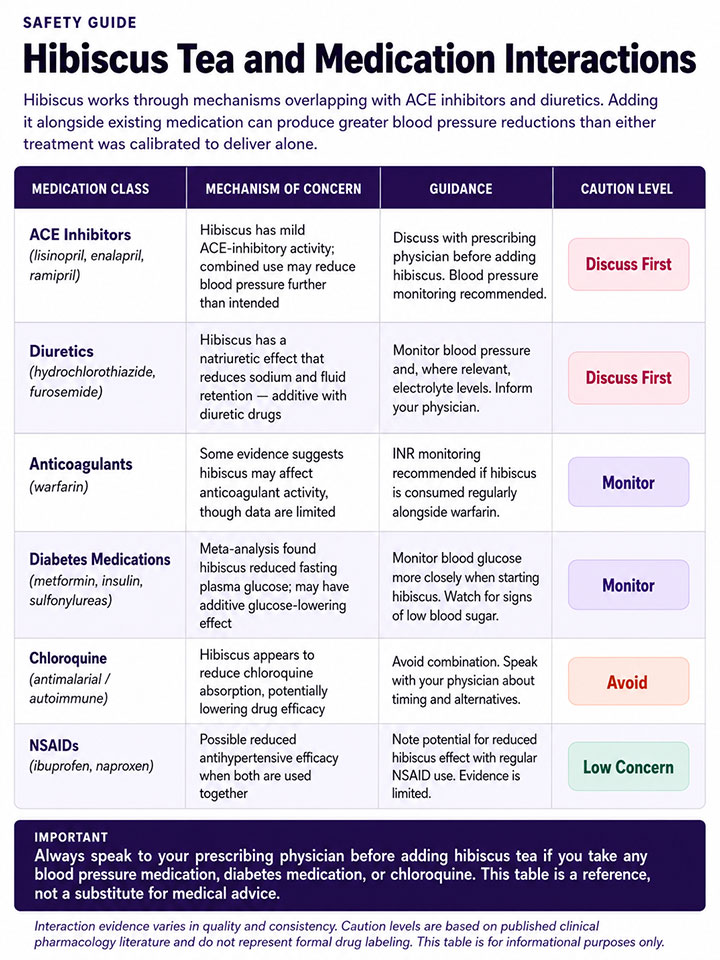
People taking ACE inhibitors or diuretics are the group most in need of a physician conversation before adding hibiscus. Hibiscus works through overlapping mechanisms: it has mild ACE-inhibitory activity and a natriuretic effect that reduces sodium retention in the kidneys.
Adding it to an existing ACE inhibitor can reduce blood pressure further than either treatment was calibrated to achieve on its own. This is not a reason to avoid hibiscus if you are on medication. It is a reason to have that specific conversation with your prescribing physician before starting.
Pregnant women should not drink hibiscus tea. Research suggests it may stimulate uterine contractions, and human safety data during pregnancy is limited. The recommendation to avoid it during pregnancy and breastfeeding is consistent across major safety reviews.
People with chronically low blood pressure (systolic readings below 90 mmHg) should approach hibiscus cautiously, as the additional blood pressure reduction may cause dizziness or fainting. People taking chloroquine for malaria or autoimmune conditions should also be aware that hibiscus appears to reduce chloroquine absorption. Those two should not be combined without medical guidance.
How Hibiscus Compares to Other Natural Options
For most people managing mild to moderate hypertension who want a non-pharmacological option alongside lifestyle changes, hibiscus sits at a useful intersection of evidence quality, tolerability, and cost. That is not the same as calling it the only option, or the right option for everyone.
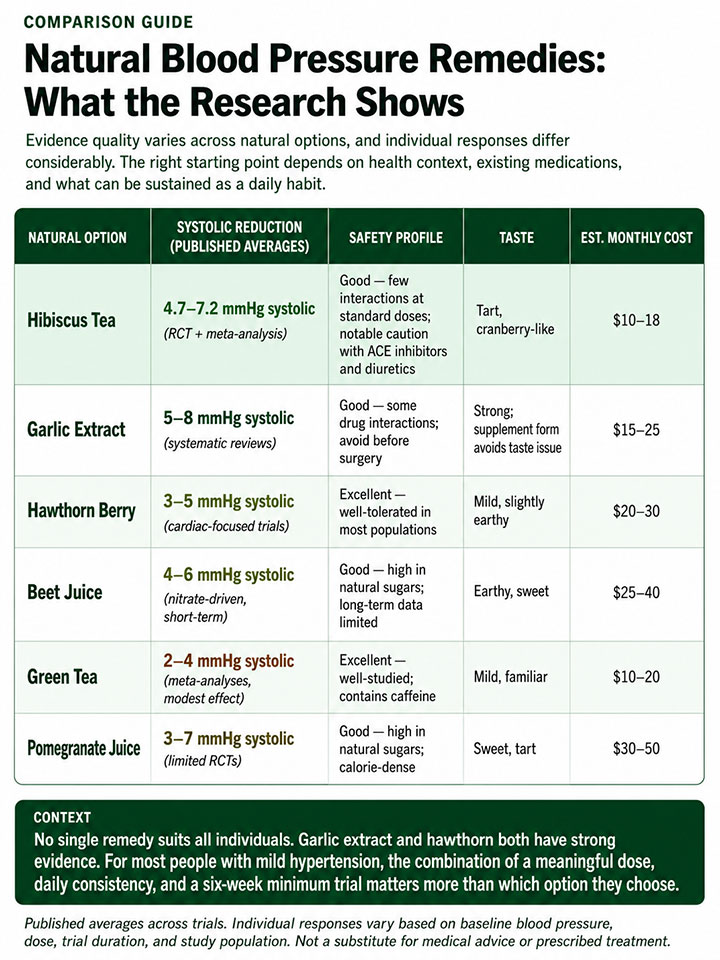
Garlic extract has substantial evidence behind it across randomized trials. A 2015 review found systolic reductions of roughly 8 mmHg in people with existing hypertension. Hawthorn performs well in trials focused on cardiac function specifically.
Beet juice shows consistent short-term effects driven by dietary nitrates, though long-term trial data is thinner. None of these is the clear winner across all individuals. The combination of approach, consistency, and individual biology determines the result far more than any head-to-head evidence table.
Common Issues
The tea is too tart to finish
Reduce steeping time to three to four minutes for a milder cup. Adding a teaspoon of honey works well if the tartness remains sharp at standard steeping. The cold brew method described earlier is the most reliable fix. It produces a noticeably smoother flavor without any other adjustment.
Two weeks in and the readings have not moved
Two weeks without a reading change is where most people quit the experiment. It is also where most of the useful troubleshooting lives, so it is worth slowing down here rather than abandoning the attempt.
The most important variable to check before anything else is your baseline, not the tea. If your baseline systolic was near 128 to 132, meaningful movement at two weeks is unlikely regardless of dose or product quality.
The trials that found the largest reductions enrolled people with readings well above 140. If you are in the pre-hypertension range, the timeline extends, and two weeks is genuinely too early to draw any conclusions.
If your baseline was higher, run through these checks. Hibiscus quality first: pale or brownish calyces have lost most of their anthocyanin content during storage, and the product should be deep burgundy to bright red, not dusty pink or amber.
Brewing concentration next: two teaspoons per eight-ounce cup, not two teaspoons per large mug or travel tumbler. Many people brew at concentrations too dilute to produce any vascular effect and do not realize it. If both are correct and readings are genuinely flat, extend the protocol to six weeks. The McKay trial found statistical significance at six weeks, not at two.
The diuretic effect is disruptive
Start with one cup daily and increase gradually over two weeks. Move the third cup earlier in the afternoon so the diuretic window does not extend into the evening. Most people find the effect normalizes after the first week, once the body has adjusted.
Stomach discomfort
Always drink hibiscus with food, or at least not on an empty stomach. The high organic acid content, particularly citric acid, can irritate the stomach lining when concentrated. Diluting slightly (eight ounces of tea with an extra two ounces of water) also reduces the acidity without noticeably affecting the flavor.
Conclusion
Six weeks of consistent use is where most of the evidence actually sits. The two-week mark is a checkpoint, not a conclusion. The pattern that shows up across the better-designed trials is that hibiscus works best in people who start with higher baseline readings, use a meaningful dose, and do not stop after two weeks because the numbers have not moved yet.
The question worth carrying into week three is not whether hibiscus works on average. It is whether you are giving it the conditions under which it works: a quality product, at adequate concentration, taken consistently. Most people who report no effect stopped too early or were using understrength tea. That is fixable. The biology, for most people with mildly elevated blood pressure, is not the obstacle.
FAQs
How much hibiscus tea should I drink to lower blood pressure?
The clinical trials that showed meaningful blood pressure changes used two to three cups daily (16 to 24 ounces total), brewed at roughly two teaspoons of dried hibiscus per eight-ounce cup. Most trials found no significant benefit with a single daily cup.
Two cups appear to produce measurable effects. Three cups most closely match the dose associated with the larger reductions in the Tufts trial and several subsequent studies.
Which hibiscus tea format is best for blood pressure?
Loose dried calyces give the most control over dose and quality. A standard commercial tea bag typically contains 1.5 to 2 grams of hibiscus. That is sufficient for one cup, but you would need two or three bags per serving to approach the doses tested in trials.
Standardized extracts and capsules provide more precise anthocyanin dosing but skip the hydration benefit and typically cost more per day of use. For most people, high-quality loose dried hibiscus steeped at a measured concentration is the closest match to what the published research actually tested.
When is the best time to drink hibiscus tea for blood pressure?
Spreading consumption across the day is more effective than drinking all three cups at once. A practical approach: one cup in the morning after eating (the acidity is harder to tolerate on an empty stomach), one in the early afternoon, and one in the early evening at least two hours before bed. Morning consumption alone, without the other two cups, is unlikely to deliver the daily anthocyanin levels that the evidence associates with meaningful blood pressure effects.
Is it safe to drink hibiscus tea while on blood pressure medication?
It requires a conversation with your prescribing physician rather than a quick look at a generic warning label. Hibiscus works through mechanisms overlapping with both ACE inhibitors and diuretics, so combining it with either of those drug classes can produce blood pressure reductions beyond what either treatment is calibrated to deliver alone. That does not make the combination automatically unsafe, but it means the dose and monitoring schedule may need adjustment. Bring it up before starting.
Does hibiscus tea lower blood pressure immediately?
No, and that expectation is worth examining. When you drink a cup of hibiscus and check the monitor an hour later, the reading reflects hydration levels, posture, the time of day, and how anxious you are about the number. It does not reflect the tea. The effects described in the research build over two to six weeks. A single cup is not a dose. It is the first of roughly eighty-four.
Is hot or cold hibiscus tea better for blood pressure?
Both deliver comparable anthocyanin content when brewed at the right concentration. The format you will consistently drink every day is the right one.