The biggest surprise wasn’t that berries helped. It was which heart health markers changed first, who benefited the most, and how little it took to see measurable results.
A handful of blueberries doesn’t look like medicine. It looks like a snack. But researchers who track cardiovascular markers before and after eight weeks of daily berry intake keep finding the same thing: something in that snack is doing work most people assume only a pill can do.
The changes aren’t dramatic overnight transformations. They’re the kind of quiet, measurable shifts that show up on a blood panel and add up over years. Bad cholesterol drops. Blood pressure eases. The inflammation your doctor tracks with a C-reactive protein test starts to settle. None of it requires a prescription, and most of it costs less than a cup of coffee.
Who Sees the Biggest Heart Health Gains?
Not everyone benefits equally, and that’s worth knowing before you build expectations. People with LDL cholesterol above 200 mg/dL tend to see the sharpest drops. Anyone with prehypertension or mild hypertension usually notices their blood pressure numbers move too, while people who start in the normal range see much smaller changes.
Age plays a role as well. Arteries stiffen over time, and the compounds in berries seem to help keep them flexible, which is part of why adults over 50 respond strongly. People with metabolic syndrome, meaning some combination of belly fat, high blood sugar, and poor cholesterol, also respond well, likely because berries act on several of those risk factors at once rather than just one.
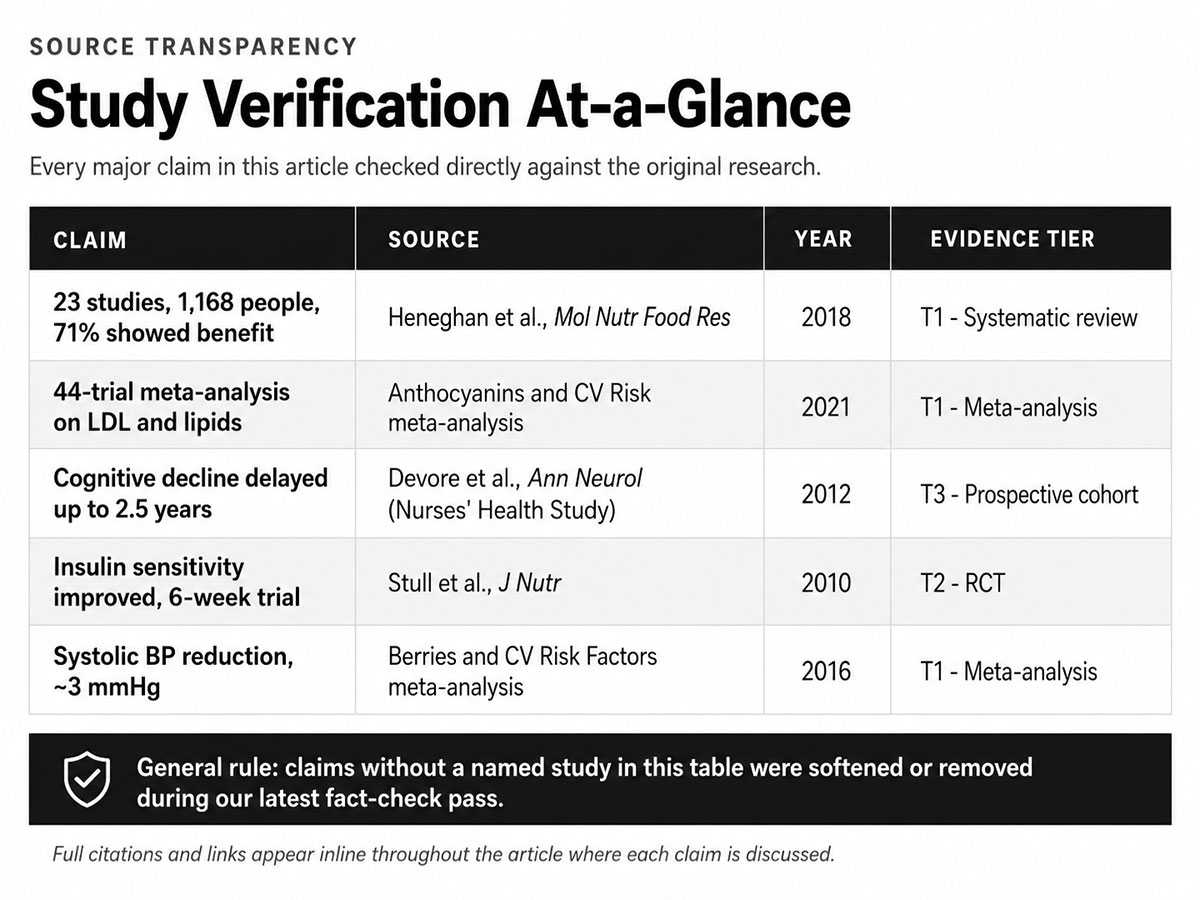
A 2018 systematic review in Molecular Nutrition & Food Research pooled 23 randomized trials covering 1,168 people and found that 71% of the higher-quality trials reported a real benefit for at least one cardiovascular risk marker. That’s not a fringe finding. It’s one of the more consistent numbers in this research area.
A Drop in “Bad” Cholesterol
LDL cholesterol is the kind that builds up as plaque inside artery walls. Over the years, that buildup narrows the vessel until blood flow gets restricted, which is how a lot of heart attacks and strokes start. Lowering LDL is one of the most direct ways to interrupt that process.
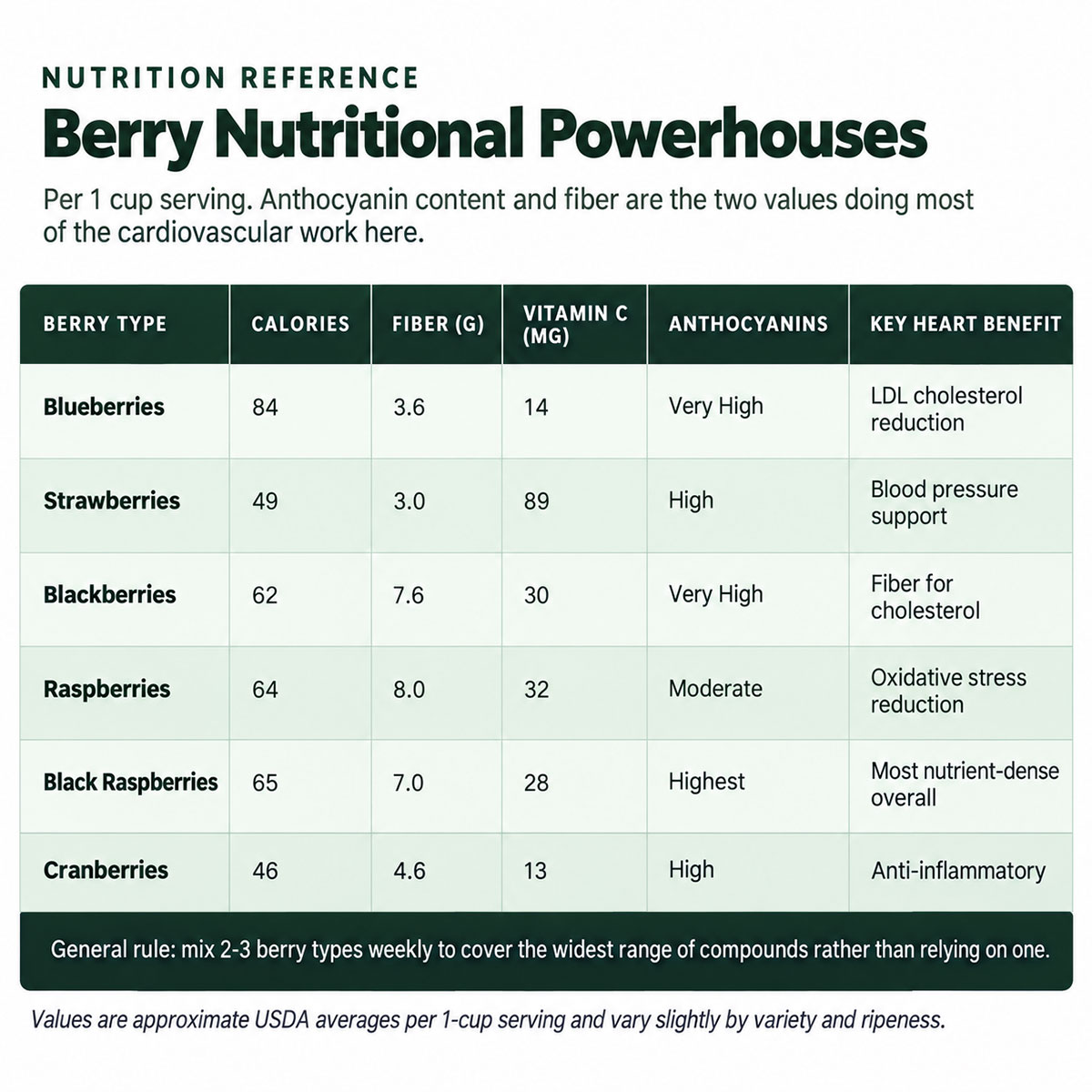
Blueberries and strawberries carry the strongest evidence here, largely because of anthocyanins, the plant pigments responsible for their deep red and blue color. A 2021 meta-analysis pooling 44 randomized trials and 15 cohort studies found that anthocyanin-rich berries significantly lowered LDL and triglycerides while raising HDL, the cholesterol type that actually helps clear arteries.
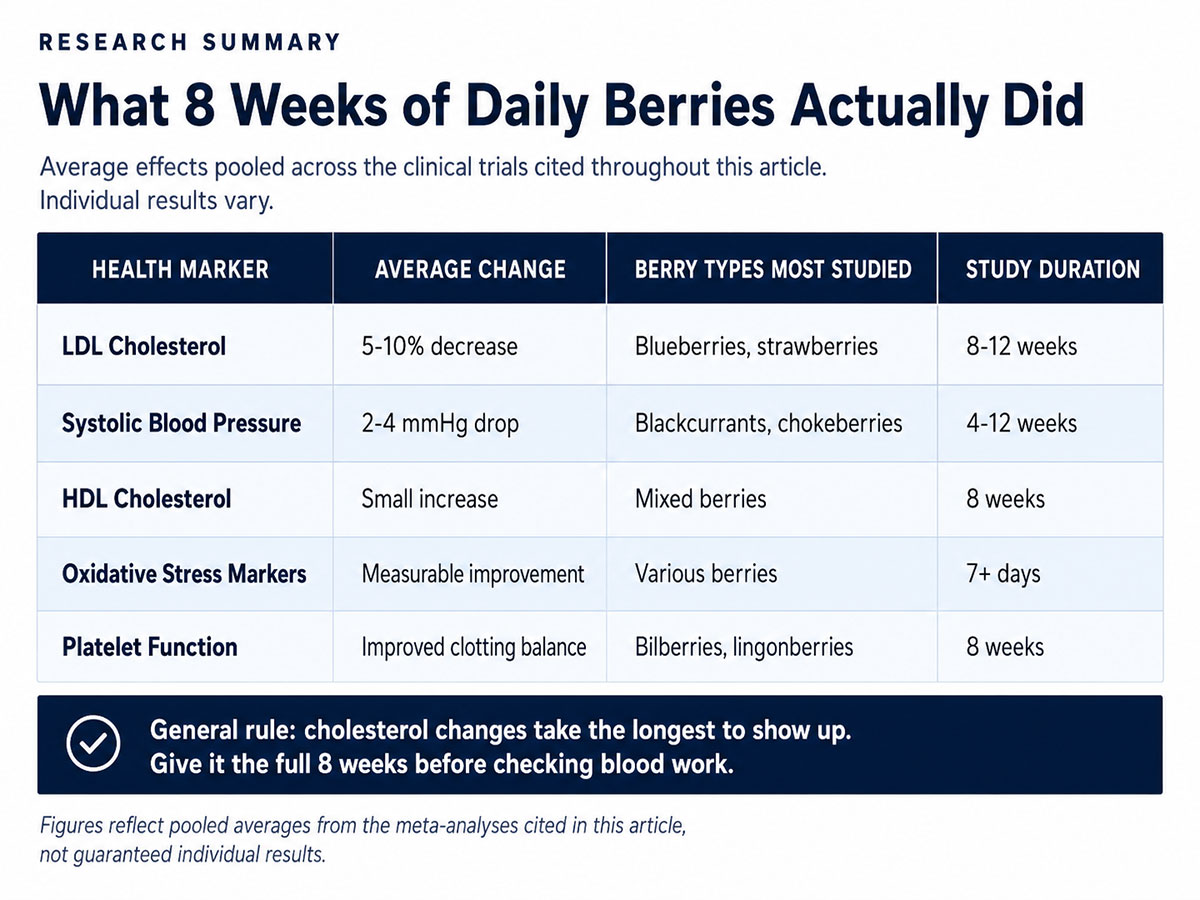
That finding took researchers a while to fully explain, and it still isn’t fully settled. The leading theory is that anthocyanins prompt the liver to produce more LDL receptors, giving it more hooks to grab and clear cholesterol out of the bloodstream, though the size of that effect varies more between people than researchers can currently explain. Some trials in the pooled data showed LDL reductions in the 5 to 10 percent range after roughly eight weeks of daily intake.
Your Blood Pressure Starts to Settle
Blood pressure changes are smaller than the cholesterol shifts, but they matter just as much for long-term risk. Researchers wanted to know how much of that mattered outside a lab, and the answer settled around 2 to 4 mmHg of systolic drop across several independent meta-analyses, most clearly in people who already run high on that number.
Systolic pressure is the top number in a reading. It reflects how hard the heart has to push blood through the arteries with each beat. A drop of even 3 points measurably lowers stroke risk over time, which is a meaningful return for a change this small.
Chokeberries and blackcurrants show the strongest blood pressure effects in the available trials, largely through their impact on nitric oxide, a molecule that helps blood vessels relax. People who already had elevated readings saw more improvement than those starting from a normal baseline. That pattern holds across most of the cardiovascular research on berries: the effect concentrates in the people who need it most.
Less Oxidative Stress and Inflammation
This change won’t show up on a home blood pressure cuff. It shows up in blood work your doctor might order, specifically a marker called C-reactive protein, or CRP, which rises when inflammation is active in the arteries.
Think of oxidative stress as slow rust accumulating inside cells. Free radicals damage cell membranes and DNA over time, and the body responds with chronic low-grade inflammation. That inflammation is part of what makes arterial plaque unstable enough to rupture and trigger a heart attack.
Berries appear to interrupt part of that chain. Vitamin C and the plant compounds concentrated in berries neutralize some of the free radical activity before it damages cells, and several trials lasting at least a week showed measurable improvement in oxidative stress markers, with longer intake producing stronger effects.
Understanding Your Heart Health Numbers
The berry research keeps referencing the same handful of lab values. Here’s what each one actually means and where berries tend to move the needle.
Total Cholesterol
Desirable sits under 200 mg/dL, borderline high runs 200 to 239, and 240 or above is considered high. A high total number isn’t automatically alarming if HDL is also high, but most people with elevated totals are carrying too much LDL.
LDL (Bad) Cholesterol
Optimal is under 100 mg/dL, near-optimal runs 100 to 129, borderline high is 130 to 159, and 160 or above is high. This is the number that berries move the most. Dropping from 150 to 135 corresponds to roughly a 15% reduction in heart attack risk, and every 10-point drop matters.
HDL (Good) Cholesterol
Under 40 mg/dL in men or under 50 in women is considered poor, 50 to 59 is better, and 60 or above is best. Berries raise HDL modestly at best, but even a small increase helps.
Blood Pressure
Normal is under 120/80. Elevated runs 120 to 129 over under 80. Stage 1 hypertension is 130 to 139 over 80 to 89, and Stage 2 is 140/90 or higher. The systolic number responds best to berry intake, and moving from 138 to 133 shifts someone from Stage 1 into the elevated category, which is real clinical progress.
One more number worth a mention: triglycerides. Normal sits under 150 mg/dL, borderline high runs 150 to 199, high is 200 to 499, and very high is 500 or above. Berries affect this one less directly than cholesterol, though fiber helps somewhat. Cutting refined carbs matters more here than any amount of daily fruit.
💗 Heart Health Calculator
See how berries could improve your numbers in 8 weeks (estimates only)
🫐 Your Projected Results After 8 Weeks
Based on average effects from short clinical trials of daily berry intake
How Much Do You Need?
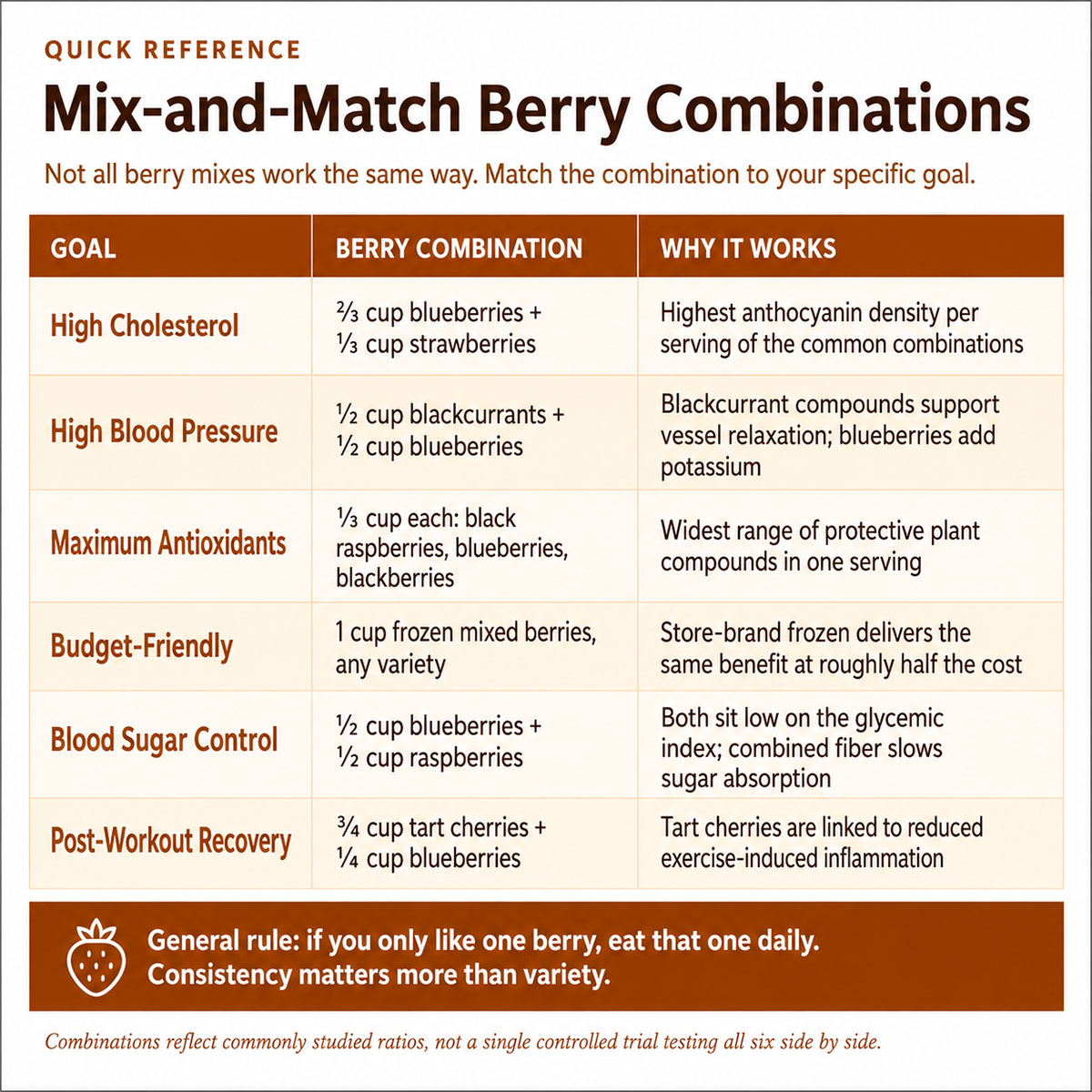
The research points to a consistent target: one cup of mixed berries daily, roughly 150 grams, which can be split into smaller servings throughout the day if that’s easier to fit into a routine.
Fresh and frozen berries perform equally well. Frozen berries are picked at peak ripeness and frozen within hours, which locks in their plant compounds before any decline sets in. A 2022 clinical trial testing blueberry intake over six months found that whole berries and berry powder produced similar improvements in cardiovascular markers, suggesting that consistency over time matters more than the exact delivery form.
Your 8-Week Berry Plan
Building a daily berry habit works better in stages than as an all-or-nothing switch.
Weeks 1 to 2: The Smoothie Start
- Blend one cup of mixed berries with milk or yogurt and a banana for sweetness.
- Make this 2 to 3 times during the week rather than daily.
- Let your taste buds adjust before adding pressure to hit a daily target.
Weeks 3 to 4: The Topper Method
- Add a cup of berries to meals you already eat, like oatmeal, yogurt, or cereal.
- Aim for every other day rather than daily.
- This folds the habit into your existing routine instead of adding a new one.
Weeks 5 to 6: Daily Habit Forming
- Add berries to a lunch salad alongside greens and nuts.
- Push toward 5 to 6 days a week.
- Notice that the habit is starting to feel automatic rather than effortful.
Weeks 7 to 8: The Daily Goal
- Replace an afternoon snack like chips or cookies with a bowl of berries.
- Keep a frozen supply on hand and thaw what you need each day.
- By week 8, daily intake should feel like a normal part of eating rather than a project.
What Happens Week by Week
Week 1 usually brings a small dip in sugar cravings as the palate starts adjusting to berries as a sweeter substitute. Some people notice mild digestive changes as fiber intake rises.
By week 2, energy tends to feel steadier through the afternoon, without the crash that follows sugary snacks. Weeks 3 and 4 are when inflammation markers typically begin shifting, invisibly, well before anything shows up on a home blood pressure cuff.
Blood pressure improvements tend to emerge in weeks 5 and 6, gradually rather than all at once. The bigger cholesterol shift usually shows up by weeks 7 and 8, once the liver has adjusted how it clears LDL.
Benefits generally plateau by around week 12, and they don’t stick around indefinitely. Stop the habit, and the numbers tend to drift back.
Heart-Healthy Berry Recipes
These make reaching a daily cup goal considerably less of a chore.
8-Week Heart Health Smoothie
Ingredients: 1 cup mixed berries (frozen works well), 1 banana, 1 cup unsweetened almond milk, 1 tablespoon ground flaxseed, a handful of spinach.
- Combine everything in a blender.
- Blend for 60 seconds until smooth.
- Pour and drink immediately.
Nutrition per serving: 220 calories, 6g fiber, 4g protein.
Berry Oatmeal Power Bowl
Ingredients: ½ cup cooked oatmeal, ½ cup mixed berries, 1 tablespoon chopped walnuts, a drizzle of honey, a pinch of cinnamon.
- Cook oatmeal as usual.
- Top with berries while still hot so they soften slightly.
- Add walnuts, honey, and cinnamon to finish.
Nutrition per serving: 280 calories, 8g fiber, 6g protein.
Heart-Smart Berry Salad
Ingredients: 2 cups mixed greens, ½ cup sliced strawberries, ¼ cup blueberries, 2 tablespoons crumbled feta, 2 tablespoons balsamic vinaigrette, a handful of pecans.
- Toss greens in a large bowl.
- Add strawberries, blueberries, feta, and pecans.
- Drizzle with vinaigrette and toss gently.
Nutrition per serving: 240 calories, 7g fiber, 6g protein.
Quick Berry Yogurt Parfait
Ingredients: 1 cup plain Greek yogurt, ½ cup mixed berries, 2 tablespoons granola, 1 teaspoon honey.
- Layer yogurt, berries, and granola in a glass.
- Repeat the layers once more.
- Finish with a drizzle of honey.
Nutrition per serving: 260 calories, 5g fiber, 20g protein.
Berry Chia Pudding
Ingredients: 3 tablespoons chia seeds, 1 cup unsweetened almond milk, ½ cup mixed berries, 1 teaspoon vanilla extract, 1 teaspoon maple syrup.
- Stir chia seeds, almond milk, vanilla, and maple syrup together in a jar.
- Cover and refrigerate overnight.
- Top with berries in the morning.
Nutrition per serving: 210 calories, 12g fiber, 6g protein. Keeps for 3 days refrigerated.
Berry Protein Smoothie Bowl
Ingredients: 1 cup frozen mixed berries, ½ frozen banana, ½ cup Greek yogurt, ¼ cup almond milk, 1 scoop protein powder (optional). Toppings: fresh berries, sliced almonds, coconut flakes, hemp seeds.
- Blend frozen berries, banana, yogurt, and milk with minimal liquid for a thick texture.
- Pour into a bowl.
- Arrange toppings in sections.
Nutrition per serving: 320 calories, 9g fiber, 25g protein.
Shopping and Storage
Strawberries peak from April through June, blueberries from May through September, and blackberries and raspberries run from June through October. Buying in season can cut prices by half or more, and out of season, frozen is the better value anyway.
Store fresh berries unwashed in their original container and wash only what you plan to eat that day, since moisture speeds up mold. Frozen berries keep for up to 12 months in an airtight bag with the air squeezed out. If you want to freeze your own, rinse, pat dry, freeze on a baking sheet for two hours, then transfer to freezer bags to avoid a solid clump.
The Budget-Friendly Berry Strategy
Frozen mixed berries typically run $3 to $4 per pound, fresh strawberries in season fall to $2 to $3, fresh blueberries run $4 to $6, and organic versions climb to $6 to $9. A cup of berries weighs about a third of a pound, which puts a daily serving of frozen mixed berries at around 50 cents, or roughly $14 a month.
Compare that to the cost of managing heart disease with medication. Statins typically run $10 to $50 a month, and blood pressure medication runs $5 to $30. Berries won’t replace medication for someone who needs it, but for many people, they’re one of the cheapest preventive habits available.
Berry Myths Debunked
Myth: You need exotic superfoods like acai or goji berries
Local blueberries, strawberries, and blackberries perform just as well in head-to-head research. Exotic branding doesn’t equal better outcomes, and there’s no clinical reason to pay a premium for imported berries when the produce aisle already has what works.
Myth: Frozen berries lose their nutrients
Frozen berries retain nearly all of their anthocyanin content because they’re frozen within hours of harvest, at peak ripeness. Fresh berries, by contrast, lose some nutrients the longer they sit on a shelf before you eat them.
Myth: Only organic berries provide the benefit
Both organic and conventional berries show similar improvements in the available research. Washing conventional berries well addresses most of the concerns, and skipping berries entirely because organic isn’t in the budget gives up a real benefit for very little actual gain.
Myth: Berry supplements work as well as whole berries
Whole berries contain fiber, water, and hundreds of compounds working together. Supplements typically isolate one or two of those compounds, which strips out the combined effect research keeps finding in whole-food trials.
The picture isn’t entirely one-sided, though. A handful of trials using purified anthocyanin extracts have shown real improvements in cholesterol and blood pressure on their own, just smaller ones than whole berries produce. The honest takeaway is that supplements aren’t worthless. They’re a weaker version of something a cup of blueberries already does better, and cheaper.
Myth: Dried berries count the same as fresh or frozen
Drying concentrates sugar substantially, enough that a cup of dried berries can carry as much sugar as three or four cups of fresh. Stick to fresh or frozen for your daily cup.
Do Cardiologists Really Say Stop Eating Blueberries?
A viral claim has circulated across social media for the past year: cardiologists are supposedly telling people to stop eating blueberries. It’s the kind of headline built to travel, and it has traveled. It’s also, on the actual evidence, mostly wrong.
The claim traces back to clickbait “foods cardiologists never eat” lists that rarely name an actual cardiologist, paired with a widely shared but often misread 2023 article about what happens to your body if you eat blueberries every day. Somewhere in the retelling, a piece about moderation turned into a warning about avoidance.
There are a few narrow situations where a cardiologist might genuinely tell a specific patient to watch their berry intake. Blueberries contain vitamin K, which can interact with blood thinners like warfarin, so anyone on that medication should talk to their doctor before making any dietary change, not just with berries.
People managing blood sugar closely sometimes notice a quicker rise if they eat a large serving on an empty stomach, though this is a timing issue rather than a reason to avoid berries altogether. And the sugar concern that shows up in a lot of these viral posts is almost always about processed blueberry products, muffins, pastries, sweetened yogurt blends, not whole blueberries themselves.

Outside of those specific cases, the clinical research runs in the other direction entirely. The American Heart Association’s own Heart-Check program certifies blueberries as heart healthy, and the meta-analyses cited throughout this piece show consistent benefit, not risk. If you’re not on blood thinners and you’re eating whole, unprocessed berries, there’s no cardiology consensus telling you to stop.
How Berries Stack Up Against Other Heart Foods
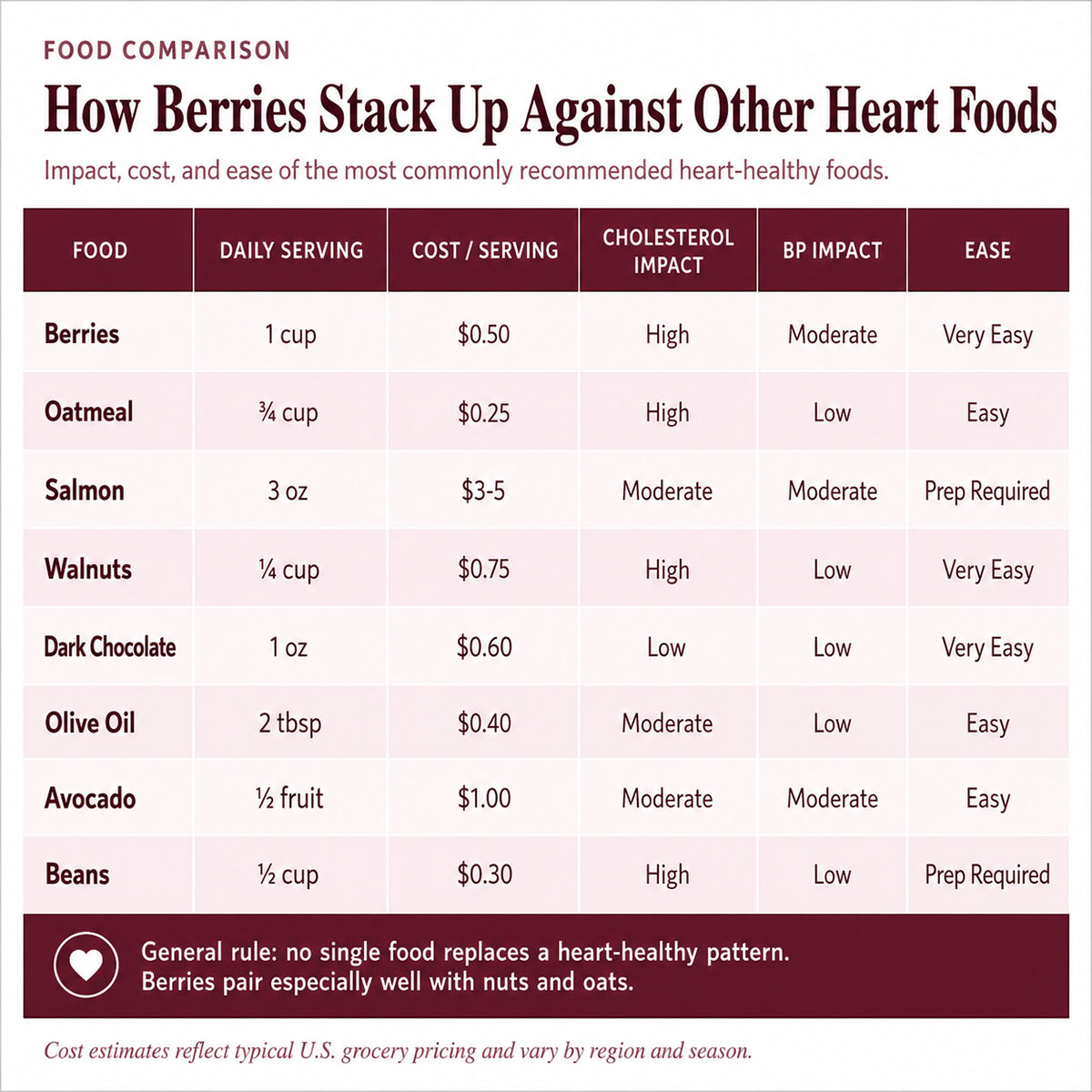
Berries aren’t the only food worth building a heart-healthy plate around, and they work best in combination with others rather than in isolation.
Oatmeal costs less but needs cooking, and salmon delivers strong benefits at a higher price and more prep. Dark chocolate sits at the other extreme: a smaller cardiovascular effect, but almost no prep at all. Berries land near the top on impact, cost, and ease all at once, which is part of why they show up so often in cardiologist-recommended eating patterns.
Troubleshooting Common Berry Problems
Berries give me diarrhea
Start with half a cup and build up over two weeks rather than jumping straight to a full daily cup. Gut bacteria need time to adjust to the added fiber, and extra water helps the transition go more smoothly.
They’re too tart for me
Start with strawberries, the sweetest of the common options, and mix them with a banana in a smoothie. Most people who stick with berries for two weeks find their taste preference actually shifts.
My family won’t eat them
Blend berries into smoothies where the flavor mostly disappears behind banana and yogurt, or fold them into pancake and muffin batter. Once the taste becomes familiar, whole berries tend to follow.
A handful of smaller frustrations come up too, and they mostly share the same fix. Fuzzy teeth after eating berries is just the natural acidity temporarily softening enamel, and it resolves on its own if you rinse with water and wait 30 minutes before brushing. Berries molding before you get to them usually means switching to frozen or buying only a three-day supply of fresh.
Forgetting to eat them gets easier once you keep a prepped container at eye level in the fridge. And if cost feels like the real barrier, frozen store-brand berries in bulk run about half the price of fresh, which brings a month’s supply back down to roughly $14.
Important Safety Information
Medication Interactions
Anyone on blood thinners like warfarin should talk to their doctor before increasing berry intake, since the vitamin K in berries can affect how the medication works. Berries also contain salicylates, compounds chemically similar to aspirin, which could add a small bleeding risk on top of an existing blood thinner.
Allergies
True berry allergies are uncommon but real. Anyone trying a new berry for the first time should start small and watch for itching, swelling, or breathing trouble. People with birch pollen allergies sometimes react to strawberries specifically, a cross-reaction known as oral allergy syndrome, and cooking the berries usually resolves it.
Blood Sugar and Digestive Concerns
Berries sit low on the glycemic index and generally don’t spike blood sugar the way other fruits can, but anyone with diabetes should still check their numbers after adding berries to confirm how their body responds. Some people notice gas or bloating in the first couple of weeks as their gut adjusts to the added fiber, which typically settles down within two to three weeks.
Kidney Stone Risk
Berries contain oxalates, which can contribute to kidney stones in people who are already prone to them. Most people can eat berries without any issue, but anyone with a history of calcium oxalate stones should check with their doctor about how much fits safely into their diet.
The Science Behind the Effect
Several distinct mechanisms are doing the work behind these numbers, and they operate somewhat independently of each other.
Anthocyanins appear to activate genes involved in fat metabolism, prompting the liver to produce more LDL receptors that pull cholesterol out of the bloodstream for breakdown. Separately, berry compounds boost nitric oxide production in the vessel lining, which relaxes artery walls and improves blood flow, a process that naturally declines with age. Berry fiber also feeds beneficial gut bacteria, which ferment it into short-chain fatty acids that reduce how much cholesterol the liver produces in the first place.
On the clotting side, berry compounds make platelets less prone to clumping, which lowers dangerous clot formation without carrying the bleeding risk that comes with aspirin. And on the inflammation side, they block specific enzymes, COX-2 and LOX among them, that would otherwise drive the kind of chronic arterial inflammation linked to plaque instability. Researchers are still working out how much each mechanism contributes relative to the others, and that’s a genuinely open question rather than a settled one.
Benefits Beyond the Heart
The same anthocyanins protecting your arteries appear to cross into brain tissue and reduce the inflammation associated with age-related memory loss. A landmark 2012 study following 16,010 women in the Nurses’ Health Study found that higher long-term berry intake was associated with cognitive decline delayed by up to 2.5 years, one of the more striking findings in this entire research area.
Blood sugar control shows up as well. A controlled trial in obese, insulin-resistant adults found that six weeks of daily blueberry intake improved insulin sensitivity significantly more than a placebo smoothie of equal nutritional value, even though body weight didn’t change in either group.
That detail matters. The effect wasn’t a byproduct of eating less or losing weight.
Athletes who eat berries around workouts also tend to report less muscle soreness afterward, likely tied to the same anti-inflammatory compounds doing the cardiovascular work. The research on mood and gut health is promising but thin, with smaller studies suggesting a benefit that hasn’t yet been confirmed at the scale of the cardiovascular and cognitive findings.
When to See Results, and When to See a Doctor
Better digestion and more regular bowel movements tend to show up first, within the first couple of weeks, as the added fiber takes effect. Sugar cravings usually ease by weeks 3 to 4, and some people notice better sleep or a bit of effortless weight loss by weeks 5 to 8. Measurable changes in blood work generally arrive by week 8, which is the point to schedule a follow-up appointment.
See a doctor if cholesterol hasn’t budged after 12 weeks of consistent daily intake. Some people are simply non-responders whose genetics override dietary changes, and that’s not a failure. It’s a signal that medication may be the better path. Blood pressure that keeps increasing despite the changes here deserves a checkup rather than more patience, and any new chest pain or shortness of breath should never be chalked up to diet.
Your Action Checklist
- Buy frozen mixed berries this week.
- Prep smoothie ingredients tonight.
- Get baseline blood work done before starting, if you haven’t already.
- Eat berries at least three times this week.
- Recheck cholesterol and blood pressure after 8 weeks.
- Share the results with your doctor.
Conclusion
Eight weeks isn’t long. It’s about the length of a school semester, or two months of a gym membership most people forget they’re paying for. And yet it’s enough time for a food this ordinary to move numbers that medication is usually the one asked to move.
That’s the part worth sitting with. Berries aren’t a miracle. But something this unglamorous, a cup of fruit that costs about 50 cents, is doing measurable work on a problem that kills more people than anything else. Your arteries don’t know or care whether the berries came from a farmers market or the freezer aisle. They only register that you ate them.
FAQs
Do berries need to be organic?
No. Conventional and organic berries show similar heart benefits in the available research. Wash conventional berries well and spend the savings elsewhere if budget is a factor.
Can I drink berry juice instead?
Whole berries are the better choice. Juice strips out the fiber that slows sugar absorption and supports cholesterol control, so you lose part of the benefit even though the flavor carries over.
Will a berry supplement work as well?
Not as well. Supplements isolate one or two compounds, while whole berries deliver fiber, water, and hundreds of compounds working together, an effect researchers haven’t been able to replicate in pill form.
How soon will I see results?
Energy and digestion often shift within the first couple of weeks. Blood work typically needs the full 8 weeks to show clearer cholesterol and blood pressure changes.
Can I eat too many berries?
It’s difficult to overdo it, since berries are mostly water and fiber. Some people get an upset stomach from eating several cups at once, so 1 to 2 cups a day is a reasonable ceiling.
Will berries help if I already have heart disease?
Likely yes, but talk to your doctor first, especially if you’re on blood thinners. Berries support the same protective mechanisms after a diagnosis, but they complement treatment rather than replace it.