Nobody procrastinates because they don’t know what they should be doing. The deadline is visible. The task is written down. And still, nothing happens.
So the instinctive response is to push harder, schedule more carefully, and promise to be more disciplined next time. That response tends not to work, because it targets the wrong problem entirely.
Fuschia Sirois, a psychologist at the University of Sheffield, and Timothy Pychyl, a procrastination researcher at Carleton University, spent years studying why people delay tasks they fully intend to complete.
Their conclusion reframes the question: procrastination is a failure of emotion regulation, not time management. When a task generates anxiety, boredom, resentment, or self-doubt, the brain looks for an exit. The escape is the actual goal. The task is just what’s being avoided.
This is why advice built around calendars, timers, and longer to-do lists rarely helps. It targets the time dimension of the problem. The emotional dimension, the part that actually triggers the delay, requires different tools.
Nine of those tools follow, drawn from behavioral economics, neuroscience, and clinical psychology. Each one targets a specific point in the procrastination cycle, and they are not equally useful for every person. Which ones fit depends on your pattern, identified in the next section.
Why Procrastination Isn’t a Laziness Problem
Two systems in the brain negotiate constantly over where attention goes. The limbic system, anchored by the amygdala, operates quickly and automatically. It prioritizes emotional comfort and immediate reward. The prefrontal cortex handles slower, deliberate processing: planning, consequence-weighing, and long-term goal pursuit.
When a task carries an emotional charge, the limbic system treats it as a threat. Under normal conditions, the prefrontal cortex can override that signal. But the prefrontal cortex runs on a limited budget.
Fatigue, hunger, stress, and accumulated decisions throughout the day all reduce its capacity. When that capacity drops low enough, the limbic system wins more often, and avoidance becomes the default response.
This is why procrastination tends to get worse in the afternoon, on stressful days, and right after a string of hard decisions. The brake that stops the avoidance response has worn down. What looks like laziness is usually a depleted override system, not a character flaw.
What Type of Procrastinator Are You?
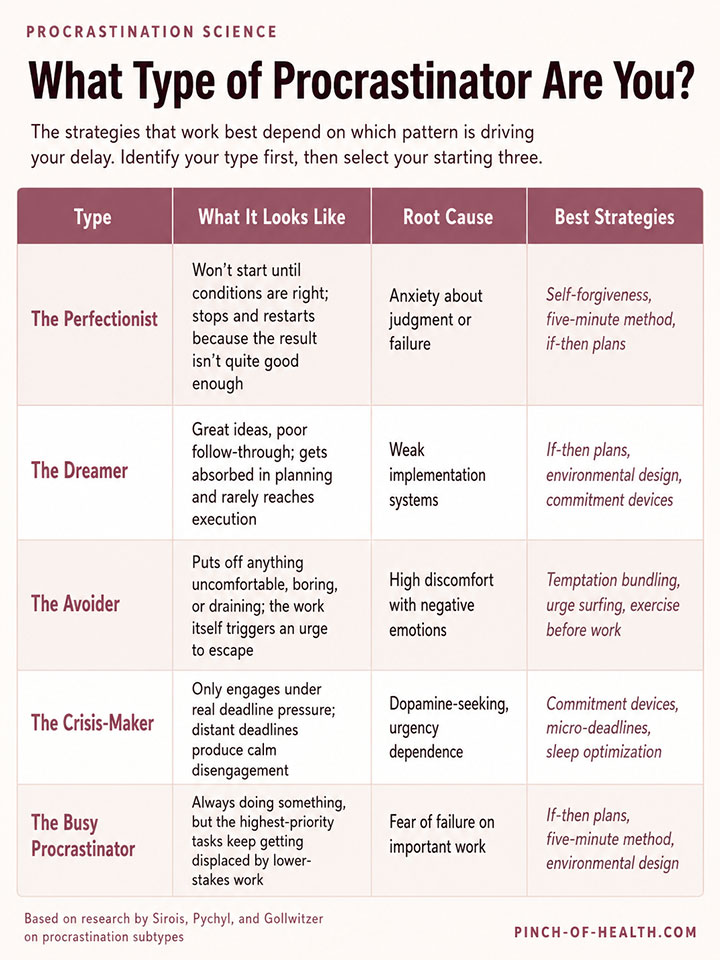
The strategies that work best depend partly on which emotional pattern is driving the delay. People put things off for different reasons, and understanding the mechanism behind your own avoidance shapes which approaches are most likely to help.
The table below outlines five common patterns. Most people recognize themselves in one or two of them most of the time, though the pattern can shift depending on the task or context.
Discover Your Procrastination Type
Answer 5 quick questions to get personalized strategies
Your Top 3 Strategies:
Once you’ve identified your pattern, use it to guide your strategy selection. The action plan near the end matches each type to the three approaches most likely to work for them first.
Signs You Might Be Dealing with Chronic Procrastination
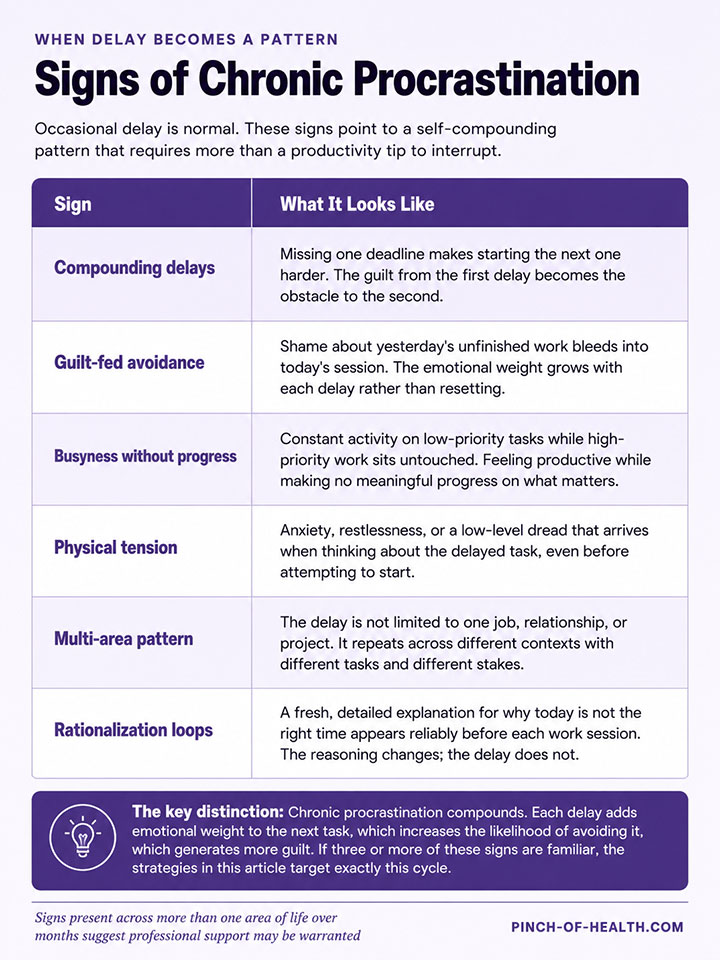
Occasional delay is normal. Chronic procrastination is a different thing. It repeats across contexts, persists despite real consequences, and tends to compound: the guilt from yesterday’s unfinished work makes today’s task carry more emotional weight, which makes avoidance more likely, which generates more guilt.
Knowing whether you’re in that cycle matters, because the strategies appropriate for a persistent pattern are more intensive than the ones helpful for ordinary delay. Below are the signs that distinguish chronic procrastination from situational avoidance.
If several of those signs are familiar, these strategies are a reasonable starting point. When procrastination is affecting employment, relationships, or health consistently despite real effort to address it, the section near the end of this article covers when professional support makes more sense than another technique.
Phase 1: Rewiring the Trigger
The strategies in this phase change how the brain responds to the moment just before a task begins. They work by reducing the emotional charge the task carries and by building automatic responses that make starting easier over time.
1. Forgive Yourself for the Time Already Lost
Most people’s first response to procrastination is self-criticism. It’s the instinctive one, and it makes things worse.
Michael Wohl, a social psychologist at Carleton University, along with Pychyl and a colleague, tracked 119 first-year students across two midterm exams. Among students who had delayed heavily before the first exam, those who forgave themselves for the delay procrastinated less before the second exam.
Students who remained caught in guilt and self-blame were more likely to repeat the pattern. The study, published in Personality and Individual Differences in 2010, suggests that shame doesn’t generate corrective energy. For people who had procrastinated little the first time, the effect wasn’t significant. The strategy matters most when the delay has already been real, and the self-criticism is running high.
The mechanism isn’t mysterious. Guilt raises cortisol, which keeps the amygdala on high alert. A brain in threat mode can’t focus well. It freezes or seeks relief, which is the definition of the avoidance the guilt was supposed to correct. Self-criticism doesn’t break the loop. It is the loop.
The practical move is a specific internal reframe. When the thought arrives that you should have started sooner, replace it with something more accurate: you delayed, that’s what happened, and you can begin now. Not an excuse. Not a performance of self-compassion. A factual acknowledgment that the past is done and the only available action point is the present moment.
2. Use If-Then Plans
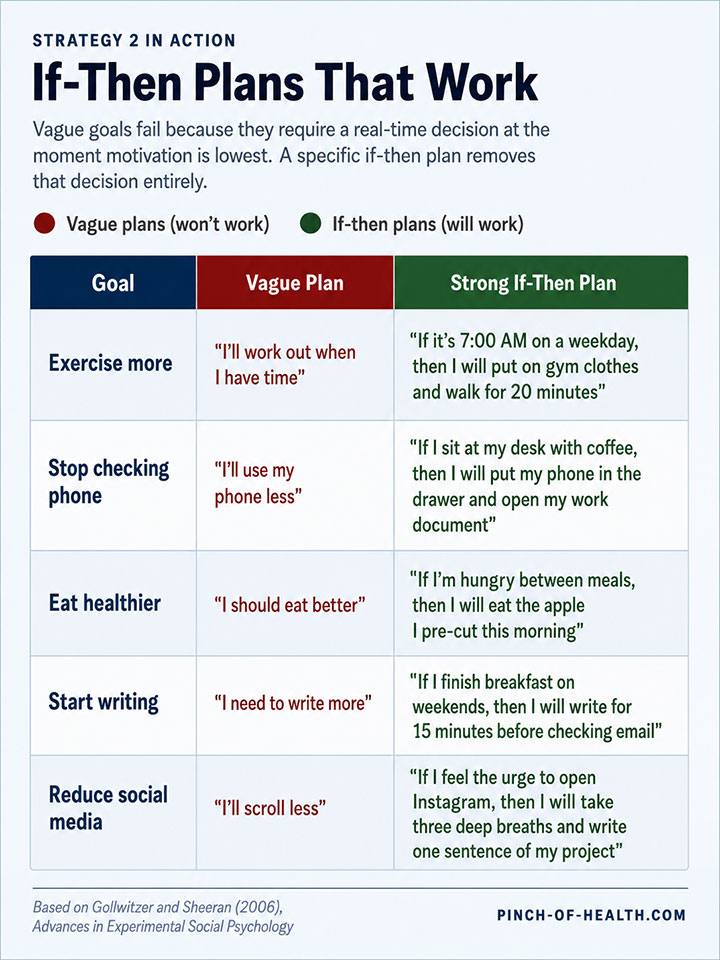
Vague intentions fail for a structural reason. Deciding to exercise more, eat better, or start writing leaves the behavior dependent on a real-time decision made in the moment when motivation is usually lowest. Every day becomes another chance to say no.
Peter Gollwitzer, a psychologist at New York University who has spent decades studying how people translate intentions into action, developed a different approach: implementation intentions, which specify exactly when and where a behavior will happen.
Gollwitzer and Paschal Sheeran at the University of Birmingham later meta-analyzed 94 independent tests of this approach across more than 8,000 participants. They found a medium-to-large effect on goal attainment compared with holding a simple goal intention alone.
The research, published in Advances in Experimental Social Psychology in 2006, traces the reason to brain architecture: once a plan is specific enough, the behavior migrates from the prefrontal cortex to the basal ganglia, the part of the brain that handles automatic habits. You stop deciding. The cue fires the action.
The format is simple: “If , then I will .” The difference between a weak plan and a strong one is specificity. “I’ll work out when I have time” leaves the decision to a moment that may never arrive. “If it’s 7:00 AM on a weekday, then I will put on gym clothes and walk for 20 minutes” makes the behavior automatic.
Writing three specific plans takes under five minutes. Putting them somewhere visible, not only in your head, is as important as writing them. A plan that exists only in memory is still a decision waiting to happen.
3. Watch the Urge Without Acting on It
You’re in the middle of something when the pull arrives. Open a different tab. Check your phone. Get some water. The urge to escape is physical, and it seems like it needs to be answered right now.
There’s a third option beyond giving in immediately and trying to white-knuckle through. Observing the urge without acting on it, a technique sometimes called urge surfing, appears to reduce the emotional reactivity that makes the urge compelling in the first place.
Researchers at the University of Wisconsin-Madison put this to a direct test, running a randomized controlled trial of an eight-week Mindfulness-Based Stress Reduction program against an active control group.
Participants who completed the training showed reduced amygdala reactivity to emotional stimuli and stronger functional connectivity between the amygdala and the prefrontal cortex, according to the study, published in NeuroImage in 2018.
With repeated practice, the alarm that discomfort triggers becomes less automatic, and the association between a hard task and an urgent need to flee it weakens.
The practice is a simple sequence: name the urge (“this is boredom” or “this is anxiety about how this will turn out”), take three slow breaths, notice the feeling without adding a judgment. Most urges peak and pass within about a minute. The goal is to observe discomfort without treating it as a signal to stop working.
This is harder than the five-minute method and easier than most people expect after a few days of practice.
Phase 2: Making Progress Feel Good
The brain delays when the reward feels too distant or the work feels too unrewarding to bother with right now. The strategies in this phase bring the reward closer, or make the boring parts of the work considerably more bearable while you’re in them.
4. Bundle a Task You Hate with Something You Love
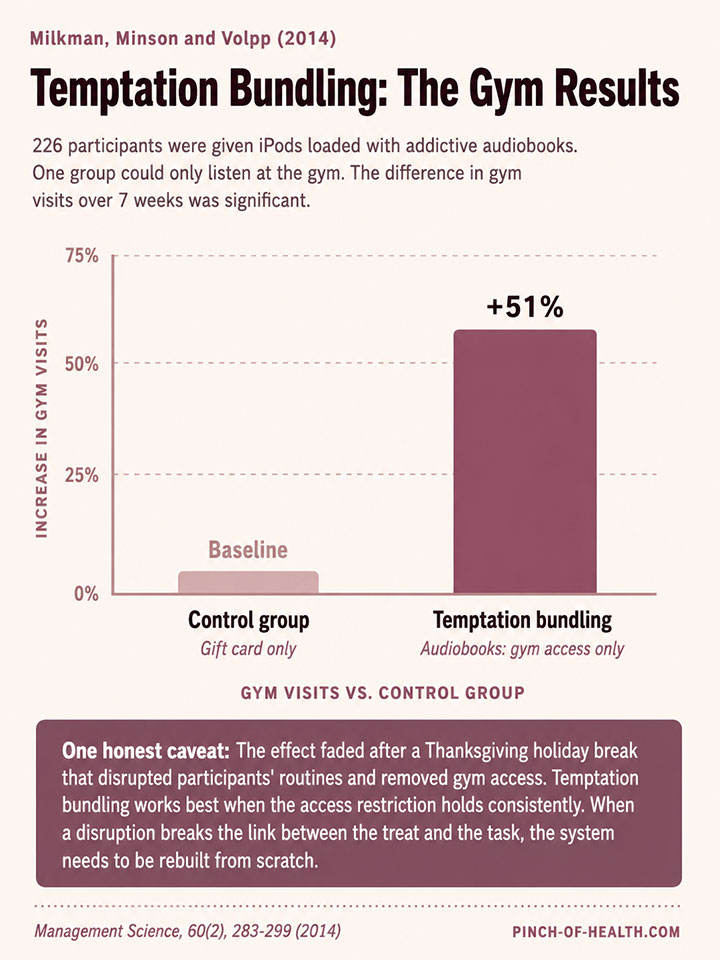
Katherine Milkman, a behavioral economist at the Wharton School of the University of Pennsylvania, recruited 226 participants for a ten-week experiment. One group received iPods loaded with addictive audiobooks, including page-turners like The Hunger Games, that they could only access at the gym. A second group got the same audiobooks without the access restriction. A control group received a gift card.
The gym-only audiobook group visited the gym 51% more often than the control group over the first seven weeks. The audiobooks didn’t increase motivation on their own. The contingent access did.
Milkman, along with Julia Minson and Kevin Volpp, published the findings in Management Science in 2014 under the term “temptation bundling.” One honest caveat: the effect faded after a Thanksgiving holiday that disrupted routines and made the gym temporarily unavailable.
The strategy works best when the access restriction holds consistently, and it needs rebuilding when a disruption breaks the link between the treat and the task.
The practical version: identify something you genuinely want to do but feel slightly guilty about spending time on. A specific podcast series, a TV show you’d watch anyway, a playlist. Then make a rule that you get that thing only while doing the task you’ve been avoiding.
The most important variable isn’t which treat you pick. It’s keeping the access restriction. Once the treat becomes freely available, the bundling stops working.
5. Start with Five Minutes
The hardest part of almost every delayed task is the moment just before it begins. Not the work itself. The starting.
Five minutes is enough to clear that moment. Commit to starting for exactly five minutes, with genuine permission to stop when the timer goes off. What often follows is a phenomenon first described by psychologist Bluma Zeigarnik in the 1920s: the brain generates low-level tension around incomplete tasks and returns to them until they’re resolved.
That tension, once triggered by starting, frequently pushes the work past the timer. Most people who begin a five-minute session continue well beyond it. But the permission to stop at five minutes is what makes starting feel safe enough to try.
This approach works best for tasks that have been sitting untouched for days. The bar for success is deliberately low: five minutes is better than zero. If you stop at the timer, you have still created a foothold that makes the next session easier to begin.
6. Make Quitting Inconvenient
Your present self wants to feel comfortable right now. Your future self is the one who has to live with today’s avoidance. Commitment devices create a cost the present self has to pay if future plans fall through, which changes the calculation on quitting.
Todd Rogers at the Harvard Kennedy School, along with Milkman and Volpp, described this mechanism in a 2014 commentary in JAMA: commitment devices work by converting a future cost into a present one.
Loss aversion (the well-established finding that the pain of losing something outweighs the pleasure of gaining the same amount) does most of the motivational work. When something real is at stake, the brain fights harder to avoid losing it.
Practical options vary by intensity. Website blockers such as Freedom or Cold Turkey remove low-effort temptation without requiring willpower. An accountability partner who expects a daily check-in adds social stakes.
Financial commitment through a platform like StickK, where a failed goal means money goes to a cause you would rather not fund, adds a sharper edge for high-priority goals. Start small. A consequence that stings, not one that devastates, is the right target for a first attempt.
For people with ADHD, social accountability tends to outperform financial penalties. The prospect of telling someone whose opinion genuinely matters that you didn’t follow through tends to be a more concrete and immediate motivator than an abstract payment.
Body doubling, working alongside another person even if they’re doing something completely different, is a related technique with a strong informal evidence base for ADHD-related procrastination.
Phase 3: Preparing Your Brain
The prefrontal cortex runs on limited resources. The strategies in this phase protect and restore those resources so the brain is in a better position to start work and sustain it.
7. Remove Everything That Isn’t the Task
In 2017, researchers at the University of Texas at Austin and UC San Diego tested a specific hypothesis: that having your smartphone nearby, even face-down and silent, reduces cognitive capacity.
The study by Adrian Ward and colleagues found that participants whose phones were in another room outperformed those with phones on the desk on tests of working memory and fluid intelligence, even when those participants reported not thinking about their phones.
A 2022 replication attempt did not find the same effect, so the specific mechanism is still under debate. What holds more consistently across behavior research is the underlying principle: every object in the environment that carries an association with a competing reward increases the cognitive cost of staying on task.
The smartphone is a particularly loaded example because of how many reward associations it carries. Out of reach is more reliable than out of sight.
The broader design principle here is the 20-second rule: make desired behaviors take less than 20 seconds to start. Make competing behaviors take more than 20 seconds. Tomorrow’s first task pre-loaded on the screen before you close down.
Gym clothes laid out the night before. Social media logged out after each use. These small friction adjustments tip decisions at the margin. Your environment makes a large number of choices before you consciously make them.
8. Move Before You Work
A 2024 scoping review of 52 studies on acute exercise and executive function found a consistent pattern: moderate-intensity aerobic exercise lasting 16 to 35 minutes improved inhibitory control and attention, with benefits measurable for approximately 30 minutes after the session ended.
The mechanisms include increased blood flow to the prefrontal cortex, release of brain-derived neurotrophic factor (a protein that supports neuron growth and new connections), and improved dopamine receptor sensitivity.
The implication is more literal than it sounds. A 30-minute walk before a difficult work session does more than improve your mood. Your prefrontal cortex gets better blood flow. Your dopamine receptors become more sensitive. The same task that felt impossible at the desk will register differently after movement, not because your attitude changed, but because your brain chemistry did.
The practical threshold is lower than most people assume. A brisk 15-minute walk produces a meaningful effect on executive function. The goal is moderate effort: heart rate elevated, breathing harder, but not depleted. Exhausting exercise can impair rather than support cognitive performance immediately afterward. Energized is the target state, not spent.
9. Protect Your Sleep
This one doesn’t tend to get the same urgency as the strategies above, and the research suggests it probably should.
June Pilcher, a psychologist at Clemson University, and colleagues reviewed the evidence on sleep and self-control in a 2015 paper in Frontiers in Human Neuroscience. Sleep-deprived individuals were more likely to give in to impulses, showed reduced ability to focus, and made poorer decisions.
The mechanism runs specifically through prefrontal cortex function: brain imaging during sleep deprivation consistently shows reduced activity in the regions responsible for impulse control and deliberate planning. When those regions are underperforming, the limbic system’s pull toward comfort and avoidance becomes much harder to override.
A night of poor sleep makes you more than tired. It makes every strategy here harder to execute. The five-minute method requires enough executive function to set the timer and start. Urge surfing requires enough attention to observe the urge rather than act on it.
If-then plans still depend on the prefrontal cortex recognizing a situation and triggering the linked response. All of those capacities degrade with sleep deprivation.
The practical floor is seven hours consistently, not only before important days. Revenge bedtime procrastination, the pattern of staying up late scrolling or watching television despite genuine tiredness, is one of the most common ways that daytime procrastination and sleep deprivation feed each other.
The guilt from unfinished work generates the urge to reclaim personal time at night. The lost sleep makes the next day’s tasks harder to start. The harder tasks generate more avoidance. Treating sleep as a condition for productive work rather than a reward earned by finishing it is the reframe that interrupts that cycle.
One practical application: use an if-then plan for your bedtime routine. “If it’s 10:30 PM, then I will put away the phone and start winding down.” The same mechanism that automates a morning exercise habit can automate a consistent sleep schedule.
Your Personalized Action Plan
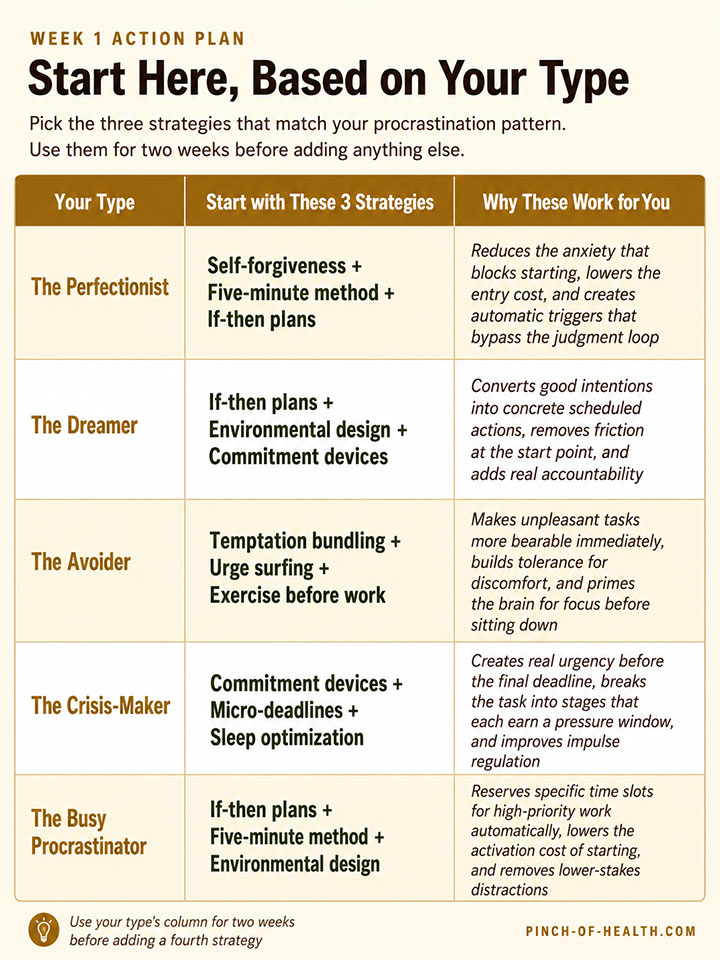
Nine strategies at once is too many. The research on behavior change is consistent on this: selecting two or three approaches and practicing them until they become automatic outperforms trying to implement everything simultaneously. The table below matches each procrastinator type to the three strategies most likely to address the specific mechanism driving that pattern.
Start with the column that matches your type. Use those three strategies for the first two weeks. After that, add one more from the list that looked relevant but didn’t make the first cut. The marker that a strategy has genuinely taken hold is that you complete the behavior without consciously deciding to. A plan that still requires daily willpower to execute has not yet made that transition.
When to Seek Help Beyond Strategies
These nine approaches work well for most patterns of procrastination in most people. They were not designed for every situation.
Wendelien van Eerde and Katrin Klingsieck conducted a meta-analysis of 24 procrastination intervention studies involving 1,173 participants. Cognitive behavioral therapy (CBT) reduced procrastination more substantially than other approaches, with effects stable at follow-up.
The meta-analysis, published in Educational Research Review, establishes a clear ceiling on what self-directed strategies can accomplish for some people.
Specific indicators to watch for:
- Procrastination has been affecting your job, relationships, or health for more than a few months.
- Anxiety or depression are contributing to the delay in ways that feel outside your control.
- The pattern persists despite six weeks of consistent strategy use.
At any of those points, professional support is the appropriate response. These strategies can produce real change. For some people and some patterns, they work within a range that therapy extends.
The Point of All of It
The standard advice to be more disciplined tends to arrive precisely when self-control is most depleted. That timing is part of why it rarely helps. What does help is changing the conditions under which the brain operates: reducing friction, building automatic triggers, protecting sleep and movement.
None of this requires extraordinary willpower. It requires making the environment do more of the work. Start with the strategies that match your pattern. Use them until they feel automatic, then add one more. The timeline is weeks, not days, but the direction is reliable.
Frequently Asked Questions
What is the root cause of procrastination?
The most consistent finding in procrastination research over the past two decades is that the root isn’t a time management problem. Sirois and Pychyl’s 2013 review frames it this way: procrastination is a form of emotion regulation failure.
When a task generates a negative emotional state, the brain prioritizes short-term mood repair over the longer-term goal. That’s what’s actually happening when you open Twitter instead of the report.
This is a meaningful reframe for anyone who has tried to fix procrastination with better calendars or stricter schedules. Those tools address the time dimension of the problem. The emotional dimension, which is what triggers the delay, requires different tools.
The neuroscience points to a specific mechanism: the amygdala, which processes emotional threats, and the prefrontal cortex, which handles planning and long-term thinking, are in constant negotiation.
Stress, fatigue, and accumulated decisions throughout the day all weaken the prefrontal cortex’s ability to override the amygdala’s preference for comfort. This is why the same task that feels manageable on a rested morning can feel impossible on a stressful afternoon.
The most common emotional triggers are anxiety about failure or judgment (the perfectionist pattern), frustration with boring or repetitive work (the avoider pattern), and overwhelm at the size of a task, which produces paralysis rather than action. Naming the specific emotion active in a moment of avoidance is the first step toward choosing the right strategy.
What are the signs of chronic procrastination?
Occasional delay is normal. Chronic procrastination is a repeating pattern that shows up across different types of tasks and generates consequences rather than mere inconvenience.
The distinguishing signs:
- Tasks sit incomplete for weeks despite the ability to complete them.
- Guilt from yesterday’s unfinished work is actively making today’s task feel heavier.
- You are routinely substituting easier tasks for the important ones and feeling busy while making no real progress.
- Physical tension or anxiety appears when you think about the delayed task.
- The pattern is showing up in more than one area of your life at the same time.
The self-compounding quality of chronic procrastination is what makes it qualitatively different from situational delay. Each delay adds emotional weight to the next task, which makes avoidance more likely, which generates more guilt. That cycle can run for months before something interrupts it. The strategies in this article are designed to interrupt it.
Is procrastination linked to ADHD?
Yes, and the connection is mechanistic rather than coincidental. ADHD affects the same executive function systems that drive procrastination in the general population, which is why people with ADHD often experience procrastination as more severe and more resistant to standard advice.
The specific overlaps: ADHD involves weaker dopamine regulation, which makes intrinsically boring tasks feel unbearable in a way neurotypical people don’t experience at the same intensity. Working memory limitations make it harder to hold a plan in mind while executing it.
Time blindness, the difficulty perceiving how much time has passed or how much remains before a deadline, reduces the urgency signal that motivates action. Together, these factors create a procrastination pattern that responds poorly to advice built around willpower and scheduling.
Several of these strategies work well for ADHD-related procrastination with minor adjustments. If-then plans reduce the working memory load of deciding what to do next. Environmental design removes dopamine-loaded distractions before you choose to engage with them.
Body doubling, working in the presence of another person even if they are doing something entirely different, creates a kind of external regulation that compensates for the internal regulation difficulty typical of ADHD.
The 2-minute rule works for ADHD, but with one important modification: set a timer so that a small clearing task doesn’t become a 45-minute hyperfocus session that replaces the main priority. Commitment devices generally work better when the stakes are social rather than financial.
An abstract financial penalty is easier to rationalize away than the prospect of telling someone whose opinion genuinely matters that you didn’t follow through.
If procrastination is significantly affecting your life and consistent strategy use isn’t producing change, and you also experience chronic inattention, impulsivity, or time blindness in other areas, an ADHD evaluation is a reasonable next step. These strategies work differently for people with ADHD, and sometimes need calibration from a clinician who understands both.
What is the 2-minute rule for procrastination?
The 2-minute rule is a decision filter for small tasks: if completing a task takes less than two minutes, do it immediately rather than adding it to a list.
The logic is about cognitive load rather than time. The mental effort of remembering a pending small task, re-opening it, and deciding to do it later often exceeds the effort of completing it. Letting small tasks accumulate creates a low-grade cognitive noise that contributes to the feeling of overwhelm that frequently triggers avoidance of larger tasks.
Completing small tasks also produces small dopamine releases, which make the brain slightly more receptive to starting the next task. A brief clearing of 2-minute items at the start of a work session can build enough momentum to make the first substantial task feel more approachable.
Two important distinctions: the 2-minute rule and the five-minute method serve different purposes. The 2-minute rule handles genuinely small tasks. The five-minute method is a starting technique for larger tasks you’ve been avoiding.
Don’t use the first one to avoid the second. For people with ADHD specifically, the 2-minute rule works best during a designated clearing window, not during a focus block. Using it during focus time lets small tasks consume the time reserved for the work that actually matters.
How can I identify my procrastination triggers?
Track for one week. The pattern usually becomes visible within four or five days.
Each time you catch yourself in avoidance, note: the task, the emotion present (boredom, anxiety, resentment, overwhelm, or something else), what you did instead, the time of day, and how much sleep you got the previous night.
After seven days, look for what repeats. Most people find that two or three emotional triggers account for the majority of their delay. Some people discover they procrastinate mainly on a specific type of task regardless of context. Others find a consistent time-of-day pattern. A smaller group finds the sleep variable predicts nearly every avoidance episode.
Once the trigger is identified, strategy selection becomes more precise. If afternoons are the consistent problem, that’s when an exercise break or environmental redesign should be scheduled, not when the most important work is placed.
If anxiety about creative output specifically triggers avoidance, that’s where self-forgiveness practice and if-then planning should be focused. Knowing the trigger doesn’t solve the problem by itself. It makes the solution considerably less random.
What are the four pillars of chronic procrastination?
Research identifies four underlying mechanisms that support persistent delay, each pointing toward a different type of intervention.
Emotion avoidance: using delay to escape uncomfortable feelings rather than addressing them. This is the root mechanism behind almost all procrastination, and it responds to urge surfing, self-forgiveness practice, and temptation bundling.
Low self-efficacy: the belief that the task exceeds your capability, which generates avoidance as self-protection. The five-minute method directly addresses this by creating small, verifiable success experiences that update the prediction. Completing five minutes successfully changes what the task seems to require.
Impulsiveness: weak impulse control that causes immediate rewards to consistently outcompete delayed ones. Environmental design and commitment devices target this pillar by changing the structure of available choices, rather than demanding more willpower in the moment.
Poor time perception: underestimating how long tasks will take, overestimating how much time remains before a deadline, and experiencing a kind of temporal foreshortening that makes distant deadlines feel unreal. If-then plans with specific times and commitment devices address this by anchoring behavior to concrete situational triggers rather than relying on deadline pressure alone.
How do I train myself to stop procrastinating?
The framing of “training willpower” is part of the problem. Willpower is a finite resource that depletes throughout the day. Strategies that reduce the demand on willpower rather than asking more of it are what produce durable results.
A practical four-week approach: In week one, write three if-then plans for your main problem area, redesign one aspect of your environment to reduce friction, and practice self-forgiveness each time you notice self-criticism about a delay.
Week two: add 15 minutes of exercise before your most important work session and start tracking how sleep affects your focus. Week three: add one temptation bundle and one commitment device with real stakes. Week four: assess which strategies have started to feel automatic and which still require conscious effort, then adjust.
The marker that a strategy has genuinely taken hold is that you complete the behavior without having consciously decided to do it. Gollwitzer and Sheeran’s meta-analysis found that once an if-then plan has been triggered consistently enough, the behavior migrates from the deliberate decision system to the automatic habit system.
That transition, where you simply find yourself having done the thing, is the goal. A plan that still requires daily willpower to execute has not yet made it there.