The Cambridge researchers gave participants 50 grams of coconut oil every day for four weeks. What they found complicates the usual warning about this fat.
For years, coconut oil occupied a comfortable place in the wellness narrative as a tropical saturated fat that supposedly played by different rules. Then in 2017, the American Heart Association issued a formal advisory against it, citing its effect on LDL cholesterol with no known offsetting benefit.
The headline from that advisory traveled far. What the data underneath it says is more complicated.
The largest randomized trial to compare coconut oil, butter, and olive oil head-to-head found that after four weeks of daily use, coconut oil produced no significant LDL difference compared to olive oil. That finding does not overturn the broader concern, but it makes the simple verdict harder to sustain.
Is coconut oil bad for cholesterol? On balance, yes. Coconut oil is between 82% and 94% saturated fat depending on the product and how it is processed, and a meta-analysis of 16 clinical trials found it raises LDL cholesterol by around 10 mg/dL compared to nontropical vegetable oils. The American Heart Association formally advises against it. A separate head-to-head randomized trial found a result most sources don’t mention. The full picture is in the section below.
Why Coconut Oil Raises LDL Cholesterol
LDL, or low-density lipoprotein, is the cholesterol fraction most associated with arterial plaque buildup and elevated cardiovascular disease risk. Dietary saturated fat is one of the primary drivers of LDL in the blood, and coconut oil is between 82% and 94% saturated fat depending on the product and processing method. For context, butter runs between 64% and 66%.
Most of the saturated fat in coconut oil is lauric acid, a medium-chain fatty acid that makes up roughly 48% of its total fat content by lab analysis. Lauric acid is sometimes argued to behave metabolically unlike the long-chain saturated fats predominant in meat and dairy. Whether that distinction is clinically meaningful for cholesterol remains the central point of disagreement in the research.
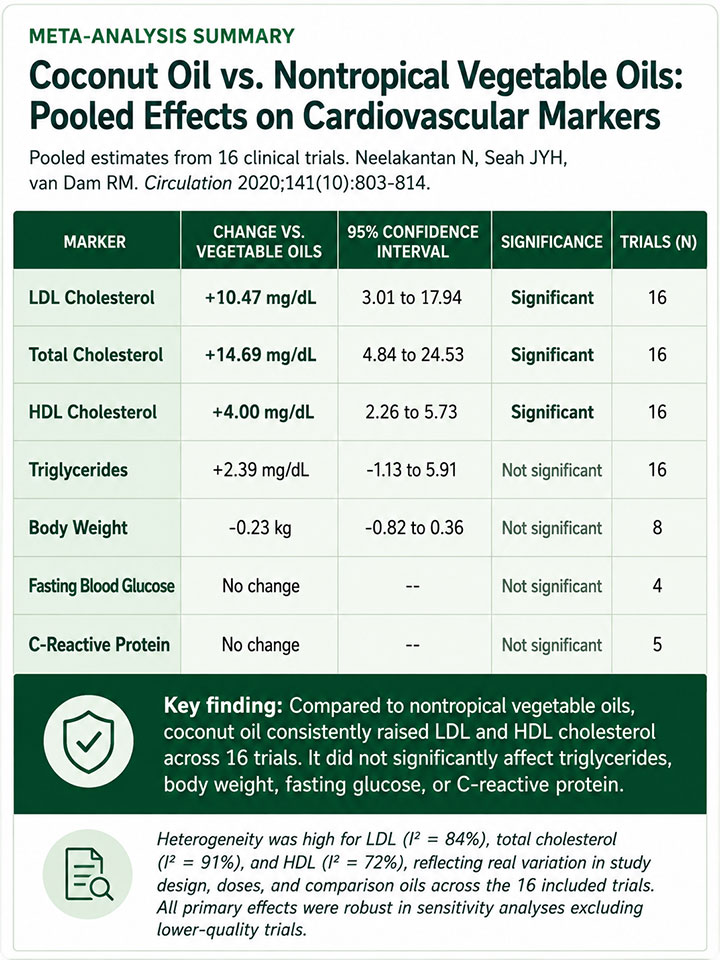
Nithya Neelakantan at the National University of Singapore set out to answer that question rigorously, pooling results from 16 clinical trials into a systematic review and meta-analysis published in Circulation in 2020. Compared to nontropical vegetable oils, coconut oil raised LDL by an average of 10.47 mg/dL (95% CI: 3.01 to 17.94). It also raised HDL, the high-density lipoprotein associated with protective cardiovascular effects, by 4.00 mg/dL. Triglycerides, fasting glucose, inflammation markers, and body weight showed no significant change.
The LDL finding held across all sensitivity analyses, including when lower-quality trials were excluded. The variability between included trials was high (I² = 84% for LDL), reflecting genuine differences in dose, duration, and the specific comparison oils used, but the direction of the effect was consistent across the dataset.
Stack coconut oil on top of an already-high saturated fat load and the numbers move further in the wrong direction.
How It Compares Directly to Butter and Olive Oil
The Neelakantan meta-analysis answered one specific question: how does coconut oil stack up against nontropical vegetable oils as a broad category? What it couldn’t do was put coconut oil, butter, and olive oil in the same controlled trial at the same time. That three-way comparison required a separate study.
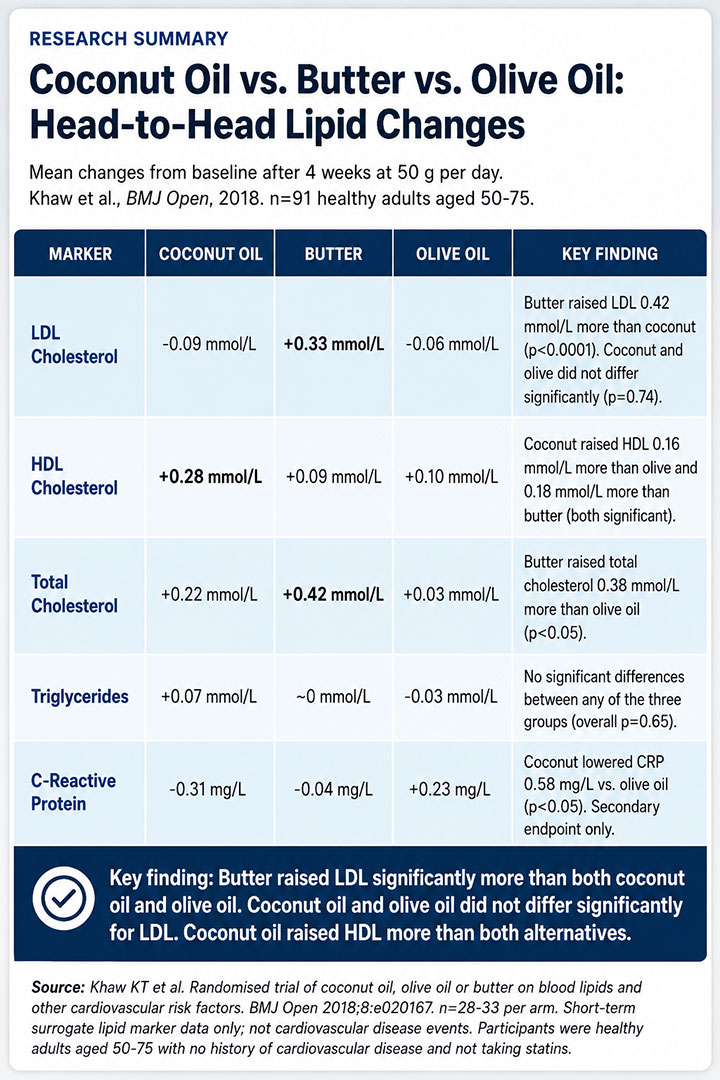
Researchers at the University of Cambridge wanted to know whether the specific fatty acid profile of coconut oil produced meaningfully different lipid changes from olive oil, its most common health-conscious swap, and butter, the most widely used saturated fat for comparison. Kay-Tee Khaw led a randomized trial published in BMJ Open in 2018 that recruited 91 healthy adults aged 50 to 75 and randomly assigned them to eat 50 grams per day of either extra virgin coconut oil, unsalted butter, or extra virgin olive oil for four weeks.
Butter raised LDL significantly more than both coconut oil (by 0.42 mmol/L) and olive oil (by 0.38 mmol/L). The coconut oil group, by contrast, showed no significant LDL change compared to the olive oil group: a difference of just -0.04 mmol/L, with a confidence interval of -0.27 to 0.19. Coconut oil also raised HDL more than both butter and olive oil in this trial. The cholesterol-to-HDL ratio, which gives a more complete cardiovascular risk picture than LDL alone, improved in the coconut oil group relative to butter, with no significant difference versus olive oil.
That result surprised even Khaw. The trial used extra virgin coconut oil rather than refined coconut oil, and the authors note that processing differences may alter the fatty acid and antioxidant profile enough to influence outcomes. That is a plausible hypothesis, not a confirmed explanation.
The limits here deserve plain language. Ninety-one participants are a small sample. Four weeks is a short window. The trial measured cholesterol as a surrogate for cardiovascular risk, not actual disease events. Because participants knew what they were eating, behavioral changes cannot be fully ruled out. None of that invalidates the finding, but it means this result needs replication in larger, longer trials before it changes guidance. The Khaw data adds important context to the coconut oil question. It is not a clearance certificate.
The HDL Argument, and Why It Does Not Close the Case
Both the Neelakantan meta-analysis and the Khaw trial found coconut oil raises HDL cholesterol. Since higher HDL is broadly associated with lower cardiovascular risk, proponents have argued that the LDL increase is partly or wholly offset by the HDL gain. It is a tidier conclusion than the evidence supports.
Frank Sacks of Harvard Medical School, who chaired the panel behind the American Heart Association’s presidential advisory on dietary fats, addressed this directly. The 2017 advisory published in Circulation concluded that while lauric acid raises HDL more than some long-chain saturated fatty acids, the accompanying LDL increase still carries real cardiovascular risk, and no clinical evidence supports the idea that the HDL gain cancels it out.
Raising HDL through dietary fat does not appear to reduce heart disease risk the same way HDL-raising interventions like aerobic exercise do. The mechanism matters. HDL’s cardioprotective function depends on how the particles behave, not just their count in the blood, and the research does not show dietary-fat-driven HDL increases conferring the same benefit. The AHA formally recommended against coconut oil on this basis, and that position has not been revised. Researchers are still working out exactly why some HDL-raising strategies are protective and others fall short.
Should You Avoid Coconut Oil If You Have High Cholesterol?
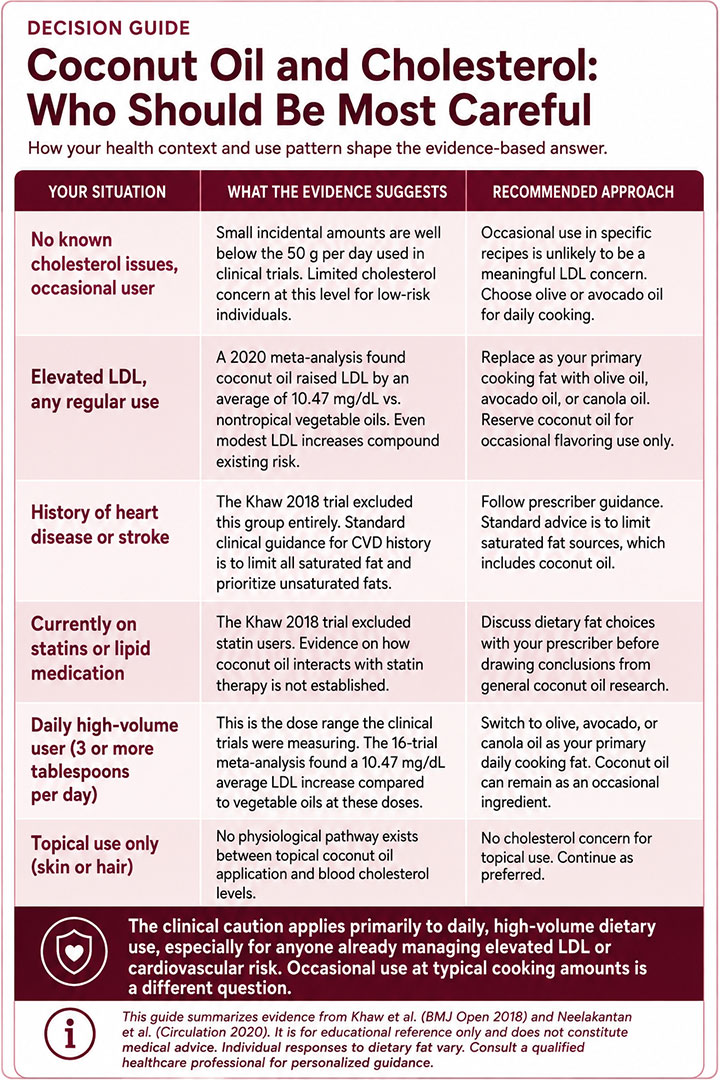
For people managing already-elevated LDL or a personal or family history of cardiovascular disease, the standard clinical position is clear: reduce saturated fat intake and replace it with unsaturated fats. Coconut oil does not serve that goal, regardless of where it falls on the butter-to-olive-oil comparison.
The Khaw trial excluded participants on statins and those with any history of heart disease. Its more reassuring head-to-head results may not generalize to higher-risk individuals. If your LDL is already elevated and coconut oil is a daily cooking fat, that is a conversation for your prescriber, not a question to resolve from a single four-week trial in healthy volunteers.
Dose matters here more than most discussions acknowledge. The 50 grams per day used in the Khaw trial works out to roughly 3.5 tablespoons, far more than most people add incidentally to a stir-fry or a batch of cookies. A small amount of coconut oil in a recipe once a week is a different cumulative exposure than daily bulletproof coffee or cooking everything in it. The concern the clinical evidence is actually measuring is daily, high-volume use, not the occasional tablespoon folded into a recipe.
Coconut Oil and Triglycerides
For people asking whether coconut oil is bad for cholesterol and triglycerides together, the triglycerides question has a cleaner answer. Neither the Neelakantan meta-analysis nor the Khaw trial found a significant effect on triglyceride levels. On that specific marker, coconut oil does not appear to be a meaningful driver.
On inflammation, the Khaw trial found coconut oil lowered C-reactive protein slightly compared to olive oil. That was a secondary endpoint in a four-week study, so it carries limited interpretive weight. Nobody has measured coconut oil’s effects on chronic inflammation rigorously enough to say anything settled yet.
Cholesterol Fat-Swap Estimator
Personalized context from the clinical evidence in 3 questions
Is MCT Oil the Same Thing for Cholesterol?
MCT oil is derived from coconut oil but refined to concentrate specific fatty acids, primarily caprylic acid (C8) and capric acid (C10). Regular coconut oil is roughly 48% lauric acid (C12), which is sometimes classified as medium-chain but behaves metabolically more like a long-chain saturated fat than C8 and C10 do. They are related products with different compositions.
The 16 clinical trials in the Neelakantan meta-analysis examined whole coconut oil, not MCT oil. Applying the coconut oil LDL data to MCT oil decisions introduces a comparison the evidence does not directly support. Research on MCT oil and blood lipids is a thinner, more inconsistent body of literature, and the cholesterol question for MCT oil specifically remains open.
Which Oil Is Better for Your Cholesterol?
If lowering LDL is the goal, unsaturated plant oils consistently perform better than coconut oil across the research. Olive oil, canola oil, and avocado oil are all higher in monounsaturated or polyunsaturated fats and lower in saturated fat. Laurence Eyres and colleagues at the University of Otago reviewed 21 research papers in a 2016 paper in Nutrition Reviews and concluded that replacing coconut oil with unsaturated fats would alter blood lipid profiles in a pattern consistent with lower cardiovascular risk. That conclusion has held across subsequent meta-analyses.
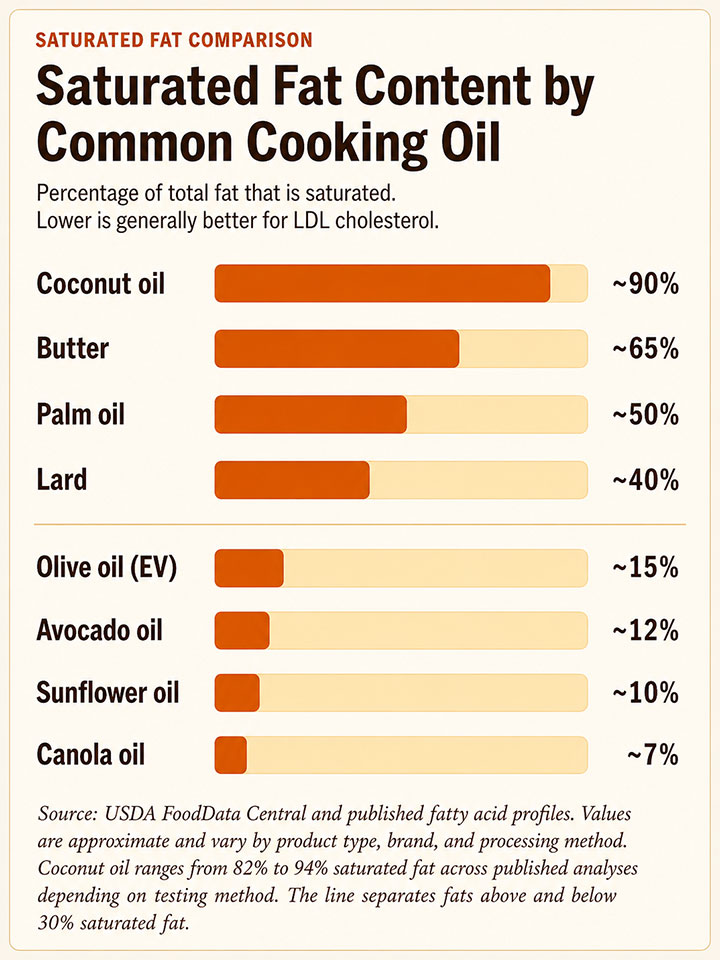
For everyday cooking, olive oil has the deepest evidence base for cholesterol management, and the Khaw direct-comparison trial did not change that picture. Coconut oil’s heat stability and distinct flavor do make it genuinely useful in specific recipes. Occasional use at typical cooking amounts is unlikely to affect LDL meaningfully in most people with no cardiovascular risk factors. Daily high-volume use, particularly for anyone already managing elevated cholesterol, is where the clinical caution becomes directly relevant.
The practical shortlist for cooking oils that support healthier cholesterol: olive oil, avocado oil, canola oil, and other liquid plant oils with a high unsaturated fat content. Coconut oil fits better as an occasional ingredient for its flavor than as a daily cooking fat.
The wellness story around coconut oil was built on something real. Its fatty acid profile is genuinely different from most other saturated fats, and the lauric acid question was worth investigating. What the investigation found is that those differences do not translate into a cardiovascular advantage. The head-to-head comparison against olive oil is a genuinely interesting data point. The ten-year picture across 16 trials is the one that shapes guidance.
The question that matters is not whether coconut oil is technically as bad as butter. It is whether the tablespoon you’re using is doing the work you think it is.