Most people assume memory loss is the first warning sign. Neurologists say that’s one of the biggest misconceptions, and the latest research may be far more reassuring than you’ve been led to believe.
We’ve all had that moment. You walk into a room and forget why you came. A familiar name sits just out of reach. You spend ten minutes hunting for your glasses, only to find them on your head.
Most of the time, these slips are harmless. They’re the brain running a little slower, not breaking down.
But for millions of people, these moments are becoming more frequent, more frustrating, and harder to explain away. At what point does everyday forgetfulness cross a line? When does a “senior moment” become something a doctor needs to know about?
That boundary has a clinical name: Mild Cognitive Impairment, or MCI. And the symptoms of mild cognitive impairment are more distinct from normal aging than most people realize.
Understanding MCI isn’t about bracing for the worst. The latest research paints a surprisingly hopeful picture. According to a major 2025 meta-analysis published in Alzheimer’s & Dementia, which reviewed data from 89 studies and over 33,000 participants, nearly half of people diagnosed with MCI remain cognitively stable over time, and a meaningful share see their scores improve over time.
The key is knowing what you’re looking at.
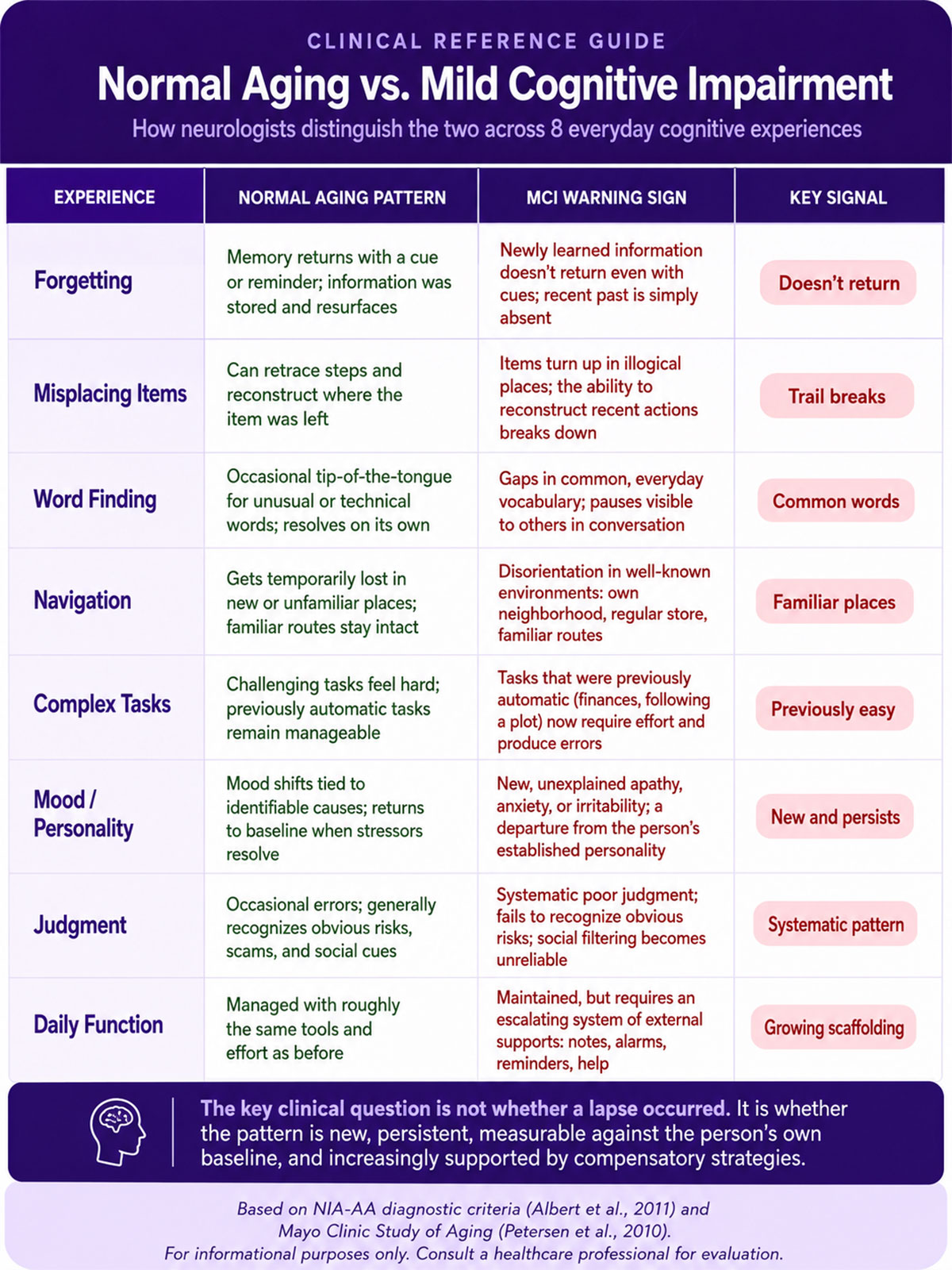
Here are the 8 differences neurologists use to tell normal aging from MCI, and why each one matters.
What Is Mild Cognitive Impairment?
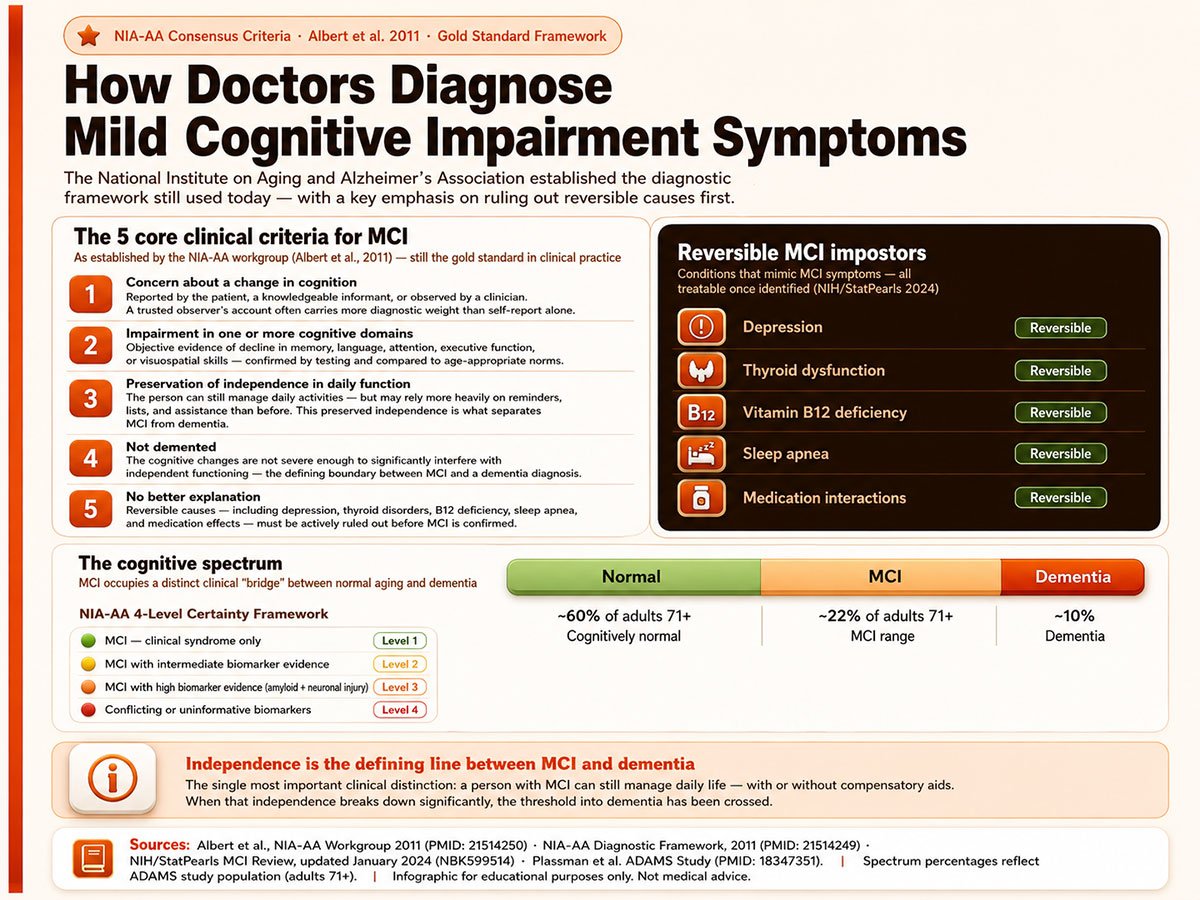
MCI sits in the space between normal aging and early dementia. It is a measurable, objective change in one or more areas of thinking, including memory, language, attention, or judgment, that goes beyond what is typical for someone’s age. Daily life remains largely independent.
The National Institute on Aging and the Alzheimer’s Association established the core diagnostic framework for MCI in 2011, creating a four-level certainty model that clinicians still use today. What the guidelines make clear is that MCI is not simply “being forgetful.” It is a pattern: detectable on cognitive testing, often reported by someone close to the person, and distinct from the gradual, predictable slowing that comes with normal aging.
Think of normal aging as a machine running at a slower speed. MCI is more like a glitch in the software. The machine still runs, but certain programs aren’t executing the way they should.
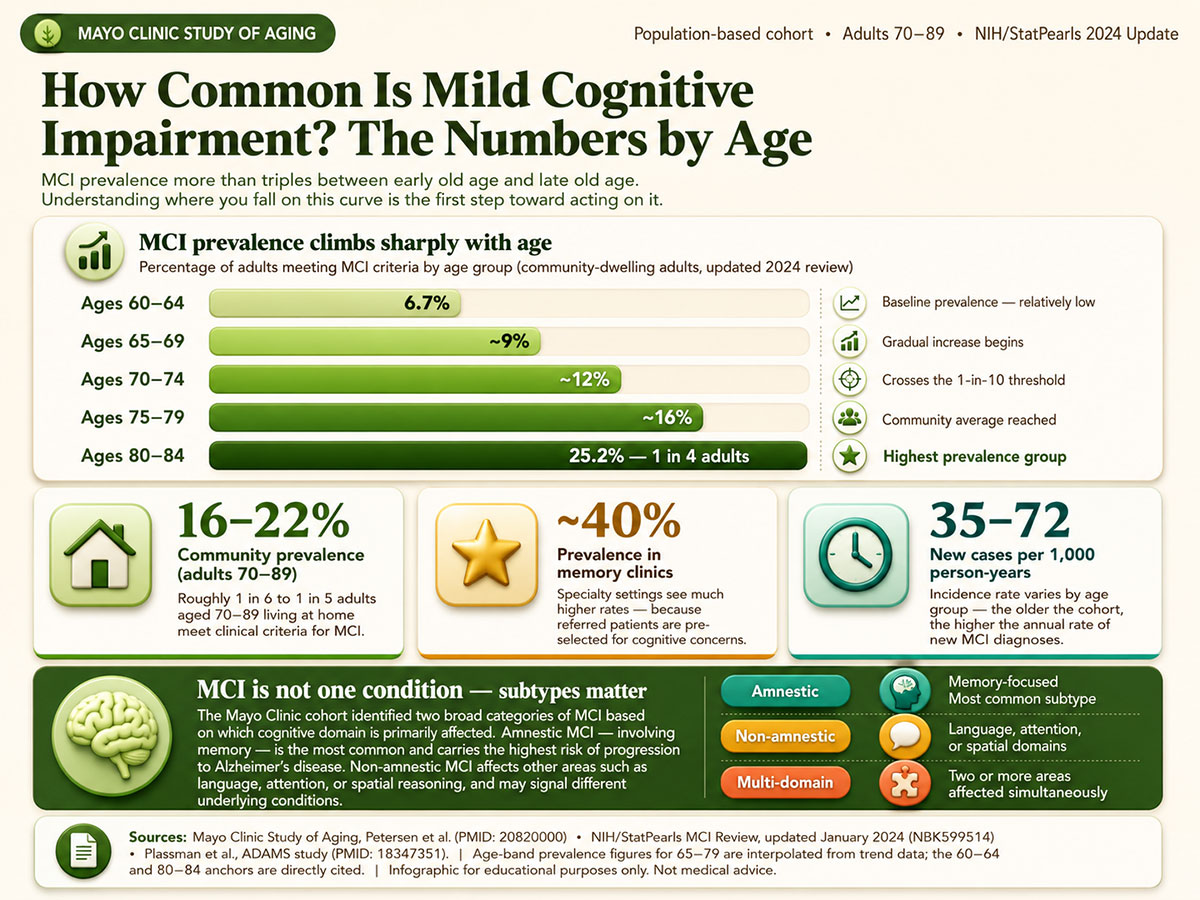
MCI affects roughly 15 to 22% of adults aged 70 to 89, according to the Mayo Clinic Study of Aging, a large, population-based cohort that tracked adults in that age range over many years. The numbers climb significantly with age: about 6.7% of adults aged 60 to 64 meet MCI criteria. By ages 80 to 84, that figure reaches 25.2%, according to an updated 2024 clinical review published through NIH/StatPearls.
1. Occasional Forget fulness vs. The Frequency Gap
Everyone forgets appointments. That is not the concern.
In normal aging, a forgotten appointment comes back to you later in the day. You see a reminder, someone mentions it, and the memory resurfaces. The information was stored. It just needed a nudge.
In MCI, newly learned information doesn’t return. You might ask about a family member’s surgery twice in the same conversation without any awareness of having asked before. The recent past isn’t fuzzy. It’s gone.
Neurologists aren’t looking at what you forget. They’re looking at how often and whether it comes back. That distinction is central to Ronald Petersen’s foundational framework for MCI diagnosis, which identified this persistence pattern as the defining boundary. Normal aging involves occasional lapses that resolve. In MCI, newly learned information simply doesn’t encode and stay.
Whether forgetfulness is a random inconvenience or a developing pattern is exactly what clinical testing is designed to answer.
2. Misplacing Keys vs. Misplacing Logic
Losing your keys is normal. Most adults do it regularly. It is usually a sign of distraction, not decline.
The difference with MCI isn’t the misplacing itself but the where and the what-next.
In normal aging, you retrace your steps. You think back to where you were, what you were doing, and the search history in your mind eventually leads you to the object. The mental “breadcrumb trail” is intact.
In MCI, that trail breaks down. Objects turn up in illogical places, car keys in the refrigerator, reading glasses in the laundry. And when they’re lost, the ability to reconstruct the sequence of events that might locate them is impaired. This is not just carelessness. It is the breakdown of a specific cognitive process: the mental reconstruction of recent actions.
This is one of the earliest and most telling signs, because it reveals a problem with both memory storage and how the brain retrieves and sequences recent events. The object isn’t the real problem. The trail back to it is.
3. Tip-of-the-Tongue vs. Lost Vocabulary
Struggling to recall a rare or technical word mid-sentence is a classic tip-of-the-tongue experience, and it is entirely normal, even in younger adults.
The MCI version looks different.
People with MCI don’t just lose obscure words. They lose access to common ones. A “watch” becomes a “hand-clock.” A “refrigerator” becomes “the cold box.” Conversations fill with pauses, sometimes long ones, while the person searches for vocabulary they’ve used thousands of times.
Researchers studying language decline in a study of ethnically diverse older adults in New York, led by Jennifer J. Manly and colleagues, found that language and memory deficits in MCI involve multiple cognitive domains, not just a single slip in retrieval. When vocabulary gaps are frequent and involve ordinary, everyday words, it suggests the brain’s internal “dictionary” is genuinely thinning rather than being temporarily unavailable.
The tip-of-the-tongue moment feels frustrating but resolves. In MCI, the word is genuinely harder to find, and the gaps are becoming visible to others in conversation.
4. Getting Turned Around vs. Geographic Disorientation
Feeling lost in a new city is expected. Even getting briefly confused in a large, unfamiliar building is well within normal range.
But becoming disoriented in familiar places is a different matter. Your own neighborhood. The grocery store you’ve shopped at for 20 years. The route from your kitchen to your bedroom.
This type of confusion signals a change in visuospatial processing: the brain’s ability to orient itself in physical space, remember routes, and recognize familiar environments. It goes beyond memory into a separate cognitive domain that affects how we perceive and move through the world.
The Mayo Clinic Study of Aging, which tracked MCI subtypes in community-dwelling older adults, found that while amnestic (memory-related) MCI is most common, non-memory domains, including spatial orientation, are frequently affected and matter significantly when assessing the full clinical picture.
Clinicians don’t ask whether you ever get turned around. Everyone does. They ask where. A new city is a navigation problem. The parking lot you’ve used every week for fifteen years is a different kind of question entirely, and neurologists trained to assess spatial MCI know the difference at a glance.
5. Feeling Overwhelmed vs. The Collapse of Complex Tasks
There are plenty of things that feel complicated: new software, a lengthy insurance form, a recipe with 12 steps. Feeling overwhelmed by complex tasks is normal at any age, particularly during stressful periods.
The MCI version involves tasks that used to be automatic.
Balancing a checkbook you’ve managed for 30 years suddenly takes much longer and results in errors. Following the plot of a movie, once effortless, now requires constant re-explanation from a family member. Paying bills on time, which used to happen without much thought, now gets missed routinely.
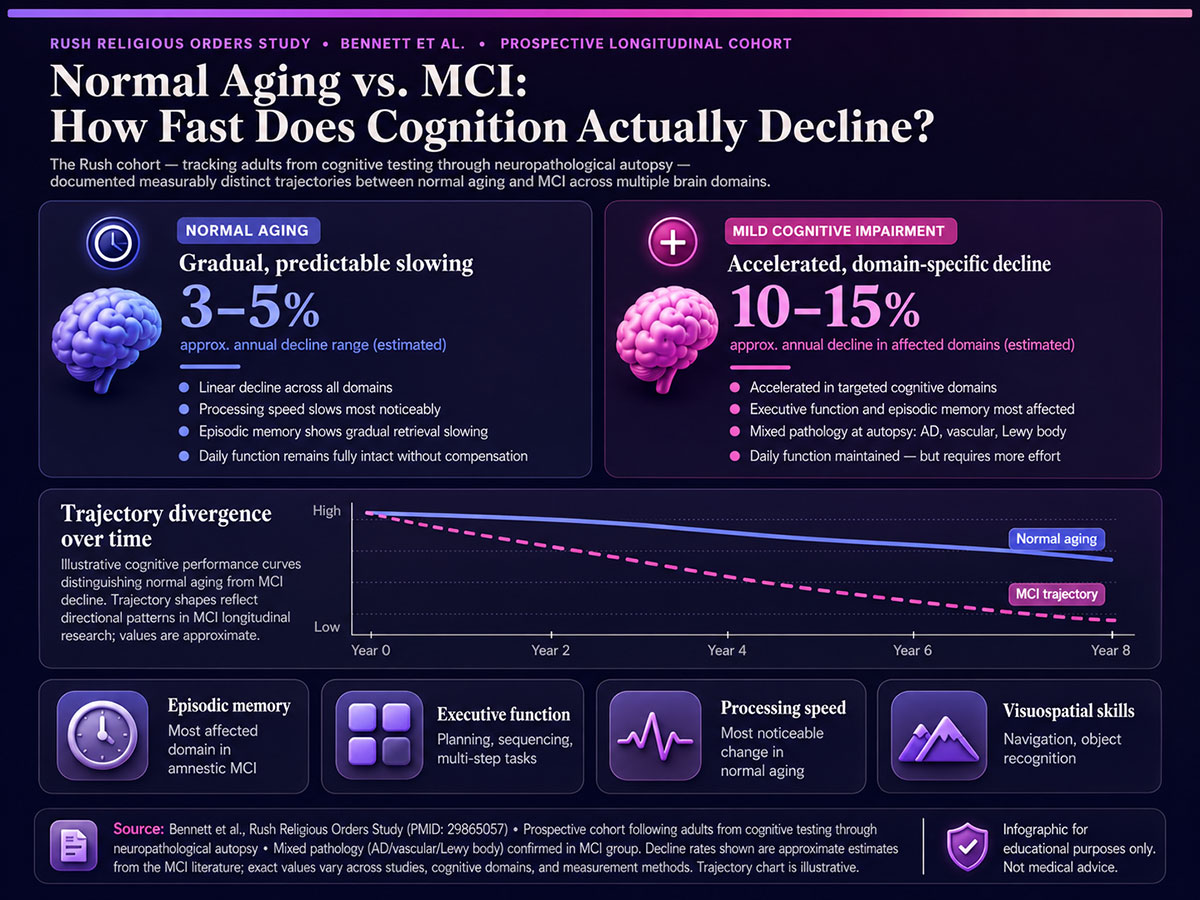
This is what neurologists call a decline in executive function: the brain’s ability to plan, sequence, and carry out multi-step goals. David Bennett and his colleagues at the Rush Alzheimer’s Disease Center, through the Rush Religious Orders Study, a prospective cohort that followed older adults from cognitive testing through autopsy, found that the trajectory of cognitive decline in normal aging is gradual and linear, while MCI shows measurably distinct, domain-specific accelerations, particularly in executive function and processing speed.
It is worth noting that the exact rate of decline varies considerably across individuals and settings. Researchers still debate whether there are reliable annual thresholds that separate typical aging from early impairment, or whether the picture is more individualized than a clean rate suggests. What the data consistently shows is the direction: normal aging produces a steady, predictable slope. MCI produces something steeper and uneven across cognitive domains.
The tell is not whether the task is complex but whether it was previously easy.
6. Mood Swings vs. The Apathy Signal
Everyone gets irritable. Life is stressful, sleep is short, and patience runs thin. A mood shift tied to a specific cause (a difficult week, a health scare, a conflict at home) is not a warning sign.
What neurologists watch for is different: a lasting, unexplained change in personality that is new for that person. The most frequently missed change in MCI is apathy, a gradual loss of interest and initiative, though anxiety, irritability, and depression also appear more often in MCI than in normal aging.
Apathy in MCI looks like a gradual withdrawal from hobbies, reduced interest in socializing, and a flatness of engagement that isn’t explained by depression or life events alone. Anxiety in social situations also tends to increase. The person who seems to have “lost interest” in things they used to love may actually be showing the earliest detectable change in the condition’s course. Memory hasn’t slipped yet. The behavioral signal has.
The timing matters more than most people realize. Apathy, anxiety, and irritability don’t just co-occur with MCI. In many cases, they show up first, sometimes by years, before the most visible memory symptoms appear. This makes them an early warning sign that tends to get overlooked because they’re attributed to aging, stress, or personality rather than cognition.
Marilyn Albert and colleagues, as part of the foundational NIA-AA workgroup recommendations, emphasized that emotional and behavioral shifts are valid early markers of cognitive change, particularly when they represent a clear departure from a person’s baseline personality.
Here the research gets more complicated: not all studies agree on exactly when behavioral changes precede memory loss versus accompany it. Some observational data suggests the gap can be several years. Others find the timing more variable. What remains consistent across the evidence is that these shifts matter, and that tracking them alongside cognitive symptoms gives clinicians a more complete picture than memory testing alone.
The clinical question is not whether someone is in a bad mood but whether the mood is new, persistent without an obvious cause, and a departure from who this person was before.
7. Social Errors vs. Poor Judgment Traps
Making a social mistake, saying something awkward, spending too much on an impulse buy, and misjudging a situation once in a while are part of being human.
In MCI, judgment shifts in more systematic ways.
People may fall for obvious financial scams that they would previously have recognized immediately. They may dress for warm weather on a cold day, showing a disconnect between environmental cues and behavioral responses. Social inhibitions may loosen in ways that feel out of character. A person who was once careful with their words may say things that are inappropriate or overly blunt in public settings.
This is sometimes called a decline in social cognition: the ability to read situations, filter responses, and apply common sense in real time. Ronald Petersen and colleagues, in a clinical review of MCI diagnostic criteria, confirmed that meaningful cognitive decline in MCI spans multiple domains, including social judgment, and is objectively measurable rather than simply a matter of personality or circumstance.
The biological link is specific: these changes often reflect shifting function in the frontal lobe, which handles filtering, inhibition, and real-time judgment. The difference isn’t in any single error. Most people have overspent, said something they regretted, or misread a situation. What shifts in MCI is the filtering itself. The frontal lobe keeps running, but its reliability as an internal editor begins to fail, and things get through that wouldn’t have before.
8. Functional Independence: The Compensation Factor
This one is subtle, and often the most missed.
In normal aging, daily function doesn’t require significantly more effort than it did before. You manage your home, your appointments, your finances, and your social life with the same general tools you’ve always used.
In MCI, daily function is preserved, but the scaffolding required to maintain it has grown. The person still lives independently, still drives, still manages their affairs. But the sticky notes have multiplied, far more than they ever needed before. The phone alarms now cover every task where they once weren’t necessary. A spouse’s reminders have become essential. Without these supports, things would fall apart.
As Brenda Plassman and colleagues found in the ADAMS study, a large, nationally representative survey of Americans 71 and older, this middle ground (between the majority who are cognitively normal and the roughly 10% who have frank dementia) accounts for approximately 22% of the older American population. The sticky notes and phone alarms aren’t failure. They’re the evidence the clinician is looking for.
The question is not whether someone can manage their day but how much effort and external support it now takes.
Normal Aging or MCI? Symptom Pattern Checker
10 questions based on the 8 clinical distinctions neurologists use. Takes about 2 minutes.
The Hopeful Side: Stability and Reversion Are Real
Most articles on MCI get one thing wrong: they treat it as a one-way door.
The data says otherwise.
The 2025 meta-analysis published in Alzheimer’s & Dementia reviewed 89 studies and more than 33,000 participants, and it is the most comprehensive synthesis of MCI outcomes to date. It found that approximately 58 to 73% of people with MCI did not progress to dementia over a mean five-year follow-up. The range reflects the setting: specialty clinics show higher conversion rates, community-based studies lower ones. Annual conversion rates to dementia run 5 to 8% in community populations and in the range of 8 to 12% in specialty clinic settings where more severe cases are typically referred. Roughly half of those diagnosed remain cognitively stable.
A meaningful proportion of people diagnosed with MCI actually revert to normal cognitive function over time: approximately 8 to 9% in clinical settings, and up to 28% in community-based studies where cases tend to be milder at baseline.
That finding took a while to sink in when researchers first started tracking it systematically. Reversion is most common when the underlying cause is treatable, rather than being an incidental fluctuation in testing.
Vitamin B12 deficiency, untreated sleep apnea, thyroid disorders, depression, and certain medication interactions can all produce cognitive symptoms that mirror MCI, and all of them are reversible once identified. This is why the distinction between “true” MCI and “MCI-mimics” matters so much.
One piece of data that tends to surprise people: MCI without progression to dementia does not appear to significantly reduce life expectancy compared to cognitively normal peers. The diagnosis is not a prognosis. What it does is identify a window where intervention, monitoring, and lifestyle adjustment make the most difference.
When the underlying cause isn’t reversible, the research on slowing progression keeps returning to the same handful of factors. Regular aerobic exercise has the most consistent evidence behind it. Social engagement comes second. Dietary patterns that reduce vascular stress, Mediterranean-style eating in particular, are attracting serious clinical interest, though the exact mechanisms are still being worked out. None of these are dramatic interventions. They’re the ones that held up across decades of data.
What to Do If You’re Concerned: A Practical Next Step Plan
Step 1: Don’t Rely on Self-Assessment
Here’s the problem with trying to assess your own cognition: early MCI often impairs the very insight needed to detect it. People with MCI frequently underestimate their deficits.
This is why a spouse’s, adult child’s, or close friend’s observations are often more accurate than self-report. If someone who knows you well is noticing changes, that matters, even if you haven’t noticed them yourself.
Step 2: Rule Out the Impostors
Before any neurological assessment, several treatable conditions should be excluded. The 2024 NIH/StatPearls clinical review specifically lists these as common causes of reversible cognitive symptoms:
- Depression: Cognitive symptoms from depression are common and respond well to treatment.
- Thyroid dysfunction: Both underactive and overactive thyroids affect memory and processing speed.
- Vitamin B12 deficiency: Especially common in older adults, and often missed without specific bloodwork.
- Sleep apnea: Chronic oxygen disruption during sleep significantly degrades memory and concentration.
- Polypharmacy: Certain combinations of medications, particularly sedatives, antihistamines, and blood pressure drugs, can impair cognition as a side effect. A pharmacist or doctor can review whether current medications are a factor. Sometimes adjusting doses or switching drugs resolves the symptoms entirely.
A primary care doctor can screen for all of these with standard bloodwork and a brief sleep assessment.
Step 3: Know What to Expect From a Neurological Evaluation
A clinical cognitive evaluation isn’t as intimidating as it sounds. It typically includes a structured conversation about symptoms and daily function, brief standardized cognitive tests (like the MoCA or Mini-Mental State Examination), and sometimes neuropsychological testing for a fuller picture.
The goal isn’t to arrive at a diagnosis of dementia. It’s to measure where cognition currently stands, so that changes can be tracked accurately and any treatable causes can be addressed early.
A question that comes up often: what about driving? MCI alone does not automatically disqualify someone from driving. Most neurologists recommend a formal driving assessment when symptoms involve spatial disorientation, attentional lapses, or slowed reaction times. An occupational therapy driving evaluation (which a primary care doctor can refer for) provides an objective, on-road assessment rather than a judgment call. The goal is honest measurement, not an automatic restriction.
Knowing the Difference Is the First Step
Normal aging slows the machine. MCI glitches the software. Both are real, both are manageable, and neither is a reason to panic.
What the research consistently shows, from the foundational NIA-AA criteria to the latest 2025 meta-analysis, is that early identification gives people the best chance to address reversible causes, adopt protective habits, and track changes with clinical accuracy.
The eight differences above aren’t meant to cause fear. They’re meant to give you a clear, objective frame of reference, because the earlier you understand what you’re looking at, the more options you have.
If something in this list resonated, talk to a doctor. Not because the news will be bad, but because the news might be very good, and knowing for certain is always better than wondering.
This article is intended for general informational purposes. It does not constitute medical advice. Always consult a qualified healthcare professional for evaluation and diagnosis.