If you have started planning your routes around staircases, you already know what knee osteoarthritis costs. For decades, the standard advice for that pain was to rest it. Movement hurts, so stop moving. The logic was tidy. The biology disagreed.
Cartilage has no blood supply of its own. It pulls nutrients from the synovial fluid surrounding the joint, and that fluid only circulates when the joint moves. Stop moving entirely, and the cartilage is deprived of what it needs. The muscles that cushion and stabilize the joint weaken. Stiffness accumulates. The next time the knee is required to move, it has less support than before.
A 2015 Cochrane review that pooled data from 44 randomized trials found that exercise reduced knee pain by 12 points on a 100-point scale and improved physical function by 10 points. That is enough to change how stairs and chairs feel. The dose required is lower than most people expect.
Why Your Knee Needs Movement, Not Rest
Knee osteoarthritis develops when the cartilage cushioning the joint wears down over time. Most adults over 50 have some degree of it. The question is not whether it exists but how it is managed. The clearest finding in the clinical literature is that managed movement outperforms rest by a wide margin.
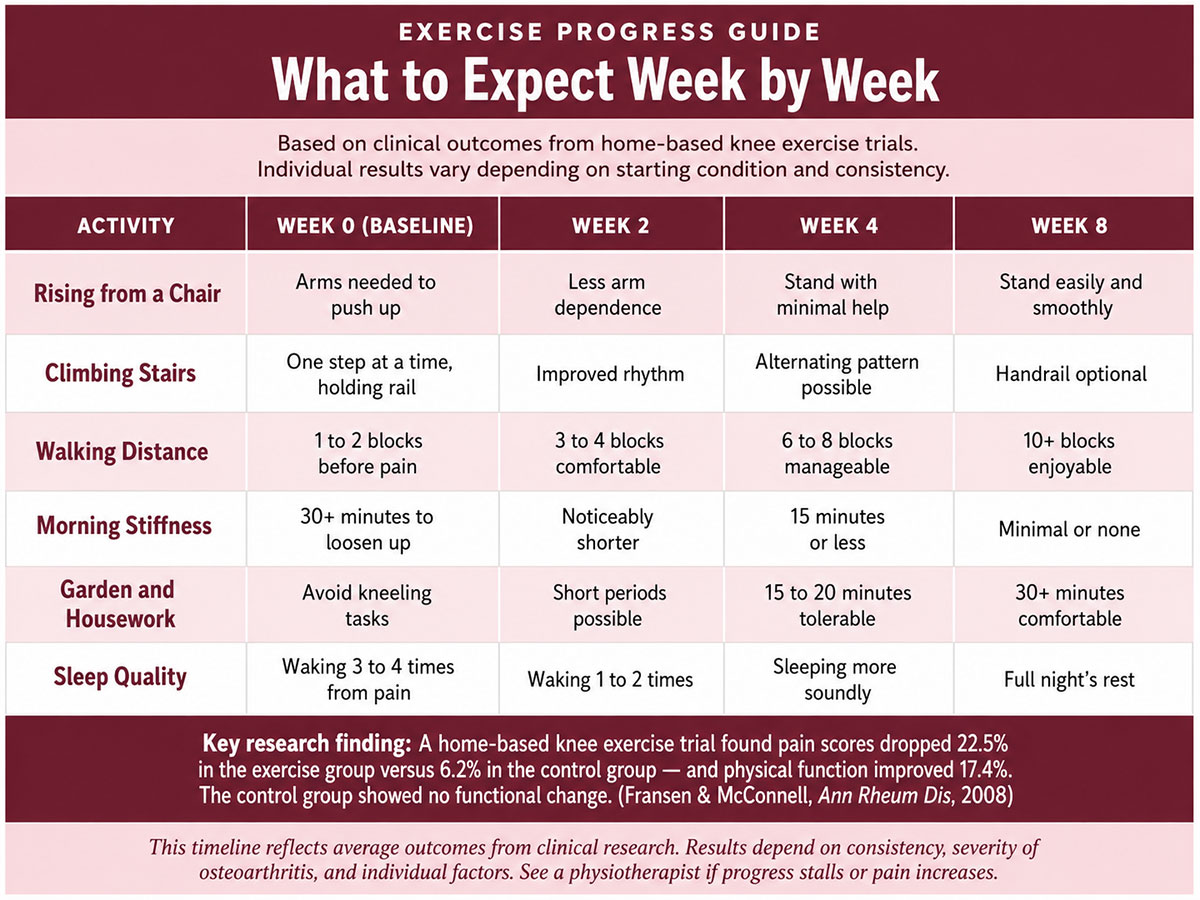
A home-based exercise trial published in the Annals of the Rheumatic Diseases tracked adults with knee osteoarthritis through a structured home routine. Pain scores dropped 22.5% in the exercise group against 6.2% in the control group. Physical function improved 17.4% in the exercise group. The control group showed no change in function.
The American College of Rheumatology and OARSI both classify exercise as a first-line treatment for knee osteoarthritis. That places it ahead of most pain medications in the clinical hierarchy and ahead of surgery for mild-to-moderate cases.
Ten minutes a day is a realistic starting point, supported by a 2021 recommendation in the Journal of Rheumatology that adults with knee osteoarthritis walk for at least 10 minutes daily to prevent inactivity-related decline.
All six exercises in this routine are low-impact. None require the knee to bear body weight in a loaded, bent position. This is the approach physiotherapists use first.
Reading Your Pain Before You Move
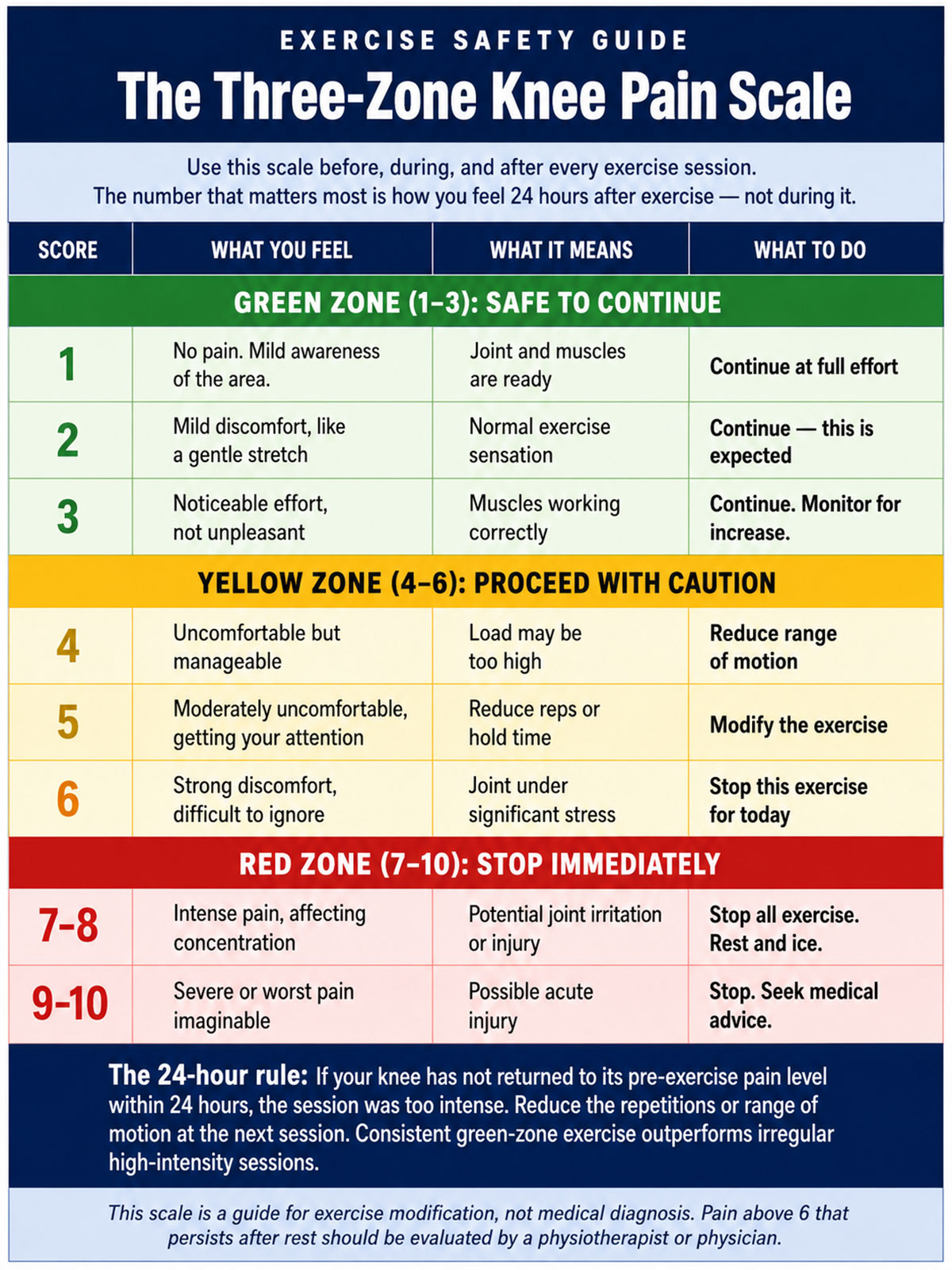
Not all pain during exercise is the same. These three zones make the distinction practical:
Green zone (1 to 3 out of 10): Mild stretch or awareness of effort. Safe to continue. Expected during these exercises.
Yellow zone (4 to 6 out of 10): Moderate discomfort that holds your attention. Reduce the range of motion or repetitions, but do not stop entirely.
Red zone (7 to 10 out of 10): Sharp, intense, or shooting pain. Stop immediately. Joint pain in this range signals the exercise needs to be modified or skipped for that day.
A rule of thumb from physiotherapy practice: if the knee has not returned to its pre-exercise baseline within 24 hours, the load was too high. Scale back the next session.
Six Exercises, Ten Minutes
This routine runs in order: warm-up first to bring the joint through its range, four targeted strengthening exercises, then a stretch to close. Do them in sequence.
1. Seated Heel Slides (Warm-Up)
Slide one heel forward along the floor, then back. Imagine polishing the tile with your heel. The movement should feel smooth and deliberate, and that smoothness is the mechanism: gentle range-of-motion work pushes synovial fluid through the joint and eases the stiffness that accumulates overnight before any load is applied.
Starting position: Sit in a sturdy chair with both feet flat on the floor, thighs resting fully on the seat.
- Keep your thigh firmly on the seat throughout.
- Slowly slide one heel forward along the floor until you feel a gentle stretch.
- Slide it back to the starting position. Keep the movement controlled in both directions.
- Ten repetitions, then switch legs.
Progression: Add a two-second hold at the end of each slide. If the floor surface is slippery, place a thin towel under the foot for control.
2. Quad Sets
Quadriceps weakness is a primary driver of knee osteoarthritis pain. A systematic review published in Osteoarthritis and Cartilage found that a 30% increase in knee extensor strength is the threshold needed for clinically meaningful reductions in pain and disability. Quad sets build toward that threshold without putting any weight through the knee at all. That is why physiotherapists use them first.
Starting position: Lie on your back with both legs straight, or sit in a chair with one leg extended in front of you.
- Tighten the muscle on the front of your thigh by pressing the back of your knee gently into the floor or seat.
- Hold the contraction for 5 seconds. The knee should not visibly rise. The effort is entirely in the sustained squeeze.
- Release fully and rest for 3 seconds.
- Ten to fifteen repetitions per leg.
Key cue: If you can see your leg moving, focus more on the contraction and less on pressing down. The invisible version of this exercise is the correct version.
3. Straight Leg Raises
This exercise addresses the moment that catches most people off guard: the transition from sitting to standing. Getting out of your favorite armchair becomes noticeably easier when the quadriceps are strong. They are the primary mechanism behind that movement. Straight leg raises build them while keeping the knee completely straight. The joint stays at zero degrees throughout, with no bending and no compression load, which is why OARSI clinical guidelines list this movement as a first-line exercise for knee osteoarthritis.
Starting position: Lie on your back. Bend one knee with the foot flat on the floor. Keep the other leg straight.
- Tighten the thigh of the straight leg until you feel the quadriceps engage.
- Lift the leg to the height of the opposite knee, approximately 12 inches off the floor.
- Hold for 3 seconds.
- Lower slowly back to the floor. Ten repetitions, then switch legs.
Progression: Add a 1 to 2 pound ankle weight once 10 repetitions at 3-second holds feel easy. If the knee bends during the lift, the added weight is too heavy.
4. Glute Squeezes
The connection between gluteal muscle weakness and knee pain is one of the more underestimated relationships in musculoskeletal medicine. A 2020 systematic review in the British Journal of Sports Medicine found that adding hip strengthening to quadriceps exercises produced greater improvements in knee pain and walking function than quadriceps work alone. The mechanism: glute muscles control knee alignment during walking and standing. When they are weak, the knee collapses inward under load.
Starting position: Lie on your back with both knees bent, feet flat on the floor, arms at your sides.
- Squeeze your glute muscles firmly together.
- Hold the contraction for 5 seconds.
- Release completely. Rest for 2 seconds.
- Ten repetitions.
Progression: Move to single-leg glute bridges (lift your hips off the floor while one leg remains bent and the other extends straight) once double-leg squeezes feel controlled at 10 repetitions with full 5-second holds.
5. Standing Hamstring Curls
Balance in older adults depends on the ability to make rapid, small adjustments to leg position. The hamstrings are central to that capacity. This exercise also addresses a muscular imbalance that rehabilitation research has consistently documented in knee osteoarthritis: most patients have quadriceps that outpace their hamstrings in strength, which affects how load is distributed across the joint during each step.
Starting position: Stand behind a sturdy chair, holding the back with both hands. Keep the supporting leg slightly bent throughout.
- Keep your knees close together.
- Slowly bend one knee, bringing the heel toward your glutes.
- Hold for 2 seconds at the top.
- Lower slowly. Ten repetitions, then switch legs.
Key cue: Move as if your leg is traveling through thick honey. Speed removes the benefit here. Controlled deceleration on the way down is where the stabilizing strength is built.
6. Seated Hamstring Stretch (Cool-Down)
Tight hamstrings pull on the back of the knee and contribute to the chronic tension that accumulates during periods of sitting or inactivity. A 2025 network meta-analysis in the BMJ found that flexibility exercise produced the largest long-term pain reductions of any single modality analyzed. The same review flagged wide variation in individual outcomes, which is why clinical guidelines still recommend adjusting exercise selection to the individual rather than prescribing one approach for all. Two minutes of this stretch closes the routine.
Starting position: Sit on the edge of a sturdy chair.
- Extend one leg straight in front of you, heel resting on the floor.
- Keep your back straight and hinge forward from the hips, not the waist.
- Hold for 30 seconds when you feel the stretch along the back of the thigh.
- Return to upright and switch legs.
Form note: No bouncing. Gentle, steady pressure is more effective for tight tissues than aggressive stretching, and considerably safer for a joint that is already sensitive to stress.
Exercises to Approach with Caution
These movements place high loads on a knee that is already irritated and are best avoided until strength and pain levels improve:
- Deep squats place aggressive compressive force on the joint below 90 degrees of knee bend and should be avoided until strength improves.
- Running or jumping on hard surfaces adds repetitive high-impact loading that irritates an already sensitive joint.
- Heavy leg press at full knee flexion creates excessive joint force in the most vulnerable range of motion.
- Any movement that produces yellow or red zone pain (4 or higher on the pain scale) should be stopped or modified regardless of the source.
The Single Biggest Mistake People Make
Prolonged rest. It is the most common response to knee pain and the one most likely to compound it over time. Inactivity weakens the quadriceps and gluteal muscles that protect the joint, reduces synovial fluid circulation, and allows stiffness to become structural rather than temporary.
That finding took a while to sink into clinical practice. The Cochrane review cited in the introduction found that exercise outperformed rest across every measured outcome: pain, physical function, and quality of life. Effects were durable for up to six months after programs ended. Rest has no comparable evidence base for knee osteoarthritis management.
The one exception is an acute flare-up: sudden swelling, warmth, and a sharp increase in pain signal the need to reduce load temporarily. On those days, the heel slides and hamstring stretch are preferable to complete rest. On all other days, the direction of the evidence is clear.
Can Knee Pain Go Away with Exercise?
For most people with mild-to-moderate knee osteoarthritis, consistent exercise significantly reduces pain. It does not reverse structural cartilage damage that has already occurred, but it changes the mechanical and biological conditions around the joint enough to reduce pain signals meaningfully. The home-based exercise trial cited above found that participants maintained lower pain scores six months after the program ended, with pain relief that outlasted the program itself.
Pain returning to zero is less common than in acute injuries. Pain dropping to a level that no longer limits daily activity is a realistic outcome for most people who maintain a routine for 8 to 12 weeks.
Supporting Your Knees Beyond the Routine
Exercise carries the most weight of any conservative intervention for knee pain. Two other factors have solid evidence behind them.
The first is body weight. Stephen Messier at Wake Forest University led a large gait analysis study, published in Arthritis and Rheumatism in 2005, that found that removing each pound of body weight reduces knee joint load by approximately four pounds per step during walking. For someone carrying 10 extra pounds, that is roughly 40 pounds of excess pressure on the joint with every step, multiplied across thousands of steps per day. Small weight changes produce large cumulative effects.
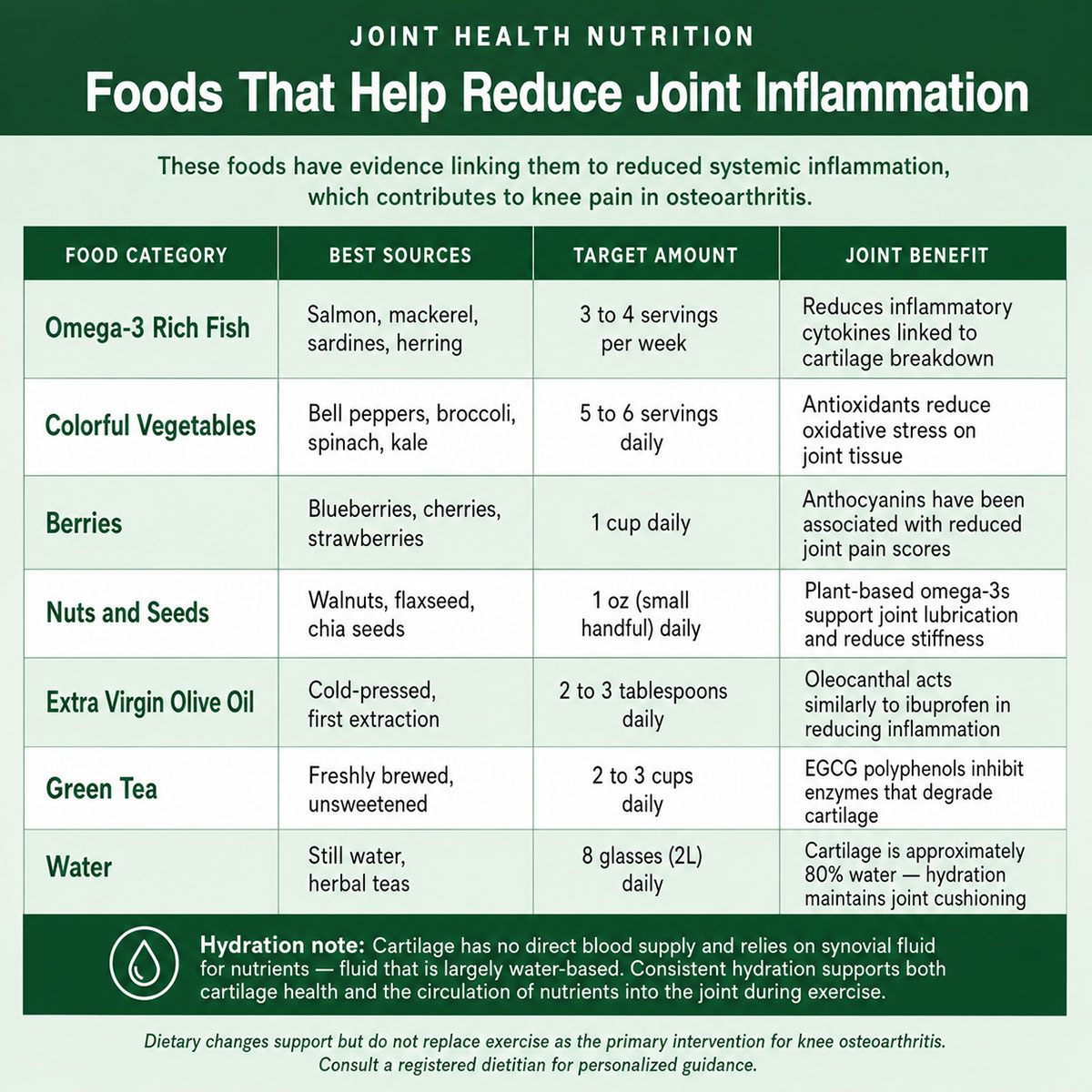
The second is diet. Certain foods reduce the systemic inflammation that contributes to joint pain. The table below covers the foods with the strongest evidence and practical serving guidance.
When to See a Doctor First
These exercises are appropriate for most adults with chronic knee pain or mild-to-moderate osteoarthritis. Some situations warrant medical clearance before starting:
- Sudden swelling with warmth in the joint may indicate acute inflammation or infection and requires medical assessment before any exercise.
- Inability to bear weight on the affected leg warrants medical assessment before any exercise.
- Recent knee replacement surgery requires following your surgeon’s specified timeline before resuming exercise.
- Unexplained numbness or tingling in the leg or foot may indicate a nerve or vascular issue requiring evaluation.
- Knee pain that worsens consistently over 6 to 8 weeks despite regular exercise warrants reassessment with a physiotherapist or physician.
For the majority of people with knee pain that has been present for weeks or months and fluctuates with activity levels, this routine is a safe starting point. If you are managing a more complex condition or have been told you have bone-on-bone arthritis, a physiotherapist can modify these exercises for your specific situation.
🦴 Knee Pain Assessment Tool
Complete this assessment to receive personalized exercise recommendations
🎯 Your Personalized Exercise Plan
Frequently Asked Questions
What is the best exercise for painful knees?
The evidence consistently points to a combination of quadriceps strengthening (quad sets, straight leg raises) and hip strengthening (glute work). A systematic review found that combining hip and quad exercises produced better outcomes in pain and walking function than quadriceps strengthening alone. Low-impact aerobic activity (walking, swimming, cycling) adds benefit on top of targeted strengthening once the routine is established.
What is the #1 mistake that makes bad knees worse?
Rest. That answer took decades to shift clinical practice, and it still surprises most people. Inactivity weakens the muscles that protect the joint, reduces the synovial fluid that nourishes cartilage, and allows stiffness to progress from temporary to structural. There is no evidence that rest helps chronic knee osteoarthritis. There is substantial evidence that it makes it worse.
How soon will I notice results?
Most people notice reduced morning stiffness and slightly easier chair-rising within the first two weeks. Functional improvements (better stair tolerance, longer comfortable walking distances) typically follow in weeks three and four. The largest pain reductions in clinical trials appear at the 8 to 12 week mark. Benefits are greatest in people who continue beyond three months rather than treating the program as a short-term fix.
Can I do these exercises every day?
Yes, provided you stay in the green zone throughout. On days when the knee is actively inflamed or tender, reduce to the heel slides and hamstring stretch only. On good days, complete the full routine. Consistency at lower intensity outperforms sporadic high-effort sessions for this condition. Three to six sessions per week reflects the exercise protocols used across the clinical trials showing the clearest benefit. Daily exercise is appropriate for most people, provided the knee returns to its pre-exercise baseline within 24 hours.
Can I combine these exercises with other treatments?
Yes. This routine works well alongside physiotherapy, aquatic exercise, and yoga. Recent evidence supports tai chi as a useful complement for knee osteoarthritis. KT taping can provide additional joint support during activity. Anti-inflammatory nutrition reduces the systemic inflammation that contributes to joint pain. Combining approaches tends to outperform any single intervention in the research.
When should I progress to harder exercises?
When the full routine can be completed comfortably at a 1 to 2 on the pain scale, and daily activities have improved noticeably, these exercises are no longer providing sufficient challenge. Four to six weeks of consistent completion is the minimum before progressing. Adding ankle weights or resistance bands to the strengthening exercises, or moving to more advanced knee strengthening progressions, makes sense at that point.
The research finding on knee osteoarthritis and exercise is consistent across four decades of trials: movement reduces pain, and rest makes it worse. The difficulty has never been the evidence. The obstacle has been making the commitment small enough to keep.
Ten minutes is a deliberately low bar. Most exercise programs for knee pain fail not because the exercises are wrong, but because the dose is unrealistic. This one is not.