Build real muscle after 50 with just your body weight. Five science-backed bodyweight exercises for muscle building. No gym, no equipment, joint-friendly
The assumption is almost universal: building muscle requires weights. The heavier, the better. Walk into any gym, and you’ll see it confirmed, older adults on the cable machines, younger ones at the squat rack, and a persistent cultural idea that serious strength requires serious iron.
The assumption is wrong. Or at least, much less right than most people believe.
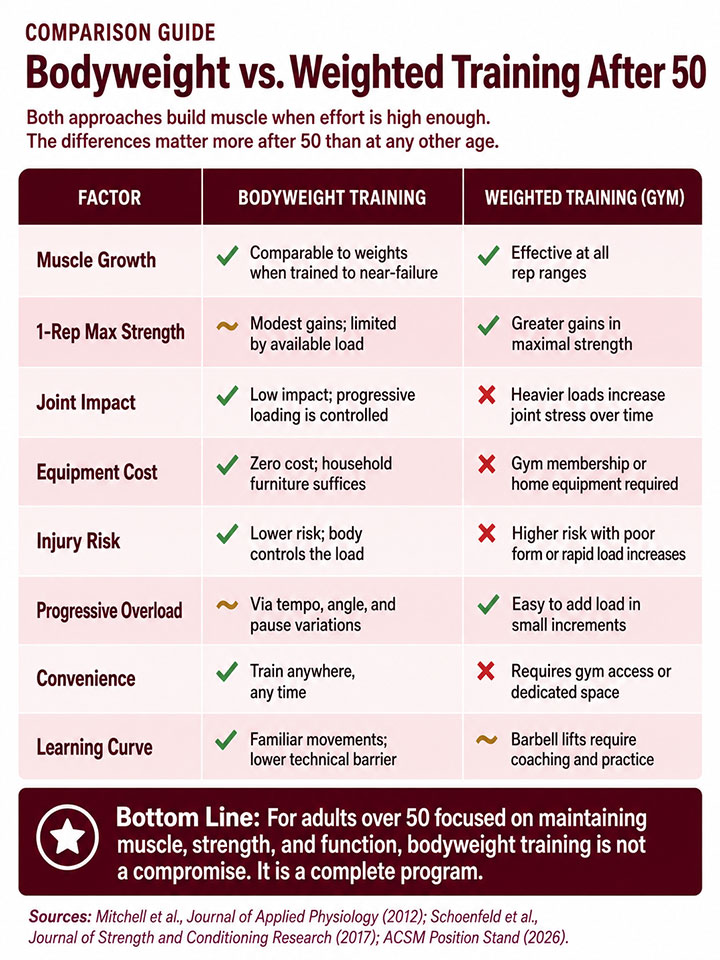
Research published in the Journal of Applied Physiology compared men training with loads at just 30% of their maximum against men lifting at a heavy 80%, with both groups pushing to failure. The finding was close enough to rattle anyone who has spent years equating load with results: comparable muscle growth, across the board. What the weight didn’t determine, the effort did.
That finding matters more after 50 than at any other age. It means you can build real muscle at home. It means your joints don’t have to pay the price of heavy barbell work to keep your body strong. And it means the five exercises below are not a compromise, but a genuine program.
Why Your Muscles Don’t Care Where the Resistance Comes From
What muscle fibers actually respond to is sustained tension and proximity to failure. When a set becomes hard enough that completing another rep feels genuinely uncertain, the fibers recruited to manage that load break down. Recovery rebuilds them thicker and stronger. That biological sequence operates identically whether the resistance comes from a loaded barbell or your own body weight.
Researchers wanted to know whether this principle held across a spectrum of loads. A 2017 systematic review and meta-analysis in the Journal of Strength and Conditioning Research analyzed 21 trials comparing low-load and high-load resistance training.
The conclusion: muscle growth was comparable across the load spectrum when all sets were trained to failure. Worth noting, though, is that heavy loads did produce greater strength gains in terms of one-rep maximum performance. For an adult over 50 whose goal is maintaining muscle and function rather than maximal lifting numbers, the practical implication holds: effort matters more than load.
The 2026 position stand from the American College of Sports Medicine, the most comprehensive synthesis of resistance training evidence ever published (137 systematic reviews, more than 30,000 participants), stated plainly that bodyweight exercises and home-based routines produce measurable benefits in strength, muscle mass, and physical function. Traditional gym equipment is not a prerequisite.
This is usually the point where people push back. Bodyweight training, the objection goes, is what you do when you can’t access real equipment, it’s a compromise, not a program. That reaction is understandable.
It’s also what the evidence directly contradicts. The mechanism of muscle growth doesn’t change based on whether the resistance comes from iron or your own mass. What changes is whether you push the set hard enough to trigger it.
For adults over 50, that reframing matters more than it does for anyone else. The question is no longer whether you have access to a weight room. It’s whether you’re pushing hard enough in the room you already have.
Age and Muscle Loss: What You’re Actually Up Against
Sarcopenia is the clinical term for age-related muscle loss. After 30, adults lose roughly 3-5% of their muscle mass per decade. After 60, that decline tends to accelerate. The practical effects show up quietly: the moment you realize you’ve started gripping the stair rail without deciding to, or that getting up from the floor has become a two-stage operation.
The encouraging finding comes from a 2011 meta-analysis by Mark Peterson and colleagues at the University of Michigan, published in Medicine and Science in Sports and Exercise. Across 49 trials in adults over 50, resistance training produced an average gain of approximately 2.4 pounds of lean body mass.
That sounds modest. But that extra muscle raises resting metabolic rate, reduces fall risk, and supports joints that have been carrying a body for half a century. It’s the kind of change that doesn’t announce itself until you notice that stairs feel different.
The 2019 position statement from the National Strength and Conditioning Association reinforced the same conclusion: resistance training works across the full age range, and older adults retain the physiological capacity to build muscle when training intensity is appropriate.
The evidence base for this is not fragile. It has been replicated across decades of research in populations well into their 80s and 90s.
The Slow-Motion Advantage: Why Controlled Tempo Builds More Muscle
Speed is not your friend when building muscle after 50. Controlled, deliberate movement is.
Time under tension describes how long a muscle works under load during a given set. A slow, three-second lowering phase keeps the muscle engaged far longer than dropping quickly through the same movement.
That sustained engagement increases metabolic stress in the tissue. The burn you feel in those last few seconds of a slow descent is not discomfort to push through. It is the precise signal that triggers growth.
Researchers at the University of Tokyo studied this directly. A 2006 study by Tanimoto and Ishii in the Journal of Applied Physiology compared low-intensity training with slow, controlled movement against high-intensity training at normal speed.
Young men in the slow-tempo group built muscle comparable to those lifting at 80% of their maximum. Here is what actually happens in those long seconds on the way down: the muscle cannot offload the tension. It has to hold it.
That sustained load, not the weight or the speed, is what signals growth. And because the stress is muscular rather than mechanical, the joints don’t pay the price.
For joints that have logged 50 or more years, this is the exercise principle that changes everything. Apply it to every movement below.
The 5 Bodyweight Exercises for Muscle Building
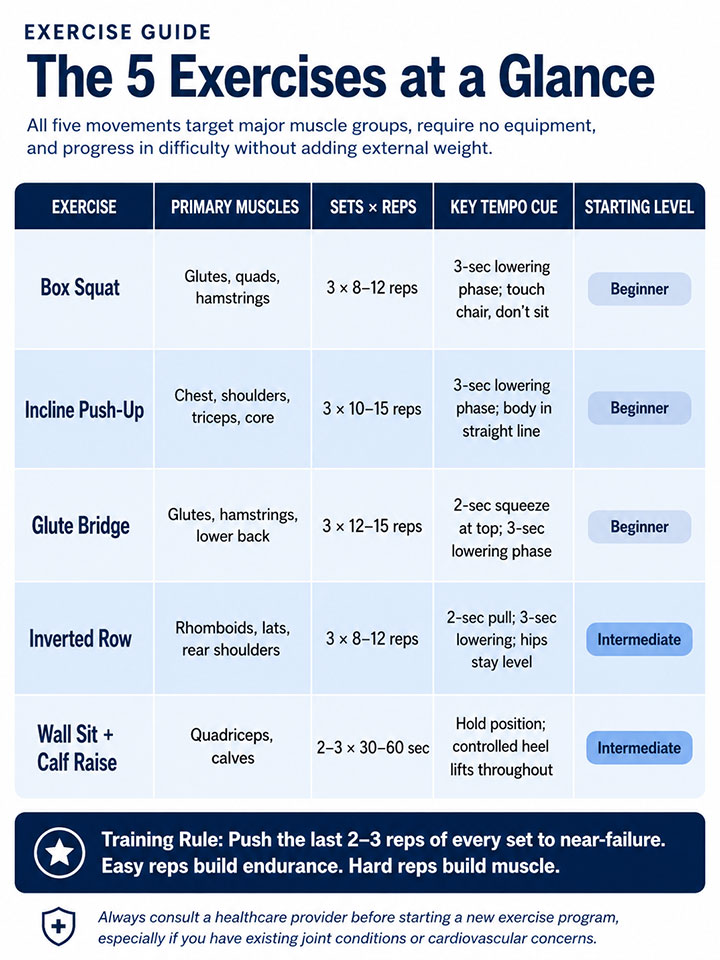
These five movements cover the major muscle groups, require no equipment, and can be made progressively harder without adding a single pound of external weight. Each one is joint-friendly by design.
1. Box Squat
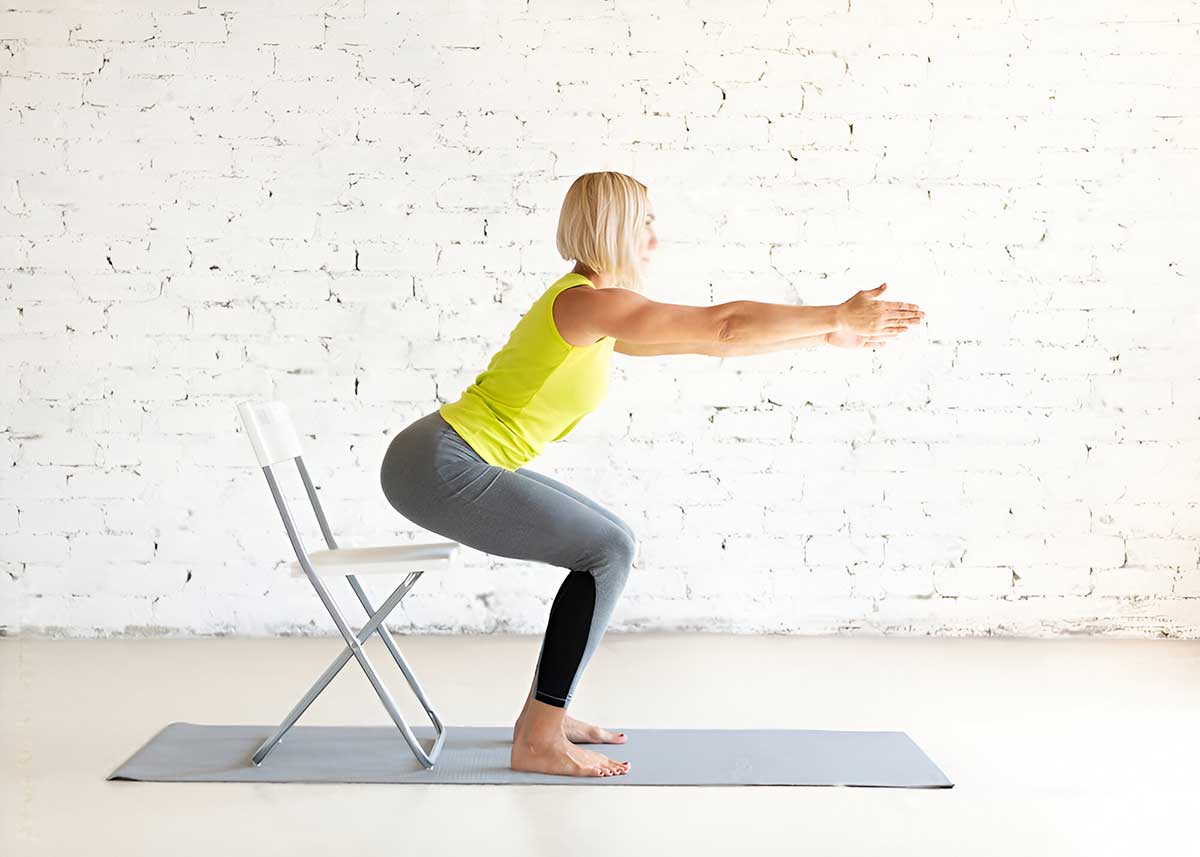
Most people who avoid squats after 50 aren’t avoiding the movement. They’re avoiding the uncertainty about how deep is too deep, and whether their knees will pay for it the next morning. The box removes that uncertainty by putting a physical stop in the way. You lower until you touch it, and no further. No guesswork, no second-guessing, no depth anxiety.
It also trains the right muscles. The glutes, quads, and hamstrings are the largest in the body, and working them produces a hormonal and metabolic response that smaller isolation exercises can’t match.
How to do it:
- Stand with feet shoulder-width apart, a sturdy chair directly behind you.
- Send your hips back and lower slowly, counting 3 seconds on the way down.
- Touch the chair lightly, pause for one second, then drive through your heels to stand.
- Squeeze your glutes at the top before beginning the next rep.
For beginners: Start with a standard kitchen chair. As you get stronger, move to a lower surface. Eventually, pause just above the chair without sitting. Add a 5-second descent when 12 reps feel easy.
Target: 3 sets of 8-12 reps, 90 seconds rest between sets.
2. Incline Push-Up
Floor push-ups aggravate many people’s wrists and shoulders, particularly those with older joints. Inclining the movement against a countertop or sturdy table reduces the load while increasing the range of reps available, and higher volume is one of the primary drivers of muscle growth in this population.
The incline push-up also engages the core throughout. You’re building upper body muscle (chest, shoulders, triceps) and, at the same time, the postural stability that supports every other movement you do.
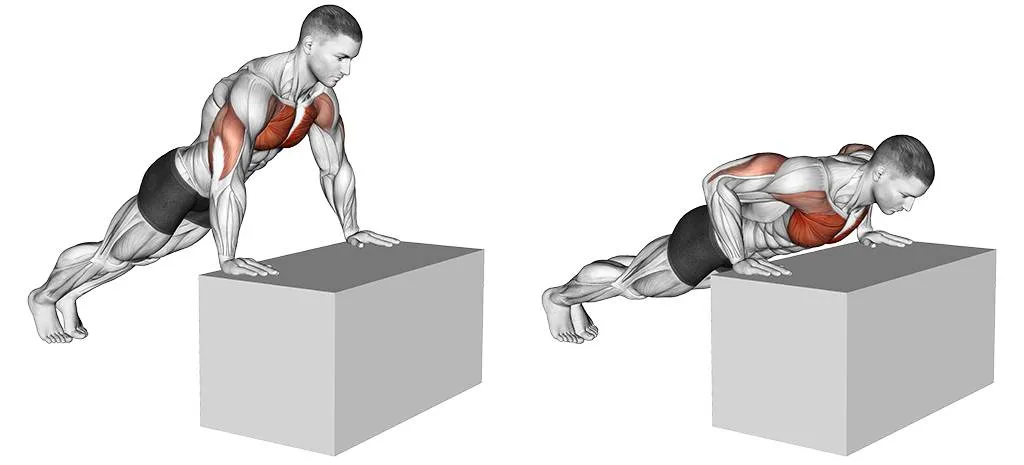
How to do it:
- Place your hands on a sturdy table or countertop, slightly wider than shoulder-width.
- Step your feet back until your body forms a straight line from head to heels.
- Brace your core, then lower your chest toward the surface over 3 seconds.
- Push back to the starting position.
For beginners: Start with wall push-ups. When those become easy, move to a higher countertop, then to a sturdy chair, progressively lowering the incline as your strength increases. A 5-second lowering phase adds significant challenge without changing the position.
Target: 3 sets of 10-15 reps, 90 seconds rest between sets.
3. Glute Bridge
Decades of sitting weaken the posterior chain, specifically the glutes and hamstrings that power walking, stair climbing, and standing up from a seated position. Glute bridges target these muscles without loading the spine. You’re lying on your back. Gravity is working with you rather than compressing your vertebrae.
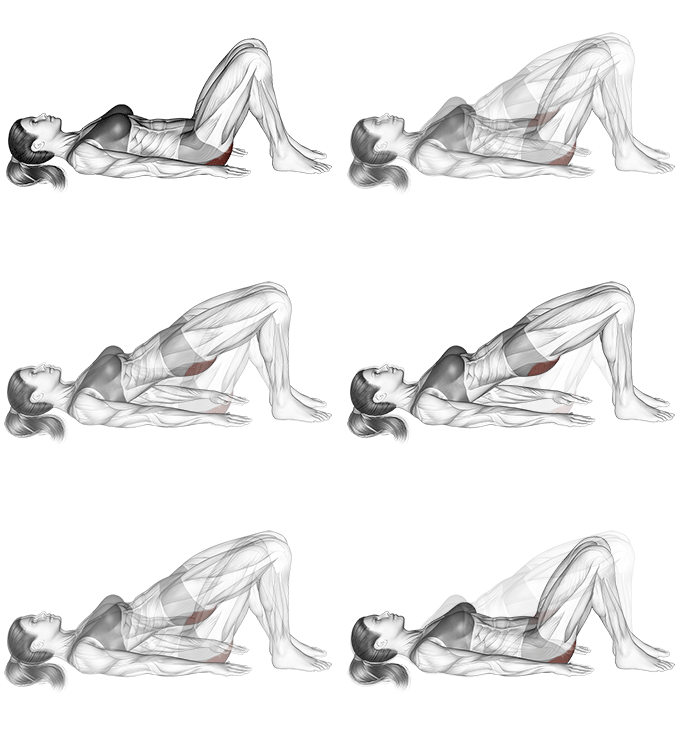
How to do it:
- Lie on your back with knees bent, feet flat on the floor, hip-width apart.
- Squeeze your glutes and lift your hips until your body forms a straight line from shoulders to knees.
- Hold at the top for 2 full seconds, squeezing hard throughout.
- Lower your hips slowly over 3 seconds back to the floor.
The 2-second hold is not optional. That sustained contraction at the top of the movement is the time-under-tension principle applied directly. Without it, the exercise is far less effective. With it, you are creating the metabolic stress signal that tells your muscles to adapt.
For beginners: Start with both feet on the floor. Progress by elevating your feet on a low step, then by attempting single-leg bridges. Working up to a 5-second hold at the top is a significant progression all on its own.
Target: 3 sets of 12-15 reps, focused on the squeeze rather than the count.
4. Inverted Row
Most people don’t know this exercise exists, which may explain why back weakness is so common in adults over 50. The inverted row trains the muscles most affected by years of sitting: the rhomboids, lats, and rear shoulders that pull the shoulder blades back and keep you upright rather than rounded forward.
All you need is a sturdy table. Your feet stay on the ground the entire time. The angle of your body controls how difficult the movement is, which makes this one of the most adjustable exercises available without any equipment at all.
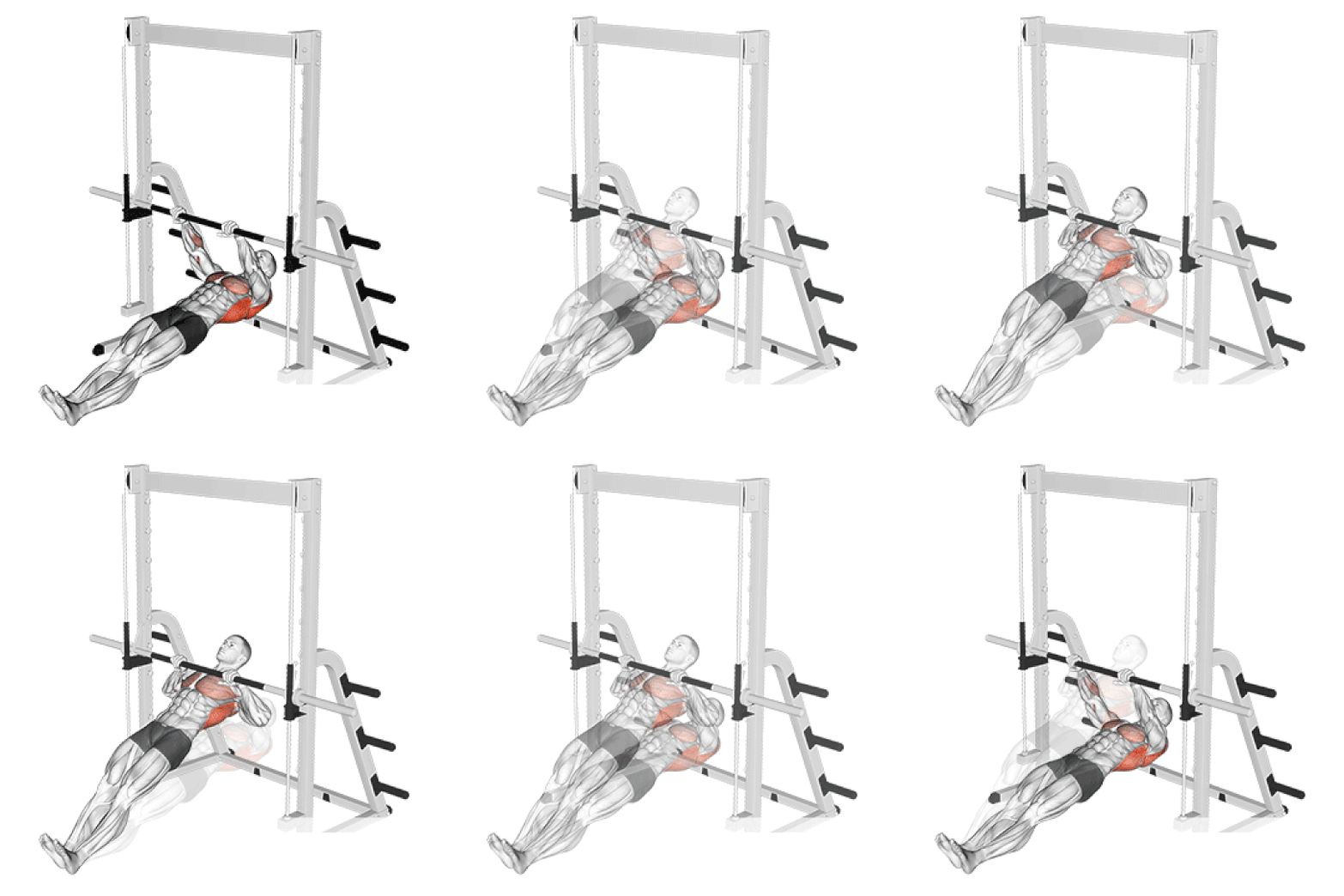
How to do it:
- Slide under a sturdy table and grip the edge with both hands, slightly wider than shoulder-width.
- Extend your legs and brace your core so your body forms a straight plank from head to heels.
- Pull your chest toward the table over 2 seconds, drawing your shoulder blades together at the top.
- Lower yourself slowly over 3 seconds back to the starting position.
The most common mistake is letting the hips sag mid-set, which shifts the work from the back to the lower back and makes the exercise both less effective and harder to sustain. Keep the core braced throughout each rep.
A second common mistake is rushing the setup. The table has to be genuinely sturdy, not one that shifts or creaks when you test it. Getting the grip position right before you begin takes 30 seconds and prevents injury.
For beginners: Start with your body at a steep angle (feet closer to the table), which makes the movement easier. As you get stronger, walk your feet forward so your body gets more horizontal. Adding a 2-second pause at the top of each rep is a significant challenge, even at an easier angle. Eventually, elevating your feet on a chair creates the closest bodyweight equivalent to a proper weighted row.
If you can’t reach 8 reps at your current angle, adjust the angle rather than forcing poor reps.
Target: 3 sets of 8-12 reps, 90 seconds rest between sets.
5. Wall Sit with Calf Raise
Wall sits create intense muscular tension through sustained isometric loading. No movement, all effort. Add a calf raise, and you’re simultaneously targeting the quadriceps and calves while building the leg endurance that protects your knees and ankles during everyday activities.
There is also zero impact. For adults with knee sensitivity, this exercise often works when squats don’t.
How to do it:
- Stand with your back against a wall and slide down until your thighs are parallel to the floor, knees directly over ankles.
- Hold this position and lift your heels off the ground.
- Lower your heels, then lift them again. Each lift and lower is one calf raise.
- Maintain the wall sit position throughout the full set of calf raises.
For beginners: If a full parallel wall sit is too challenging, start at a shallower angle. Hold for 30 seconds without the calf raises first. Add the raises when the hold itself feels manageable. Work toward a 60-second hold with 15-20 calf raises as a meaningful intermediate target.
Target: 2-3 sets of 30-60 seconds.
Which Progression Level Should I Start At?
Answer 5 quick questions. Get a starting point matched to your current strength.
How to Train for Muscle Growth After 50
The exercises matter. How you structure them matters just as much.
Train Close to Failure
The last 2-3 reps of each set carry most of the muscle-building signal. When your muscles are burning and the movement slows, that’s the stimulus that triggers protein synthesis and subsequent growth.
Research by Burd and colleagues at McMaster University, published in PLOS ONE in 2010, found that low-load training taken to failure produced greater elevations in muscle protein synthesis than high-load training stopped short of failure.
What “close to failure” feels like in practice: the movement has slowed noticeably, your muscles are burning, and you’re genuinely uncertain whether you can complete one more clean rep. Stopping while the exercise still feels comfortable means you’re not creating sufficient stimulus for growth. Stopping 1-2 reps before absolute failure is sufficient. You don’t need to collapse to make progress.
Observe the 48-Hour Recovery Rule
Muscle grows during rest, not during training. After 50, recovery is slower than it was at 30, and protein synthesis rates are somewhat reduced. Inflammatory responses to exercise also last longer in older adults, which means the 48-hour minimum between sessions targeting the same muscle groups is less a guideline than a requirement.
Three training days per week works well for most adults: Monday, Wednesday, Friday, or any comparable split with at least one day between sessions. If your muscles are still noticeably sore after 48 hours, wait another day. That soreness is information.
Use a 3-0-3 Tempo
Three seconds down. No pause at the bottom. Three seconds up. Most people find the downward phase harder to slow than the upward phase, there’s a strong instinct to let gravity do the work, which is precisely where the muscle-building signal gets lost.
The eccentric portion of a movement (the controlled descent) creates more fiber stress than the concentric push back up, which is why the descent is worth the attention it requires.
If you’re rushing the lowering phase, you’re losing most of what makes bodyweight training effective. A set of 10 slow-tempo reps does more than a set of 20 dropped quickly. That’s not intuitive, but it’s what the research on time under tension consistently shows. Count out loud if you have to. The counting is the point.

What to Eat to Support Muscle Building After 50
The training is only half the equation. Building new muscle tissue requires raw material, and most adults over 50 are eating enough to maintain a younger body’s protein needs, not enough to build new tissue on an older one.
The Protein Requirement
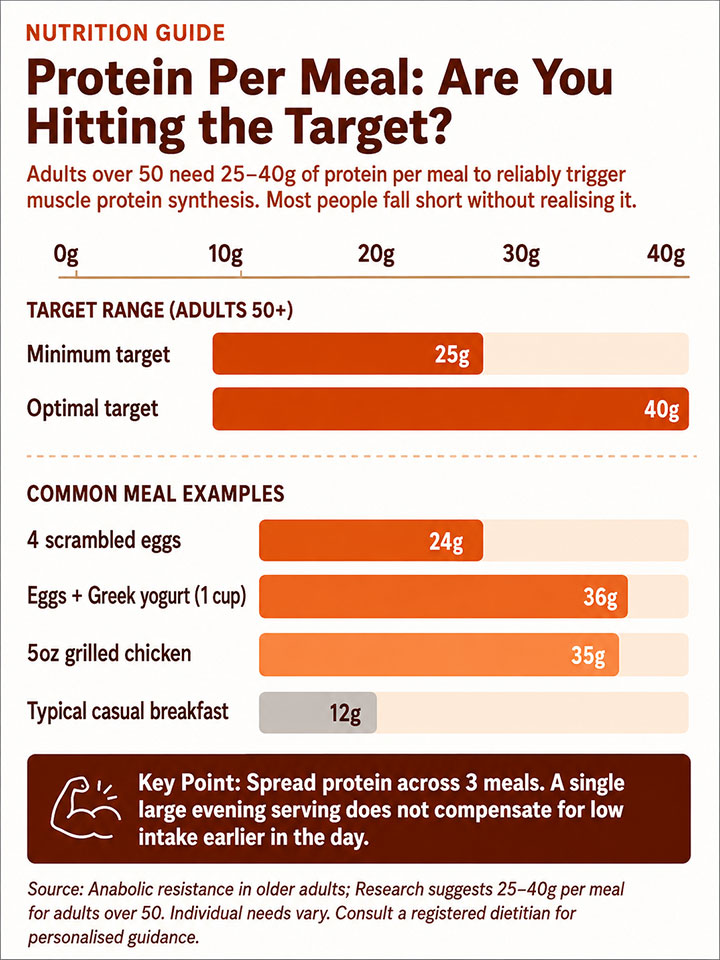
Older adults require more protein per meal to trigger the same muscle protein synthesis response that younger adults get from smaller amounts. This phenomenon, called anabolic resistance, reflects a reduced sensitivity to protein’s anabolic signal in aging muscle tissue. Research suggests 25-40 grams of protein per meal for adults over 50 to reliably clear this threshold.
Hitting 40 grams at breakfast is harder than it sounds. Four scrambled eggs provide roughly 24 grams, and adding a cup of Greek yogurt gets you to 34-38 grams. That combination works, but it requires planning. Most people eating casually fall well short of these targets, particularly at breakfast and lunch.
Distributing protein across three meals is more effective than concentrating most of it at dinner. Muscle tissue can only use a certain amount of protein at once. A single large serving in the evening does not compensate for low intake earlier in the day.
Hydration
Muscles are roughly 75% water. Even mild dehydration, at around 2% of body weight, measurably reduces strength output and endurance. Water carries nutrients to muscle cells, lubricates joints, and removes metabolic byproducts from tissue under stress.
Aim for half your body weight in ounces per day as a starting point, adjusting upward when you’re training in warm conditions or sweating during sessions.
What to Expect: Realistic Results
Muscle building after 50 is slower than it was at 25. A realistic expectation for the first three to six months of consistent training is two to four pounds of lean muscle, accompanied by measurable improvements in strength, balance, and how your body handles everyday physical tasks. Carrying groceries gets easier. Stairs require less effort. Getting up from a low seat stops requiring a plan.
These are not small changes. That additional muscle supports your joints, raises your resting metabolic rate, and directly reduces your risk of falls and fractures, which are among the most consequential health events in later life. The goal isn’t a transformed physique. The goal is a body that still does what you need it to do, for as long as you need it to.
Your 30-Day Starting Plan
Frequency: Three sessions per week with at least one day off between sessions.
The Workout:
- Box Squats: 3 sets of 8-12 reps
- Incline Push-Ups: 3 sets of 10-15 reps
- Glute Bridges: 3 sets of 12-15 reps
- Inverted Rows: 3 sets of 8-12 reps
- Wall Sits with Calf Raises: 2-3 sets of 30-60 seconds
Rest 90-120 seconds between sets. Complete all sets of one exercise before moving to the next.
Week 1-2: Learn the movements. Apply the 3-0-3 tempo and notice how different it feels from moving quickly. Focus on form over rep count.
Week 3-4: Push closer to failure on each set. Add one rep per set where possible. Track your numbers, even loosely.
Progressive overload after 30 days: Use the progressions described under each exercise. Slow your tempo by one additional second. Move to a harder variation. Add a fourth training day. The body adapts only when the stimulus keeps moving forward.
Strength Is a Practice, Not an Achievement
There is a version of aging that most people accept by default: the gradual retreat from physical effort, the quiet accommodation of weakness as inevitable, the assumption that the window has closed. Research says the window stays open much longer than that.
Peterson’s meta-analysis found meaningful muscle gains in adults well past 80. The NSCA position statement found retained capacity to adapt in populations most clinicians would consider too old to make meaningful progress.
These five exercises work because they address the actual mechanisms of muscle growth: mechanical tension, metabolic stress, and progressive effort. None of those mechanisms require a gym membership or a single piece of equipment.
What they require is consistency and the willingness to keep making the last few reps genuinely hard. That part doesn’t get easier with age. But the results don’t diminish, either.