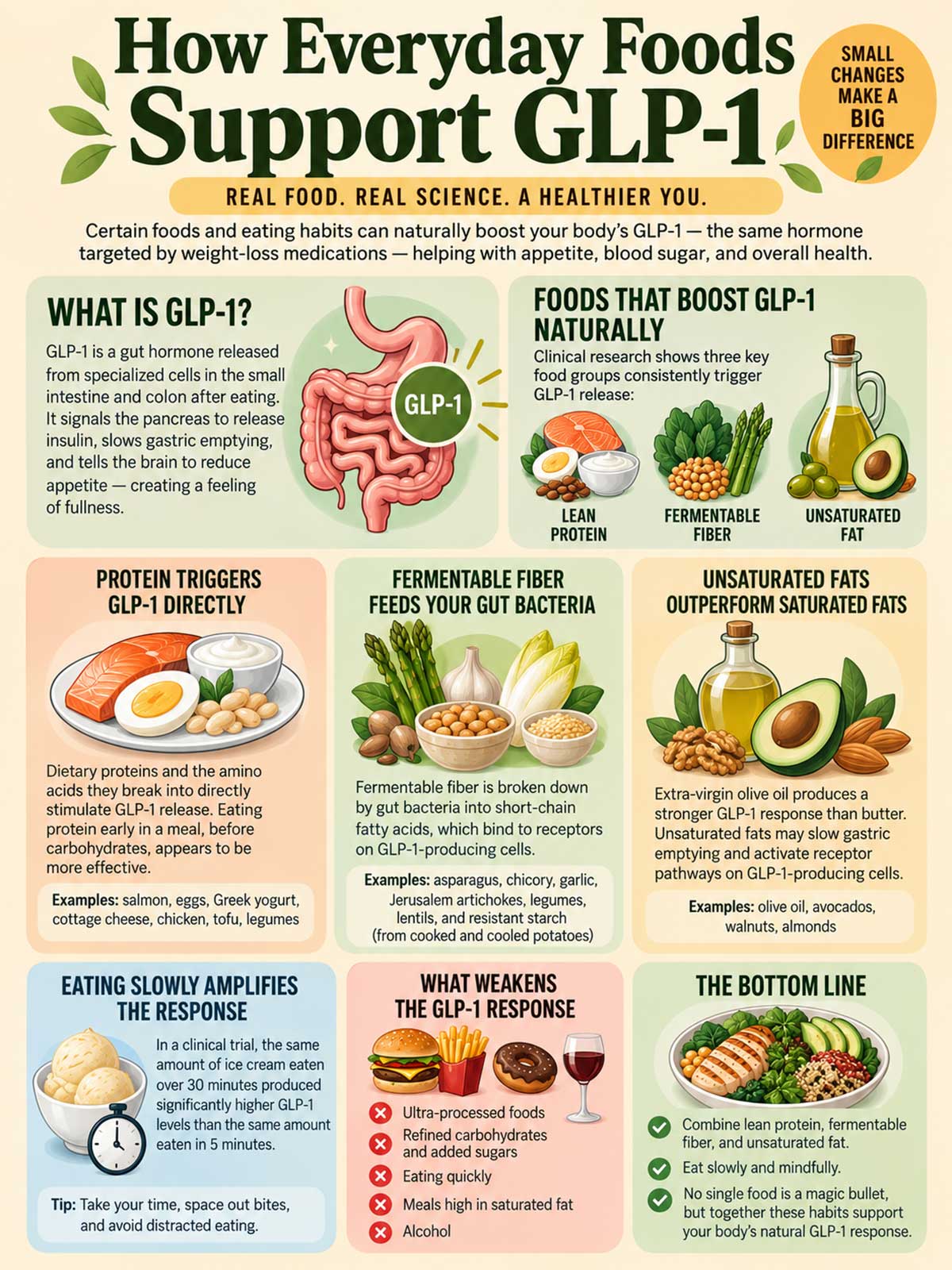
GLP-1 drugs have changed weight loss, but your body already makes this powerful hormone. Researchers found three surprisingly simple ways to trigger it.
Researchers at a clinical facility in Athens once asked seventeen healthy men to eat the same amount of ice cream twice. Once in five minutes, and once over thirty. Same ice cream. Same portion. Same day. What came back on the blood draws wasn’t the same at all.
The hormone that differed was GLP-1, the same one Ozempic, Wegovy, and Mounjaro are built to mimic. What those drugs do pharmacologically, certain foods do to a smaller degree on their own. The question worth asking is which foods, what the mechanism actually is, and how honestly you can read the evidence before the marketing language gets there first.
What Foods Act Like Ozempic Naturally?
No food produces a GLP-1 response that matches the sustained hormone levels a GLP-1 receptor agonist delivers. That distinction matters, and collapsing it into “natural Ozempic” language misrepresents the biology.
What food can do is trigger a genuine, measurable GLP-1 release in the hours after a meal, one that influences appetite, insulin response, and blood sugar regulation, even if the effect is temporary and smaller in scale than a weekly injection.
Foods that consistently show this effect in clinical research fall into three categories: those high in lean protein, those that feed fermentation in the gut (fermentable fiber), and those that supply unsaturated fat rather than saturated fat. The mechanism behind each is different, and that difference shapes how a plate should be built.
Build Your GLP-1-Supportive Plate
Select one option from each category to see how your meal supports GLP-1 production.
Protein Is the Most Direct GLP-1 Trigger
Tohru Hira and colleagues at Hokkaido University spent years mapping how specific food components interact with the gut cells responsible for GLP-1 secretion.
Their 2021 review in the International Journal of Molecular Sciences established that dietary proteins and the peptides and amino acids they break into during digestion directly bind to receptors on intestinal L-cells (the cells that produce GLP-1) and trigger hormone release.
Phytochemicals such as quercetin, found in apples, onions, and capers, showed similar signaling activity in cell model studies.
A 2023 systematic review and meta-analysis in the American Journal of Clinical Nutrition pooled 16 randomized crossover trials covering 244 participants and found that a whey protein premeal reliably raised plasma GLP-1 and GIP levels and lowered post-meal blood glucose.
Most of the trials skewed toward people with overweight or type 2 diabetes, so the effect in lean, healthy adults is directionally supported but less thoroughly studied.
Whole food protein sources (salmon, eggs, Greek yogurt, cottage cheese, chicken, tofu, legumes) are where the practical application starts for most people. What the whey trials actually suggest is simpler than the supplement aisle implies: eating protein early in a meal, before the carbohydrates arrive, appears to matter more than the specific protein source.

The Fiber Path Runs Through Your Gut Bacteria
Patrice Cani at the Université Catholique de Louvain wanted to know whether gut bacteria were doing more than simply digesting fiber, specifically whether the byproducts of that fermentation could travel upstream and influence appetite hormones.
His team’s 2009 randomized, double-blind, placebo-controlled trial in the American Journal of Clinical Nutrition gave ten healthy adults either 16 grams of prebiotic fiber daily or a placebo for two weeks.
The prebiotic group showed significantly higher plasma GLP-1 and peptide YY concentrations, lower hunger ratings, and lower post-meal blood glucose. The rise in GLP-1 correlated with gut fermentation activity at r=0.85, a strong correlation for a trial of this size.
Fermentable fiber feeds bacteria in the colon, which produce short-chain fatty acids as a metabolic byproduct. Those short-chain fatty acids bind to receptors on GLP-1-producing L-cells. The fiber itself is not the signal.
The bacteria’s waste product is. This is why resistant starch and fermentable soluble fiber consistently outperform non-fermentable fiber like wheat bran in the GLP-1 evidence base: it’s not about fiber quantity, it’s about whether the fiber reaches the bacteria that produce the signal.
Inulin, found in asparagus, chicory, garlic, and Jerusalem artichokes, is among the most fermentable forms. Legumes and lentils supply both fermentable fiber and protein together, which means they address two of the three main GLP-1 food levers through a single ingredient.
What Olive Oil Has That Butter Doesn’t
The assumption going into the trial was that fat type probably wouldn’t matter much for the gut hormone response. Lutgarda Bozzetto and colleagues at Federico II University in Naples found otherwise.
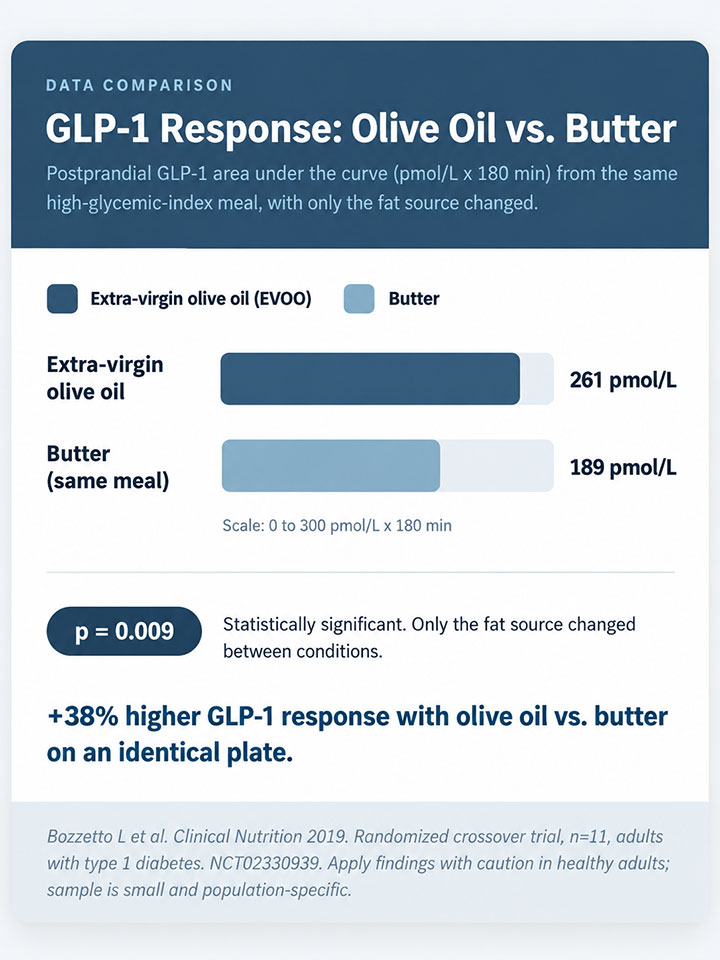
In a randomized crossover trial published in Clinical Nutrition in 2019, eleven patients with type 1 diabetes consumed three versions of the same high-glycemic-index meal: one with extra-virgin olive oil, one with butter, and one with minimal fat.
The olive oil meal produced a postprandial GLP-1 response of 261 pmol/L across 180 minutes, compared with 189 pmol/L for the butter meal (p=0.009). That is a statistically significant difference from what amounted to swapping the fat source on an otherwise identical plate.
Two mechanisms appear to be at work. Extra-virgin olive oil slows gastric emptying and extends the window during which the gut detects nutrients and secretes GLP-1. The monounsaturated fatty acids in olive oil may also directly activate receptor pathways on L-cells in a way saturated fats do not.
The trial was small (n=11) and conducted in people with type 1 diabetes, so applying the finding to healthy adults requires some caution.
Avocados, walnuts, and almonds operate on the same principle. The practical implication is narrower than most coverage suggests: this isn’t an argument for adding olive oil to every plate. It’s an argument that the fat source already on the plate is doing something measurable in the hormone data, and the measurement favors the unsaturated option.
How Fast You Eat Is Not a Trivial Detail
This brings the story back to Athens. In the 2010 crossover trial published in the Journal of Clinical Endocrinology and Metabolism, Alexander Kokkinos and colleagues had seventeen healthy men eat 675 calories of ice cream (the same ice cream) in either five minutes or thirty.
Blood draws taken throughout the morning showed significantly higher GLP-1 and peptide YY concentrations in the slow-eating sessions on every measurement.
The dominant assumption at the time was that what you ate determined your hormonal response and how fast you ate was largely a social concern. The researchers proposed a different reading: slower eating gives the gut more time to detect incoming nutrients as they move through the small intestine. A longer detection window produces a more sustained hormone release, rather than a sharp peak that fades before the next meal.
The study has since been replicated with mixed results in people with obesity and type 2 diabetes, where the effect on gut hormones appears less consistent. For healthy adults, the direction of the evidence is clear enough to act on.
Eating more slowly, spacing out bites, and avoiding distracted eating all appear to extend the period of nutrient detection that GLP-1 secretion depends on. The food on the plate matters. The pace at which it is eaten does too.

What Weakens the GLP-1 Response
Ultra-processed foods show the clearest association with lower GLP-1 secretion, partly because they are typically low in protein and fermentable fiber, and partly because refined carbohydrates and added sugars are absorbed rapidly in the upper small intestine, before nutrients reach the L-cell-dense lower gut where most GLP-1 originates. Eating quickly compounds both effects.
Meals built primarily around saturated fat consistently produce lower GLP-1 responses than equivalent meals with unsaturated fat, as the Bozzetto trial showed directly. Alcohol also appears to reduce post-meal GLP-1 secretion, though the human evidence for this is thinner than for the dietary patterns above.
Can Food Actually Compete With the Drugs?
The honest answer is no, not in the same clinical terms. GLP-1 receptor agonist drugs produce sustained, pharmacologically elevated hormone levels across hours and days. The food-driven response is a temporary postprandial pulse, real and measurable, but not clinically equivalent to a weekly semaglutide injection.
No study has compared the two directly, and researchers have not claimed otherwise. What food can do is support the body’s own GLP-1 system, which is active at every meal.
For people who are not candidates for GLP-1 medication, or who want a food-first approach before or alongside medical treatment, the verified evidence supports the idea that protein, fermentable fiber, unsaturated fat, and slower eating each shift the postprandial GLP-1 response in a measurable direction.
The sample sizes in most trials are small, the longest-term data skews toward people with metabolic disease, and researchers are still working out how much the cumulative dietary effect translates to appetite control in free-living, healthy adults.
That open question is not a reason to dismiss the evidence. It is a reason to read it at its actual weight, which is promising and considerably more grounded than the “natural Ozempic” category it usually gets filed under.
Building a GLP-1-Supportive Plate
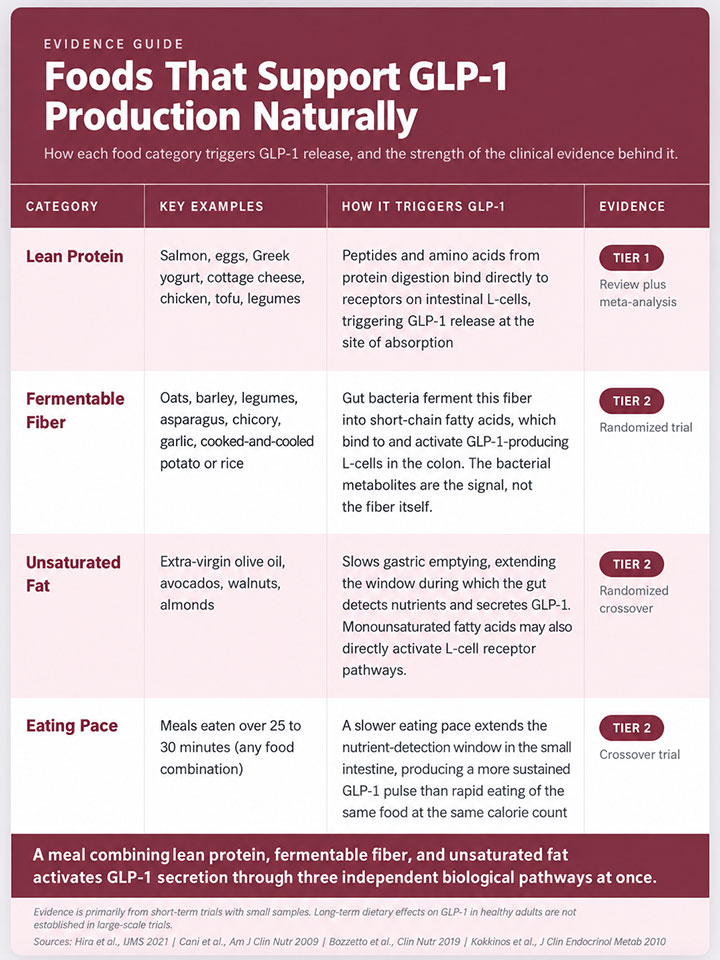
The meal pattern emerging most consistently from the verified evidence combines a lean protein source, a fermentable fiber source (legumes, oats, asparagus, or cooked-and-cooled starch), and a source of monounsaturated fat such as olive oil or avocado.
Pace matters as much as what’s on the plate. No single food here is doing anything dramatic in isolation. What the evidence shows is that each element works through a distinct mechanism, and a plate that covers all three addresses the conditions under which L-cells release GLP-1 most consistently.
The body’s own GLP-1 system is food-responsive and measurable, responding at every meal. The research gives a reasonably clear picture of what encourages that response. The bigger question, whether building meals this way over months produces meaningful changes in appetite, blood sugar, or body weight outside a controlled trial, is one the research hasn’t answered in large, long-term trials yet. That’s the study someone should run.