Your brain’s creatine needs aren’t the same as everyone else’s. Sleep loss, menopause, aging, and diet can change how much you have to gain from supplementation.
Your brain is the most metabolically expensive organ you own. Two percent of your body weight. Twenty percent of your daily energy budget.
Most people take for granted that whatever the body makes and stores is sufficient. For a meaningful portion of the population, it is not. Not because of disease or dietary failure, but because of a molecule that varies in availability depending on what you eat, how much you sleep, and where you are in life.
Creatine is that molecule. For thirty years, researchers studied it almost entirely as a sports supplement, and the people most likely to benefit from the brain research were the ones least likely to be looking for it: women navigating menopause, older adults eating less meat, anyone running on too little sleep or no animal protein at all.
The Low-Baseline Effect: Why Results Vary So Much Between People
Creatine functions in the brain as a short-term energy buffer. Neurons require constant ATP to fire, and during periods of high demand (concentrated mental work, sleep loss, hormonal stress), the phosphocreatine system helps recycle ATP fast enough to keep up.
When that buffer runs low, performance follows in predictable ways: processing speed drops, working memory degrades, sustained focus shortens.
The research on creatine and cognition has produced inconsistent results partly because those studies were not always comparing the same type of person. Someone eating meat regularly, sleeping well, and facing modest cognitive demands carries different creatine stores than someone who eats plant-based, sleeps poorly, or is managing a hormonal transition. The same dose does more for the person starting from less.
The researchers who first tested creatine on cognition chose an unusual group: 45 young adult vegetarians with no dietary creatine at all. Rae et al., writing in Proceedings of the Royal Society: Biological Sciences in 2003, found significant improvements in working memory and reasoning ability after six weeks of 5 grams daily, with both outcomes reaching p < 0.0001.
The vegetarian population wasn’t incidental to the study design. It was the point. Researchers wanted to test the group with the most room to respond.
The most rigorous general-population test came from a 2023 trial published in BMC Medicine, the largest single RCT on creatine and cognition to date, with 123 adults split roughly between vegetarians and omnivores.
This study is often described as a null result. That framing is imprecise. Bayesian analysis supported a small beneficial effect, and the primary digit-span measure approached conventional significance at p = 0.064, without crossing the threshold.
The reasoning test showed no significant change. One result the authors flagged as unexpected: vegetarians did not benefit more than omnivores, a finding that has not yet been fully explained.
The pattern that emerges: creatine’s cognitive effects are strongest in people whose baseline is low for structural reasons, more modest in well-nourished mixed populations, and larger when the brain has more room to absorb additional creatine. The groups most likely to respond are the ones covered next.
Sleep Deprivation: The Fastest Way to Create a Temporary Deficit
You pull an all-nighter. Or maybe you have a newborn at home, or a deadline that owns your calendar for a week. Either way, your brain’s phosphocreatine reserves fall, ATP recycling slows, and cognitive performance drops with it. The decline is measurable, rapid, and consistent across studies.
Ali Gordji-Nejad and colleagues at Forschungszentrum Jülich in Germany asked a direct question: could a single high dose of creatine counteract that decline during active sleep deprivation? In their 2024 study published in Scientific Reports, fifteen healthy volunteers stayed awake for 21 hours under controlled conditions.
Half received 0.35 grams of creatine per kilogram of body weight (roughly 25 grams for a 160-pound person), and the other half received a placebo. Cognitive performance and brain phosphate levels were measured at 3, 5.5, and 7.5 hours after the dose.
Creatine maintained phosphocreatine and ATP levels across all three measurement windows. On memory, language, and processing tasks, the creatine group outperformed placebo by a significant margin at each time point. In some tasks, creatine-supplemented participants matched or exceeded their own pre-deprivation baseline performance.
That outcome takes a moment to register. Creatine produced an actual return toward normal function during ongoing sleep loss, not merely a slowing of the decline. A follow-up from the same research group tested a lower single dose of 0.2g/kg and found a smaller but consistent protective effect on logical reasoning and processing speed.
Both studies point in the same direction, and both make the dose constraint clear: the acute brain effect requires six to eight times the standard 5-gram daily maintenance amount.
Women and Menopause: Where the Evidence Gets Most Specific
The strongest imaging numbers in the entire creatine-and-brain literature come from a 2025 randomized controlled trial of 36 perimenopausal and menopausal women. The medium-dose creatine group improved reaction time by 6.6 percent versus 1.2 percent for placebo.
Frontal brain creatine levels rose 16.4 percent versus 0.9 percent for placebo. The frontal lobe is the region most associated with mood regulation, working memory, and the type of focused cognition that menopausal women most commonly report losing.
That study, the CONCRET-MENOPA trial published in the Journal of the American Nutrition Association, randomized participants to one of four groups: low-dose creatine hydrochloride (750mg daily), medium-dose creatine hydrochloride (1,500mg daily), a combination formula, or placebo. Women taking the medium dose also showed favorable changes in serum lipid profiles and reported meaningful reductions in general fatigue and concentration difficulties.
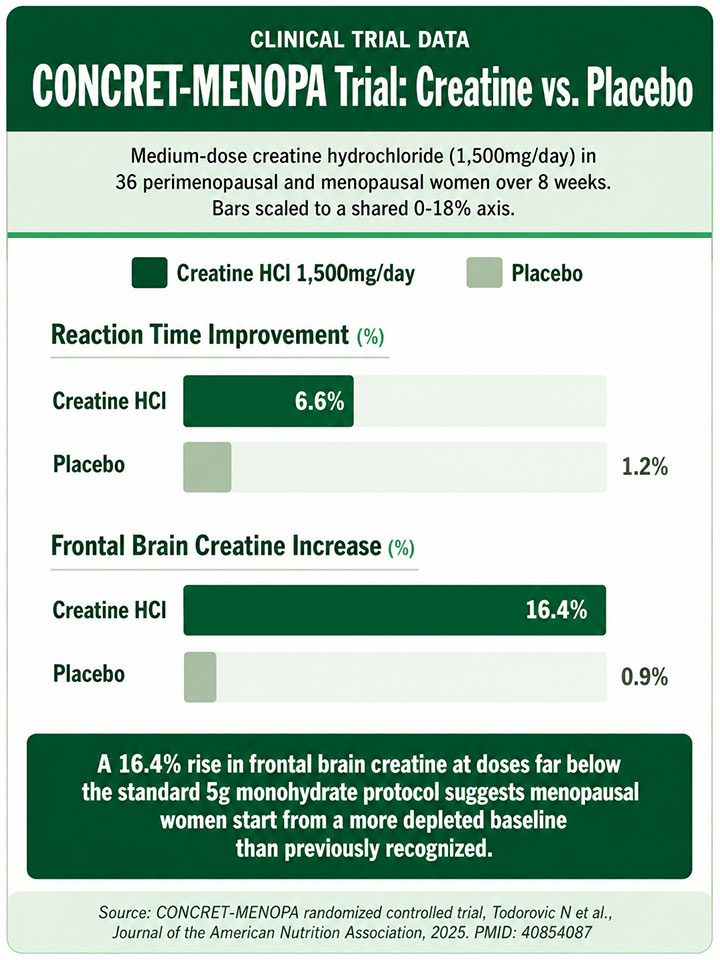
The form used was creatine hydrochloride at doses well below the standard 5g creatine monohydrate recommendation, which makes the brain imaging results more striking, not less. Measurable frontal creatine increases at low doses suggest a depleted starting point, not a modest supplement effect.
The reason menopause matters for creatine comes down to estrogen specifically. Estrogen influences creatine metabolism and phosphocreatine resynthesis throughout a woman’s life. A 2021 lifespan review in Nutrients documented that women have 70 to 80 percent lower total creatine stores than men, a gap driven by lower average muscle mass and lower dietary creatine intake.
When estrogen declines during perimenopause and menopause, that deficit deepens. The brain’s energy buffer, already lower than a comparable man’s at the same age, falls further precisely when cognitive demands feel highest.
A separate study looked at what happens when you combine creatine with exercise in this population. A 2025 pilot study in the Journal of the International Society of Sports Nutrition paired 5 grams of creatine daily with a structured resistance training program in 15 perimenopausal and postmenopausal women over 14 weeks.
Perimenopausal participants showed significant improvements in sleep quality. Among the postmenopausal group, one-third moved from scores in the mild cognitive impairment range to the normal range.
Because the study combined creatine with twice-weekly supervised training and had no placebo control, the outcomes cannot be attributed to creatine alone. The direction aligns with what the imaging data from CONCRET-MENOPA would predict.
The brain fog most women experience during menopause is routinely attributed to hormones, full stop. The emerging picture is more specific: hormonal changes reduce the brain’s energy reserves, and creatine directly replenishes those reserves. It is a partial explanation and a practical tool, and most women have never been offered either.

Complex Mental Work: When Cognitive Load Is High
The standard view, before recent meta-analyses, was that creatine’s cognitive effects were real but marginal for most people outside specific high-stress conditions.
A July 2024 analysis by Xu et al. in Frontiers in Nutrition pulled together 16 randomized controlled trials involving 492 adults and found significant positive effects on memory and executive function across the pooled sample.
The benefits appeared most clearly on tasks requiring sustained mental effort, multi-step reasoning, or processing under pressure.
One methodological issue deserves mention: an EFSA panel review and a 2026 commentary in the same journal flagged that the study pooled correlated outcomes from the same participants as though they were independent effect sizes.
That inflates both the apparent sample size and the effect estimate. The direction of the findings is consistent with the underlying individual trials. The magnitude should be treated as uncertain pending larger, better-designed meta-analyses.
Here is the distinction that puts creatine’s role in the clearest terms. Caffeine blocks adenosine receptors to create a perception of alertness. Creatine does nothing to perceived alertness or subjective energy.
It sits in neurons as phosphocreatine, ready to donate a phosphate group to ADP and regenerate ATP the instant a cell needs more energy than it can produce from baseline processes. Caffeine is like turning up the volume on a dying battery. Creatine is like plugging in a charger.
The practical implication is that creatine’s effects are most visible during genuinely demanding cognitive work: sustained complex problem-solving, learning new material under pressure, or any stretch where the brain is drawing energy faster than baseline production can supply. On a routine afternoon with no particular demands on working memory, the difference may be imperceptible.
What Is Your Creatine Responder Profile?
5 quick questions identify where you fall in the research and what dose makes sense for your situation.
Older Adults: A Different Kind of Low Baseline
Age gradually reduces both the body’s capacity to synthesize creatine and the amount coming in through diet, since older adults typically eat less red meat and fish. The result moves creatine stores in the same direction as a plant-based diet or hormonal transition: lower available buffer, more room for supplementation to make a difference.
The evidence supports that prediction. Avgerinos et al.’s 2018 systematic review in Experimental Gerontology found the most consistent cognitive benefits in older populations. One trial within the review documented significant improvements in forward number recall, backward and forward spatial recall, and long-term memory in adults aged 68 to 85 following a short high-dose supplementation protocol.
Adults over 65 who take multiple medications should check with their physician before starting, given the potential for interactions with compounds that affect kidney function. Without those complicating factors, the case for supplementing is straightforward. The fitness industry has mostly ignored this population, and the research points toward supplementation for this group.
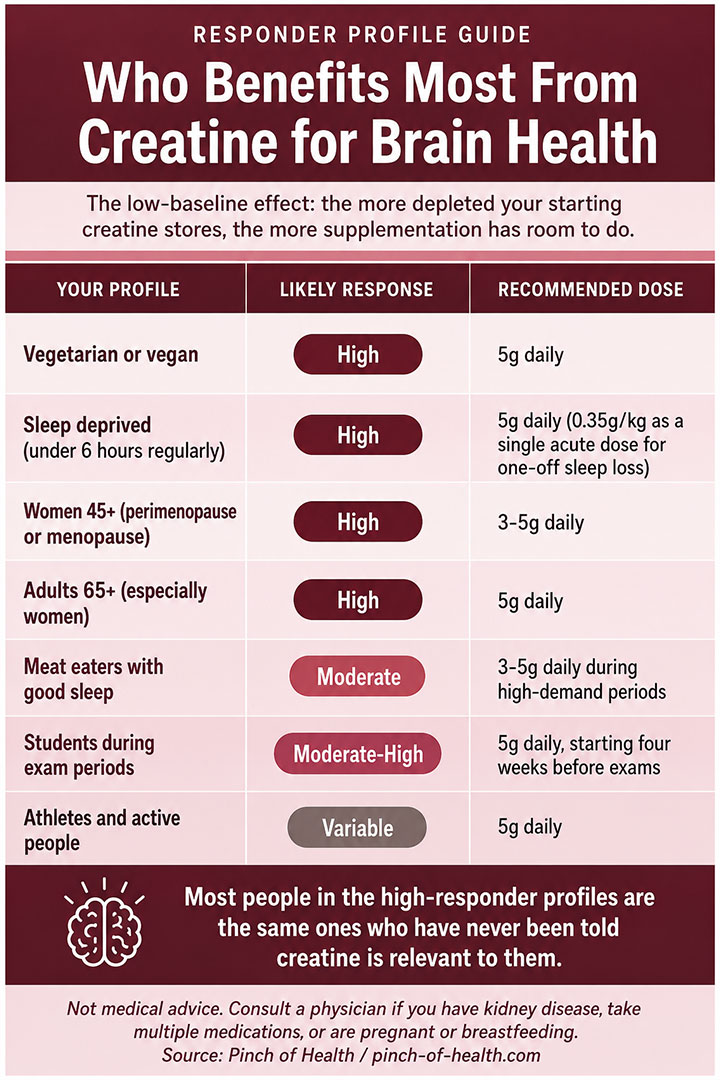
Who Benefits Most From Creatine for Brain Health
Four profiles show the strongest response to creatine supplementation. Two others show reliable but more moderate effects.
Emerging Evidence: Brain Injury and Depression
Two areas of creatine research are earlier in development than the work on sleep, women’s health, and aging. The studies are smaller in sample size than those reviewed above, some lack blinding, and the mechanisms, while plausible, are less directly tested in humans.
On traumatic brain injury: an injured brain enters an energy crisis at the moment of impact. Damaged cells need more ATP to repair themselves precisely when the injury has disrupted normal energy production.
An open-label pilot study by Sakellaris et al., published in Acta Paediatrica in 2008, treated 39 children and adolescents with traumatic brain injuries using creatine at 0.4 grams per kilogram daily for six months.
The creatine group showed significantly lower rates of headache, dizziness, and fatigue over the observation period. Because the study was not blinded, its results can only be read as directional evidence: encouraging but not definitive.
A 2019 imaging study in Brain Imaging and Behavior measured neurochemistry in 77 symptomatic former NFL players and found that a higher cumulative head impact index correlated with lower creatine levels in parietal white matter (r = -0.23, p = 0.02).
This is a correlation between past exposure and current creatine stores, not a treatment finding. It suggests that repeated head impacts deplete brain creatine over years, and if that finding is replicated, it would be a reason to study prophylactic supplementation in contact sport athletes.
On depression: brain imaging research has found reduced energy production in key cortical regions in people with major depressive disorder. What prompted a 2012 Korean research team to test creatine as an add-on to standard antidepressant treatment was a specific hypothesis: that restoring brain energy metabolism might accelerate the clinical response.
Their trial, published in the American Journal of Psychiatry, randomized 52 women with major depression to receive escitalopram plus either 5 grams of creatine daily or a placebo. The creatine group showed symptom improvement by week two, and the remission rate at eight weeks was 52 percent versus 26 percent for placebo. Side effects were attributed primarily to the antidepressant, not to creatine.
Whether these results extend to men, to other antidepressant classes, or to depression subtypes without a clear energy-metabolism component remains unknown. The honest answer is that neither area has been measured properly at scale yet. Both are interesting enough to keep following.
How Long Does Creatine Take to Work for the Brain?
Brain saturation is slow. Unlike caffeine, which reaches peak effect within 30 to 60 minutes, creatine crosses the blood-brain barrier through active transport, a process that takes weeks at standard doses. The brain has to move creatine across a barrier that limits how much gets through at once.
At 5 grams daily, measurable increases in brain creatine typically begin within one to two weeks. Full saturation approaches by weeks four to six. Most people who will respond have started to show effects by that point.
A loading protocol (20 grams daily for seven days, then dropping to 5 grams for maintenance) compresses the timeline to one to two weeks, at the cost of a higher chance of early digestive discomfort. Splitting the loading dose into four 5-gram portions across the day reduces that substantially.
A dose-ranging study in adolescent females with treatment-resistant depression found that 10 grams daily produced a 9.1 percent increase in frontal lobe phosphocreatine, compared to roughly 4 percent at lower doses.
That finding comes from a specific clinical population, not healthy adults, and should not be read as a blanket recommendation to double the standard dose. It does suggest that brain creatine uptake continues responding to higher doses in ways that muscle uptake, which saturates faster, does not.
How to Take Creatine for Brain Health
Type: Creatine monohydrate. The form matters. It is the one used across all the major trials, and the only one for which brain benefits and safety at standard doses have been directly tested at scale.
You have three dosing approaches depending on your goal and timeline:
Standard Protocol (Most Common)
- Take 5 grams daily, every day without exception.
- At this dose, brain saturation is reached in four to six weeks.
- This is the right starting point for most people beginning supplementation for cognitive support.
- No loading phase is required.
Loading Protocol (Faster Results)
- Take 20 grams daily for seven days, then drop to 5 grams for maintenance.
- Brain stores approach saturation in one to two weeks with this approach.
- Split the 20 grams into four 5-gram doses throughout the day to reduce digestive discomfort.
- This is worth trying when cognitive demands are starting soon, and you want to saturate faster.
Acute Protocol (Situational Use)
- Take 0.35 grams per kilogram of body weight as a single dose.
- For a 160-pound person, that is approximately 25 grams.
- Use this for acute sleep deprivation or a high-stakes one-off cognitive demand.
- Effects in the Gordji-Nejad trial were measured at 3, 5.5, and 7.5 hours after dosing.
- This protocol is not intended for daily use.
Timing: When you take creatine makes no meaningful difference to cognitive outcomes. Morning, evening, with food, without food: none of this affects how the brain responds. What matters is daily consistency. Missing doses allows brain stores to drift down, and that is the one variable that does affect results.
Absorption: Mix with water. No sugar, no delivery system, no proprietary formula is required. Creatine monohydrate absorbs adequately on its own.
Creatine Dosage Calculator for Brain Health
Enter your body weight and choose a protocol to get a personalized dose recommendation based on the research.
Getting Creatine From Food
Creatine is found almost entirely in animal muscle tissue. Plants contain none. The highest concentrations appear in herring and pork, followed by beef, salmon, and chicken.
The practical problem with relying entirely on food is heat. Cooking destroys between 30 and 50 percent of creatine content depending on method and temperature. To reach 5 grams from diet alone, you would need to eat approximately two pounds of raw beef, or one pound of raw herring, every single day. That is neither practical nor realistic for most people, including regular meat eaters.
How Creatine Compares to Other Cognitive Supplements
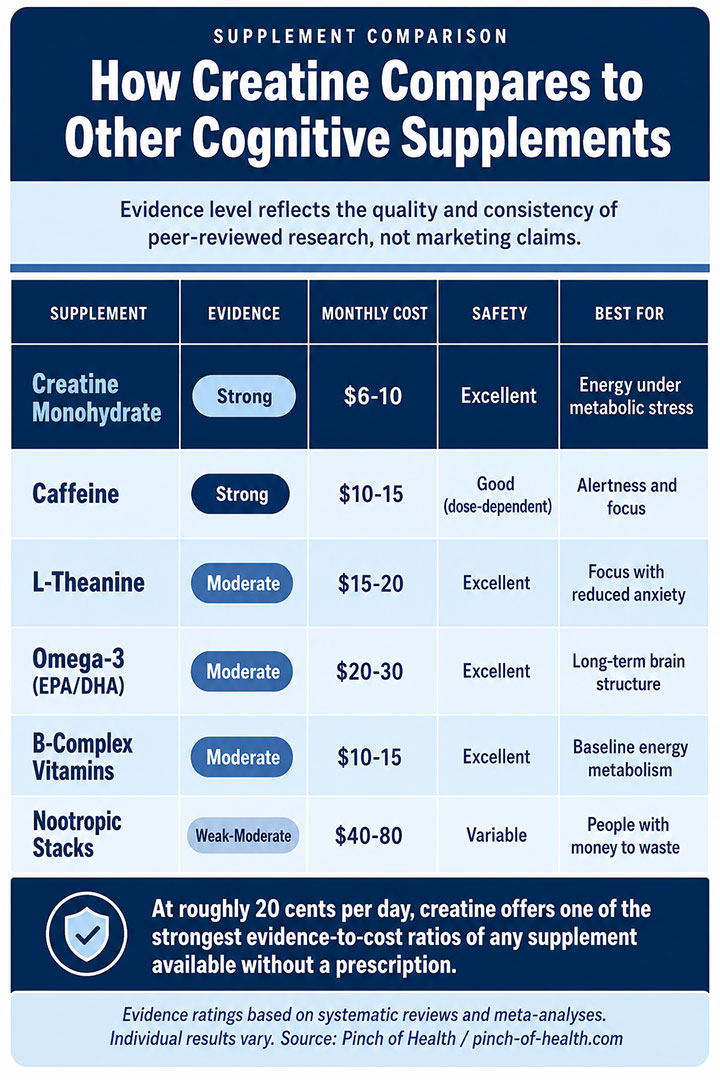
Creatine’s position at the top comes from the combination of a strong evidence base and a cost of roughly 20 cents per day. It does not stimulate, does not interact with most medications, and has been studied continuously for over three decades without significant safety concerns emerging in healthy adults.
Is Creatine Safe?
The kidney concern is worth addressing directly, because it is the single claim most likely to stop someone from trying creatine who would actually benefit. Creatine supplementation raises serum creatinine, a metabolic byproduct.
Elevated creatinine is a standard marker for kidney stress in people who are not supplementing, which is why physicians sometimes see the number on a lab panel and flag it. In healthy individuals taking creatine, the elevation is normal biochemistry, not organ damage.
Multiple systematic reviews and decades of controlled trials have found no adverse renal effects in healthy adults at standard doses. If you have diagnosed kidney disease, check with your physician first. For everyone else: tell your doctor you are supplementing before routine blood work, and let that be the end of the conversation.
Bloating is real but manageable. Creatine draws water into muscle cells as stores fill, which can add one to three pounds in the first week or two. Starting at 3 grams daily and working up, or skipping the loading phase entirely, reduces this substantially. It resolves on its own within two weeks for most people.
A 2009 study raised the possibility that creatine might elevate DHT, a hormone associated with hair loss. Follow-up research has not replicated this finding. The link is unconfirmed, and the original study is too small to draw conclusions from. If hair loss runs in your family, it is worth monitoring. It is not a reason to avoid creatine.
On long-term use: people have taken creatine daily for years without serious adverse events appearing in controlled research. Studies lasting five or more years show no evidence of cumulative harm in healthy adults.
People with existing kidney disease should not supplement without medical supervision. The same applies to anyone pregnant or breastfeeding, where safety data is insufficient. Adults over 65 taking multiple medications, those with a history of kidney stones, people with diabetes, and anyone taking diuretics or NSAIDs regularly should check with their physician before starting.
Quick Start Guide
- Buy pure creatine monohydrate powder. No proprietary blends, no loading formulas. Monthly cost should fall between $6 and $10. Anything above that is mostly packaging.
- Start with 5 grams daily. Mix it into water, coffee, or a smoothie. The taste is mild enough that most people don’t notice it.
- Take it at the same time each day. The specific timing does not affect outcomes. Building the habit does.
- Track your afternoon cognitive clarity from day one. Rate your 3 PM mental sharpness on a scale of one to ten. Note when focus becomes effortful. You need a baseline to measure any change against.
- Drink eight to ten glasses of water daily. Creatine draws water into cells, and staying hydrated prevents the early bloating some people experience in the first week.
- Commit to six weeks before forming any conclusions. Stopping at week two because nothing has happened yet is the most common way to miss the effect entirely.
Final Thought
Creatine did not change. What changed is the picture of who was missing it.
For thirty years the supplement sat in a category defined by its first and most obvious users: athletes with high energy demands. The brain research arrived and told a parallel story: that the people with the most to gain were those whose energy production was already strained in some way.
Sleep-deprived. Plant-based. Postmenopausal. Older and eating less meat. These are not edge cases. They describe a large fraction of the adults who are currently told, implicitly or explicitly, that cognitive supplements are not for them.
Don’t expect a buzz. Expect the absence of the crash. That is what creatine offers: a brain that keeps running when it should be running out of gas.
Frequently Asked Questions
How long does creatine take to work for the brain?
Brain saturation takes four to six weeks with 5 grams daily. A loading protocol of 20 grams for seven days can compress that to one to two weeks. For acute cognitive support during sleep deprivation, a single high dose produces effects within a few hours: the Gordji-Nejad 2024 trial measured cognitive performance at 3, 5.5, and 7.5 hours after dosing.
Can I take creatine if I don’t work out?
Yes. The cognitive effects of creatine are independent of its muscle effects. The brain and muscles use the same phosphocreatine energy system, but the brain’s response does not require exercise to activate. Many people supplement with creatine purely for cognitive support with no strength training involved.
Will creatine make me gain weight?
In the first one to two weeks, water retention in muscles may add one to three pounds. This is water moving into muscle cells as creatine stores fill. It is not fat, and it is reversible. After the initial saturation period, weight stabilizes. The effect is more pronounced during a loading phase than at the standard 5-gram dose.
Why did I gain more weight than expected after starting creatine?
People who run a full loading phase at 20 grams daily sometimes retain more water initially, occasionally approaching five pounds in the first week. It is still water, not fat, and it will normalize as the loading phase ends and maintenance begins. If the early water weight concerns you, skip the loading phase and start at 5 grams daily. The saturation timeline will be longer, but the initial retention will be lower.
What is the difference between creatine for muscles and for the brain?
The supplement and the mechanism are identical. The timelines and dose thresholds differ. Muscles saturate faster than the brain (often within one to two weeks with a loading protocol) because the blood-brain barrier limits how much creatine can cross at once.
Research also suggests that brain creatine stores continue responding to higher doses in ways that muscle uptake does not, though that finding comes from small clinical trials in specific populations and should not be generalized to all healthy adults.
Do I need to cycle off creatine?
No. Cycling was a practice from older bodybuilding protocols with no scientific basis for either muscles or brain. Brain creatine stores stay elevated with consistent daily supplementation, and there is no evidence of tolerance or diminishing response over time in healthy adults.
Can I take creatine with coffee?
Yes. Caffeine and creatine work through separate pathways and do not interfere with each other. Some early research suggested caffeine might blunt creatine’s effects on muscle, but that finding has not held up in subsequent trials. Both have mild diuretic properties, so staying well hydrated is a reasonable precaution when combining them.
Is creatine safe for women?
Yes. The concern that sometimes circulates, that creatine causes weight gain or bloating in women specifically, is a loading-phase water retention issue that affects everyone equally and resolves within a couple of weeks.
The CONCRET-MENOPA trial and the broader female lifespan research both support supplementation across life stages. Women with lower baseline creatine stores than men may actually see larger cognitive gains from the same dose, which is an argument for supplementing, not against it.
Will creatine help with brain fog?
It depends on what is causing it. If the fog is driven by energy depletion from poor sleep, high cognitive demand, a plant-based diet, or menopausal hormonal changes, creatine may make a meaningful difference.
If it is coming from thyroid dysfunction, iron deficiency, or an inflammatory condition, creatine will not touch it. The mechanism is specific to one part of the energy system. That makes it genuinely useful for a specific set of people and inert for everyone else.
Should a 70-year-old take creatine?
The evidence supports it. Older adults eating less red meat and fish carry lower creatine stores, and the Avgerinos 2018 systematic review found the most consistent cognitive benefits in older populations, including significant memory improvements in adults aged 68 to 85.
Anyone over 65 taking multiple medications should confirm with a physician first, given potential interactions with kidney-affecting compounds. Without those complicating factors, the risk-benefit picture is favorable.
Why do doctors say no to creatine?
Physician hesitancy typically comes from two sources. The first is the creatinine confusion: supplementing raises serum creatinine, which flags as a kidney marker on standard blood work if the physician does not know the patient is supplementing. Worth mentioning before any routine labs.
The second is a general institutional caution about unregulated supplements, which is reasonable as a broad policy. The issue is when that same caution applies uniformly to creatine, one of the most rigorously studied compounds in nutritional science, while multivitamins and protein powders with far thinner evidence bases get implicit approval. The safety record here is unusually good.