Chasing better experiences won’t make you happier. A Harvard study tracked 2,250 people in real time and found something most of us get completely backwards.
Most people trying to feel happier are solving the wrong problem. They assume better experiences fix it: more travel, deeper connections, fewer bad days, a more meaningful job. That logic has intuitive force, but it runs into a difficult finding.
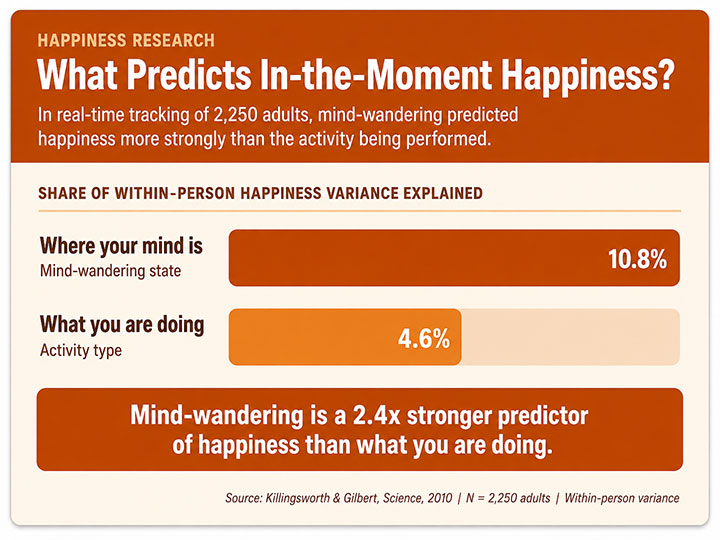
Harvard psychologists Matthew Killingsworth and Daniel Gilbert recruited 2,250 adults and pinged them throughout the day using a smartphone app. At each ping, participants reported what they were doing, what they were thinking about, and how happy they felt. The results from this 2010 study published in Science are the kind that sound implausible right up until you catch yourself inside them.
Participants spent roughly 47% of their waking hours thinking about something other than what they were actually doing. That’s almost half of a person’s life spent mentally elsewhere. And the mind-wandering itself, whatever direction it took, predicted lower happiness more reliably than the activity the person was engaged in.
What that means in practice: you could be doing something you genuinely enjoy, and if your attention is elsewhere, you’ll feel worse than someone doing something mundane who is actually present.
Think about the last time you sat down to something pleasant and found, a few minutes in, that your thoughts had already moved on. The experience was still there. You just weren’t.
That reframe is what savoring techniques are built to address.
The Happiness Framework Most People Are Missing
The pursuit of better experiences is not the only misdirection. Social scientist Arthur C. Brooks, a professor at Harvard Business School and author of “From Strength to Strength,” argues that genuine happiness is built from three components most people treat as one: enjoyment (combining pleasure with social experience), satisfaction (the feeling earned through effort and striving), and meaning (a sense of purpose that extends beyond yourself).
Pleasure alone (the passive, acquisition-driven kind) specifically doesn’t work. Chasing more stimulation or better circumstances, without the other two components, produces exactly the dissatisfaction it was supposed to cure.
This reframe shifts the question. If happiness required better pleasures, you’d always need more of them and always be falling short. Enjoyment, satisfaction, and meaning work differently: they aren’t consumed by the experience of them, and practicing attention toward any of the three leaves more available, not less.
What Savoring Is Actually Doing
Psychologists Fred Bryant and Joseph Veroff spent decades building the conceptual foundation for what they called savoring: not a vague invitation to appreciate the moment, but a specific family of attention-direction strategies.
Their 2007 book, “Savoring: A New Model of Positive Experience,” laid out a framework that includes sensory sharpening, memory-building, sharing with others, temporal awareness, and counting blessings.
Each strategy does the same mechanical thing: pulls the mind away from its default drift and anchors it to something good that’s actually present.
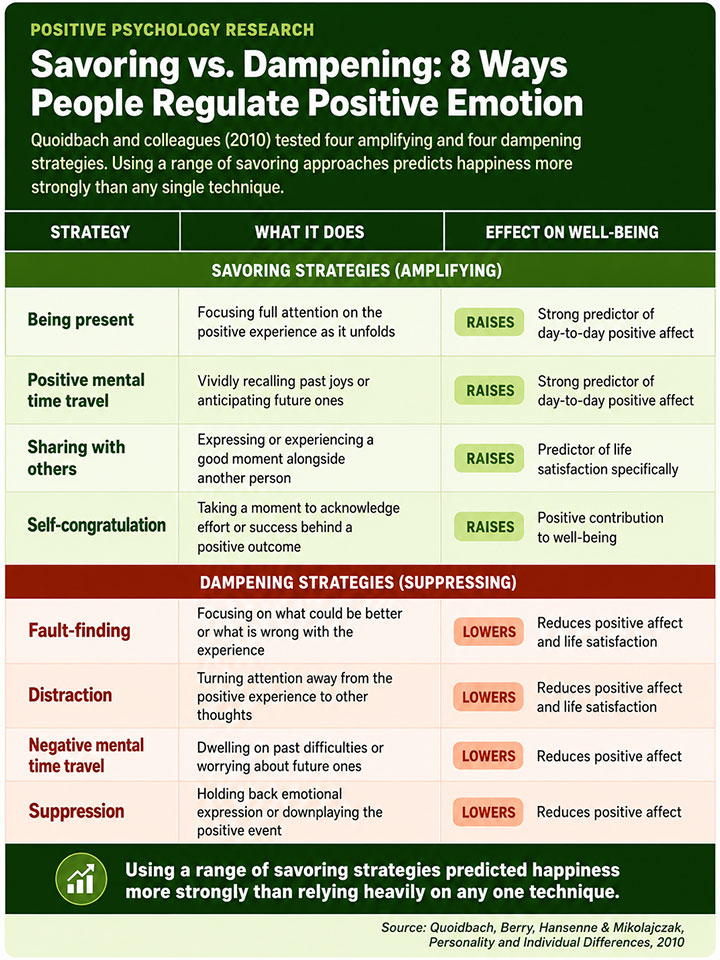
What Jordi Quoidbach and colleagues found in a 2010 study in Personality and Individual Differences added a more specific picture: eight savoring and dampening strategies target different aspects of well-being.
Being present in the moment and positive mental time travel (vividly recalling past good experiences or anticipating future ones) were the strongest predictors of day-to-day positive affect. Sharing with others specifically predicted life satisfaction.
Dampening strategies, including distraction and fault-finding, pushed both measures down. The study’s most counterintuitive result: using a range of strategies, rather than relying on a single one, predicted overall happiness more strongly than any one technique on its own.
The Four Techniques That Hold Up to Research
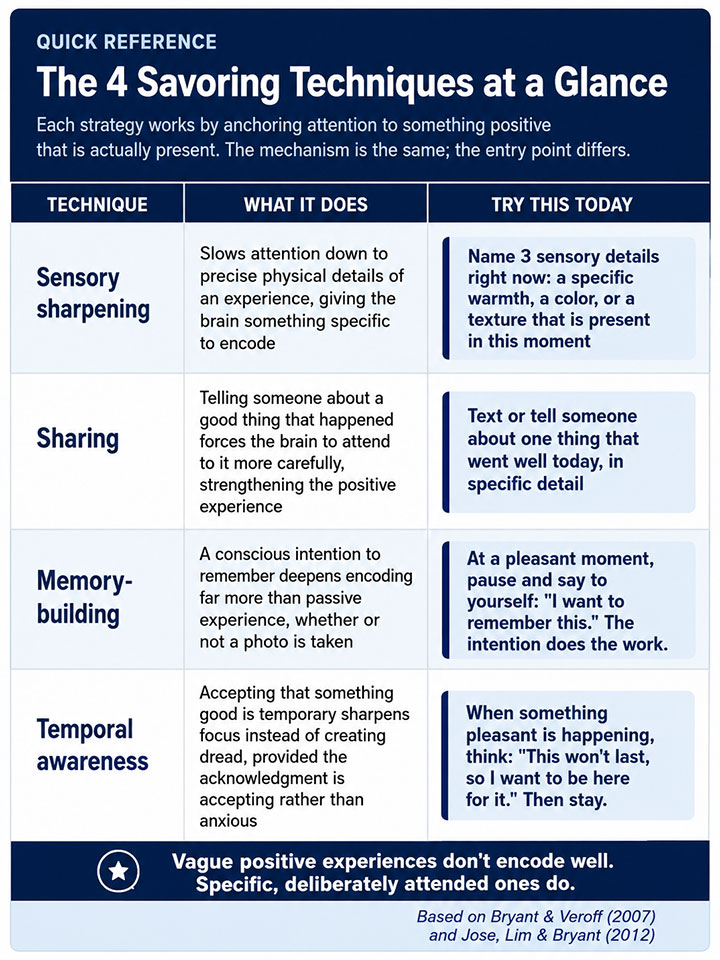
1. Sensory sharpening. Deliberately slow attention down to the physical details of an experience: the specific warmth of a drink, the exact quality of light in a room, the particular texture of a sound. Vague positive experiences don’t encode well. Specific ones do.
2. Sharing. Telling someone else about something good that happened, or experiencing something pleasant alongside another person, strengthens the positive effect. Articulating what is good forces closer attention to it. Bryant and Veroff identified this as one of the most reliably effective savoring strategies across different populations.
3. Memory-building. Taking a mental photograph (or an actual one) with the specific intention of remembering the moment deepens encoding. The intention is what does the work. Snapping a photo while distracted doesn’t produce the same result. Pausing to say to yourself “I want to remember this” does.
4. Temporal awareness. Knowing something is temporary doesn’t have to diminish it. Bryant and Veroff found that deliberately acknowledging the transience of a good moment can sharpen attention and deepen appreciation. How you hold that thought is the difference.
A daily diary study by Paul Jose, Bee Teng Lim, and Fred Bryant (2012), tracking 101 adults over 30 consecutive days, found that passive, anxious reminders of impermanence (“this will be over soon”) loaded onto dampening factors in their analysis. Accepting acknowledgment works differently. Saying to yourself “this won’t last, so I want to be here for it” pulls focus toward the present rather than toward anticipatory dread.
The Giving Finding, and Where the Evidence Actually Stands
One of the more cited findings in happiness research involves spending. A 2008 study in Science by Elizabeth Dunn, Lara Aknin, and Michael Norton found that spending money on yourself showed no consistent positive link to happiness, while prosocial spending (money given to others or donated to charity) reliably predicted it, even after controlling for income.
There’s a clear theoretical reason for that result. Giving requires attention to someone else’s experience. It generates connection and a sense of purpose, and it turns the mind away from an internal inventory of what you don’t yet have.
There’s also a complication worth knowing about. In 2020, the same team published a Registered Replication Report in the Journal of Personality and Social Psychology (Aknin, Dunn, and Norton), this time with much larger samples. When 1,950 adults were asked to recall a time they spent money on others, there was no significant effect on their current happiness.
A third experiment with nearly 5,200 participants found a significant effect, though a very small one (d=.06). The most direct version of the experiment, in which participants actually bought something for a sick child at a local children’s hospital (N=712), produced a robust effect (d=.36).
The pattern that emerges is more specific than the original study suggested. The boost is real when the act of giving is immediate and fully engaging, but much harder to detect when recalled abstractly. The warm glow of generosity doesn’t appear to be primarily a memory phenomenon.
That distinction maps precisely onto the attention mechanism the mind-wandering research had been pointing toward all along. An experience you are genuinely present for produces measurably different results from one you’re thinking about at a distance, whether that experience is something pleasant you want to hold onto or a generous act you want to feel good about.
Savoring Works Hardest When Life Is Hardest
The obvious objection to any of this is practical. Savoring sounds manageable when life is going reasonably well. But what about when it isn’t, when life offers very little that’s obviously pleasant?
Two studies by Daniel Hurley and Paul Kwon addressed this directly. The first, from 2012, tested a two-week group savoring intervention in 193 undergraduate students and found significant decreases in depressive symptoms and negative affect in the intervention group compared to controls.
Positive affect didn’t differ between the groups, a result that identifies the mechanism more precisely: savoring in short interventions appears to reduce the floor of emotional experience rather than lift the ceiling.
The 2013 follow-up found something more striking: participants with low savoring ability and few positive daily events were at meaningful risk for low positive affect and low life satisfaction. The other three combinations (high savoring with few events, low savoring with many events, high savoring with many events) had similarly positive outcomes.
That last result reframes the whole skill. For people whose daily lives offered very little that was obviously pleasant, the ability to savor what was there acted as a buffer. The skill mattered most when there was the least to work with.
Savoring is not a luxury practice for comfortable circumstances. The data suggests it may be most useful precisely when things are difficult.
Which Savoring Technique Works Best for You?
4 questions to find your best starting point.
What Eight Weeks of Practice Actually Changes
A reasonable question follows: does any of this produce durable change, or just temporary mood lifts?
A 2012 review by neuroscientist Richard Davidson and neuroendocrinologist Bruce McEwen in Nature Neuroscience found that deliberate attention training (through contemplative practices including mindfulness) reshapes neural circuits governing emotional regulation across the lifespan.
Brain plasticity doesn’t stop in adulthood, and the specific circuits involved in how people process emotional experience are among those affected by sustained practice.
How that change develops during a training period is a finer question. Laura Kiken and colleagues tracked 235 participants through an eight-week mindfulness program, with both state mindfulness and trait mindfulness assessed at multiple points across the intervention.
Their 2015 study in Personality and Individual Differences found that individual trajectories of improvement in state mindfulness during the program predicted later gains in trait mindfulness and reductions in psychological distress. The steeper the rate of improvement during training, the bigger the downstream shift.
The same conclusion emerged from a completely different research tradition. A six-group randomized controlled trial by Martin Seligman and colleagues (2005), published in American Psychologist, worked from a behavioral angle rather than a neuroscientific one: participants wrote down three good things that happened each day for one week.
Those who continued the practice past that initial week showed increases in happiness and decreases in depressive symptoms that held at the six-month follow-up.
Two independent lines of research, one tracing neural circuits and one tracking a daily writing habit, arrived at the same finding. Present-moment attention is trainable, and training it appears to compound.
The Attention Problem Hiding Inside a Happiness Problem
None of the four techniques above are complicated to execute. What’s hard is accepting the reframe that makes them worth executing.
The Killingsworth and Gilbert data showed that attention quality, not life quality, was the stronger predictor of happiness. That’s a specific, falsifiable claim, not a call to be more positive. It means the person sitting across the table who is fully present in the conversation is doing something functionally different from the person eating the same meal whose mind has already moved somewhere else.
Training that attention doesn’t require better circumstances, but it does require patience with evidence that keeps qualifying the easy version of the story. The “giving” finding is real and more methodologically sensitive than a single study made it look. Savoring reduces the negative end of mood more reliably than it lifts the positive, which is worth knowing at the outset.
What the research stays consistent on is the central claim: what you do with your attention matters more than what you are attending to. That conclusion doesn’t soften into something easier with more evidence. More evidence keeps sharpening it.
Frequently Asked Questions
How do you savor every moment?
You don’t, and trying to will exhaust you. What the research supports is deliberate savoring in specific moments, not a constant state of conscious appreciation.
The four techniques (sensory sharpening, sharing, memory-building, temporal awareness) work best when used selectively, on experiences that genuinely deserve the attention. Quoidbach and colleagues (2010) found that using a range of strategies, rather than forcing any single one continuously, predicted overall happiness most strongly.
What is the Three Good Things intervention?
Three Good Things is a positive psychology exercise developed by Martin Seligman and colleagues (2005). You write down three things that went well each day and a brief explanation of why each happened.
In Seligman’s six-group randomized trial, participants who continued practicing beyond the initial week showed lasting increases in happiness and reductions in depressive symptoms at the six-month follow-up. It’s one of the few positive psychology interventions with a durability finding rather than a short-term lift.
Can savoring techniques help with anxiety or depression?
The evidence here is specific, not general. Hurley and Kwon’s 2012 intervention found significant reductions in depressive symptoms and negative affect in the savoring group compared to controls. Positive affect didn’t differ between groups in that study.
Savoring, then, appears to work more as a floor-raiser than a reliable mood elevator. For clinical anxiety or depression, these techniques should supplement professional treatment, not replace it.
Is savoring the same as mindfulness?
Related but distinct. Mindfulness involves non-judgmental attention to whatever is present, including neutral or uncomfortable experiences. Savoring specifically targets positive experiences and uses active strategies to register and extend them.
Both train the same attentional capacity. Savoring applies that capacity to a narrower, specific goal: making positive experiences actually land rather than pass by unnoticed.