Stretching your back might be making it worse. The real fix targets a muscle group most people never think to strengthen.
You’ve probably blamed your back. Your doctor may have looked at your spine, ordered an X-ray, and told you everything looks fine. Yet the ache is still there: nagging, persistent, and worst of all, there every time you stand up.
A growing body of research suggests the real culprit isn’t your spine at all. It’s your hips. And until that piece gets addressed, the ache won’t go anywhere.
The Hidden Culprit: Your Spine Is Covering for Your Hips
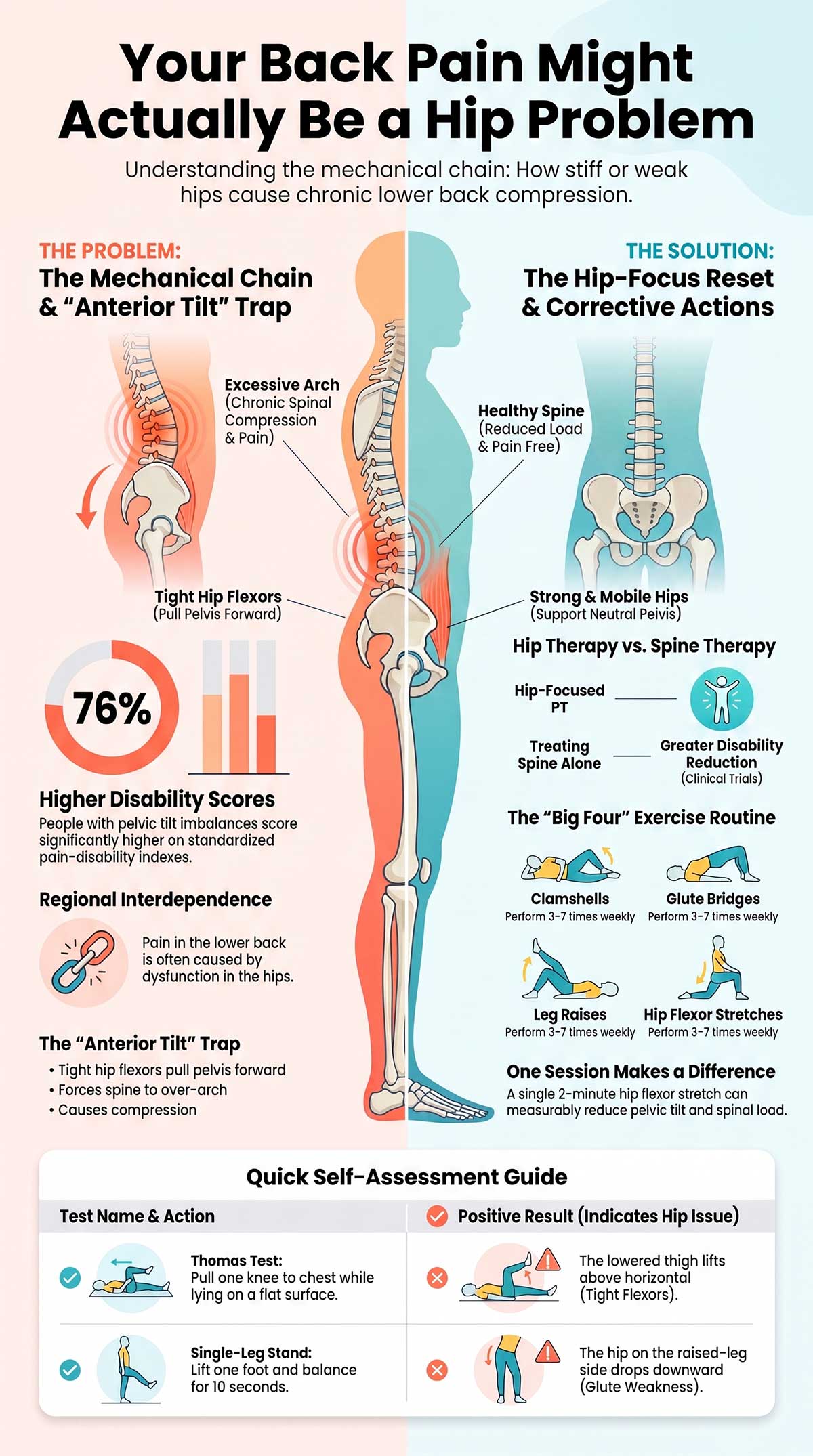
Your lower back doesn’t work alone. It sits between your mid-back above and your hips below, and it depends on both to share the load of movement. When your hips stop doing their job, your lower back picks up the slack. Every step. Every shift in weight. Every time you get up from a chair.
This is called regional interdependence, the clinical observation that pain in one area is often caused by dysfunction somewhere else. A clinical commentary in the Journal of Orthopaedic and Sports Physical Therapy addressed this pattern directly, noting that hip joint dysfunction is a frequently overlooked contributor to lower back pain. Despite clear evidence of a hip-lumbar connection, most clinical treatment still targets the spine.
Think of it like a leaking pipe: you can keep mopping the floor, but until you fix the pipe, the water keeps coming.
This misalignment in treatment doesn’t reflect stubbornness on the part of clinicians. Lower back pain when standing is one of the most common complaints in clinical practice, and the structural explanation (a disc, a nerve, a vertebra) is easier to image than a movement pattern. But imaging misses the compensations that load a healthy spine until it hurts.
The Mechanical Chain
Your lumbar spine connects directly to your pelvis, which sits on top of your hips. When the hips are stiff or weak, the pelvis tilts forward, and the lower back arches to compensate. Biomechanics research has established this chain clearly: limited hip extension forces the lumbar spine to extend more than it should, which places stress on the spinal joints even when the discs themselves are perfectly healthy.
That last part matters. You can have a normal MRI and still be in real pain. The problem is the mechanical load your hips are dumping onto your spine, one repetition at a time, every time you stand upright.
Why Standing Is Different
Sitting doesn’t require much from your hips. But standing, walking, and shifting your weight all demand full hip extension, the ability to open the hip joint forward. If that range of motion is limited, your pelvis compensates. Your lower back arches. The joints and soft tissue at the back of your spine get compressed every time you’re upright.
The spine is being loaded specifically in the position that demands the most from your hips. Lying down asks nothing of the hip extensors. Standing asks everything. That’s not a coincidence: it’s a diagnostic.
What if the Pain Is Only on One Side?
The hip-lumbar pattern described in this article tends to be bilateral: the hips are tight or weak on both sides, the pelvis tips forward, and the compression is felt across the lower back rather than sharply to the left or right. If your ache is more diffuse and consistently worse when you’re upright, that profile fits.
One-sided lower back ache can still involve a hip component. Hip strength and mobility are rarely identical on both sides, and the weaker or tighter hip tends to generate more compensatory load on that side of the spine.
But one-sided pain that doesn’t follow the standing-to-relieved-by-lying-down pattern may also point to the sacroiliac joint, local muscle strain, or in some cases kidney-related discomfort that has nothing to do with the spine or hips at all.
The self-assessments later in this article can help clarify which pattern applies to you. If your pain is strictly one-sided, sharp rather than achy, and doesn’t track with time on your feet, a clinical evaluation is the more reliable next step than a home exercise program.
The “Anterior Tilt” Trap: How Your Hips Pull Your Spine Out of Alignment
Picture a bucket of water balanced on your pelvis. A neutral pelvis keeps the bucket level. An anteriorly tilted pelvis, tilted forward, tips the bucket and spills water in front. That tilt doesn’t happen on its own. Tight hip flexors pull it there.
Your hip flexors are the muscles at the front of your hips. They connect your thigh to your lower spine and pelvis. When they’re tight, from long hours of sitting, from poor posture, from inactivity, they act like a shortened rope pulling the front of your pelvis downward.
The back of your pelvis rises. Your lower back arches. Every minute you spend standing, your lumbar spine is under a load it was never meant to carry alone.
One Stretching Session, Measurable Change
Researchers at Brigham Young University wanted to know whether hip flexor stretching could produce a measurable shift in standing posture, not over weeks, but after a single session. They enrolled 23 participants (all male, a limitation worth noting) and measured pelvic position before and after a targeted hip flexor stretching protocol.
The results, published in the Journal of Manipulative and Physiological Therapeutics, were more direct than most clinicians expected: passive hip extension increased by a mean of 2.6 degrees, and anterior pelvic tilt during relaxed standing decreased by 1.2 degrees, a statistically significant change measured while participants were simply standing still.
Not lying down. Not mid-movement. While standing still. That finding matters because it confirms the mechanism is real and immediate: one session of hip flexor stretching changes your standing posture in a measurable way. The sample was small, and replication in mixed-sex populations would be valuable, but the direction of the result aligns with what clinicians observe every day in physical therapy.
Pain with No Apparent Cause
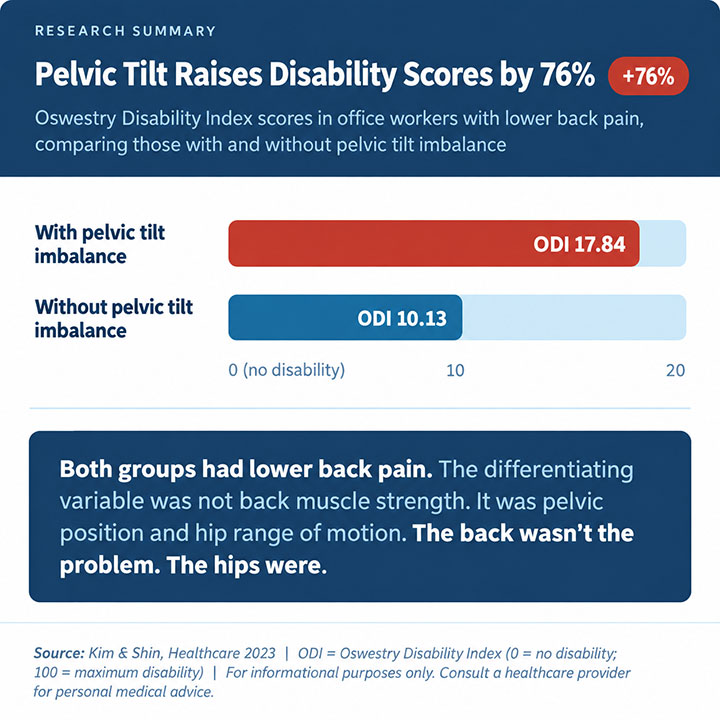
One of the most frustrating things about this pattern is that it doesn’t show up on imaging. A 2023 cross-sectional study published in Healthcare measured this gap directly. Office workers with lower back pain and pelvic tilt imbalance scored significantly higher on the Oswestry Disability Index, a standardized pain-disability measure, than workers without the imbalance: 17.84 versus 10.13.
They also showed reduced hip range of motion. The critical detail is what was not driving the difference: back muscle strength. The pelvis and hips were the variable. The back muscles were not.
If you’ve been told your back looks fine, but you still hurt when you stand, this is likely why.
The Sit-to-Stand Struggle: What Your Movement Reveals
Watch someone with hip-driven lower back pain try to stand up from a chair. It’s a tell. They lean further forward than necessary. They push off with their arms. They take longer to get fully upright. These aren’t signs of weakness in any simple sense. They’re the body routing around a system that isn’t doing its share.
A 2024 systematic review of 54 studies in BMC Musculoskeletal Disorders confirmed this pattern across the literature. People with lower back pain consistently showed reduced hip range of motion, particularly hip internal rotation, along with measurable hip abductor and extensor weakness and significantly altered movement mechanics during sitting-to-standing transitions. Sit-to-stand velocities were slower. The movement pattern had changed because the hips couldn’t pull their weight.
Fifty-four studies, and the picture they assembled was the same one any physical therapist sees in clinic every week.
When the Glutes Go Quiet
When your hips can’t extend fully, your body improvises. Weight shifts forward over the legs, the hip muscles contribute less, and the lower back takes up the difference. Over months and years, that workaround calcifies into the default movement pattern. The hips aren’t weak in the way an injured muscle is weak. They’ve simply been excused from the job for so long they’ve stopped volunteering for it.
This is sometimes described clinically as gluteal amnesia: the hip muscles stop firing in the right sequence. The glutes and hip abductors, which should stabilize the pelvis and drive your movement, stay quiet. The lower back tightens to fill the gap. The forward lean isn’t a quirk of your posture or a sign you need to stand straighter. It’s a compensation pattern with a mechanical cause.
You can’t undo years of compensation overnight, but you can interrupt the pattern right now.
A 2-Minute Posture Reset: Fast Relief for Standing Pain
Before working on long-term strength, there’s something you can do right now. It won’t solve the underlying problem, but it gives you immediate feedback and, for most people, immediate relief.
The Half-Kneeling Hip Flexor Stretch
This is one of the most direct ways to reduce anterior pelvic tilt and lower back compression during standing. The tailbone tuck in step 3 is the difference between stretching your thigh and actually changing how your pelvis sits on your hips.
- Kneel on your right knee on a soft surface. Place your left foot flat on the floor in front of you, knee bent at 90 degrees.
- Keep your torso upright. Do not lean forward.
- Tuck your tailbone under slightly, as if you’re trying to flatten the arch in your lower back.
- Gently shift your weight forward until you feel a stretch in the front of your right hip and thigh.
- Hold for 30 to 60 seconds. Breathe steadily. Switch sides.
If you feel the stretch in the front of your thigh and notice your lower back relax slightly, you’ve found the right position.
The Standing Pelvic Reset
Once you’re upright, try this: stand with your feet hip-width apart. Gently draw your lower belly in and tuck your tailbone slightly downward, as if bringing your hip bones up toward your ribs. Hold for 5 seconds. Breathe normally.
This briefly unloads the lumbar joints by reducing the forward arch. It won’t last long. Your hip flexors will pull the pelvis back. But it shows you what neutral feels like and confirms that hip tightness is contributing to your pain.
The 8-Week Fix: Building the Support Your Back Needs
Quick relief is useful. But the real answer is building hip strength and control so they can do their job without offloading stress onto your spine.
Why the Glutes Are the Starting Point
Your gluteus maximus is the largest and most powerful hip extensor. Your gluteus medius and minimus stabilize your pelvis whenever you’re on one leg, which is every step you take. When these muscles are weak or underactive, the pelvis drops and shifts with every stride, loading the lower back unevenly. Targeting them is about giving your lumbar spine a stable base to work from, not aesthetics.
What Seven Trials Found
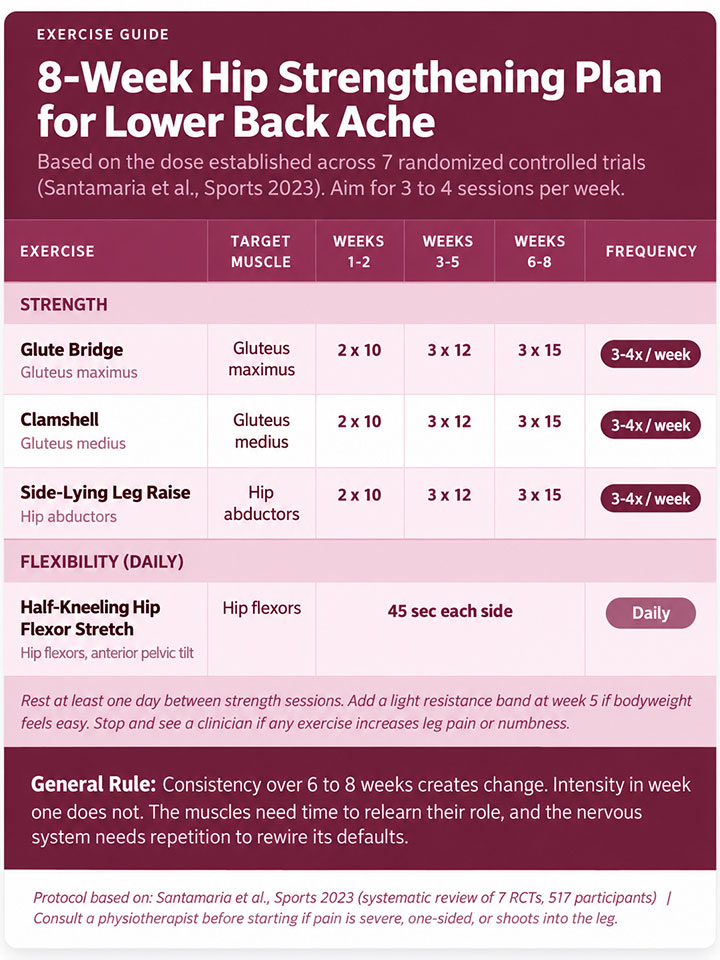
A 2023 systematic review in Sports pooled the results from seven randomized controlled trials covering 517 participants to answer a direct question: does hip strengthening reduce pain and disability in people with lower back pain? Five of the seven trials showed statistically significant improvement compared to control groups.
What’s notable is the consistency, not just the direction of the result. Seven trials across different populations and clinical settings, and five of them pointed the same way. The effective dose across those trials ranged from three to seven sessions per week over six to eight weeks.
That frequency matters for a specific reason. The goal extends beyond muscle strength: retraining the neural patterns that govern which muscles fire first and in what order. Your nervous system needs repeated practice to rebuild those defaults. Three sessions a week is the minimum. More frequent practice gets the movement pattern re-established faster.
Hip-Focused vs. Spine-Focused Treatment: A Head-to-Head Test
The strongest piece of evidence for this approach comes from a 2024 randomized controlled trial published in Lancet Rheumatology and funded by the National Institute on Aging. The MASH trial enrolled 184 older adults with chronic lower back pain who also had documented hip pain or weakness, and randomized them to either hip-focused physical therapy or spine-focused physical therapy.
The hip-focused group achieved greater reductions in disability, with secondary-outcome gains in chair-rise performance at six months and walking endurance on the six-minute walk test. The trial’s own investigators described the between-group difference as modest but consistent.
What the trial establishes matters more than any single number. When hip impairment is part of the picture, the standard treatment target, the spine, is often the wrong one. This finding comes from a major funding body, a top-tier journal, and a direct head-to-head design.
It has been slow to change routine clinical practice. That says more about how medicine adopts new protocols than it does about the quality of the evidence. Clinicians still reach for spine-first treatment partly out of habit, partly because imaging makes the spine the obvious diagnostic focus, and partly because the hip-lumbar connection only became a formal research priority in the last decade.

A Basic Starting Framework
These four exercises target the key structures identified across the trial literature. Start with 2 sets of 10 to 15 reps per exercise, three times a week. Add a third set in week three as the movements begin to feel easier.
- Clamshells: Lying on your side, feet together, knees bent. Raise the top knee like a clamshell opening. Targets the gluteus medius.
- Glute bridges: Lying on your back, feet flat, knees bent. Press through your heels to lift your hips toward the ceiling. Targets the gluteus maximus.
- Side-lying leg raises: Lying on your side with a straight top leg. Raise it to about 45 degrees and lower with control. Targets the hip abductors for pelvic stability.
- Half-kneeling hip flexor stretch: Daily, to counteract the pelvic pull that drives lumbar compression. Hold each side for 45 to 60 seconds.
Consistency across six to eight weeks is what creates change, not intensity in week one. The muscles need time to relearn their role, and the nervous system needs repetition to rewire its defaults.
Is This You? How to Check at Home
Not all lower back ache is hip-driven. But if yours worsens when you stand and eases when you lie down, the pattern is worth checking. Two simple assessments take about two minutes total and can tell you which part of the hip-lumbar picture applies to you.
Hip vs. Spine Self-Check
Answer 5 questions to see whether the hip-lumbar pattern in this article matches your situation.
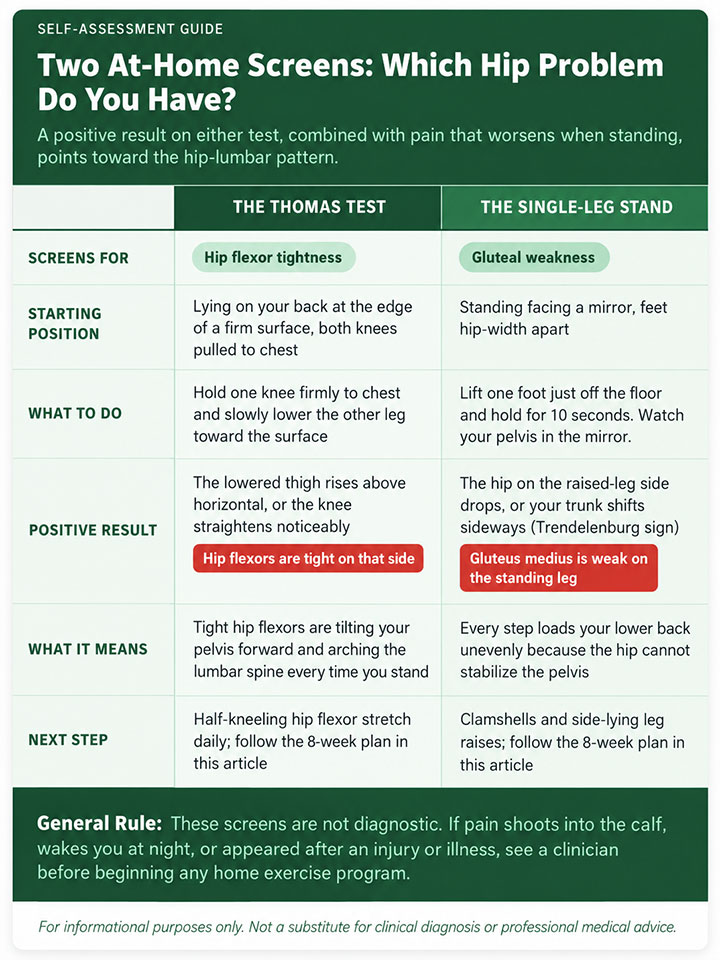
The Thomas Test: Screening for Hip Flexor Tightness
This screens for the mechanical driver of anterior pelvic tilt.
- Sit at the edge of a firm chair or bed pushed against a wall.
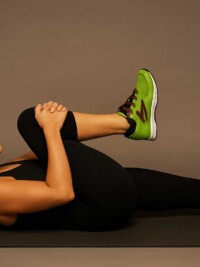
- Lie back and pull both knees to your chest.
- Hold one knee firmly to your chest and slowly lower the other leg toward the surface.
- A positive result: the lowered thigh lifts above horizontal, or the knee extends noticeably. This suggests the hip flexors on that side are tight.
Testing positive on one or both sides, combined with pain that is worst when standing, is a strong indicator that hip tightness is contributing to your lower back ache.
The Single-Leg Stand: Screening for Gluteal Weakness
- Stand in front of a mirror with feet hip-width apart.
- Lift one foot just off the ground and hold for 10 seconds.
- Watch your pelvis. Does the hip on the raised-leg side drop? Does your trunk shift sideways to compensate?
A dropping hip, called a Trendelenburg sign, indicates weakness in the gluteus medius on the standing leg. Because every step involves a brief single-leg stance, this weakness is loading your lower back thousands of times a day without you registering it as a hip problem at all.
These two tests screen for the most common hip-lumbar pattern, but they are not diagnostic. If your pain runs into your calf, wakes you at night, appeared after a fall or illness, or is accompanied by bladder or bowel changes, skip the home exercises and see a clinician.
Those signs may point to nerve involvement or structural spinal pathology that needs direct clinical evaluation. A history of cancer, infection, or osteoporosis is also a reason to get a professional assessment before beginning any self-directed exercise program.
Rethinking Your Lower Back Ache
The default response to lower back pain has been the same for decades: image the spine, treat the spine, stretch the spine. And for a subset of patients, that’s exactly right. Structural pathology is real. But for the large proportion of people whose scans come back normal and whose ache arrives reliably on their feet and leaves when they’re off them, the spine is covering for a problem that starts somewhere else.
The evidence on this is unusually tidy for musculoskeletal medicine, a field where almost everything is contested. A single stretching session shifts pelvic tilt in a measurable way. Seven trials, pooled, point in the same direction. A head-to-head NIA-funded study put hip therapy directly against spine therapy and found a winner. That doesn’t happen often.
Start with a different question: not what’s wrong with your back, but what your hips have stopped doing, and for how long.