Most people who drink green tea for weight loss are drinking the wrong type, brewed at the wrong temperature, at the wrong time of day. The tea itself is fine. The gap is between what the research found and what the wellness industry decided to tell you about it.
The honest version of the science is more interesting than the marketing version. Green tea does appear to increase the rate at which the body burns fat. The mechanisms are real and reasonably well understood.
But a Cochrane systematic review that pooled 15 randomized controlled trials and nearly 2,000 participants found that the actual weight lost by people taking green tea preparations was very small, and probably not clinically meaningful on its own. That conclusion sits uncomfortably next to the supplement aisle.
What the research does say clearly is this: some green teas are measurably better than others for the specific compounds that drive those effects, how you brew matters more than most people realize, and for the people who do see results, consistency over months matters more than dosage. This guide covers what the evidence actually shows and what it doesn’t.
The Quick Answer: Which Green Tea Is Best for Weight Loss?
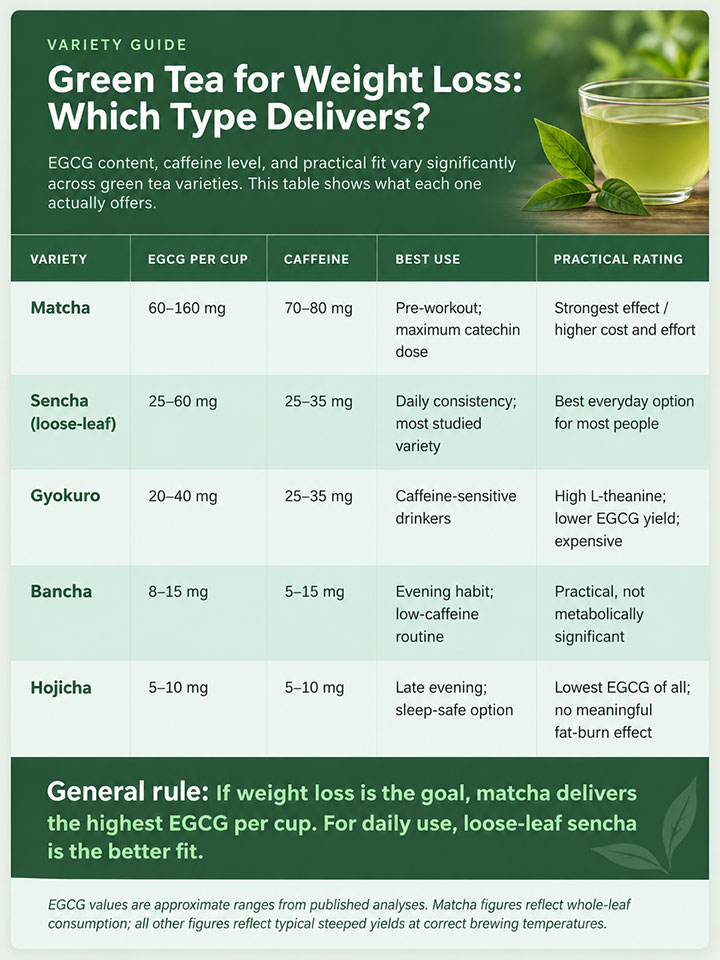
Matcha is the strongest option for weight loss because you consume the entire ground leaf rather than steeping it and discarding the leaves. That difference in preparation translates directly into EGCG concentration.
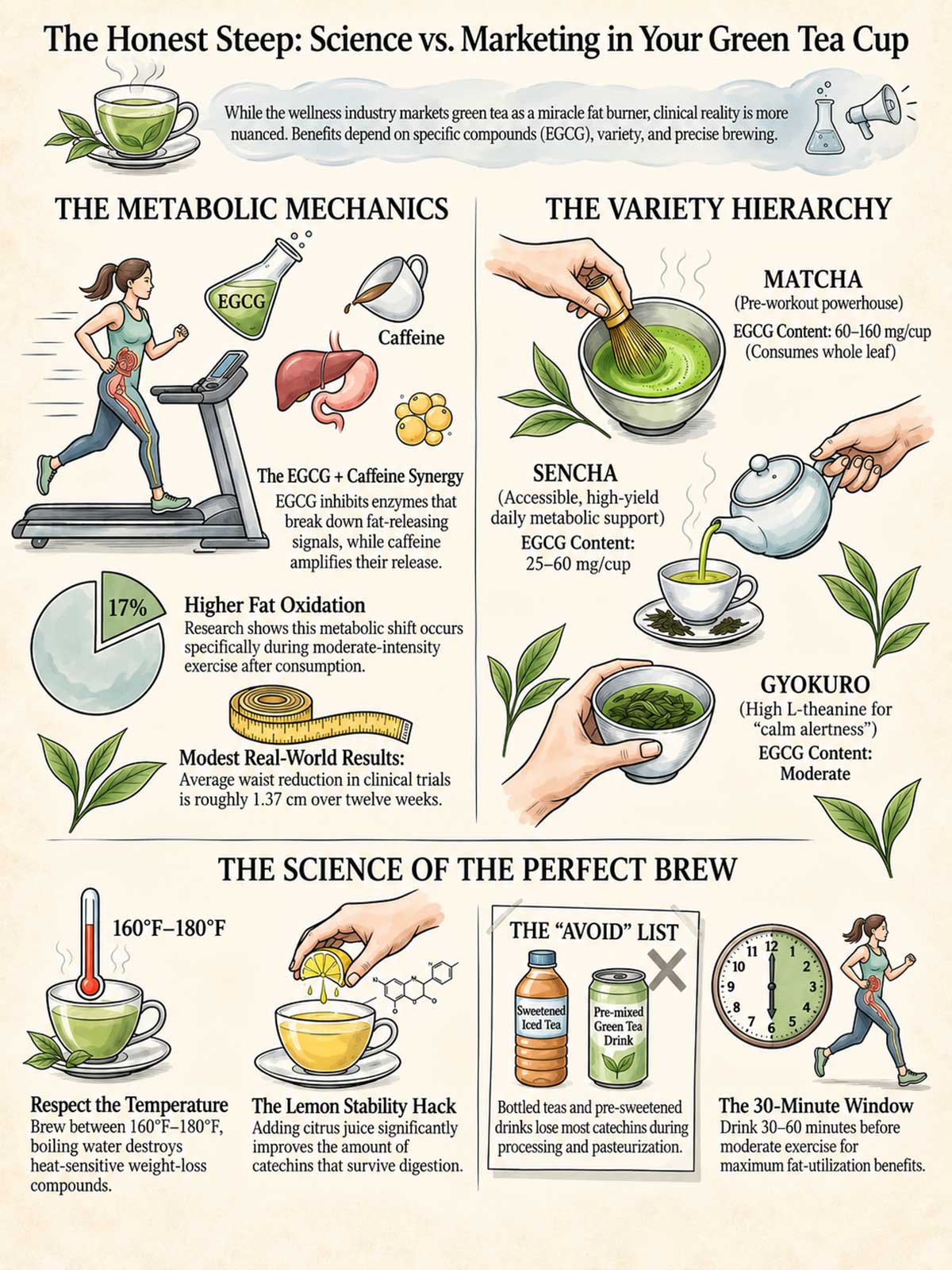
A 2008 study in the American Journal of Clinical Nutrition found that fat oxidation rates during moderate-intensity exercise were 17% higher after participants took green tea extract compared to a placebo. The extract used in that study contained EGCG at concentrations comparable to matcha, not a standard steeped cup.
For people who want something more practical as a daily drink, sencha is the better choice. It delivers meaningful EGCG levels at a fraction of the cost and preparation effort. It is also the variety most often used in the long-term trials where those modest effects were measured.
Three things work across both: drink it unsweetened, keep to two to four cups per day, and treat it as a supporting strategy alongside reduced calorie intake and movement rather than a replacement for either.
How Green Tea Actually Affects Metabolism
Two compounds do most of the work: EGCG and caffeine. Neither is remarkable in isolation. Together, they produce a measurable effect on energy expenditure that neither achieves alone.
EGCG inhibits catechol-O-methyltransferase, an enzyme that breaks down norepinephrine. More norepinephrine in circulation means a stronger signal to fat cells to release stored fatty acids. Caffeine amplifies this by triggering additional norepinephrine release through a different pathway.
A 1999 study in the American Journal of Clinical Nutrition by Abdul Dulloo and colleagues at the University of Geneva was among the first to quantify this combined effect in humans, finding roughly a 4% increase in 24-hour energy expenditure.
A 2021 systematic review in Nutrients by Mariangela Rondanelli and colleagues examined 15 studies and found that green tea catechins consistently reduced the respiratory quotient (a measure of the ratio of fat to carbohydrates being burned as fuel) even at modest EGCG doses of 100 to 300 mg per day. The shift was modest but consistent.
The third compound worth knowing about is L-theanine. It doesn’t directly affect metabolism, but it appears to moderate the caffeine response in a way that produces calm alertness rather than jittery stimulation.
This matters for practical reasons: green tea is generally more comfortable to drink throughout the day than coffee, which may make consistent intake easier to sustain.
What the Evidence Actually Says About Weight Loss
Researchers still disagree on how meaningful the metabolic effects are in the real world. The intervention studies that found the clearest metabolic signals typically used concentrated green tea extract at EGCG doses far above what most people get from a few cups of brewed tea.
When the Cochrane review looked specifically at weight outcomes in people drinking green tea preparations as part of controlled trials, the weight lost was statistically significant in some populations but very small in absolute terms, and not likely to be clinically meaningful without a corresponding change in diet and activity.
Where the evidence is stronger is in the specific context of exercise. The 2008 American Journal of Clinical Nutrition trial, the fat oxidation study mentioned above, found that green tea extract shifted the body toward burning more fat relative to carbohydrates during moderate exercise. That’s a more specific and plausible claim than general weight loss, and it’s better supported by the mechanism.
Green Tea Varieties Ranked for Weight Loss
Matcha
Matcha is powdered whole-leaf green tea. Because you drink the entire leaf rather than steeping it, you get roughly 60 to 160 mg of EGCG per cup compared to 25 to 60 mg in a standard cup of sencha.
Some high-grade matcha from Japanese producers has been measured at up to 137 times the EGCG content of a standard steeped cup, though the range in commercially available matcha is wide and lower-quality culinary grades produce figures much closer to the upper end of sencha’s range.
The practical downside is cost and preparation. Ceremonial-grade matcha from a reputable Japanese producer runs significantly more than any other green tea option. Preparation requires whisking, ideally with a bamboo chasen.
And the flavor, rich, grassy, and slightly bitter, is not immediately appealing to people new to tea. These are reasons for considering sencha as the realistic daily option even if matcha has the stronger biochemical profile on paper.
Sencha
Sencha is the most widely consumed green tea in Japan and the variety most frequently studied in long-term intervention trials. It delivers meaningful catechin levels at a fraction of the cost of matcha and a flavor profile most people find more accessible.
High-quality loose-leaf sencha brewed at the right temperature produces a cup with measurable EGCG content that falls within the range where metabolic effects were observed in the research literature.
The brewing temperature is not a minor detail. Sencha brewed with boiling water destroys a significant portion of the catechins before they reach the cup. The correct range is 160 to 170 degrees Fahrenheit (71 to 77 degrees Celsius). Two to three minutes of steeping at that temperature extracts a better catechin yield than longer steeping at higher temperatures.
Gyokuro
Gyokuro is shade-grown for three to four weeks before harvest. The shading process increases L-theanine and chlorophyll production at the expense of some catechin development, which means gyokuro has a slightly different nutritional profile from sencha despite coming from the same plant.
Its higher L-theanine content produces a noticeably different cup: calmer, sweeter, and less astringent than sencha. For people who find caffeinated beverages produce anxiety or restlessness, gyokuro’s EGCG-to-L-theanine ratio may produce a more comfortable response than either sencha or matcha.
It is considerably more expensive than sencha and requires even lower brewing temperatures (140 to 160 degrees Fahrenheit) for one to two minutes. The flavor is something else entirely, genuinely sweet and almost broth-like in a way that nothing else in the green tea category produces.
But the cost and the ritual required make it a poor everyday option for anyone whose primary goal is the metabolic effect rather than the tea itself.
Bancha and Hojicha
Both are lower in caffeine and catechins than the other varieties. Bancha comes from the more mature leaves harvested later in the season, which produces lower catechin concentrations. Hojicha is roasted, and the roasting process further reduces EGCG while converting some catechins into other compounds.
They are genuinely good options for evening consumption or for people who need to limit caffeine, but they are not meaningfully useful for the specific weight-loss application this article addresses. Their role is practical, not metabolic.
Green Tea Forms: Which Delivers More EGCG?
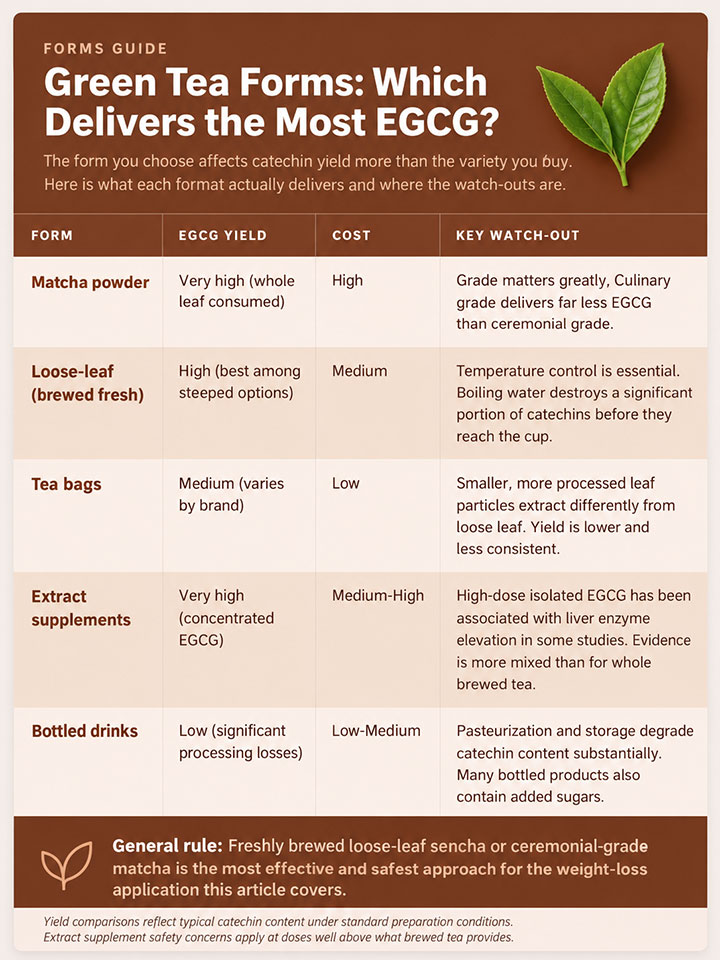
The form matters more than most people buying green tea products realize. Bottled green tea drinks are the most common purchase and the least effective option by a wide margin. Processing, pasteurization, and storage all degrade catechin content. Many bottled products contain added sugars that partially offset any metabolic benefit from the remaining EGCG.
Loose-leaf sencha brewed fresh preserves catechins best among the steeped options. Tea bags deliver acceptable catechin levels if the water temperature is controlled, though they typically contain smaller, more processed leaf particles that extract differently from loose leaf.
Green tea extract supplements contain highly concentrated EGCG, but the research on supplements is more mixed. Absorption rates vary significantly by formulation, and isolated high-dose EGCG supplements have been associated with liver enzyme elevation in some studies at doses well above what you get from brewed tea.
Whole brewed tea, including the natural caffeine and L-theanine, is a safer and more thoroughly studied approach.
How to Brew Green Tea for Maximum Catechin Yield
Temperature is the single most important brewing variable. EGCG is heat-sensitive, and boiling water (212 degrees Fahrenheit, 100 degrees Celsius) significantly degrades catechin content.
The target range across most green tea varieties is 160 to 180 degrees Fahrenheit, with the delicate Japanese varieties like gyokuro and high-grade sencha toward the lower end. If you’re boiling a kettle, let it rest for two minutes before brewing. Variable-temperature kettles eliminate the guesswork.
Steeping time matters less than temperature but is still relevant. Two to three minutes extracts a good catechin yield from sencha without excessive bitterness. Going to five minutes at the right temperature does not proportionally increase EGCG and makes the cup significantly more bitter. Cover the vessel while steeping to prevent beneficial volatile compounds from escaping with the steam.
For matcha, the preparation is different. Sift half to one teaspoon of matcha into a bowl, add two ounces of water at 175 degrees Fahrenheit (80 degrees Celsius), and whisk in a W or zigzag motion until frothy. Add additional water to taste. Drink it immediately, as matcha begins oxidizing once prepared.
One variable not on most brewing guides is what you add to the cup after steeping. Research from Purdue University found that adding citrus juice to green tea significantly improved catechin stability through the digestive process, with lemon juice the most effective option tested.
Without any protective agent, less than 20% of green tea catechins survive digestion in a bioavailable form. Citrus juice creates an acidic environment that inhibits catechin oxidation, and the recovery improvement was substantial.
A squeeze of fresh lemon is a legitimate addition to brewed green tea if catechin absorption is the goal. The vitamin C in lemon appears to be a large part of the mechanism.
When to Drink Green Tea for Weight Loss
The best evidence for timing comes from the exercise fat-oxidation research. The American Journal of Clinical Nutrition trial that found a 17% increase in fat oxidation had administered green tea extract 24 hours before exercise, and participants performed the exercise bout at moderate intensity (60% of maximal oxygen consumption).
Drinking green tea 30 to 60 minutes before a moderate-intensity workout is the best-supported timing for the specific metabolic benefit that this research identified.
For general consumption, the main constraint is caffeine. A cup of sencha contains approximately 25 to 35 mg of caffeine, well below the 95 mg in a typical cup of coffee, but enough to delay sleep if consumed within four hours of bedtime for caffeine-sensitive people.
Morning and early afternoon are the practical window for most people aiming for two to four cups per day. If you want something in the evening, hojicha or roasted bancha provide the habit without the sleep disruption.
Drinking green tea with iron-rich foods is worth avoiding if iron absorption is a concern. EGCG binds to non-heme iron and can reduce absorption from plant sources. This is not a meaningful issue for most people consuming a varied diet, but it’s relevant for vegetarians who rely heavily on plant iron.
How Many Cups Per Day?
The metabolic research generally used EGCG doses of 100 to 400 mg per day, which translates to roughly two to four cups of well-brewed sencha, or one to two cups of matcha.
Benefits appear to plateau at five to six cups per day, and higher intake increases the risk of side effects including nausea, sleep disruption, and in some sensitive individuals, elevated liver enzymes from very high EGCG concentrations.
Starting with one to two cups and increasing gradually allows most people to identify their tolerance before committing to four daily cups.
The Honest Weight-Loss Math
A 2023 meta-analysis in Heliyon, pooling 11 randomized controlled trials in 613 overweight and obese participants, found that green tea catechin supplementation reduced waist circumference by a mean of 1.37 cm (roughly half an inch) over the study periods.
The trials varied in duration, but most ran eight to twelve weeks. That half-inch reduction is real and statistically significant. It is also roughly the circumference change that comes from wearing slightly different clothing in the morning. Green tea appears to work. The effect size matters.
Three to four cups of well-brewed green tea per day might contribute 50 to 80 extra calories burned. Over months, that accumulates. It does not accumulate faster than a diet that remains at a caloric surplus.
Green Tea vs. Ozempic and GLP-1 Drugs: What’s Actually Being Compared?
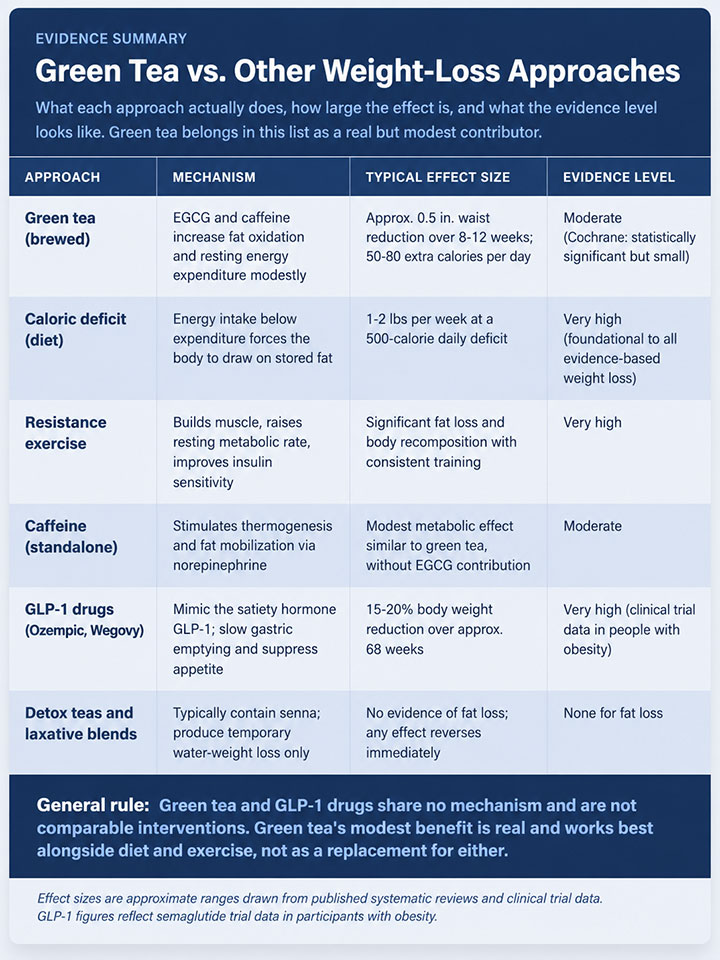
GLP-1 receptor agonists like semaglutide (Ozempic, Wegovy) work by mimicking a hormone that signals satiety and slows gastric emptying. Clinical trial data show average weight loss of 15 to 20% of body weight over 68 weeks in participants with obesity.
Green tea has no meaningful mechanism in common with GLP-1 agonists. It does not affect satiety hormones, gastric emptying, or appetite suppression at the doses available from tea.
The comparison comes up because both green tea and GLP-1 drugs are associated with the phrase “weight loss support,” and some marketing content has positioned green tea as a natural alternative to weight-loss medications.
The evidence does not support that framing. They are not in the same category of intervention, and positioning them as alternatives misrepresents what either one does.
What green tea does well is different and genuinely useful: it shifts fuel utilization toward fat during exercise, produces modest increases in energy expenditure, and replaces caloric beverages without requiring willpower. Those are real, achievable benefits. They are not GLP-1 drug benefits.
Potential Side Effects and Who Should Take Care
Most people drinking two to four cups of green tea per day experience no adverse effects. The side effects that do appear tend to cluster around higher intake or concentrated extract supplements rather than brewed tea.
Nausea is the most common complaint, and it’s almost always associated with drinking green tea on an empty stomach. The catechins and tannins in green tea can irritate an empty digestive tract in some people. A small amount of food before or with green tea resolves this in most cases.
Caffeine sensitivity affects a subset of people who experience anxiety, headaches, or sleep disruption at doses that most people tolerate easily. Gyokuro, bancha, and hojicha all deliver significantly lower caffeine than sencha or matcha and are worth considering for caffeine-sensitive people who want the other benefits.
Green tea interacts with several medications, including blood thinners (green tea has mild antiplatelet activity), stimulant medications (combined caffeine effect), and some antidepressants. Anyone taking prescription medications regularly should check with a physician before adding significant amounts of green tea to a daily routine.
Common Myths About Green Tea and Weight Loss
The most persistent myth is that green tea melts fat. It doesn’t. It modestly shifts the ratio of fat to carbohydrates the body uses for fuel during exercise and slightly increases the rate of calorie burning at rest. That’s useful. “Melting fat” is not what the mechanism describes.
The second myth is that more green tea produces proportionally more weight loss. The relationship is not linear. The metabolic effect plateaus well before anyone reaches problematic consumption levels, and drinking eight cups per day does not produce twice the effect of four. It produces similar metabolic effects with meaningfully more caffeine and more irritation to the digestive tract.
The third is that organic certification means higher EGCG content. It doesn’t. Organic certification addresses pesticide use in cultivation, not the catechin profile of the final product.
A high-quality conventional sencha from a reputable Japanese producer may contain more EGCG than an organic tea bag from a source with poor quality control. Origin, freshness, variety, and brewing method determine EGCG content far more than organic status.
A Buyer’s Guide That Makes Distinctions
For matcha: look for ceremonial-grade from Japan (Kyoto, Nishio, or Uji are the primary producing regions), a rich, bright green color in both the tin and the prepared cup, and a harvest date within the current or previous year.
Dull color indicates oxidation, which means EGCG degradation has already occurred. Ippodo and Encha are consistently reliable producers. Culinary-grade matcha works for recipes but delivers less EGCG per cup.
For sencha: prioritize loose leaf over tea bags, Japanese origin over Chinese (Japanese producers maintain stricter pesticide testing), and check for a harvest date rather than just a “best by” date. Freshness is not cosmetic. Catechins degrade over storage. Rishi Tea and Ippodo both produce reliably good sencha at different price points.
For both: avoid anything that emphasizes flavor additions, pre-sweetened preparations, or blends with other ingredients. The compounds you are trying to consume are in the plain tea. Everything added to it is competing for that cup.
Which Green Tea Fits You?
Answer three questions and get a personal recommendation based on your caffeine tolerance, daily schedule, and primary goal.
Conclusion
The Cochrane review’s conclusion (that green tea produces small and probably not clinically significant weight loss on its own) is the most honest summary of where the evidence stands. It’s also not the whole picture.
The fat-oxidation research during exercise, the modest but consistent metabolic effects, the practical value of replacing caloric beverages with something that actively supports the body’s fuel-burning during activity: these are real benefits that the “don’t bother, it doesn’t work” reading undersells.
Green tea doesn’t work the way the supplement aisle says it does. It works differently and more modestly, and for people who understand what it actually does, it’s worth the cup.
FAQs
Which tea burns the most belly fat?
No tea spot-reduces fat from specific areas. The body draws from fat stores throughout the body in a pattern that’s largely determined by genetics and hormones, not by what you drink. Matcha green tea has the strongest evidence for supporting fat oxidation during exercise, which contributes to fat loss over time when combined with a caloric deficit.
Which green tea is most effective for weight loss?
Matcha, because you consume the whole leaf and therefore the full EGCG content rather than an infused fraction of it. For daily sustained use, high-quality loose-leaf sencha is a more practical and economical choice with meaningful catechin levels.
What happens if you drink green tea every day for 30 days?
You’ll likely notice some improvement in energy levels and a modest increase in metabolism, particularly if you’re replacing other caffeinated or sweetened beverages with it. Measurable changes in body composition from green tea alone typically require consistent use over eight to twelve weeks, not thirty days, and they’re more pronounced when combined with dietary changes and exercise.
Will I lose belly fat if I drink green tea every day?
Green tea can contribute to fat loss when combined with a caloric deficit and physical activity. The 2023 Heliyon meta-analysis found about half an inch of waist circumference reduction over roughly eight to twelve weeks in participants using green tea catechins. That effect is real and meaningful, but not sufficient as a standalone intervention.
What are the serious side effects of drinking green tea?
At typical consumption of two to four cups of brewed tea per day, serious side effects are uncommon. The concerns that do exist are concentrated in supplement use (concentrated EGCG supplements have been associated with liver enzyme elevation in some studies, particularly at very high doses), high-volume consumption in caffeine-sensitive individuals (anxiety, palpitations, insomnia), and interactions with specific medications including blood thinners and stimulants. Nausea on an empty stomach is the most common complaint from regular green tea drinkers and is usually resolved by drinking tea with food.
What is the best time to drink green tea for weight loss?
Thirty to sixty minutes before moderate-intensity exercise, based on the fat-oxidation research. Second best is mid-morning after breakfast for a metabolic lift without the empty-stomach nausea risk. Avoid within four hours of bedtime if you’re caffeine sensitive.
Is bottled green tea as effective as brewed?
No. Bottled tea products lose a significant portion of their catechin content during pasteurization and storage. Many also contain added sugar that partially offsets any caloric benefit. Freshly brewed loose-leaf tea or matcha is substantially more effective for the specific metabolic goals this article addresses.
Can I drink green tea on an empty stomach?
Some people can without issue. Others find the tannins and catechins irritating on an empty stomach, leading to nausea. If you’re starting a green tea routine, have a light snack first until you know your tolerance.
Will adding lemon reduce its effectiveness?
The opposite. Citrus juice creates an acidic environment in the digestive tract that preserves catechins through digestion. Research from Purdue University found that lemon juice was the most effective of several substances tested for improving catechin stability. A squeeze of lemon in brewed green tea is a legitimate strategy for improving absorption, not a compromise.
How much weight will I lose if I only drink green tea?
Drinking only green tea for any significant period is not a recommended or safe approach to weight loss. Within a calorie-controlled diet and consistent exercise routine, green tea may contribute to roughly one to three pounds of additional loss over three months. The emphasis is on “additional” relative to the diet and exercise program, not on green tea as the mechanism.
What can I drink in the morning to support fat loss?
Matcha or sencha prepared without sweeteners, ideally 30 minutes before morning exercise. A squeeze of lemon improves catechin absorption. Plain water remains the single most effective morning drink for supporting metabolism and appetite regulation, and green tea is best understood as a complement to adequate hydration rather than a replacement for it.