Walking is usually framed as the safer choice than staying in bed with sciatica. But there’s a reason the same advice can work for one person and backfire for another.
Almost every piece of advice about sciatica tells you the same thing: walk more. The confidence behind that instruction is striking given that the trial evidence specifically for sciatica is thinner than the tone implies.
A Cochrane review of ten randomized controlled trials found that, for people with confirmed sciatica, there was little or no difference in pain or function between advice to rest in bed and advice to stay active. Walking is still worth doing, though the case for it rests more on avoiding the known harms of bed rest than on proven acceleration of nerve recovery.
There is also a more pressing problem buried in the advice. A meaningful share of people searching this question don’t have sciatica at all. They have a look-alike condition where walking consistently makes the pain worse, and giving both groups the same advice extends rather than shortens their recovery.
What Walking Does for the Sciatic Nerve
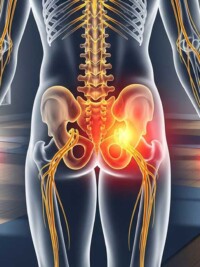
The sciatic nerve runs from the lower lumbar spine all the way down the back of each leg, a path long enough that a problem at one small disc level can produce pain somewhere that feels impossibly distant from its source. When a herniated disc presses on a nerve root, the result is the shooting pain, numbness, or tingling most people recognize as sciatica.
Walking doesn’t fix that compression. What it does is interrupt several of the processes that make compression worse over time. Spinal discs have no direct blood supply of their own, so they depend on movement to draw in oxygen and nutrients while flushing out the inflammatory compounds that accumulate around irritated nerve tissue.
Walking also prevents a secondary problem that commonly develops when people rest completely after a flare: deconditioning. The muscles that stabilize the lumbar spine, particularly those in the core and hips, weaken quickly with disuse. Weaker support means more load through the affected disc, which can extend the original compression rather than allow it to resolve.

What the Research Actually Shows
The assumption that walking helps sciatica is widely held, but the evidence behind it is worth examining directly. That Cochrane review pooled data from ten trials and more than 1,900 participants. For the subgroup with general low back pain, staying active produced modest benefits.
For the subgroup with confirmed sciatica, defined as back pain with verified neurological deficits, the difference between moving and resting was small and inconclusive.
This doesn’t mean walking makes sciatica worse. The review found no clear harm from movement, and the honest interpretation, one consistent with NICE guideline NG59 and similar clinical standards, is that walking is unlikely to delay recovery, and avoiding it probably will.
The evidence just doesn’t prove that walking speeds nerve healing in the way the confident advice tends to imply.
The strongest data in support of walking comes from a study that wasn’t about sciatica specifically. Dr. Natasha Pocovi and her team at Macquarie University in Sydney spent years tracking whether a walking program could prevent low back pain from coming back.
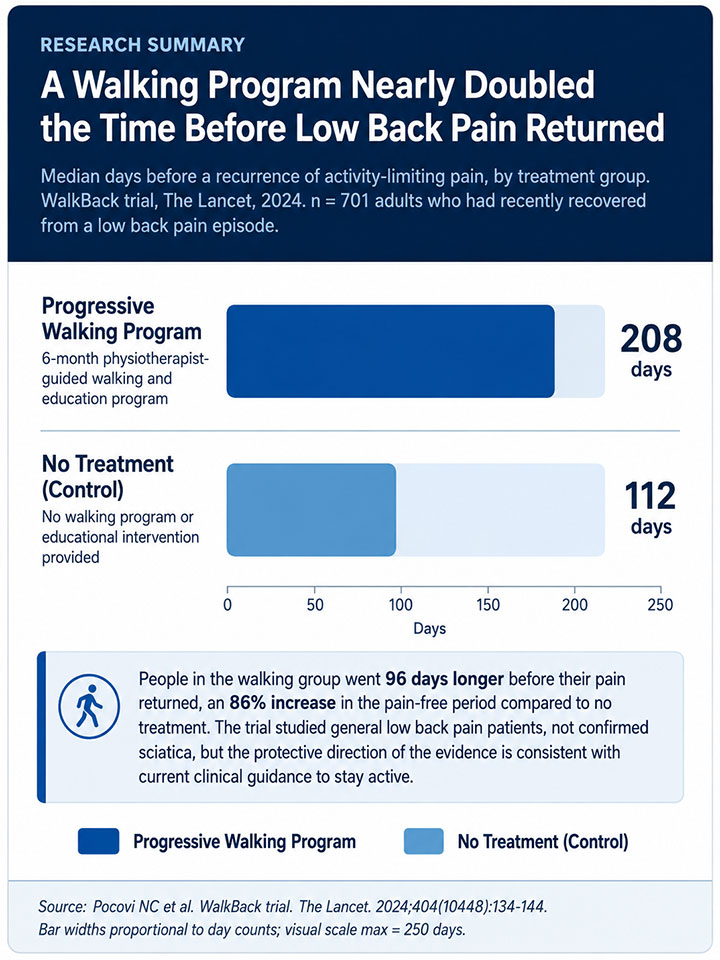
The WalkBack trial, published in The Lancet in 2024, randomized 701 adults who had recently recovered from a low back pain episode into a six-month, physiotherapist-guided walking and education program or a no-treatment control group.
People in the walking group went a median of 208 days before experiencing a recurrence of activity-limiting pain. The control group reached that point in 112 days.
The population was patients with general low back pain, not people with confirmed radiculopathy. But the effect size is meaningful, and the direction of the evidence is consistent: progressive walking is genuinely protective for people whose back problems keep returning.
How Much Walking Is Good for Sciatica?
This is the question almost everyone actually needs answered, and it’s the one most sources dodge with a single tip and no progression framework.
The working principle, drawn from physical therapy protocols for nerve root irritation, is short and frequent rather than long and ambitious. During an active flare, five to ten minutes on flat ground several times a day outperforms one thirty-minute walk. The reason is physiological: a sensitized nerve root responds poorly to sustained loading.
Most people do the opposite of this instinctively. If short walks help, the logic goes, a longer walk should help more. The nerve doesn’t agree.
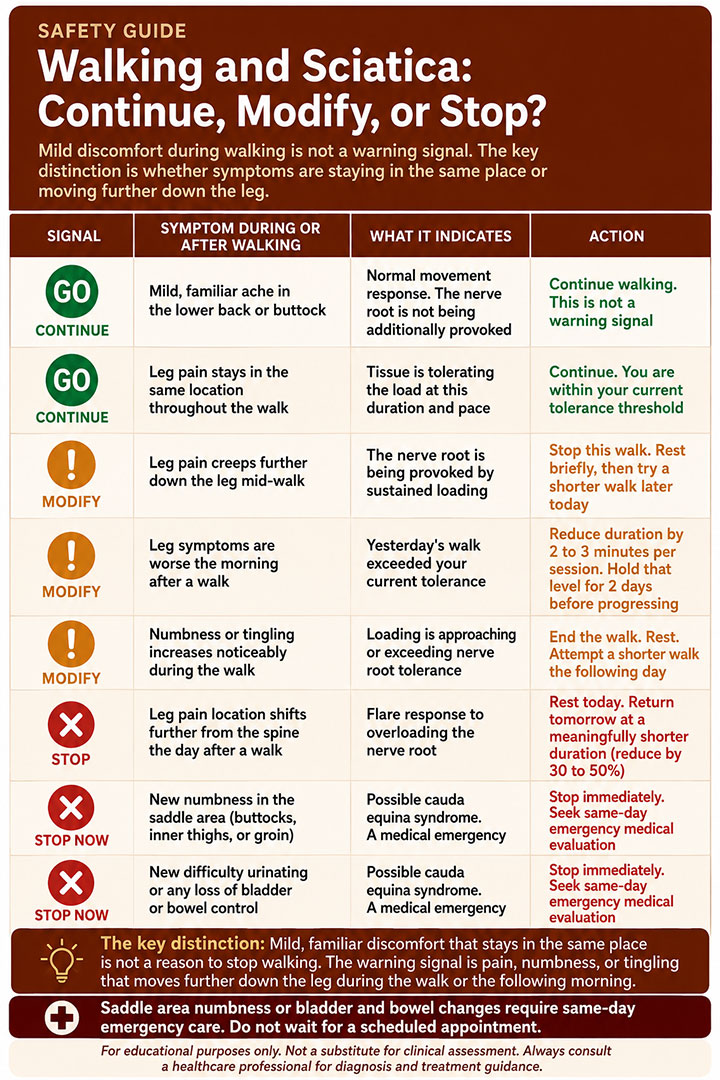
Symptoms that creep further down the leg during a walk, or that flare the next morning after a longer outing, are signals that the tissue is being provoked past its current tolerance. Shorter walks repeated throughout the day accumulate more total movement while staying below that threshold.
Progression should be slow and symptom-guided. Hold the duration steady until a given walk produces no increase in leg symptoms the following day, then add two to three minutes per session. If leg pain shifts further from the spine during a walk, or if numbness increases mid-walk, scale back rather than push through.
Stride length matters as much as duration. People with lumbar nerve root pain naturally shorten their stride, and matching that instinct reduces the lumbar extension that aggravates most disc-related compressions. A lightly engaged core, relaxed shoulders, and a neutral head position distribute spinal load more evenly.
Supportive footwear with adequate cushioning absorbs ground-impact forces that would otherwise travel directly up through the lumbar spine.
As for format, a treadmill on a flat setting is a reasonable substitute for outdoor walking when terrain is difficult. Gripping the handrails, though, locks the trunk, removes the arm swing that stabilizes walking posture, and converts the movement into a stiff-legged pattern that loads the lumbar spine rather than allowing it to decompress. Incline walking extends the lumbar spine, which can aggravate certain disc levels.
Brisk walking is fine once symptoms have settled, but speed is not the variable to prioritize first. Duration and frequency come before pace.
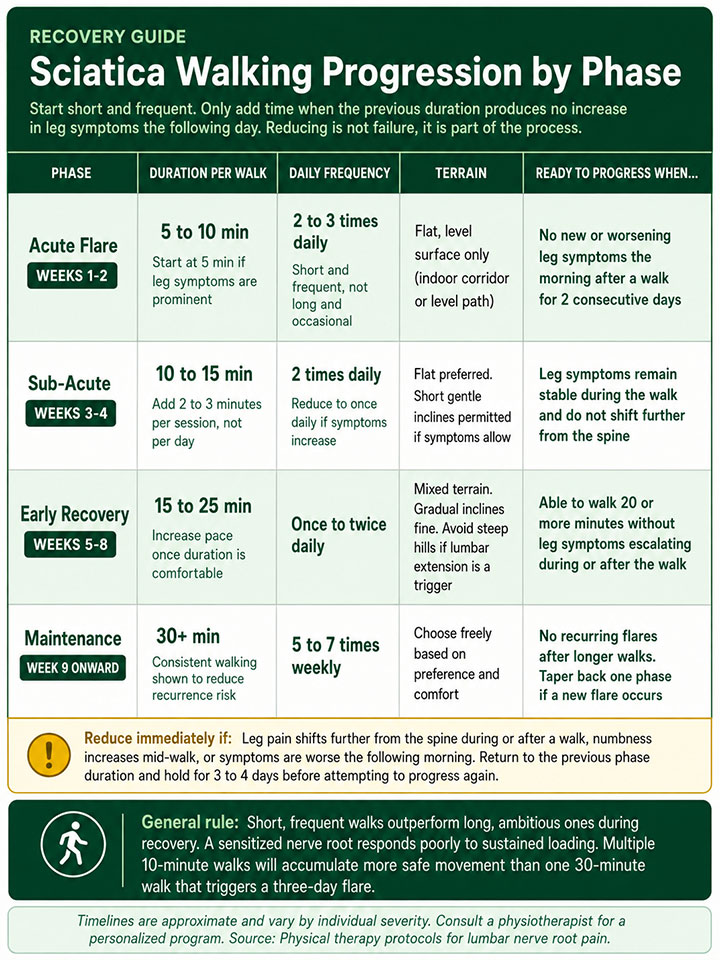
| Week | Duration Per Walk | Frequency | Terrain |
|---|
When Walking Makes the Pain Worse
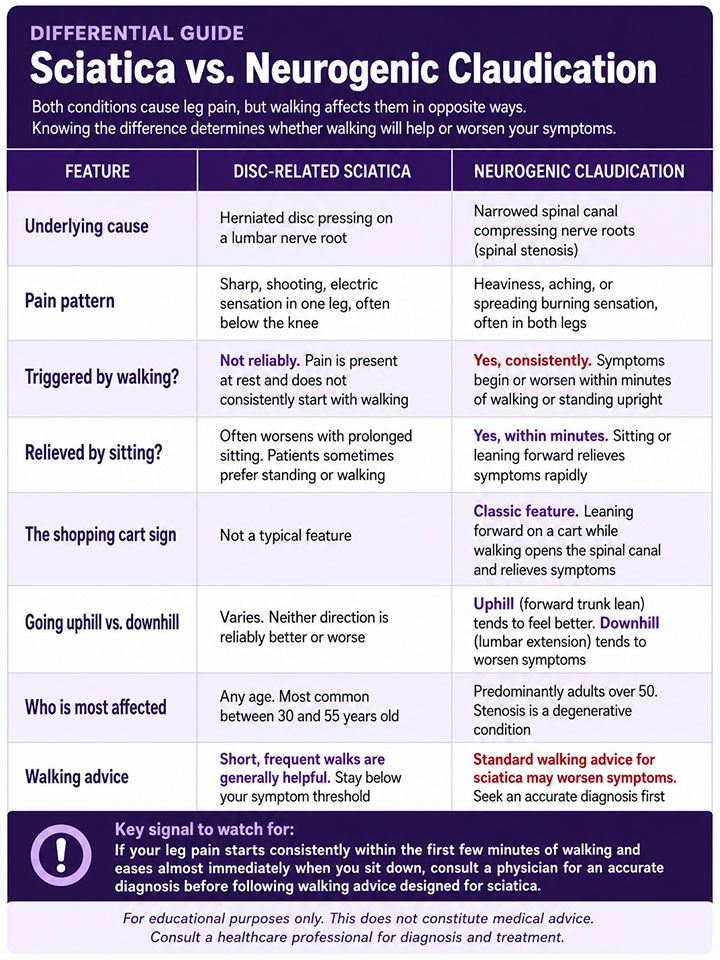
If your leg pain starts reliably with walking or standing and eases within minutes of sitting down, that pattern deserves a closer look before assuming the sciatica advice applies to you.
The condition that follows this pattern is neurogenic claudication, a symptom of lumbar spinal stenosis. Spinal stenosis is a narrowing of the spinal canal that compresses nerve roots from surrounding bone and tissue rather than from a herniated disc pressing from one side.
Where disc-related sciatica is not reliably triggered by walking and often worsens with prolonged sitting, neurogenic claudication does the opposite.
Standing upright extends the lumbar spine, which narrows the canal further and increases pressure on the compressed nerve roots. Forward flexion opens the canal and relieves symptoms almost immediately.
This is why people with neurogenic claudication instinctively lean on shopping carts while walking and feel fine going slightly uphill, where the trunk naturally flexes forward, but struggle going downhill, where the spine extends.
Neurogenic claudication tends to affect both legs rather than one side, and symptoms are often described as heaviness, aching, or a spreading burning rather than the sharp, shooting quality typical of disc-related sciatica.
The condition is substantially more common in adults over 50, since stenosis is a degenerative process. Researchers still don’t have a single clean diagnostic test for it in a primary care setting, so an accurate picture usually requires imaging alongside a physical examination.
If your pattern fits this description, the walking advice designed for disc-related sciatica may be doing the opposite of what you need. A physician can clarify which condition is present, and the management of neurogenic claudication requires a different discussion entirely.
Walking Safely During a Sciatica Flare
Most walking advice covers posture and footwear. Almost none of it addresses when to walk or for how long, and those two variables are usually what determine whether a walk helps or sets off three days of flare. These five adjustments address the full picture.
- Start on flat, even ground. Inclines require more lumbar extension or flexion, both of which can aggravate nerve root irritation depending on which disc level is affected.
- Shorten your stride. Smaller steps reduce lumbar extension and the load transfer through the affected disc.
- Engage the core lightly. A gentle, conscious contraction of the abdominal muscles as you walk acts as a natural spinal support.
- Walk earlier in the day when you can. Spinal discs are slightly more hydrated after a night of lying down and better able to absorb compressive load.
- Stop if leg symptoms worsen progressively during the walk. Mild discomfort is different from escalating neurological symptoms. The key signal is whether the pain, numbness, or tingling is moving further down the leg.
Warming up briefly before walking, a few minutes of gentle hip circles or standing knee lifts, can improve circulation in the surrounding musculature before any sustained load is applied. Cooling down with a short walk at a slower pace is more useful than stopping abruptly.
When to See a Doctor Instead of Walking It Off
Most sciatica resolves without surgery, and that context matters. The majority of people with disc-related sciatica improve with conservative management over weeks to months, without any intervention beyond movement, time, and avoidance of aggravating positions. Walking is part of that recovery for most of them.
Two scenarios, though, require immediate medical evaluation rather than a modified walking routine. The first is any new numbness in the saddle area, meaning the buttocks, inner thighs, groin, or genitals.
This pattern, combined with low back pain, suggests cauda equina syndrome (a compression of the nerve bundle at the base of the spinal canal) and requires same-day emergency evaluation.
New difficulty urinating, any loss of bladder or bowel control, or sudden weakness in both legs carry the same urgency. These are surgical emergencies, not symptoms that call for a shorter walk.
The second scenario is sciatica that has not improved at all after six to eight weeks of conservative care. A clinician can assess whether physical therapy, imaging, or a targeted spinal injection is warranted, and whether the original diagnosis still fits.
Some presentations that look like disc-related sciatica at the outset turn out to have a different underlying cause that a walking program alone won’t address.
What the Evidence Comes Down To
The consensus in favor of walking holds up more than it doesn’t, but it is stronger as a case against prolonged rest than as a case for any specific dose. The WalkBack trial’s 208-day finding comes from general low back pain patients, not confirmed sciatica, and the Cochrane review is genuinely equivocal on the distinction.
What the evidence does support is that staying still prolongs symptoms for most people, that short and frequent walks are safer than one long march that triggers a three-day flare, and that the sciatic nerve responds better to graduated load than to avoidance. Walking is good for sciatica, but the wrong prescription for a spinal canal too narrow to tolerate standing upright.