The most effective response to negative self-talk isn’t simply replacing bad thoughts with good ones. These five techniques take a very different approach.
The advice most people receive for negative self-talk is: Think positive. Reframe. Focus on the good. What the research actually shows is that telling yourself to think positively when you’re mid-spiral can make things worse.
That finding tends to land differently the second time you read it. The conventional remedy, the one people have handed each other for decades, can deepen the problem it’s supposed to fix.
The difference between the self-reflection that helps and the self-talk that harms isn’t always obvious from the inside. One builds awareness. The other chips away at it by degrees. What follows is what the evidence says about why that loop runs so deep, and what it takes to interrupt it.
Why Your Brain Defaults to the Negative
The brain was designed for survival, not happiness. Thousands of years of evolution built an alarm system tuned to scan for danger and social rejection, and that alarm system is still running today, even when the nearest threat is a difficult conversation at work.
Psychologists call this the negativity bias. It means the brain registers bad experiences more forcefully than equivalent good ones. A single critical comment from a coworker lands harder than three compliments from friends. That asymmetry is not irrational. It is wiring built for a world where missing a threat costs more than missing an opportunity.
Negative self-talk arrives through this same system in the form of Automatic Negative Thoughts, or ANTs. These are fast, involuntary mental reactions that feel like facts but are usually distortions. I’m not smart enough. Nobody likes me. I’ll never figure this out. ANTs arrive without invitation, and they carry the emotional weight of something true even when the content is not.
Breaking out is harder than getting in. The thoughts we think shape how we feel, and how we feel makes certain thoughts more accessible. A single critical thought drops the emotional register. That makes the next critical thought easier to reach, which drops the register further. Without a deliberate interruption, the loop runs.

What Changing Your Thinking Actually Requires
Cognitive Behavioral Therapy, or CBT, is one of the most studied psychological treatments in clinical history. Its core premise is direct: how you interpret an event, not the event itself, determines how you feel. Change the interpretation, and the emotional output changes with it.
The research base behind CBT is unusually large. A 2012 review by Stefan Hofmann at Boston University identified 269 separate meta-analyses on CBT’s effects across anxiety, depression, and eating disorders, with the strongest evidence concentrated in anxiety.
By 2023, a synthesis by Pim Cuijpers and colleagues had extended that picture considerably, pulling together 409 randomized trials and 52,702 patients in a single analysis. At that scale, the evidence is unambiguous: CBT works reliably, across populations, and the effect sizes are large enough to matter clinically.
CBT works partly because it interrupts the automatic connection between a trigger and a thought spiral. It trains the brain to slow down, examine a thought, and test its accuracy. With consistent practice, new thought pathways strengthen while old negative ones weaken. Researchers call this neuroplasticity, and it applies here in a practical rather than a motivational sense: the brain changes with repeated use, and patterns that fire least often are the ones that eventually fade.
Strategy 1: Reappraise the Event, Not Just the Feeling
Most people’s instinct when a negative thought arrives is to push it away. The assumption is that enough willpower can simply suppress unwanted thinking. Research consistently shows it backfires.
Thomas Webb and colleagues at the University of Sheffield set out to map how different emotion regulation strategies actually perform under controlled conditions. Their 2012 meta-analysis in Psychological Bulletin analyzed 306 experimental comparisons across studies. The results were specific enough to matter.
Suppressing the experience of a negative emotion, or suppressing thoughts about what caused it, produced a near-zero effect. Suppressing the outward expression of emotion fared somewhat better.
The most effective approach across conditions was reappraising how you interpreted the situation in the first place, particularly through perspective-taking, which produced the largest effects in the analysis.
Cognitive reappraisal means deliberately shifting the meaning you attach to a situation. A job rejection arrives. The immediate thought: I’m a failure, and I’ll never succeed. Reappraisal does not deny the disappointment. Instead, it asks: What can I take from this for next time? That shift, from threat to challenge, changes the emotional response that follows.
A 2010 study by Allison Troy at the University of Denver, published in Emotion, found that people with stronger reappraisal ability showed greater resistance to stress-induced depression. The participants had each experienced at least one significant stressful life event in the period before the study.
The skill acts as a buffer. Troy’s follow-up work added a qualification that matters: reappraisal works best when the stressor is one you cannot directly change. When the situation is actually controllable, reframing it can become a way of avoiding it. The technique is powerful and genuinely limited, which is useful to know before you rely on it.
Strategy 2: Name the Distortion
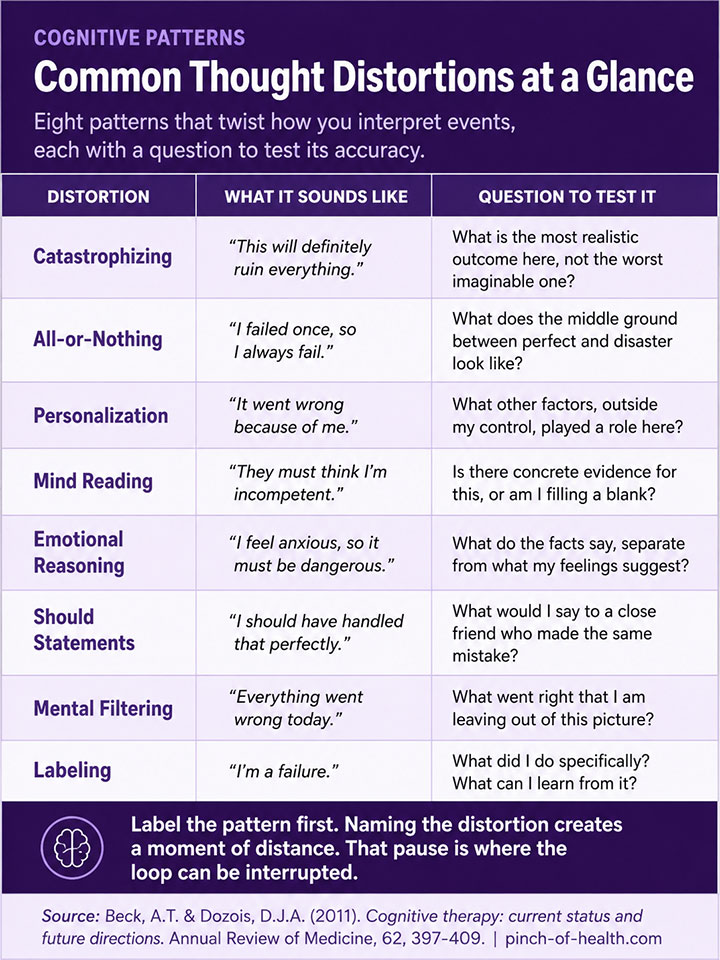
Not all negative thoughts are equally broken. Some are exaggerated. Some are selective. Some rest on a logic that collapses the moment you look at it directly.
Here is what the most common patterns look like in practice. Catastrophizing predicts the absolute worst outcome, then treats it as inevitable. A mildly awkward conversation becomes: everyone thinks I’m incompetent and I’m going to be fired.
All-or-nothing thinking leaves no middle ground, so a missed workout becomes proof of having no discipline, ever. Personalization assigns blame for outcomes that involve other people, bad timing, or plain luck: a friend cancels plans, and the immediate thought is I must have done something wrong.
Clinicians call these cognitive distortions. Aaron Beck, the psychiatrist who developed cognitive therapy at the University of Pennsylvania, mapped these distorted thinking patterns decades ago.
Beck and David Dozois at the University of Waterloo summarized the enduring framework in a 2011 review in the Annual Review of Medicine. What Beck established then still holds: catching a distortion in the act creates a split second of distance between you and the thought.
That pause is where the loop can be interrupted. When a sharp, self-critical thought arrives, label it: “That’s catastrophizing.” “That’s all-or-nothing thinking.” You don’t need to argue with the content. Naming the pattern is often enough to break the path the thought was automatically taking.
Strategy 3: Watch the Thought Without Following It
Picture your thoughts as clouds moving across a sky. You are the sky, not the clouds. Clouds appear, shift, and pass. They don’t define the sky, and you don’t need to reach for each one.
That image is the entry point to Mindfulness-Based Cognitive Therapy, or MBCT, which blends standard CBT techniques with mindfulness practice. The central idea is simpler than most people expect: you do not have to believe every thought you have. Thoughts are mental events, not verdicts. Watching them pass is a different act from wrestling with them.
Researchers Shian-Ling Keng at Duke University, Moria Smoski, and Clive Robins examined this directly in a 2011 review in Clinical Psychology Review covering multiple clinical and non-clinical studies on mindfulness practice.
The evidence showed two effects running at the same time: mindfulness reduced the overall frequency of automatic negative thoughts, and it made people significantly better at noticing those thoughts without being pulled into them.
Both outcomes appeared together, across studies. That second effect is often underplayed. You cannot let a thought pass if you cannot first see that you are having it.
The practical distinction is between engaging and disengaging. Arguing with a thought pulls you deeper into its content: But what if it IS true? What if they really don’t like me? That loop has no exit. Disengaging looks different: There’s that thought again. I don’t need to follow it. The thought passes without gathering momentum. The sky remains.
None of this comes easily when you’re already inside the spiral. That’s not a reason to skip the practice. It’s a reason to run it before you need it urgently.
Strategy 4: Change Who Is Talking
Something that sounds strange but has solid evidence: talking to yourself using your own name changes how your brain processes stress.
Jason Moser at Michigan State University and Ethan Kross at the University of Michigan tested this in two converging experiments that measured both EEG and fMRI brain activity. Their 2017 study in Scientific Reports found that third-person self-talk reduced emotional brain activity significantly faster than first-person reflection, and required no more cognitive effort.
Participants viewing disturbing images showed decreased activity in emotion-processing brain regions within roughly one second of switching to third-person language. The shift was automatic, not labored.
The mechanism is the same one that lets you give better advice to a friend than to yourself. When someone you care about makes the mistake you are currently flogging yourself for, you would respond with something measured and realistic.
Deliberately framing an internal question in the third person, using your own name, applies that same perspective inward without requiring you to manufacture distance you don’t feel.
A closely related practice is self-compassion. Self-criticism without compassion tends to produce shame, and shame is a poor motivator for anything genuinely useful. The aim is not to lower your standards. It is to engage with mistakes the way a fair person would, rather than the way a prosecutor would. That turns out to be more productive.

Strategy 5: Put the Thought on Trial
The thought that feels most certain is often the one most worth questioning. “Always” and “never” are reliable flags. Very few things in a person’s life are always or never true, and questioning the absolute language in a thought often reveals how little evidence there actually is underneath it.
One of the most practical CBT tools treats a negative thought the way a fair judge would treat a claim that needs proof. Three questions drive it:
- What is the objective evidence that supports this thought?
- What is the evidence against it?
- Is this thought helpful, or is it just hurtful?
The third question is often the most revealing. Even if a thought has a grain of accuracy, asking whether it serves any purpose changes your relationship to it. I made a mistake on that report may be factually correct. I’m terrible at my job and will always fail is neither accurate nor useful.
Irena Cristea and colleagues at Babe-Bolyai University published a 2015 meta-analysis in Clinical Psychology Review that examined CBT’s effect on dysfunctional thinking across multiple randomized controlled trials with adults experiencing depression.
Targeting cognitive distortions produced medium-to-robust improvements in dysfunctional thinking, and those improvements were strongly linked to reductions in depression symptoms. One finding from that review is worth stating plainly: CBT’s ability to change dysfunctional thoughts was not significantly different from other effective psychotherapies tested in the comparison.
The courtroom technique works. Whether it works because it is uniquely CBT, or because structured, deliberate thinking about the accuracy of a thought is simply effective regardless of the framework around it, is less clear. That ambiguity does not reduce its usefulness. It adds honesty to how it’s presented.
Which Inner Critic Is Loudest in Your Head?
Eight real-life scenarios. Five possible reactions each. One dominant pattern.
Each scenario below shows a situation most people encounter. For each one, choose the response that sounds most like what you would actually think, not what you wish you would think.
Your answers identify which of five inner critic patterns shows up most often in your internal dialogue:
- The Catastrophizer
- The Perfectionist
- The Comparator
- The Mind Reader
- The Self-Blamer
Takes about two minutes. No right or wrong answers.
What Kind of Inner Critic Are You?
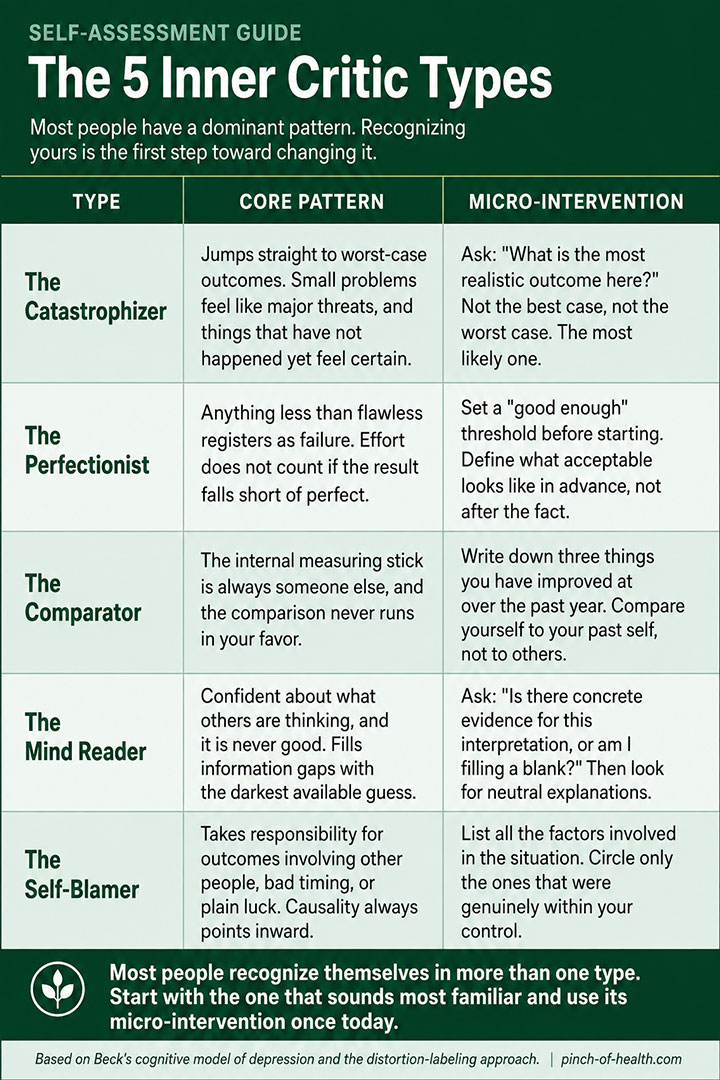
Most people have a dominant pattern. The inner critic is not the same voice for everyone. Review the five profiles below and notice which one sounds most like the commentary you hear most often.
The Catastrophizer jumps to worst-case outcomes as the default position. Small problems become large threats. Things that have not happened yet feel certain and imminent. This pattern often reflects hyperactive threat-detection: the brain’s alarm system firing at higher sensitivity than the situation calls for.
A useful micro-intervention: ask yourself, “What is the most realistic outcome here?” Not the best case, not the worst case. The most likely one.
The Perfectionist registers anything less than flawless as failure. Effort does not count if the result is not right. This reflects all-or-nothing thinking at its most demanding. A micro-intervention that works: set a “good enough” threshold before starting a task. Define in advance what acceptable looks like, rather than discovering it did not exist once the task is done.
The Comparator measures everything against someone else. The internal measuring stick is always another person, and the comparison never runs in your favor. The brain’s negativity bias amplifies this: it registers what others have faster than it registers what you have built.
A micro-intervention: write down three things you have improved at over the past year. The comparison that reveals the most is the one with your past self.
The Mind Reader is confident about what others are thinking, and it is never good. A short reply means they are annoyed. Silence means something went wrong. The brain fills information gaps with negative assumptions by default, a direct product of the same threat-detection wiring described earlier.
Micro-intervention: ask yourself whether there is concrete evidence for the interpretation, or whether you are filling a blank with the darkest available guess.
The Self-Blamer takes responsibility for outcomes involving other people, circumstances, or plain bad luck. When things go wrong, the causality points inward regardless of whether that is accurate. This is personalization at its most persistent.
Micro-intervention: list all the factors involved in a situation, then circle the ones that were genuinely within your control.
Moving the Voice Forward
Negative self-talk didn’t build itself overnight. The patterns took years of repetition to become automatic, and replacing them takes the same thing: consistent practice over time. The good news is that the brain that learned to be its own harshest critic is using the same mechanism that can teach it something else.
A 2006 review by Andrew Butler and colleagues at the University of Pennsylvania examined 16 methodologically rigorous meta-analyses covering CBT across a broad range of psychological conditions.
Large effects were found for depression, generalized anxiety disorder, panic disorder, and social phobia. Moderate effects appeared for anger, chronic pain, and childhood somatic disorders. The range matters: these are not uniform results, and the techniques require repetition to produce them.
There are also situations where self-help reaches its limits. If negative self-talk is constant, severe, or tied to symptoms of anxiety or depression affecting daily functioning, working with a licensed psychologist or therapist provides a level of support these strategies cannot replace.
CBT delivered by a trained clinician has a deeper evidence base than any self-directed practice. That recommendation is information worth taking seriously, not a caveat softening a sales pitch.
Go back to whichever inner critic profile felt most familiar. Pick its micro-intervention. Use it once today. The goal is a voice that is fair, grounded, and working for you rather than against you.