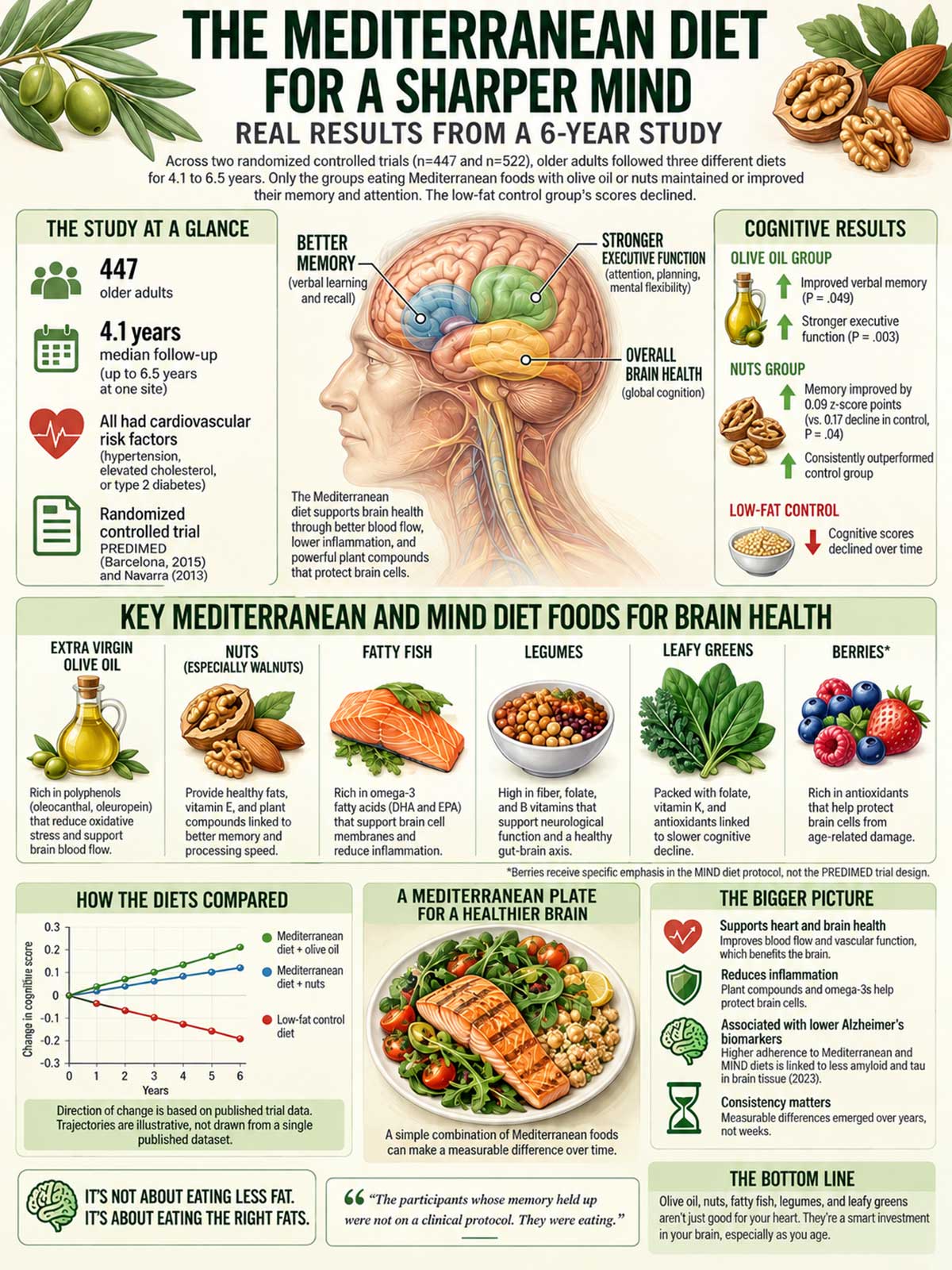
447 older adults. Three diets. Six years of carefully tracked eating. Only one group’s memory scores actually improved. It was not the group eating less fat.
Many people in their 50s and 60s already know the feeling. A name said a hundred times vanishes at exactly the wrong moment. A word used every day is suddenly gone. These moments carry real weight now, because there is solid research on whether what lands on a dinner plate has something to do with how well the brain holds up.
A large, randomized controlled trial suggests the answer is yes. And the specific finding is the part most people haven’t heard: one type of dietary fat, not less fat, made the measurable difference.
What a 6-Year Controlled Trial Found
Cinta Valls-Pedret, a researcher at the Hospital Clínic in Barcelona, spent years tracking what happened to older adults’ memory and attention as they followed three different diets. The 447 participants, all cognitively healthy and all at high cardiovascular risk, were divided into three groups.
One followed a standard low-fat diet, the kind routinely recommended for heart health. The other two followed a Mediterranean-style pattern, with one key difference: one group received a liter of extra virgin olive oil per week and the other received 30 grams of mixed nuts daily.
Over a median of 4.1 years, the cognitive picture diverged in ways that were not subtle. The control group’s scores declined. The Mediterranean groups held steady or improved. The finding, published in JAMA Internal Medicine in 2015, is now a primary reference in the nutrition-and-cognition literature.
A low-fat diet, the standard recommendation for heart health, did not protect the aging brain. The groups eating more fat, in the specific forms of olive oil and nuts, did.
The participants were not people in peak health. They had hypertension, elevated cholesterol, or type 2 diabetes. These are common conditions for adults in their 60s, which means the results apply to the population most concerned about cognitive decline, not to an unusually healthy group whose results would be difficult to apply to real-world populations.
Olive Oil vs. Nuts: What the Numbers Show
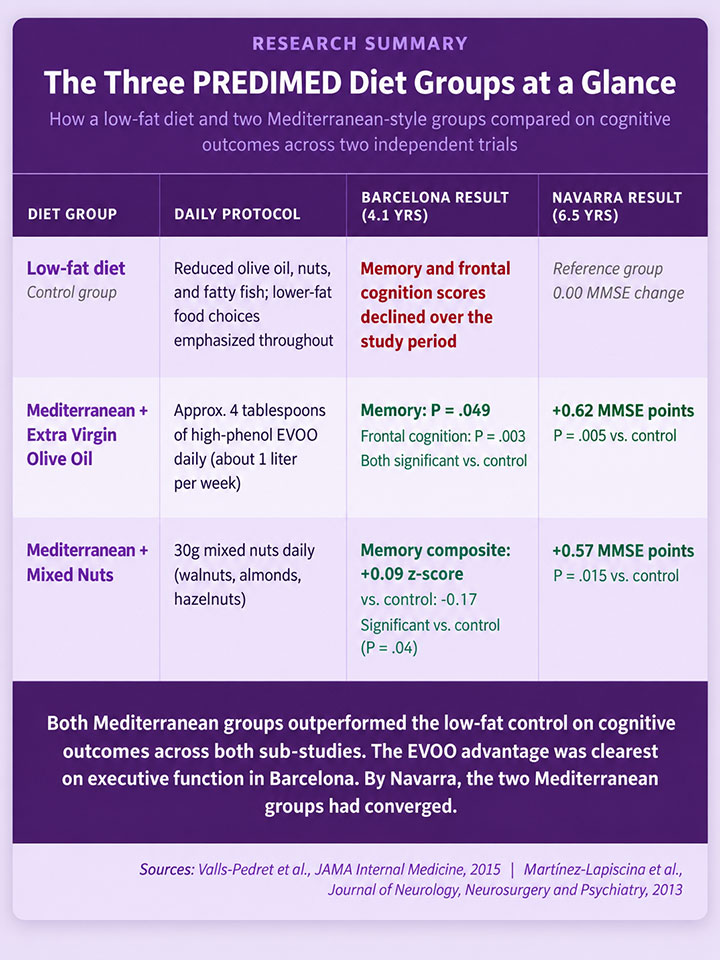
The Valls-Pedret et al. 2015 study broke the cognitive outcomes into three composites: memory, frontal (attention and executive function), and global. The olive oil group showed statistically significant improvements on verbal memory tests, specifically the Rey Auditory Verbal Learning Test, which measures how well people learn and recall word lists, with a P-value of .049.
Their frontal cognition composite improved more strikingly still, with a P-value of .003. Executive function covers the mental tools used for planning, sustained attention, and the flexibility that makes daily decisions manageable.
The nut group’s results tell a quieter version of the same story. Their memory composite improved by 0.09 z-score points over the study period, while the control group’s dropped by 0.17, a gap that reached statistical significance (P=.04).
The nut group’s frontal cognition gains were not significant on their own. Their overall profile consistently outperformed the control group without matching the olive oil group’s peak results.
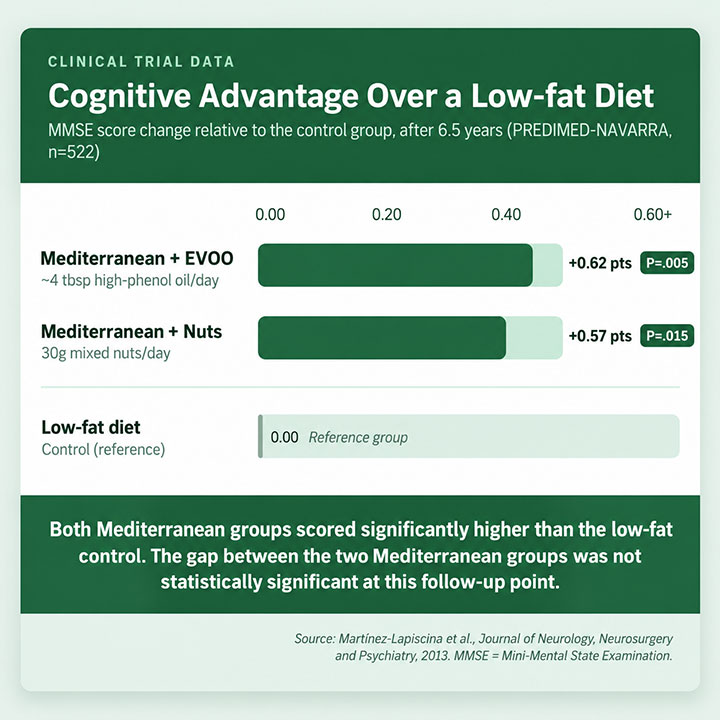
The Navarra site of the PREDIMED trial ran longer, 6.5 years, and used a different cognitive instrument. The Martínez-Lapiscina et al. 2013 trial followed 522 participants and assessed global cognition with the Mini-Mental State Examination rather than the composite battery used in Barcelona.
Both Mediterranean groups improved: the olive oil group by 0.62 MMSE points and the nut group by 0.57, each significant against controls. The gap between them was not.
That narrowing is the more interesting finding. In Barcelona, EVOO showed a clear edge on executive function that the nut group didn’t match.
Over a longer follow-up and a broader cognitive measure, the two Mediterranean groups landed nearly side by side. Whether that reflects a different instrument, a longer time horizon, or something about how the two interventions play out over years is not resolved in the literature.
Walnuts and the General Population
The PREDIMED trials focused on older adults already managing significant cardiovascular risk. Researchers Lenore Arab and Antoinette Ang at UCLA wanted to know whether the walnut-cognition relationship showed up in a broader, healthier population.
Their analysis used data from two rounds of the National Health and Nutrition Examination Survey, one of the largest ongoing health studies in the United States, comparing cognitive test performance between walnut consumers and non-consumers across a nationally representative adult sample.
Arab and Ang’s 2015 cross-sectional study, published in the Journal of Nutrition, Health and Aging, found that walnut consumers scored better across nearly every cognitive test. The effect was especially pronounced in adults 60 and older. In that age group, walnut consumers averaged 13.1 grams daily (roughly seven or eight walnut halves) and scored 7.1 percentile points higher on story recall and 7.3 percentile points higher on the digit-symbol substitution test, which measures processing speed and attention.
The study’s design limits how far these conclusions can be pushed. Observational and cross-sectional data cannot prove that walnuts caused the better scores. People who eat walnuts regularly may also have other healthy habits that explain part of the difference.
What the analysis does establish is a consistent, statistically significant association across multiple cognitive domains in a large, diverse sample. That consistency is harder to dismiss than a single finding in a single test.

A long-term prospective study drawing on data from the Nurses’ Health Study, published by O’Brien and colleagues in the Journal of Nutrition, Health and Aging in 2014, followed over 15,000 women aged 70 and older for six years. Higher long-term nut intake was associated with better cognitive status across every outcome measured.
Women consuming at least five servings of nuts per week scored meaningfully higher than non-consumers on a global composite score, a difference equivalent to being approximately two years younger cognitively.
What this study adds is a prospective signal, not just a cross-sectional snapshot: the cognitive advantage showed up in the people who had been eating nuts consistently over years, not just the ones who happened to eat them on the day of testing.
Why the Mediterranean Pattern Protects the Brain
The brain depends on a steady supply of oxygenated blood. Any dietary change that improves arterial health, reduces systemic inflammation, or supports vascular function benefits the brain directly.
The same vessels that carry blood to the heart supply the cerebral cortex. This is why foods associated with cardiovascular protection keep appearing in cognitive research: the Mediterranean diet’s most studied benefits, for the heart and for the brain, point toward the same biological mechanisms.
Extra virgin olive oil is dense with polyphenols, including oleocanthal and oleuropein. These compounds reduce oxidative stress, a molecular imbalance that drives cellular damage and accelerates with age, with particular association with neuronal decline. Fatty fish, including salmon, sardines, and mackerel, deliver omega-3 fatty acids that are structural components of brain cell membranes.
Researchers still cannot fully disentangle which component drives which benefit. The PREDIMED trials tested the pattern as a whole, with olive oil added to Mediterranean eating rather than tested in isolation.
That is not a limitation of the evidence so much as a reflection of how food actually works in the body. Each element likely does something the others don’t, but no single component explains the full benefit. The pattern is the point.
The MIND Diet: A Related Pattern Worth Knowing
Most people searching for information on diet and memory will encounter the MIND diet before they encounter the PREDIMED trials. The MIND diet (Mediterranean-DASH Intervention for Neurodegenerative Delay) is a hybrid of the Mediterranean diet and the DASH diet, developed specifically to target brain health.
It shares most of its core foods with the Mediterranean pattern but places stronger emphasis on leafy greens and berries, and more explicitly specifies which foods to limit, including red meat, butter, and fried food.
The two patterns overlap substantially. Someone following the Mediterranean eating approach described in the PREDIMED trials is eating in the same broad territory as the MIND diet.
In 2023, research highlighted by the National Institute on Aging linked adherence to both the MIND and Mediterranean diets to fewer biomarkers of Alzheimer’s brain pathology, specifically lower levels of amyloid plaques and tau tangles found in postmortem brain tissue. That finding moved the conversation forward from test scores to actual brain pathology, which is a different kind of evidence entirely.
For practical purposes, the distinction between the Mediterranean and MIND diets matters less than the elements they share: olive oil as the primary fat, a daily handful of nuts, leafy greens at most meals, fatty fish several times a week, and legumes throughout the week. Both patterns point to the same plate. Most people aren’t eating either of them.

What This Looks Like in Practice
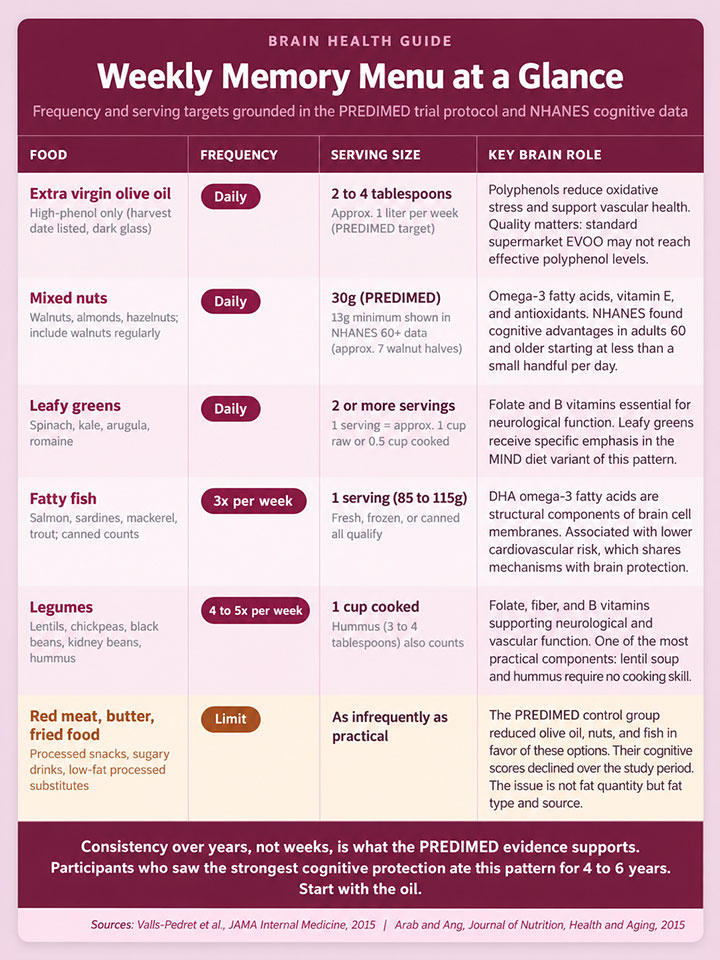
The most common mistake people make when they try to eat for brain health is starting with the wrong oil. The EVOO in the PREDIMED trials was selected specifically for polyphenol concentration. Most commercially available extra virgin olive oil contains a fraction of those levels.
The markers to look for are practical: a harvest date on the label, a dark glass container, and that characteristic peppery bite at the back of the throat. That taste is the polyphenols. Oils that disclose their phenolic content at 150 mg/L or higher are worth the premium for this purpose. Use them generously as the primary cooking fat and in dressings.
On nuts, the PREDIMED nut group consumed about 30 grams of mixed nuts daily, typically walnuts, almonds, and hazelnuts combined. The NHANES data on walnuts specifically suggests that even 13 grams a day, less than a small handful, was associated with cognitive advantages in adults 60 and older. A daily serving of mixed nuts with walnuts as a regular part of the rotation covers both lines of evidence.
Fatty fish three times a week and legumes four to five times a week make up the other core commitments. Salmon, sardines, and mackerel provide the omega-3s associated with brain cell membrane health. Lentils, chickpeas, and black beans deliver the folate and B vitamins that support neurological function. Neither requires elaborate preparation. Canned sardines on toast is PREDIMED-aligned. Lentil soup is PREDIMED-aligned. The bar for compliance is lower than most people expect.
What the control diet looked like is worth knowing, because people often drift toward it without realizing it. Participants in the low-fat group were advised to reduce olive oil, nuts, and fatty fish in favor of lower-fat options. Their cognitive scores declined over the study period.
Replacing the specific fats in olive oil and nuts with refined carbohydrates or low-fat processed foods appears to be a net negative for brain health over time. That is what the declining control group scores demonstrate more clearly than any summary could.
The timeline is the part most people underestimate. The PREDIMED Barcelona trial ran for a median of 4.1 years before cognitive differences reached statistical significance. The Navarra trial ran 6.5 years.
No version of this eating pattern shows measurable results in two weeks. The participants whose scores held steady were eating this way consistently, over years. Consistency, not any single meal, is the mechanism.
Who This Research Applies To
The PREDIMED trials enrolled adults with existing cardiovascular risk factors, including hypertension, elevated cholesterol, and type 2 diabetes, who were still cognitively healthy at enrollment. The dietary intervention helped slow the age-related cognitive decline that would otherwise accumulate over time.
These trials were not testing diet as a treatment for existing cognitive impairment. For people already experiencing significant memory problems, the evidence that diet can reverse that impairment is more limited, and diet should not be the primary intervention in those cases.
That distinction is not a reason to wait. The research suggests that people managing common health conditions, the kind many adults in their 50s and 60s are already dealing with, can still benefit meaningfully from a dietary shift. The earlier the dietary shift, the more cognitive decline there is still time to slow.
The cognitive tests in the PREDIMED battery did not assess what most people picture when memory fails: names, faces, where the keys went. They covered processing speed, verbal learning, working memory, executive function, and visuospatial skills.
Even the modest improvements documented in these trials translate into meaningful functional differences in daily life. The difference between the EVOO group and the control group, after 4.1 years of divergent eating, was not subtle on tests that measure how people actually function day to day.
The participants whose memory held up were not on a clinical protocol. They were eating. What separated them from the people whose scores declined was olive oil, nuts, and the consistent application of a dietary pattern over years.
Two different PREDIMED sites, two different follow-up periods, two different cognitive batteries: the same result. The oil in the cabinet matters. And so do the decisions made again and again, over months and years, about which fat to reach for and what goes on the plate.