Aloe vera is one of the most trusted names in skincare, and probably also one of the most oversold. The plant itself is straightforward: cut a leaf, scoop out the clear gel, and you have a substance that has been applied to human skin for at least 4,000 years. The claims made about that gel, on the other hand, have become increasingly difficult to sort from reality.
The honest answer is that aloe vera is good for your face, but not for the reasons most product labels suggest. Its strongest evidence sits in a narrow range: hydration, sunburn relief, and wound healing. The anti-aging claims are more complicated.
The acne-fighting story is real but has been significantly overstated. And the popular claim that aloe vera regulates sebum production has not held up in clinical testing. What follows is not a promotional summary. It is a review of what the studies actually measured.
What Aloe Vera Actually Contains
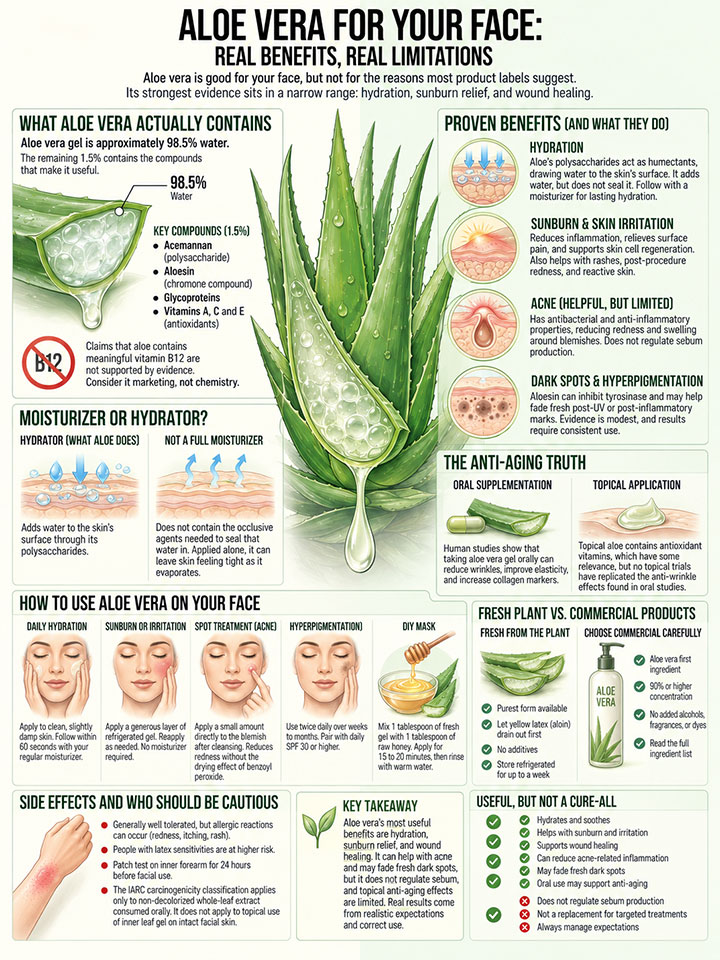
Aloe vera gel is approximately 98.5% water. That figure, confirmed across multiple industry compositional analyses, is not a shortcoming. It explains precisely why the gel works the way it does.
The remaining 1.5% contains the compounds that make it useful: acemannan (a polysaccharide responsible for much of the wound-healing and anti-inflammatory activity), aloesin (a chromone compound relevant to pigmentation), glycoproteins, and antioxidant vitamins A, C, and E.
One claim found on many product labels and ingredient breakdowns is that aloe vera contains vitamin B12. The evidence for meaningful B12 content in topical aloe vera gel is unreliable, and no peer-reviewed study supports the claim that B12 concentrations in aloe gel are high enough to have any measurable skin effect.
Writers in the field, including registered dietitian Jack Norris, have specifically flagged this as an unfounded claim. Consider it marketing rather than chemistry.
Hydration: The Strongest Case
The hydration claim is the most defensible, but it needs a qualifier that most articles skip entirely. Aloe vera’s polysaccharides act as humectants: they draw water toward the skin surface and hold it there temporarily. Aloe adds water. It does not seal it.
This matters practically. If you apply aloe gel directly from a plant leaf and let it dry on its own, the rapid evaporation can leave skin feeling tighter than before you started. The correct approach is to follow it immediately with a light moisturizer, or to use a formulation that combines it with an occlusive or emollient agent.
For oily or combination skin that finds traditional moisturizers heavy, aloe gel followed by a single layer of niacinamide serum covers both steps without the weight.
Sunburn and Skin Irritation: Where Aloe Earns Its Reputation
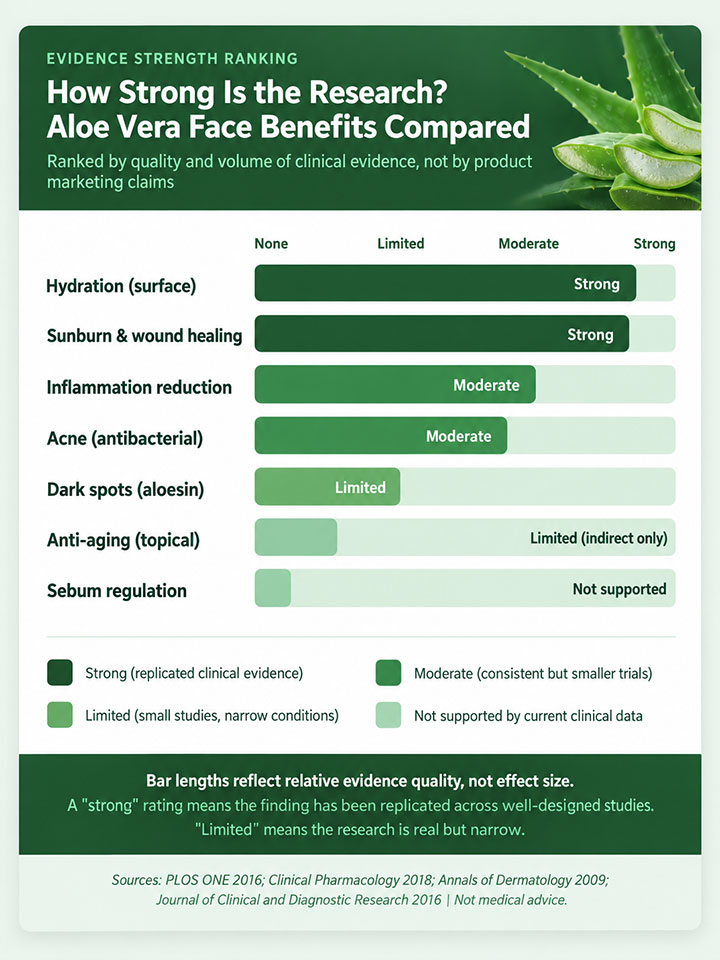
The sunburn evidence is the oldest and most solid. A 2016 study published in PLOS ONE found that both aloe vera gel and Cape aloe extract significantly improved wound healing in human primary epidermal keratinocytes (the skin cells most affected by UV damage).
The glycoproteins in aloe reduce inflammation and relieve surface pain, while the acemannan polysaccharide supports skin cell regeneration and speeds repair.
Beyond burns, the anti-inflammatory activity has clinical support for other surface irritations: rashes triggered by harsh skincare actives, post-procedure redness, and reactive skin. This is where the gel shines as a daily buffer rather than as a targeted treatment.
Acne: Helpful, but Not What the Labels Claim
Aloe vera has genuine antibacterial and anti-inflammatory properties. A study published in Journal of Clinical and Diagnostic Research confirmed its inhibitory activity against common oral and skin pathogens. The anti-inflammatory activity reduces the redness and swelling around active blemishes. These are real, if modest, contributions.
Where the story gets overclaimed is sebum. A 2018 randomized controlled trial published in Clinical Pharmacology: Advances and Applications tested a combination cream containing 10% aloe vera, 20% propolis, and 3% tea tree oil against a 3% erythromycin cream and a placebo. The combination treatment reduced inflammatory lesions significantly.
The sebometry readings showed no statistically significant difference from placebo. Aloe was one of three active ingredients in that formulation, and sebum production was not one of the things it changed.
The sebum-regulation claim continues to appear on product pages and in ingredient breakdowns with no clinical basis. What aloe can do for acne-prone skin is meaningful on its own terms: it reduces the inflammatory response around a breakout, works as a lightweight spot treatment without the drying effect of benzoyl peroxide, and soothes skin that has become reactive from retinoid use. That is a useful tool. It is not a sebum regulator.
Dark Spots and Hyperpigmentation: Real Mechanism, Modest Evidence
Aloesin, one of aloe vera’s chromone compounds, has a documented effect on melanin production. In a small human study cited across several dermatology reviews, aloesin applied four times daily to UV-exposed forearm skin reduced the development of post-UV hyperpigmentation, with results comparable to arbutin. The mechanism is inhibition of tyrosinase, the enzyme that drives melanin synthesis.
That finding is genuine, but it requires context. The study used a concentrated, isolated aloesin compound applied repeatedly throughout the day, not a commercial gel at standard concentrations.
There is also a 2023 case report published in Medicine documenting that aloe vera gel reduced the visibility of chemotherapy-induced hyperpigmentation in pediatric patients over a four-week application period. Promising, but a case report of four patients is not the same evidence tier as a controlled trial.
The honest position: aloe vera may contribute to gradual fading of fresh dark spots, particularly from UV exposure or inflammation. For established or deep hyperpigmentation, vitamin C serums, niacinamide, or targeted treatments with more robust clinical data will do meaningfully more.
Anti-Aging: The Oral vs. Topical Distinction That Changes Everything
This is where the evidence is most frequently misread, and where the popular account diverges most from what the studies actually measured.
The most-cited human study on aloe vera and skin aging, published in Annals of Dermatology in 2009, found that dietary aloe vera gel supplementation reduced facial wrinkles, improved elasticity, and increased type I procollagen gene expression in skin tissue.
The 30 participants were women older than 45 who took oral aloe vera gel daily for 90 days. They did not apply it to their faces.
A 2016 randomized controlled trial published in Clinical, Cosmetic and Investigational Dermatology confirmed similar elasticity improvements from oral aloe sterol supplementation, again in a study based on ingestion rather than topical application.
The antioxidant vitamins C and E in topical aloe gel do neutralize free radicals at the skin surface, and that activity has some theoretical relevance to aging. But the concentration of those antioxidants in a standard aloe gel is substantially lower than in a dedicated vitamin C serum, and no topical aloe gel trial has replicated the anti-wrinkle effects found in the oral studies.
The anti-aging claim as typically written (“aloe vera promotes collagen production and reduces fine lines”) is not wrong in mechanism. It is wrong in route. If anti-aging is a goal, the aloe sterol literature points toward oral supplementation.
Topical aloe vera’s contribution to that goal is indirect at best, operating primarily through the hydration pathway: well-hydrated skin shows fewer surface-level fine lines, and that is a real but different thing from structural anti-aging.
Fresh from the Plant vs. Commercial Products
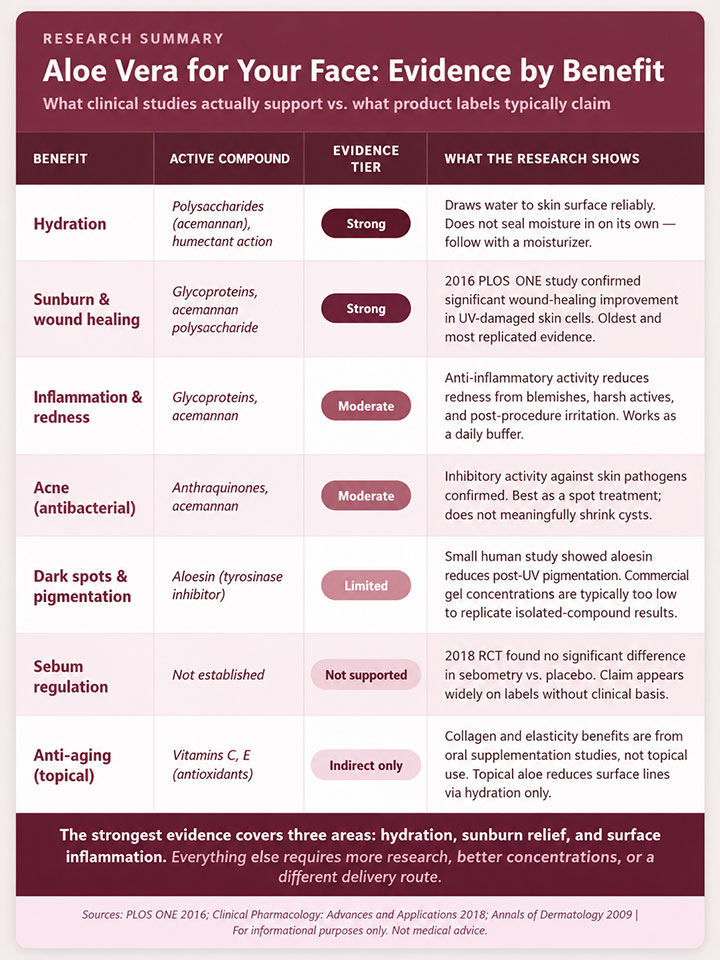
Fresh aloe vera gel cut directly from the plant is the purest form available. Cut a leaf close to the base, stand it upright for a few minutes to allow the yellow latex layer to drain out (that substance is called aloin, a known skin irritant for many people), then slice the leaf flat and scoop out the clear inner gel with a spoon. Apply it directly or store it refrigerated for up to a week.
Commercial aloe vera gels range from near-pharmaceutical to near-useless, depending on what else is in them. A product that lists aloe vera as the first ingredient and contains no added alcohols, fragrances, or artificial dyes is a reasonable substitute for fresh gel.
Look for a concentration of 90% or higher. Many popular commercial gels, including some widely recommended products, achieve their gel texture through thickeners and contain aloe vera as a secondary or minor ingredient despite what the front label implies. Read the full ingredient list, not the percentage claim on the packaging, which is largely unregulated.
A single mature aloe vera plant produces more gel than most people will ever use. There are no additives to read past, no percentage claims to verify, and no cold chain to worry about. It is, in the most practical sense, the most reliable format available. For a skincare ingredient, that is a harder standard to meet than it sounds.
Side Effects and Who Should Be Cautious
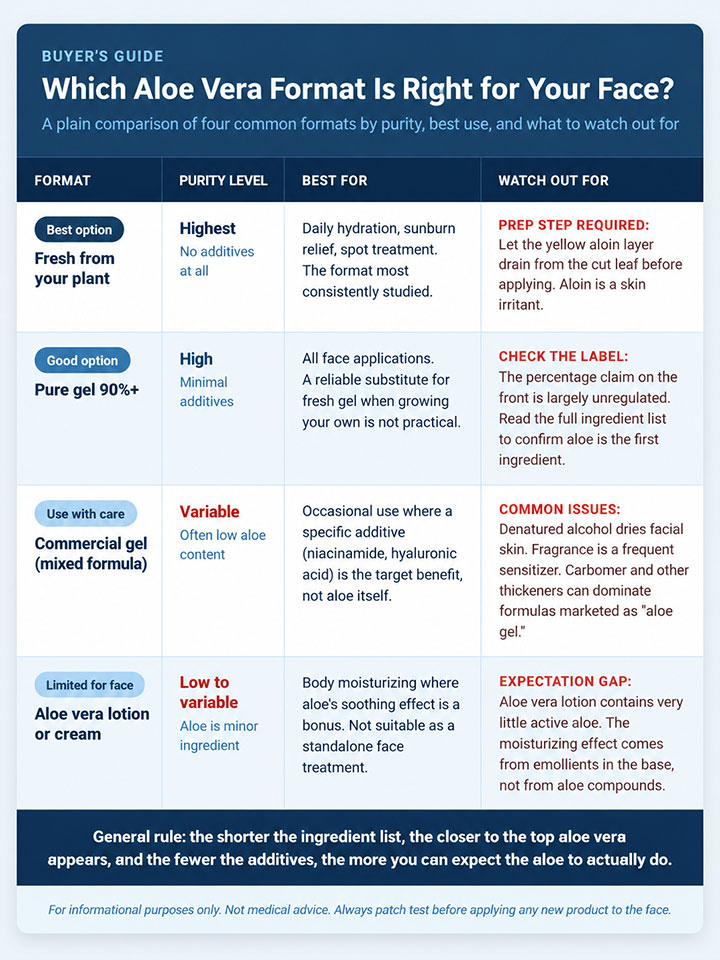
Topical aloe vera is well tolerated by most people, but not all. Allergic reactions, typically appearing as localized redness, itching, or a raised rash, occur in a small subset of users. People who are sensitive to latex products carry a higher risk, because aloe’s outer layer contains latex-adjacent compounds. Even fresh gel from inside the leaf can produce a reaction in latex-sensitive individuals if preparation is imprecise.
A patch test on the inner forearm, left for 24 hours before facial application, catches most contact reactions before they spread. This applies equally to commercial products and fresh plant gel.
One nuance that rarely appears in mainstream articles: the carcinogenicity classification for aloe vera is specific to non-decolorized whole-leaf extract consumed orally. The International Agency for Research on Cancer (IARC) classified this form as a Group 2B possible carcinogen in 2016, based on animal studies involving high-dose oral intake.
Topically applied aloe vera gel, drawn from the inner leaf and applied to intact facial skin, is a different substance and a different route of exposure. The IARC classification does not apply to the topical use discussed here.
If a commercial product causes persistent irritation, dryness, or breakouts, suspect the additives before the aloe vera itself. Fragrance, denatured alcohol, and thickeners like carbomer are more common culprits than the aloe gel component.
How to Use Aloe Vera on Your Face
The way you use it matters as much as whether you use it. Applied as a first step with no follow-up, aloe gel often underdelivers. Built into a routine correctly, it earns its place.
For daily hydration: Apply a thin layer to clean, slightly damp skin immediately after washing. Follow within 60 seconds with your regular moisturizer. The moisture-sealing step is not optional if hydration is the goal.
For sunburn or reactive skin: Apply a generous layer of refrigerated pure aloe gel to clean skin and allow it to absorb fully. Reapply as needed. No follow-up moisturizer is required in the acute phase. The priority is cooling and anti-inflammatory relief, not occlusion.
For spot treatment on active blemishes: Apply a small amount directly to the blemish after cleansing, either alone or layered over a salicylic acid toner that has fully dried. Aloe’s anti-inflammatory activity reduces visible redness quickly. It will not dramatically shrink a deep cyst.
For hyperpigmentation maintenance: Use consistently over weeks to months, applied twice daily to clean skin. Pair with daily SPF 30 or higher, because UV exposure reverses pigmentation progress faster than aloe can make it.
The DIY approach: An aloe vera and honey mask (one tablespoon of fresh gel mixed with one tablespoon of raw honey, applied for 15 to 20 minutes and rinsed with warm water) addresses both hydration and mild antibacterial activity in one step.
An aloe and green tea mist (cooled brewed green tea mixed with aloe gel in a spray bottle) provides antioxidant activity alongside surface hydration throughout the day.
What the Evidence Actually Supports
The most useful thing aloe vera does for your face is also the least glamorous: it brings water to the surface of the skin, quickly and without side effects. Everything else it offers (reduced inflammation, gradual pigmentation work, some structural collagen support over time if consumed orally) sits on top of that foundation.
The products that hype it as a collagen-builder or sebum regulator are not lying about the mechanism. They are lying about the dose, the route, or both.
Frequently Asked Questions
Can I apply aloe vera on my face daily?
Yes. Aloe vera is well tolerated for daily use by most skin types. If you notice irritation after a week of consistent use, the most likely cause is an additive in a commercial product rather than the aloe itself.
How long do I leave aloe vera on my face?
For hydration, apply it and follow immediately with a moisturizer. For sunburn or irritation relief, leave it on for as long as needed and reapply as the skin absorbs it. For overnight use, pure aloe gel without fragrances or alcohol is generally safe left on the skin.
What are the disadvantages of applying aloe vera on the face?
Applied alone without a follow-up moisturizer, aloe can leave skin feeling tight as the water evaporates. A small percentage of people experience allergic contact reactions. Commercial gels with added alcohols or fragrances can cause irritation in sensitive skin types.
Does aloe vera remove dark spots?
Aloesin, a compound in aloe vera, has demonstrated tyrosinase-inhibiting activity in small human studies, which means it can reduce the formation of new melanin in UV-exposed skin. It is not a fast or dramatic solution for established dark spots, but consistent use over weeks may produce gradual lightening of fresh post-inflammatory marks.
Can I use aloe vera straight from the plant on my face?
Yes, with one preparation step: allow the yellow latex layer (aloin) to drain from the cut leaf before scooping out the clear inner gel. Aloin is a known skin irritant and the cause of most reactions attributed to fresh aloe vera.
What happens if I leave aloe vera on my face overnight?
Pure aloe vera gel left overnight is safe for most people and provides extended hydration. Avoid leaving commercial gels with alcohol or fragrance on the skin overnight, as these ingredients can cause irritation with prolonged exposure.
Can aloe vera reduce acne scars?
Aloe vera’s wound-healing properties may support the gradual fading of fresh, superficial acne marks. Deep or established scarring involves structural changes to collagen that aloe vera cannot meaningfully address. For those, dermatological treatments are more appropriate.
Does aloe vera clog pores?
Aloe vera is generally considered low-comedogenic, meaning most people with oily or acne-prone skin can use it without triggering breakouts. It is not certified non-comedogenic in the way pharmaceutical products are rated, but it performs well in practice for most skin types.
Is it safe to use aloe vera on your face every day?
Yes, for most people. People with latex sensitivities or known plant allergies should patch test first and watch for contact reactions during the first week of use.
What should you not mix aloe vera with?
Avoid applying aloe vera at the same time as high-concentration retinoids or AHAs in your routine, as these actives can increase skin sensitivity and the combination may cause irritation. Apply aloe at a different step, or on alternating days with those treatments.
Where should you not put aloe vera?
Avoid applying aloe vera gel to open wounds, severely broken skin, or active eczema flares without dermatologist guidance. While it is soothing for mild irritation, applying it to compromised skin barriers carries an increased risk of sensitization.
Does aloe vera help with eczema or psoriasis?
A 2005 double-blind placebo-controlled trial published in the Journal of the European Academy of Dermatology and Venereology found that commercial aloe vera gel reduced psoriasis plaque severity more than placebo over four weeks. For eczema, aloe vera may calm surface irritation but should not replace medical treatment. Consult a dermatologist before using it on chronic skin conditions.