The oat aisle isn’t as simple as it looks. Different types deliver different amounts of the compounds linked to cholesterol benefits, and that difference matters.
Researchers at the University of Bonn didn’t set out to prove that oats lower cholesterol. They already knew that. What they wanted to understand was how, at the level of the gut’s microbial population, oat fiber does what decades of clinical trials have confirmed it does.
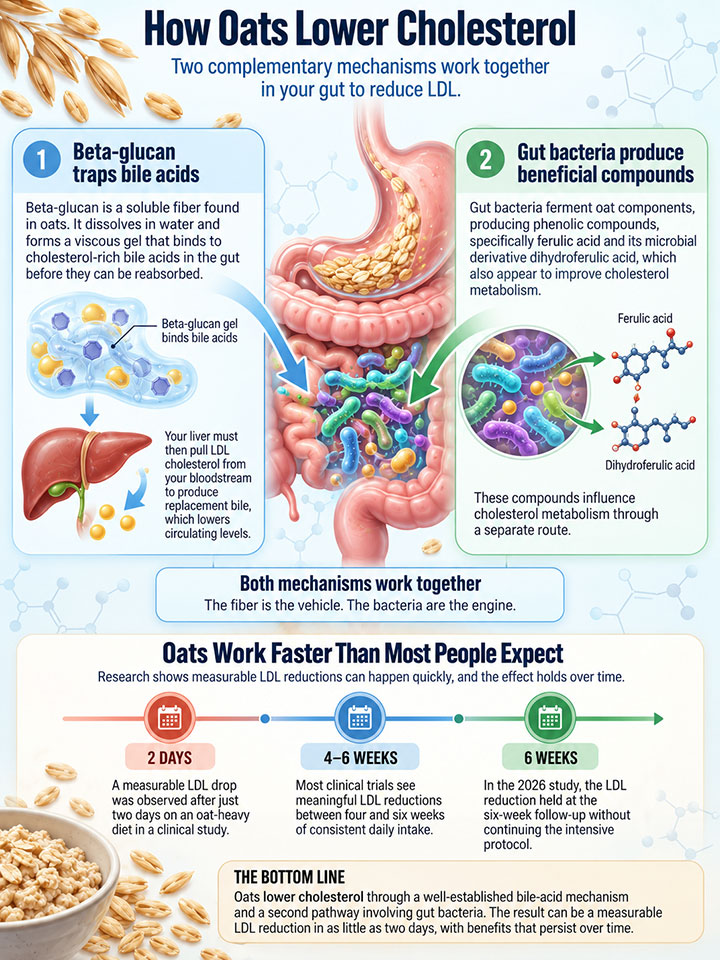
The answer, published in Nature Communications in early 2026, changed the timeline considerably. Two days on an oat-heavy diet produced a measurable LDL drop. Six weeks later, the effect held.
That finding is more specific, and stranger, than the usual advice. The standard explanation for oats and cholesterol is well-established: a soluble fiber called beta-glucan traps cholesterol-rich bile acids in the gut, forcing the liver to pull LDL from the bloodstream to replace them.
That mechanism is real and well-supported. What the Bonn study added is a second pathway nobody had clearly mapped before, one involving gut bacteria producing phenolic compounds from oat fermentation that also appear to improve cholesterol metabolism.
There are two takeaways here, and they pull in different directions. Oats work faster than most people expect, at least in a clinical setting. But the “2-day oatmeal protocol” that generated headlines was an intensive, calorie-restricted intervention in people with metabolic syndrome, not a bowl of overnight oats before work.
The gap between those two things matters, and this article is about what happens in the middle: what the evidence actually supports, how much beta-glucan produces a measurable result, and why the oat type in your pantry changes the answer.
What the research actually says about oats and LDL
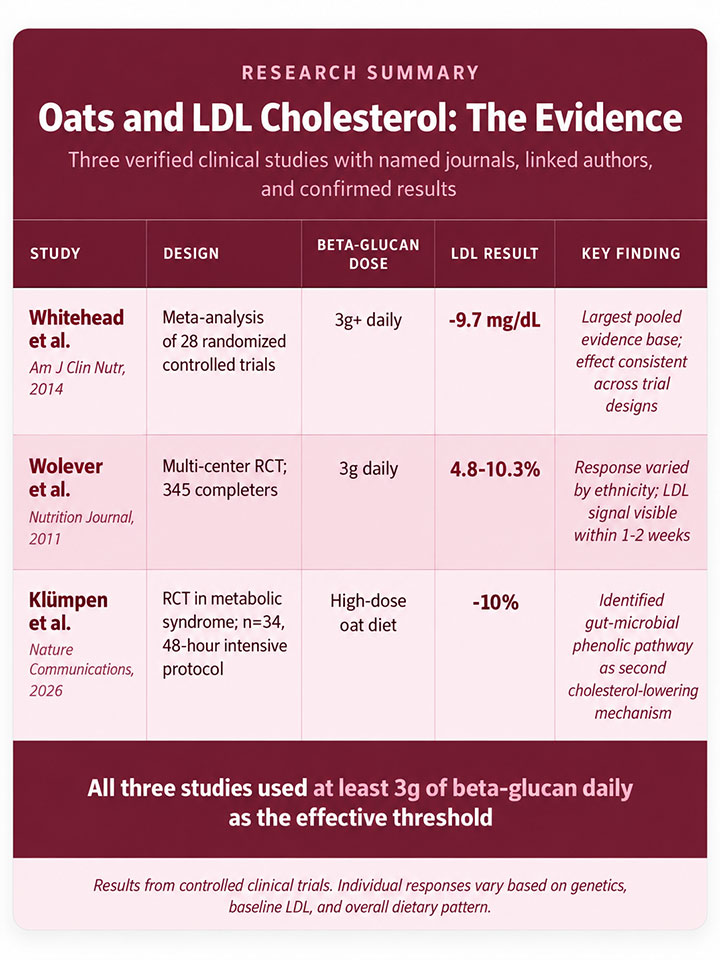
The most useful number in the oats-and-cholesterol literature is not a percentage. It is 0.25 mmol/L. That is the average LDL reduction found in the Whitehead et al. meta-analysis, published in the American Journal of Clinical Nutrition in 2014, which pooled 28 randomized controlled trials comparing at least 3 grams of oat beta-glucan daily against control diets.
In conventional US terms, that is roughly 9.7 mg/dL for LDL, with a corresponding total cholesterol reduction of about 11.6 mg/dL.
Those figures sound modest. Statin drugs can move LDL by 30 to 50 percent. But the comparison is not quite right, because oats are not competing with statins. They are competing with doing nothing, or with small dietary changes that produce smaller effects.
A 5 to 6 percent LDL reduction from a breakfast food, sustained daily, is a meaningful contribution to cardiovascular risk management.
The Whitehead analysis also identified something worth flagging: people with higher baseline LDL levels tended to see larger absolute reductions. The mechanism explains why. When LDL in the bloodstream is high, the liver has more to work with when it pulls cholesterol to replace bile acids.
That does not mean oats work poorly for people with normal LDL, but it does mean the numbers on your last lipid panel affect how much to expect.
A more recent line of research suggests the bile-acid mechanism may not be the whole story. The Klümpen et al. trial, published in Nature Communications in 2026, enrolled 34 participants with metabolic syndrome and put them on either a calorie-restricted, oat-heavy diet or a control diet for two days, followed by a six-week maintenance period.
LDL dropped roughly 10 percent in the oat group, and the improvement held at the six-week follow-up without continuing the intensive protocol.
Lead researcher Linda Klümpen and her colleagues at the University of Bonn traced a significant part of that effect to phenolic compounds produced when gut bacteria ferment oat components, specifically ferulic acid and its microbial derivative dihydroferulic acid.
The beta-glucan mechanism is passive in the sense that the fiber acts as a physical trap. What the Bonn study suggested is that the gut microbiome is an active participant, converting oat compounds into molecules that influence cholesterol metabolism through a separate route.
Researchers still don’t know exactly how these two mechanisms interact or which one accounts for more of the effect in typical daily consumption, which is a genuinely open question in the current literature.
How much oats do you need to lower cholesterol?
The daily target is 3 grams of beta-glucan. That threshold appears across FDA, EFSA, and Health Canada guidelines for the same reason it appears in the Whitehead meta-analysis: it is the dose at which the evidence consistently shows meaningful LDL reduction.
Going lower produces less consistent results. Going higher does not appear to produce proportionally larger reductions, though it may help in specific populations such as people with diabetes, where the glucose-stabilizing effect of the fiber adds a separate benefit.
The challenge is that 3 grams of beta-glucan is not the same thing as 3 grams of oats. The beta-glucan content varies considerably by oat type and processing level:
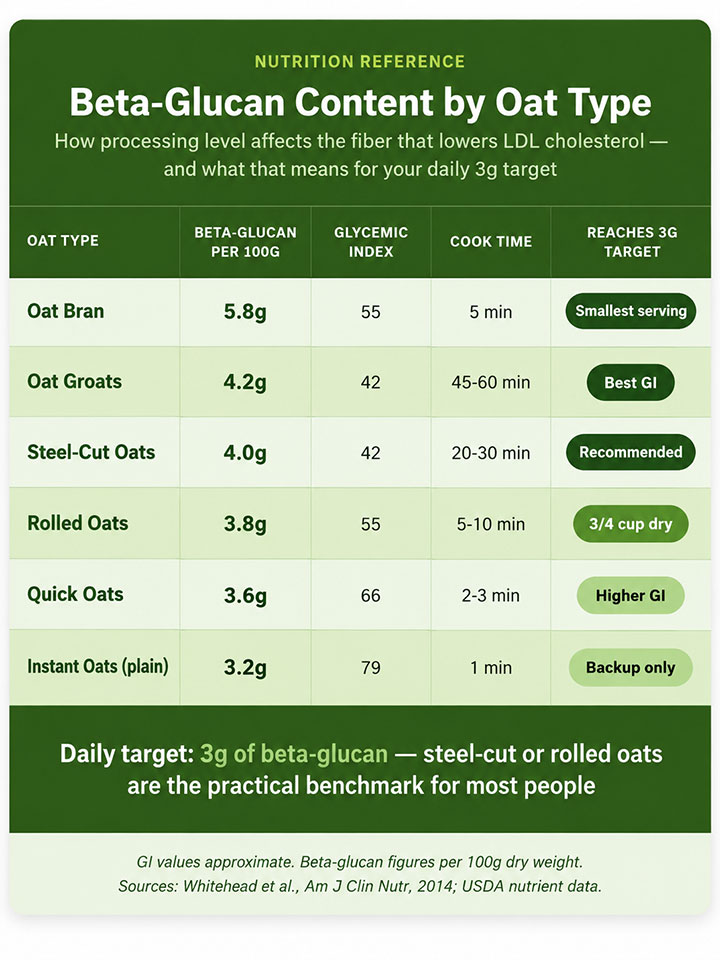
- Oat groats contain approximately 4.2g of beta-glucan per 100g dry weight and have the lowest glycemic index of any oat product (around 42), but require 45 to 60 minutes to cook.
- Steel-cut oats deliver around 4.0g per 100g with a similar glycemic profile and 20 to 30 minutes of cooking time, making them the practical benchmark for most people targeting the 3g threshold.
- Rolled oats (old-fashioned oats) provide about 3.8g per 100g, and roughly three-quarters of a cup of dry rolled oats gets you to the 3g target in a single serving.
- Quick oats retain around 3.6g per 100g but carry a noticeably higher glycemic index (approximately 66 versus 42 for steel-cut). For people managing blood sugar alongside cholesterol, that difference is worth factoring in.
- Instant oats, particularly flavored packets, lose beta-glucan content through processing and often include added sugars. Plain instant oats provide around 3.2g per 100g but sit at a glycemic index near 79.
- Oat bran is the concentrated option, at approximately 5.8g of beta-glucan per 100g, and five minutes to cook. A relatively small serving reaches the target, making it useful for people who find a full bowl of oatmeal impractical.
Oat bran for cholesterol: is more beta-glucan better?
Oat bran’s higher beta-glucan concentration makes it appealing if the goal is hitting 3g in the smallest possible serving size. A few tablespoons stirred into a smoothie or yogurt gets there without a full breakfast commitment.
The practical trade-off is texture and versatility. Oat bran is less neutral-tasting than rolled oats and does not substitute cleanly in most recipes. Used as a baking addition or blended into liquids, it is effective. As a standalone preparation, it is an acquired taste.
What the evidence does not support is that doubling beta-glucan intake doubles the cholesterol effect. The dose-response relationship flattens considerably above 6 grams daily, so the useful question is not how much you can consume in a single sitting, but whether you can reliably consume 3 grams every day for the next several months.
What about oat milk?
Oat milk occupies a separate category from whole oats, and the distinction matters for anyone tracking beta-glucan specifically. The processing required to turn oats into a pourable liquid filters out most of the intact beta-glucan.
A typical 240ml serving of oat milk contains less than 1 gram of beta-glucan, compared to the 3g available in a three-quarter cup serving of dry rolled oats. Some manufacturers add beta-glucan back in, and label claims vary enough to be worth reading.
Oat milk is a reasonable choice for people avoiding dairy, but it should not be counted as a cholesterol-lowering serving of oats.
How fast does oatmeal lower cholesterol?
The honest answer is that the timeline varies more than most articles suggest, and the variance itself is informative. The Whitehead meta-analysis included trials ranging from two to twelve weeks, and the LDL-lowering effect did not show a statistically significant relationship with duration across that range.
The fiber is doing its work in the gut with every meal. The question is how quickly that translates into a measurable blood lipid change for a specific person.
Most clinical trials begin to see meaningful reductions between four and six weeks of consistent daily intake. The Wolever et al. trial, published in Nutrition Journal, found that in the intervention arms where beta-glucan was bioactive and at sufficient molecular weight, cholesterol response began within one to two weeks and stabilized over the final weeks of the four-week study. That is a faster signal than many people expect from a dietary change.
The Klümpen 2026 finding adds a further complication: in an intensive, controlled setting with metabolic syndrome patients consuming a near-exclusive oat diet, a measurable LDL drop appeared at two days.
That speed likely reflects both the concentrated dose and the specific population. For most people eating oats as part of a mixed diet, four to six weeks is a reasonable minimum before expecting to see a change on a standard lipid panel.
Several factors slow or accelerate the timeline. Higher baseline LDL, consistent daily intake, and a diet otherwise low in saturated fat all tend to produce clearer and faster responses. Genetics influence how much an individual’s liver responds to bile acid depletion.
A small proportion of people show minimal response even at consistent intake over twelve weeks, and that appears to be a genuine biological variation rather than a compliance failure.
Week by week: what actually changes
The timeline above covers when cholesterol changes show up on a lipid panel. What it does not cover is what the experience of getting there actually feels like, and that is a different and more practically useful question if you are the person trying to stick with it.
The popular “30-day oat challenge” framing captures something real here, even if the week-by-week breakdown tends to be oversimplified in practice. The adjustments are not uniform. They are front-loaded in discomfort and back-loaded in results.
The first week is the one most people remember as unpleasant if they were not previously eating much fiber. Bloating, mild gas, and a feeling of uncomfortable fullness are common as gut bacteria adjust to an unfamiliar substrate.
This is not a sign of a problem. It is a sign of microbial activity, which is actually part of the mechanism. Starting with a half-serving and working up over five to seven days, while increasing water intake, resolves most of these symptoms.
The digestive adjustment is largely done by week two. Energy stability is the change most people notice: oats release glucose slowly enough that the mid-morning energy crash common with refined-carbohydrate breakfasts tends to disappear. This is not a cholesterol effect. It is a separate, useful consequence of the same beta-glucan slowing absorption in the small intestine.
Week three is quieter on the surface. The gut microbiome changes flagged in the Bonn research are happening, but there is nothing to feel yet. The beta-glucan is sustaining the right microbial populations, gradually shifting their composition.
Some people report improved sleep and mood during this phase, which may connect to changes in neurotransmitter precursors produced by a shifting microbiome. The science on that specific pathway is still preliminary, and the honest position is not to oversell it.
By week four and into months two and three, the eating habit has either become automatic or revealed where it breaks down in your particular schedule. People who hit week four without having found two or three oat preparations they genuinely like tend to stop.
This is the practical constraint the clinical trials do not measure: adherence is where the cholesterol benefit actually lives.

Oats vs. other cholesterol-lowering foods
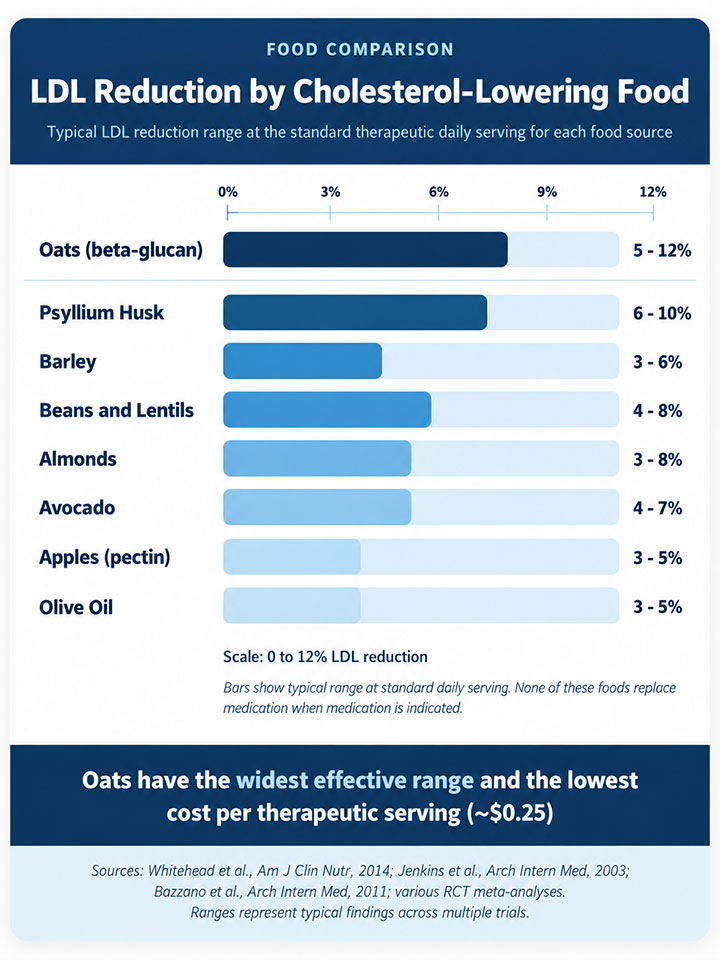
The comparison that matters most is not oats versus almonds or psyllium husk in isolation. It is oats versus the realistic alternatives a person might actually sustain. On that measure, oats perform well for two reasons that have nothing to do with beta-glucan content: they are cheap (roughly $0.25 per therapeutic serving for rolled oats), and they are genuinely adaptable to both sweet and savory preparations, which extends the range of meals where they fit.
Psyllium husk produces a slightly larger LDL reduction per gram of soluble fiber than beta-glucan does, and requires far less volume to achieve the therapeutic dose. Its weakness is sensory: it thickens any liquid it contacts, which a significant number of people find unpleasant enough to stop taking it.
Beans and lentils offer comparable LDL reductions of 4 to 8 percent with additional protein and iron, but require more preparation time and produce more pronounced gas for people not already eating them regularly. Barley contains beta-glucan at concentrations similar to oats and is an underused option.
None of these foods is mutually exclusive. The standard clinical advice, from guidelines published by bodies including the American Heart Association, is to use multiple soluble fiber sources rather than concentrating all intake in one food.
Oats as a daily anchor, supplemented by occasional beans, an apple, and some barley, adds up to a soluble fiber intake that produces larger and more consistent LDL reductions than any single source can achieve alone.
Oats and diabetes: a note on glycemic index
For people managing blood sugar alongside cholesterol, oat type selection matters more than it does for the general population. The glycemic index difference between steel-cut oats (GI approximately 42) and instant oats (GI approximately 79) is large enough to produce meaningfully different postprandial glucose responses, even when the beta-glucan dose is similar.
Steel-cut and rolled oats are the appropriate choices for people with type 2 diabetes or insulin resistance. Adding protein and fat to any oat preparation (an egg, a tablespoon of nut butter, Greek yogurt as a topping) further flattens the glucose curve.
The meta-analysis by Zurbau et al., published in PLOS ONE, found that oat beta-glucan supplementation in type 2 diabetes patients reduced fasting plasma glucose by an average of 0.52 mmol/L over three to eight weeks.
The cholesterol and glucose benefits operate in parallel. That combination is what makes oats more than a reasonable food for people managing both: it is one of the few dietary choices where evidence supports two distinct mechanisms at once through the same daily serving.
What to look for when buying oats
The single most important label criterion is processing level. “Old-fashioned rolled oats” or “steel-cut oats” indicate minimal processing, preserved beta-glucan molecular weight, and lower glycemic index.
“Instant oats” indicates higher processing, reduced fiber bioactivity, and often added sodium or sugar in flavored packets. For cholesterol purposes, plain steel-cut or rolled oats deliver the therapeutic dose in a serving size that is practical to eat daily.
Flavored instant oat packets frequently contain enough added sugar (10 to 15 grams per packet is common) to partly offset the cholesterol benefit through increased triglyceride production.
Plain instant oats are a functional backup for travel or emergencies, but they are not the optimal daily vehicle for beta-glucan delivery. If the choice is between flavored instant oats and skipping oats entirely, flavored instant is still better than nothing. But it should not be the primary source.
For people who want to increase beta-glucan density, oat bran adds well to smoothies, yogurt, and baked goods without changing the flavor profile significantly. Using oat bran to supplement a steel-cut oat breakfast rather than replace it combines the texture and satiety of whole oats with a beta-glucan boost that comfortably clears the 3g threshold.
Working oats into a realistic daily routine
The clinical evidence is built on consistent daily consumption. Intermittent high-dose oat eating does not appear to produce the same cumulative effect as regular intake, which means the sustainability of the habit matters more than the specific preparation.
Three things tend to make the habit stick: having two or three default preparations rather than one (so boredom or ingredient gaps don’t break the chain), keeping oat bran or quick oats available as a backup for days when steel-cut cooking time is not realistic, and spreading intake across meals when a full serving at breakfast is not appealing.
Savory oat preparations work as well as sweet ones from a beta-glucan standpoint. Oats cooked in stock with mushrooms and a poached egg, or steel-cut oats used as a porridge base for roasted vegetables, hit the same therapeutic target as overnight oats with berries. The mechanism does not care about flavor. What matters is that 3 grams of beta-glucan reach the intestine and do their work.
If you take cholesterol-lowering medication and are considering using oats as a complementary strategy, discuss the approach with your prescribing physician. Not because oats interfere with statins, but because a genuine LDL reduction from dietary intervention may warrant a conversation about medication dosage over time, and that is a decision that should involve clinical monitoring rather than a unilateral change.
Beta-Glucan Daily Target Calculator
Find out exactly how much of your oat type you need to reach the 3g cholesterol-lowering threshold
GI: 55 | Cook: 5 min
GI: 42 | Cook: 20-30 min
GI: 55 | Cook: 5-10 min
GI: 66 | Cook: 2-3 min
GI: 42 | Cook: 45-60 min
GI: 79 | Best as backup
Recipes worth keeping
Power steel-cut bowl
Serves 2. Beta-glucan per serving: approximately 3.2g. Cook 1 cup steel-cut oats in 3 cups water for 20 to 25 minutes over low heat, stirring occasionally. Top with half a cup of chopped walnuts, one diced apple, one teaspoon of cinnamon, two tablespoons of ground flaxseed, and a cup of fresh berries.
The walnuts add plant sterols and polyunsaturated fats, and the apple contributes pectin for an additional soluble fiber source alongside the beta-glucan.
Overnight oats with protein
Serves 1. Beta-glucan per serving: approximately 3.0g. Combine half a cup of rolled oats with half a cup of plain Greek yogurt, half a cup of unsweetened plant milk, one tablespoon of chia seeds, one tablespoon of almond butter, and one teaspoon of vanilla extract.
Refrigerate overnight. Add half a cup of mixed berries before eating. Preparation time at night: five minutes. The protein from the yogurt and almond butter meaningfully reduces the glycemic impact of the oats.
Savory Mediterranean oats
Serves 1. Beta-glucan per serving: approximately 2.8g. Cook half a cup of rolled oats in one and a quarter cups of vegetable stock until creamy, about seven minutes. Separately, sauté one cup of spinach and a quarter cup of halved cherry tomatoes in one tablespoon of olive oil.
Top the oats with the vegetables, two tablespoons of crumbled feta, and a soft-boiled egg. Season with black pepper and dried oregano. This preparation is useful for people who find sweet breakfasts unappetizing, and the olive oil adds the anti-inflammatory properties of oleocanthal to the beta-glucan effect.
Mushroom oat risotto
Serves 4. Beta-glucan per serving: approximately 2.5g. Sauté one diced onion and three minced garlic cloves in two tablespoons of olive oil until soft. Add one and a half cups of steel-cut oats and toast for two minutes.
Add four cups of warm mushroom stock one cup at a time, stirring frequently, over 25 minutes. Stir in two cups of sautéed mixed mushrooms, a quarter cup of nutritional yeast, fresh thyme, and parsley. This is a dinner preparation that produces a serving in the same beta-glucan range as a breakfast bowl, which makes it easier to reach the daily target.
Chocolate oat energy balls
Makes 16. Beta-glucan per 2-ball serving: approximately 1.2g. Mix one and a half cups of rolled oats with one-third cup of natural peanut butter, a quarter cup of honey, one-third cup of mini dark chocolate chips, two tablespoons of chia seeds, and one teaspoon of vanilla extract. Refrigerate for 30 minutes, then roll into 16 balls. These function best as a beta-glucan supplement to a primary oat serving rather than as the sole source, given the lower per-serving content.
The practical ceiling
Two to three cups of cooked oats daily is the upper limit most nutritionists recommend before total fiber intake begins to create digestive problems for most people. The relevant ceiling is not oats specifically, but total daily fiber: 50 to 60 grams total is the point at which persistent bloating, gas, and altered bowel habits tend to appear in people not accustomed to high-fiber diets. Most people eating oats for cholesterol purposes hit the 3g beta-glucan target well below that ceiling.
The question “can I eat too many oats?” is usually the wrong frame. The more relevant question is whether the rest of the diet is creating conditions that allow the beta-glucan effect to register. A high saturated fat intake elevates LDL through a separate mechanism that oats cannot fully offset.
A diet chronically low in vegetables reduces the soluble fiber diversity that appears to support the microbiome changes identified in the Klümpen study. Oats work better inside a broader dietary pattern than they do as an isolated intervention against an otherwise unchanged diet.
The Bonn study’s most useful contribution was not the two-day headline. It was the demonstration that the gut microbiome matters in this mechanism, and that it responds quickly to dietary change.
The fiber is the vehicle. The bacteria are the engine. Getting the engine running well enough to produce consistent results takes longer than two days and requires more than oats alone. But it is measurable, it is achievable without medication, and a bowl of steel-cut oats in the morning is a genuinely reasonable place to start.
Frequently asked questions
How can I lower my cholesterol in 30 days?
A 30-day dietary intervention can produce a meaningful LDL reduction if it targets the right mechanisms consistently. For oats specifically, hitting 3 grams of beta-glucan daily for 30 days typically yields a 5 to 6 percent LDL reduction in people with mildly to moderately elevated cholesterol, based on the pooled data from the Whitehead meta-analysis.
That works out to roughly 8 to 12 mg/dL for someone starting around 160 to 200 mg/dL. Combining oats with other soluble fiber sources (apples, beans, psyllium), reducing saturated fat, and adding regular aerobic activity can push that reduction further within the same timeframe.
How long does it take for oatmeal to start lowering cholesterol?
The clinical range is one to six weeks, with a median around four to six. The Wolever trial found measurable LDL response beginning within one to two weeks in some participants. The Klümpen 2026 study found a 10 percent LDL drop within 48 hours in an intensive, oat-exclusive diet in metabolic syndrome patients.
That gap (48 hours versus four weeks) is not a contradiction. It reflects the difference between an intensive clinical protocol and the kind of consistent daily eating the rest of this article describes. Both are real.
They just describe different interventions. For most people eating oats as part of a mixed diet at the 3g beta-glucan threshold, four weeks is a reasonable minimum before a standard lipid panel would be expected to show a change.
What flushes cholesterol out of your body?
Bile acids are the primary exit route. The liver converts cholesterol into bile acids, which travel to the intestine to aid digestion. Normally, most bile acids are reabsorbed and recycled.
Soluble fiber, particularly beta-glucan from oats and pectin from apples, binds to bile acids in the intestine and carries them out through the stool before they can be reabsorbed. The liver must then draw cholesterol from the blood to produce replacement bile acids, which lowers circulating LDL levels.
This is not metaphorical flushing. It is the established physiological mechanism behind every major dietary fiber recommendation for cholesterol management.
What are six foods that lower cholesterol?
Six foods with genuine, repeated clinical trial support for LDL reduction: oats (beta-glucan), barley (beta-glucan), beans and lentils (soluble fiber and plant sterols), apples and pears (pectin), almonds and walnuts (plant sterols and healthy fats), and fatty fish such as salmon and mackerel (omega-3 fatty acids, which primarily reduce triglycerides and may modestly improve LDL particle size).
None of these replaces medication when medication is indicated. But unlike most foods marketed for heart health, each one has a plausible mechanism and a consistent body of trial evidence behind the claim, which is a shorter list than most people assume.