How many almonds actually make a difference? Research points to a surprisingly specific daily range, and the amount matters more than most people realize.
When your doctor tells you your LDL is too high, the conversation usually ends at the prescription pad. That’s reasonable medicine. It’s also why almost nobody talks about the 1998 controlled trial where 45 people with high cholesterol lowered their LDL significantly in four weeks by swapping what they ate for a snack.
The food was almonds. The effect held up against both an olive oil control diet and a dairy-fat control diet. And that was just the beginning of three decades of research that has since followed these modest tree nuts into clinical trials, cohort studies of tens of thousands of people, and the cardiology literature’s permanent record.
This challenge will not fix everything. But the evidence for almonds and cholesterol is more substantial than most people realize, and four weeks is long enough to find out if it works for you.
Week 1: The Mechanics Behind the Handful
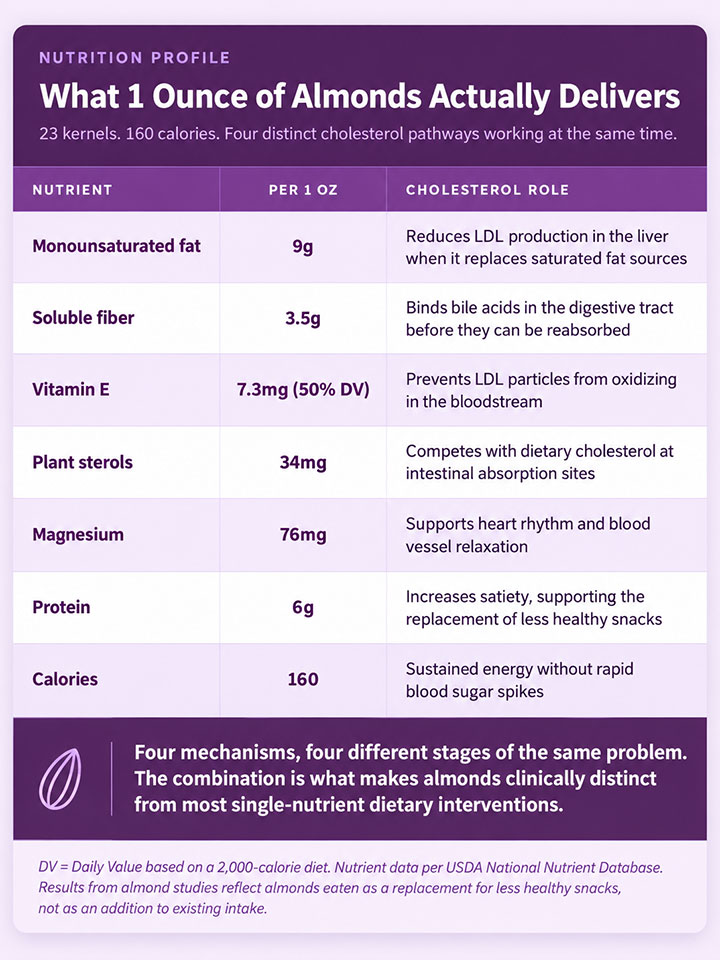
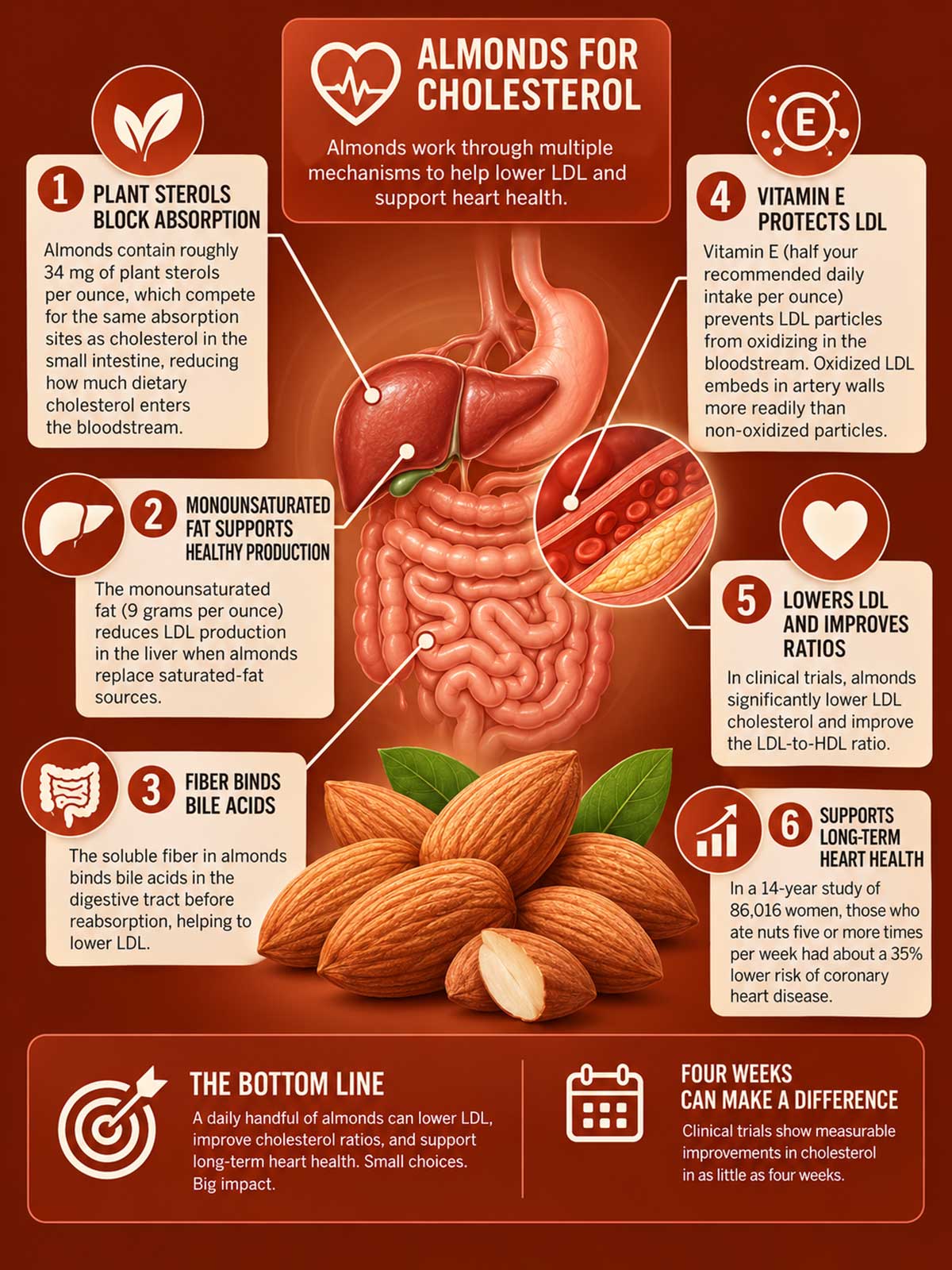
What makes almonds unusual among cholesterol-lowering foods is that they don’t work through a single mechanism. They hit four different stages of the same problem.
The plant sterols described above block dietary cholesterol at the intestinal absorption stage. The monounsaturated fat (9 grams per ounce) reduces LDL production in the liver when almonds replace saturated-fat sources. The soluble fiber binds bile acids in the digestive tract before reabsorption.
The fourth mechanism is the one most people haven’t thought about. Vitamin E (half your recommended daily intake per ounce) prevents LDL particles from oxidizing in the bloodstream. Oxidized LDL embeds in artery walls more readily than non-oxidized particles, and a standard lipid panel doesn’t distinguish between the two.
What a Handful Actually Delivers
One ounce of almonds (23 kernels, roughly a small palmful) runs about 160 calories. Most of the relevant trials used 43 to 73 grams per day, which is 1.5 to 2.5 ounces. The weight of evidence points to 1 to 1.5 ounces daily as the practical range that produces measurable cholesterol benefits without adding a problematic calorie load.
How Many Almonds Should You Eat to Lower Cholesterol?
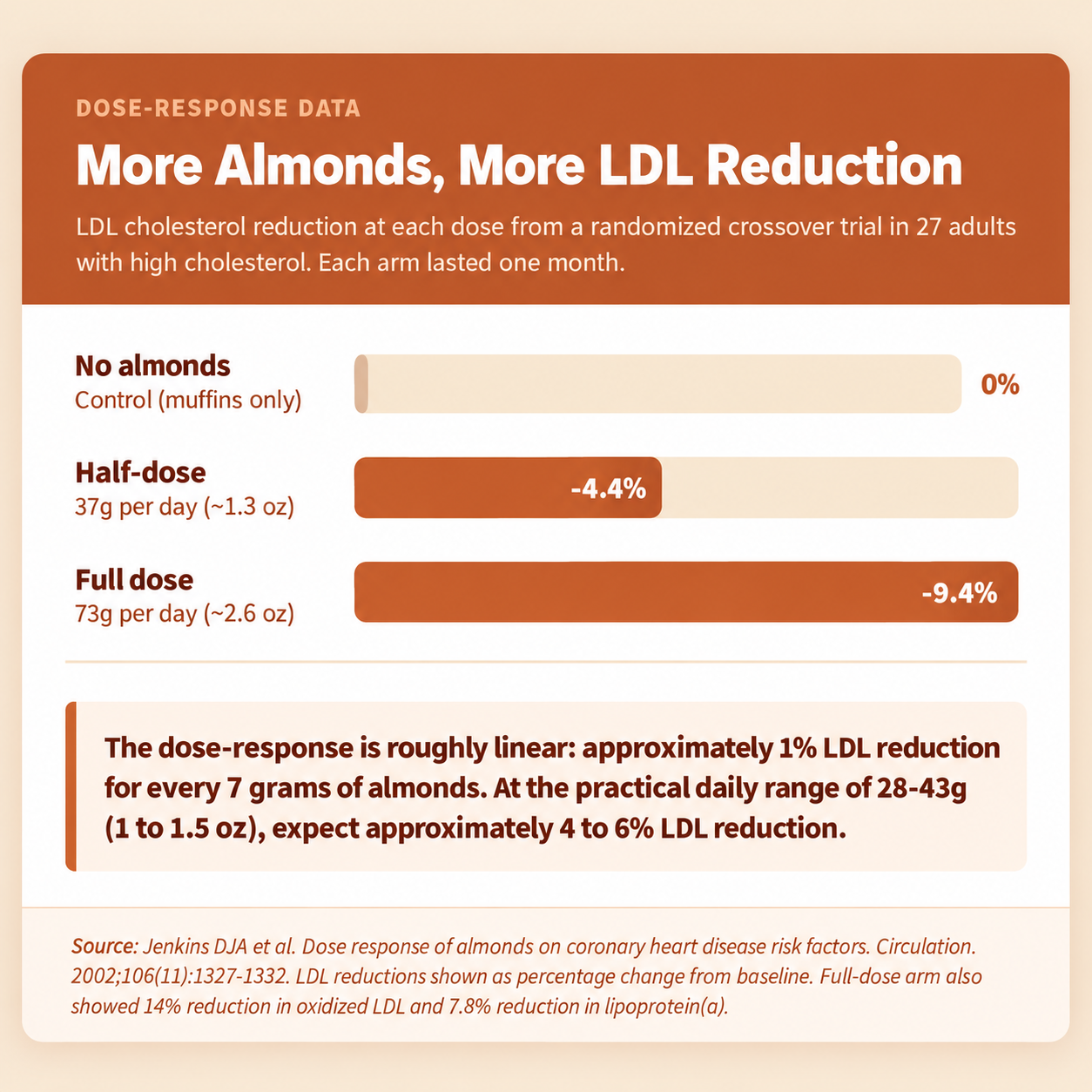
Research at the University of Toronto established that LDL reduction scales roughly linearly with dose: approximately 1% for every 7 grams of almonds added to the daily diet.
That means one ounce (28g) produces approximately 4% LDL reduction and a 1.5-ounce portion (43g) produces approximately 6%. Most people in real life aim for 1 to 1.5 ounces, which is the range that the strongest trial evidence actually used.
The 23-almond serving is a reasonable floor, not a ceiling. If your cholesterol is significantly elevated and your doctor approves of dietary modifications, eating a larger handful has clinical support.
When You Eat Them Matters Less Than You Think
Some sources are precise about timing. Morning before a workout, afternoon during the slump, with meals to slow absorption. These aren’t wrong, but the most important variable is consistency, not scheduling. The trials that produced results had people eating almonds daily. Pick a time that fits your actual routine and protect that slot.
Eating almonds with other food does slightly boost fiber effectiveness, since soluble fiber binds more cholesterol when there’s more bile acid production happening from a meal. Pairing them with breakfast or lunch is modestly better than eating them alone on an empty stomach. But “daily” matters more than “precisely timed.”
Week 2: The Case Against Your LDL
LDL cholesterol causes damage in two ways. First, it deposits into artery walls. Second, when LDL particles oxidize (a process that happens faster in the presence of certain dietary fats), they trigger an inflammatory response that accelerates plaque formation. Almonds address both problems, which is why the evidence runs deeper than simple cholesterol-number reduction.
The Dose-Response Story
The most influential trial on this question was led by Dr. David Jenkins at St. Michael’s Hospital in Toronto and published in Circulation in 2002. The design was clean: 27 people with high cholesterol ate three different daily supplements in random order, each for one month.
One was full-dose almonds (73g/day), one was half-dose almonds with muffins to match calories, and one was muffins alone. Both almond doses reduced LDL from baseline. At the full dose, the Jenkins et al. trial in Circulation found LDL fell by 9.4% and the LDL-to-HDL ratio improved by 12%. At the half-dose, LDL fell by 4.4%.
That near-linear relationship (more almonds, more LDL reduction) held across the dose range tested. It also answered a question the earlier research had left open: the benefit wasn’t solely from removing worse food. Almonds were pulling their own weight.
What You Replace Matters as Much as What You Add
The cholesterol-lowering effect is meaningfully larger when almonds replace refined carbohydrates than when they’re added on top of an existing diet. A granola bar, crackers, pretzels, or a muffin at snack time creates a real substitution opportunity. Adding almonds on top of those same snacks dilutes the benefit and adds calories without proportional gain.
That distinction (replacement, not addition) is where most people quietly abandon the benefit. A granola bar at 3 pm becomes a granola bar plus almonds. The LDL effect shrinks. The calorie load grows. At 160 calories per ounce, two extra portions a day that aren’t replacing anything add 320 calories without the cholesterol payoff.
Week 3: Beyond LDL
The standard lipid panel captures part of what almonds are doing. The rest doesn’t show up on any test your doctor currently orders.
Your HDL Gets Better at Its Job
HDL removes excess cholesterol from the bloodstream and carries it to the liver for disposal. More HDL particles are beneficial. But research from Penn State University found something more specific: it isn’t only the quantity of HDL that almonds change. It’s the quality.
In a six-week controlled trial, Penny Kris-Etherton and her research team at Penn State fed 48 adults with elevated LDL a daily almond snack (43g) or an isocaloric muffin. The 2015 trial in the Journal of the American Heart Association found that the almond group saw LDL-C drop by 5.3 mg/dL, while the muffin group saw HDL-C decrease.
The same team then went deeper. A 2017 paper in the Journal of Nutrition from that research program examined HDL subfractions, the specific particle subtypes that vary in how effectively they remove cholesterol from cells.
Almonds increased the proportion of the most mature, most functional subtype: the particles that most actively retrieve cholesterol.
That finding doesn’t appear on a standard lipid panel. A follow-up blood test won’t capture it. But it adds a dimension to the cholesterol picture that the LDL number alone can’t represent.
The Rest of the Picture
Three other markers tend to shift in favorable directions with regular almond consumption, even if most people won’t notice them directly. Inflammation markers, particularly CRP, often decrease, since the vitamin E and polyphenols in almonds reduce LDL oxidation.
Blood sugar tends to stabilize, because the fiber and healthy fat slow glucose absorption. And for people who genuinely replace less nutritious snacks, waist circumference sometimes decreases, which has its own effect on cardiovascular risk.
None of these secondary effects is guaranteed. The cholesterol data is far more consistent than the data on CRP or glycemic response. But they’re relevant context for understanding why nut consumption studies tend to show greater cardiovascular risk reduction than LDL changes alone would predict.
One Honest Caveat
The effect size varies considerably based on your starting point. Trials in people with elevated LDL, like the Jenkins and Penn State research, consistently produce the largest reductions. Trials in people with already-normal cholesterol tend to find smaller effects.
A large walnut study following healthy older adults over two years found an average LDL reduction of only 4.3 mg/dL. That’s meaningful, but far more modest than what the hyperlipidemic almond trials showed.
Researchers still haven’t fully settled why baseline cholesterol level modifies the response this much. The practical implication: if your LDL is borderline or elevated, you’ll likely see more from four weeks of almonds than someone whose numbers are already in normal range.
Week 4: Playing the Long Game
The four-week window is where the clinical trial data lives. But the most significant piece of evidence for almonds and cholesterol isn’t a four-week trial at all.
What 14 Years of Evidence Shows
In 1998, a research team from Harvard School of Public Health published a prospective cohort study in the BMJ that had been running since 1980. The scale was unlike anything the almond trials could achieve: 86,016 women, tracked for 14 years.
The research team, led by Dr. Frank Hu, was looking at whether the frequency of nut consumption predicted coronary heart disease outcomes in real life.
Hu et al.’s 1998 analysis in the BMJ found that women who ate nuts five or more times per week had about a 35% lower risk of coronary heart disease compared to those who rarely ate nuts. The 35% figure refers to actual cardiac events (fatal and non-fatal), not to a laboratory cholesterol reading, across 14 years of real-world diet patterns in tens of thousands of people.
That finding deserves more attention than it typically gets. Four-week trials measure numbers. The Nurses’ Health Study measured the thing the numbers are supposed to predict. And the numbers held up.
The benefit came primarily from LDL improvements, but nut eaters also had lower rates of diabetes, inflammation, and obesity across the 14 years. These factors compound. No single controlled trial can capture that compounding over time, which is why this observational data matters even with its limitations.
Your 4-Week Report Card
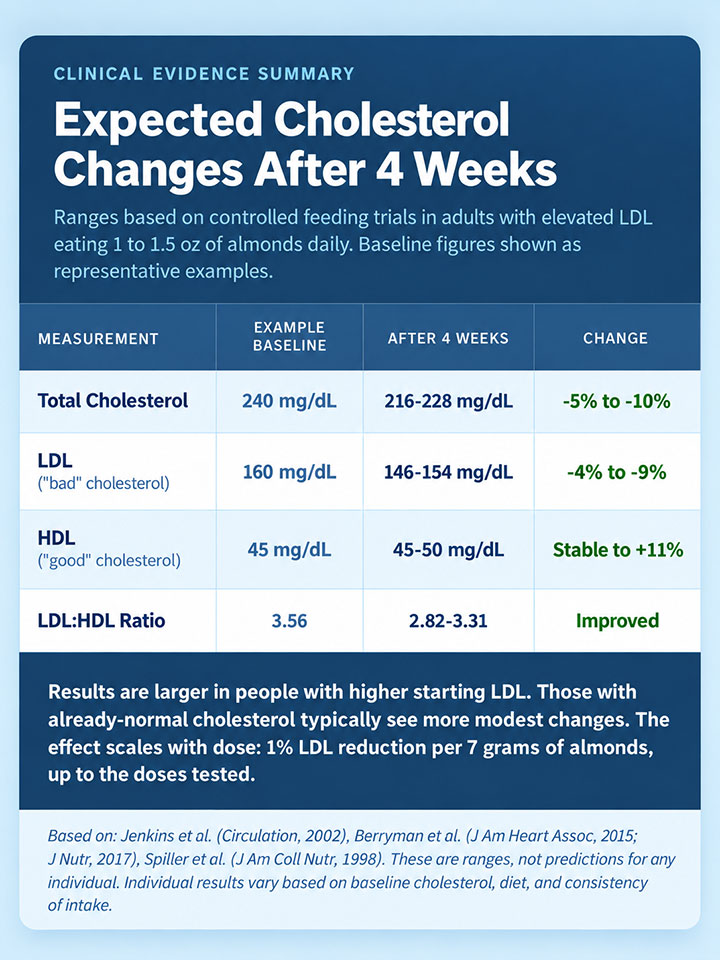
Based on the aggregate of the trial evidence, here’s what consistent daily almond consumption (1 to 1.5 oz replacing less healthy snacks) can produce over four weeks in people with elevated LDL:
- Total cholesterol falls by 5 to 10%.
- LDL cholesterol falls by 4 to 9%, with larger reductions at higher starting values.
- The LDL-to-HDL ratio improves.
- HDL function improves even when HDL quantity stays roughly stable.
- Oxidized LDL (not captured on a standard panel) reduces.
- Inflammation markers show modest improvements in some individuals.
If your numbers don’t move after four weeks, two things are worth checking. First, are you actually substituting almonds for something else, or adding them on top? Second, have you been consistent, daily, and not five days out of seven? The trials that produced results tracked adherence carefully. Real-world self-reporting tends to be optimistic.
LDL Impact Calculator
Based on clinical trial data from the Jenkins dose-response study. Enter your LDL or use the default to see your projected four-week outcome.
Three Recipes That Put Almonds to Work
Cholesterol-Fighting Morning Smoothie
This smoothie pairs almonds with berries for a double hit of LDL protection: the fiber and plant sterols from almonds, plus the anthocyanins in berries that reduce LDL oxidation. One serving delivers as much fiber as several servings of most breakfast cereals.
Ingredients:
- 1 cup unsweetened almond milk
- 23 raw almonds (about 1 oz)
- 1 cup frozen blueberries or strawberries
- 1 tablespoon ground flaxseed
- 1/2 banana
- Ice as needed
Instructions:
- Add almonds to the blender first and blend until finely ground.
- Add remaining ingredients and blend until smooth.
- Pour and drink immediately.
Time: 5 minutes | Servings: 1 | Calories: ~320
5-Minute Almond Energy Bites
These are built for meal prep. Make a batch on Sunday and the week’s snacking is handled. Each bite contains the equivalent of five to six almonds’ worth of fiber and healthy fat, with oats adding extra beta-glucan for cholesterol support.
Ingredients:
- 1 cup almonds, finely chopped
- 1/2 cup rolled oats
- 2 tablespoons almond butter
- 2 tablespoons honey
- 1/4 cup dark chocolate chips (70% cacao or higher)
- Pinch of sea salt
Instructions:
- Pulse almonds in a food processor until coarsely chopped.
- Mix all ingredients in a bowl until combined.
- Roll into 12 balls, about 1 tablespoon each.
- Refrigerate in an airtight container for up to two weeks.
Time: 5 minutes | Servings: 12 bites | Calories per bite: ~95
Almond-Crusted Salmon
The combination of almonds and salmon stacks two distinct cholesterol pathways: almonds reduce LDL through plant sterols and fiber, while salmon’s omega-3s lower triglycerides and reduce cardiovascular inflammation. This is the most evidence-backed recipe of the three.
Ingredients:
- 1/2 cup almonds, finely chopped
- 2 salmon fillets, 4 to 6 oz each
- 1 tablespoon Dijon mustard
- Fresh dill or parsley, chopped
- 1 tablespoon lemon juice
- Salt and pepper to taste
Instructions:
- Preheat the oven to 375°F and line a baking sheet with parchment.
- Mix chopped almonds with herbs, salt, and pepper in a small bowl.
- Brush each salmon fillet with Dijon mustard, then press the almond mixture firmly onto the top.
- Bake for 15 minutes, until the salmon flakes easily with a fork.
- Drizzle with lemon juice before serving.
Time: 20 minutes | Servings: 2 | Calories per serving: ~380
Buying and Storing Almonds for Maximum Benefit
Almonds with the brown skin intact have higher antioxidant content than blanched. Raw and dry-roasted both work well. Avoid almonds roasted in oil or with heavy salt additions, because the added sodium and saturated fat work against the cholesterol benefits. Read labels.
Freshness matters more than most packaging suggests. The monounsaturated fats responsible for lowering LDL also degrade when almonds sit in a warm cabinet too long. Oxidized fats don’t deliver the same lipid benefit.
Store almonds in an airtight container in the refrigerator for six to twelve months of useful life. If they taste bitter or smell off, they’ve turned.
Bulk purchasing from a reputable source is more economical and often fresher than pre-packaged individual servings. Portioning out the week’s supply on Sunday takes about two minutes and removes the friction of measuring every morning.
Conclusion
The 4-Week Almond Challenge works because it’s backed by a range of evidence that most single-food dietary claims can’t match: mechanistic studies, dose-response trials, and a cohort study large enough to measure what the LDL numbers are actually predicting.
Fourteen years, 86,000 women, a 35% reduction in coronary events for the most frequent nut eaters. That data exists. It’s peer-reviewed. And the intervention costs about the same per month as a generic statin.
The obstacle is consistency, not the quality of the evidence. A handful of almonds a day produces measurable results in four weeks of controlled feeding. In the real world, “most days” and “about a handful” tend to produce something between “some benefit” and “nothing measurable at all.” Four weeks of actual daily consistency is the test. Start there.
Frequently Asked Questions
How many almonds should I eat each day to lower cholesterol?
The trial evidence points to 1 to 1.5 ounces (28 to 43 grams) daily as the effective range. That’s 23 to about 35 almonds. Larger doses produce proportionally larger LDL reductions.
The University of Toronto dose-response trial found roughly 1% LDL reduction per 7 grams of almonds, and 43 grams daily is where the strongest evidence cluster sits.
Your body can’t meaningfully process more than a certain amount at once, and larger portions add significant calories without proportional benefit.
Raw or roasted: does it matter?
Minimally. Heat reduces vitamin E content by 10 to 15%, so raw almonds have a small edge. Dry-roasted is fine, and the flavor often makes daily consistency easier, which matters more than the marginal nutrient difference.
What to avoid is almonds roasted in vegetable oil or heavily salted. If the label lists more than one ingredient, check what the others are.
Are almonds or walnuts better for cholesterol?
Both have strong evidence, but through different mechanisms. Almonds are the better-studied option for LDL reduction specifically, with the plant sterols and monounsaturated fat combination producing consistent results across trials.
Walnuts have a higher omega-3 content (ALA), which makes them more effective for reducing triglycerides and inflammation. A two-year trial in elderly adults found walnut consumption lowered LDL by an average of 4.3 mg/dL.
For cholesterol specifically, the almond evidence is more consistent at standard portions. For overall cardiovascular risk, either (or both) is well-supported.
What if I’m allergic to almonds?
Walnuts are a reasonable alternative for LDL reduction. Pistachios also lower LDL and improve the LDL-to-HDL ratio in controlled trials. For people with tree nut allergies, flaxseed and chia seeds provide some of the same fiber and omega-3 mechanisms, though the evidence for cholesterol reduction in nut-free alternatives is thinner. Talk to your doctor about which substitution fits your allergy profile and cardiovascular needs.
How long before my doctor will see a change in my bloodwork?
Four to six weeks of consistent daily intake is the window most trials use to detect meaningful changes. Some individuals see results in two weeks. Others need six to eight. Your starting LDL matters: the higher your baseline, the larger and faster the response tends to be.
Schedule a cholesterol test four to six weeks after starting. Keep eating almonds even if the first test doesn’t show a dramatic shift. The anti-inflammatory and antioxidant effects are occurring even when the LDL number doesn’t move as much as expected.
Can I eat almonds alongside my cholesterol medication?
Yes. The STALL Study, published in the Journal of Clinical Lipidology, specifically examined almonds added to background statin therapy and found the combination produced additional benefit. Talk to your doctor before making any changes to your medication.
If your LDL improves significantly with diet, your prescriber may consider adjusting your dose, but that’s a conversation to have with them, not a self-directed decision. If you take blood thinners, discuss vitamin E intake with your doctor, since high doses can affect clotting.
Will almonds cause weight gain?
Not when they replace other snacks. Almond consumption studies consistently show that people who eat nuts regularly don’t gain more weight than those who avoid them, and some research finds nut eaters weigh less on average.
The reason is satiety: the protein and fiber combination in almonds reduces hunger in the hours after eating, which tends to result in eating less at the next meal. The critical word is “replace.” Adding almonds on top of an unchanged diet adds 160 calories per ounce without the satiety offset.
Do I need to eat them at exactly the same time every day?
No. Daily adherence is what the evidence measures, not the specific hour. Eating almonds with a meal is slightly better than eating them alone (active digestion increases bile acid production, giving the fiber more to bind), so pairing them with breakfast or lunch is a small advantage. But “every day” matters far more than “at precisely 8 am.” Find a slot that fits your actual routine.
This article is for informational purposes only and does not replace medical advice. Always consult your healthcare provider before making dietary changes, particularly if you take cholesterol medication or have kidney disease. Individual results vary. The studies cited used almonds as part of a healthy diet, not as a standalone treatment.