Lowering cortisol sounds like an obvious win, but cortisol isn’t something healthy people simply need to eliminate. So what does the research actually show about these supplements?
Every ashwagandha label in the cortisol supplement aisle prints the same number: 27.9%. It comes from one study, published in 2012, with 64 participants, and it circulates across product pages and competitor roundups as though it settled the question.
The number is real. Where it gets more complicated is what the study actually measured.
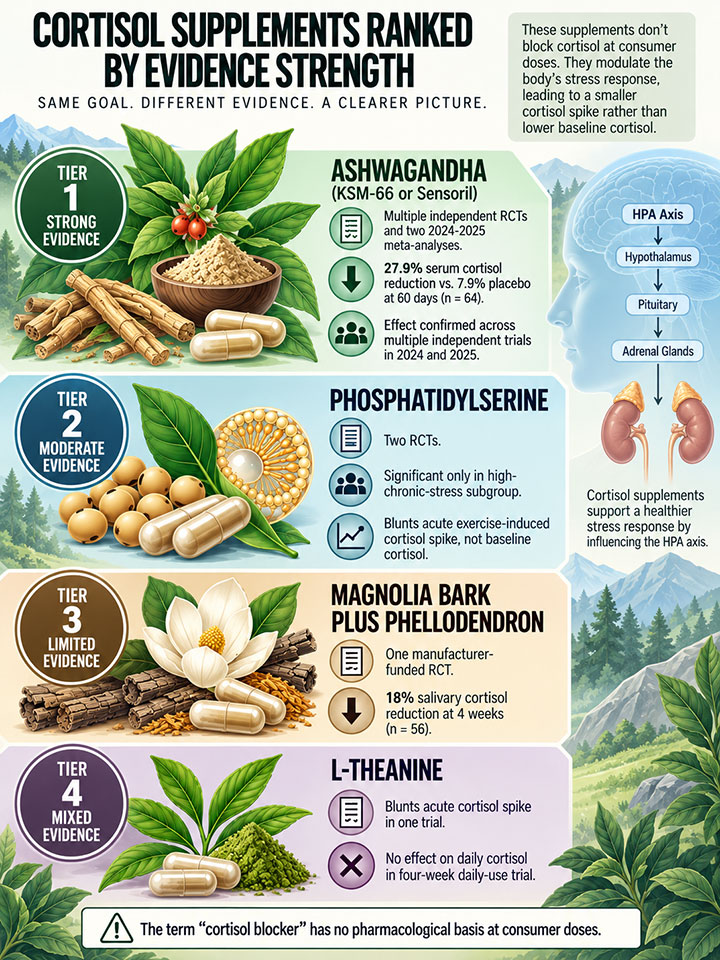
Some cortisol supplements have genuine human trial data, and a smaller number have independent replication or pooled meta-analyses. The “cortisol blocker” framing that dominates this category describes a pharmacological mechanism none of these products achieve at consumer doses.
What a few of them do offer is a different thing entirely: narrower, better-evidenced, and worth understanding before you choose one.
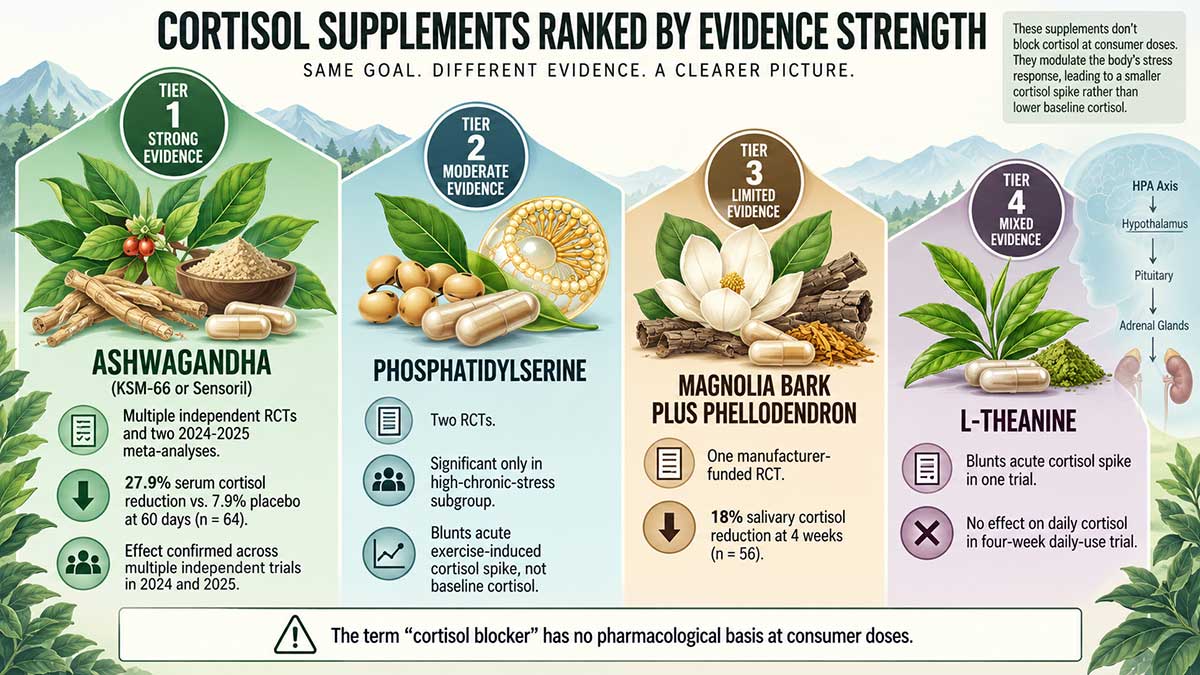
Ashwagandha, specifically a standardized extract (KSM-66 or Sensoril), has the strongest RCT record in this category.
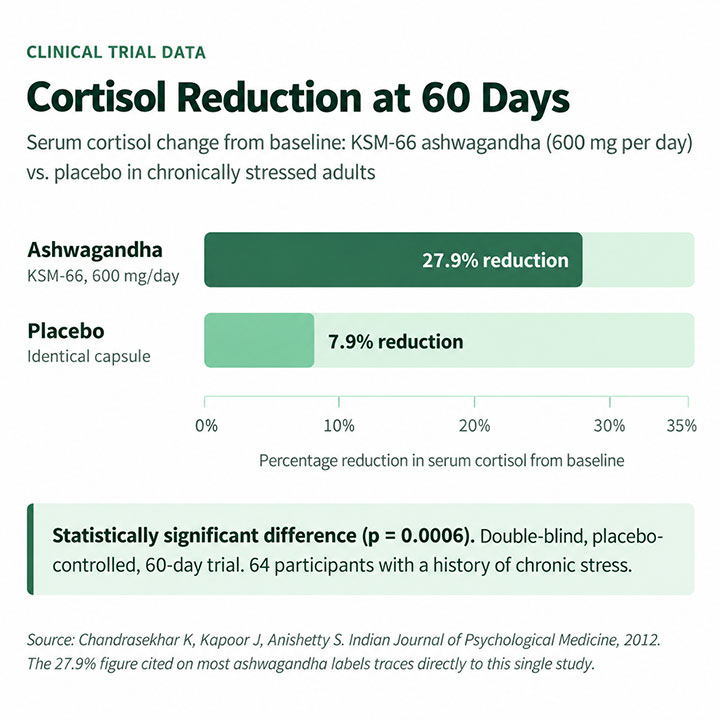
A 2012 randomized trial by Chandrasekhar and colleagues found that 600 mg of KSM-66 daily reduced serum cortisol by 27.9% over 60 days, compared to 7.9% in the placebo group. Meta-analyses from 2024 and 2025 confirmed the effect across multiple independent trials.
Do “Cortisol Blocker” Supplements Actually Block Cortisol?
No, and the word “blocker” is doing pharmacological work it has not earned. True cortisol blockers are prescription medications (ketoconazole, mifepristone, metyrapone) used in clinical settings to treat conditions like Cushing’s disease, where cortisol is measurably and dangerously high. Consumer supplements are nowhere in that conversation.
What the better-evidenced products in this space do is modulate the HPA axis. The hypothalamus detects a stressor and signals the pituitary, which in turn signals the adrenal glands to release cortisol.
Adaptogens appear to reduce the sensitivity of that pathway, and the result is a smaller cortisol spike after a stressor, not lower resting cortisol across the day. That distinction matters when you’re deciding what to buy and what to expect from it.
Endocrinologists have been direct on the broader context. A February 2026 PBS News report asked several of them about the cortisol-management supplement trend, and the response was consistent: most healthy people don’t have a cortisol problem that warrants management, and no OTC product is a proven treatment for a clinical cortisol disorder.
The category has evidence behind a handful of ingredients and nothing like the mechanism its marketing describes.
Ashwagandha: The Strongest Evidence in This Category
The Chandrasekhar trial is worth understanding in detail, because the 27.9% reduction it found is now a number that appears on thousands of product labels as though it applies to every ashwagandha product at every dose for every person under stress. It doesn’t.
The trial enrolled 64 adults with a history of chronic stress and randomized them to either 300 mg of KSM-66 root extract twice daily (600 mg total) or a visually identical placebo for 60 days. Serum cortisol was drawn at baseline and at day 60.
The ashwagandha group’s reduction was statistically significant at p=0.0006, and participants also reported substantially lower scores on perceived stress and anxiety scales. The methodology was sound for a study of this size (double-blind, placebo-controlled, with pre-registered outcomes).
But 64 participants is an early-stage result, not a settled answer, and the population (chronically stressed adults in India, using one specific extract) is narrower than any label implies.
The picture fills out considerably from there. A 2024 systematic review published in a peer-reviewed complementary medicine journal pooled nine RCTs involving 558 participants and found ashwagandha formulations produced a significant reduction in serum cortisol (MD = -2.58) alongside meaningful improvements in perceived stress and anxiety.
The 2025 meta-analysis published in BJPsych Open pooled 15 RCTs with 873 participants and confirmed stress and anxiety reductions across multiple independent formulations. Together, these two reviews bring the evidentiary picture much closer to what the labels promise, though not all the way there.
A separate 60-day double-blind RCT by Lopresti and colleagues, published in Medicine (Baltimore) in 2019, introduced a different data point: 240 mg of a standardized extract called Shoden taken once daily produced a statistically significant reduction in morning cortisol alongside improvements on the Hamilton Anxiety Rating Scale.
The dose and extract differ from the Chandrasekhar trial. That matters. Not all ashwagandha products are equivalent, and when a label says “ashwagandha extract” without naming the form or standardization percentage, you are looking at a different product than the ones studied.
One safety note worth stating plainly: rare case reports of liver injury associated with ashwagandha have appeared in the published medical literature. These are not findings from the RCTs, which generally reported mild GI side effects only.
But the case reports are real, and anyone with existing liver conditions or on hepatotoxic medications should discuss use with a physician. The same applies to anyone on thyroid medication: ashwagandha has been shown to affect thyroid hormone levels in some studies, and the interaction with thyroid drugs is not fully characterized.
Phosphatidylserine: It Blunts the Spike, Not the Baseline
Phosphatidylserine is a phospholipid found in high concentrations in neuron cell membranes. It appears in both the cortisol supplement category and in brain health research, for different mechanistic reasons in each. Here the question is specific: what does it do to cortisol?
The foundational finding came from a placebo-controlled study by Monteleone and colleagues in which nine healthy men received 800 mg per day of phosphatidylserine for 10 days, then performed an exercise protocol designed to raise cortisol levels.
The phosphatidylserine group showed significantly blunted ACTH and cortisol responses to the physical stressor (p=0.003 and p=0.03, respectively). Nine participants is a small number. The finding has held up.
A soy-based replication by Hellhammer and colleagues, published in Lipids in Health and Disease in 2014, enrolled 75 healthy men and tested a phosphatidylserine and phosphatidic acid complex (400 mg of each per day) for six weeks.
The cortisol-normalizing effect was significant only in the subgroup with high chronic stress at baseline. Men with low chronic stress showed no significant difference from placebo. This caveat almost never appears in product marketing.
The practical conclusion: phosphatidylserine is a stronger candidate for post-exercise recovery or high-load situations than for general daily cortisol management. One additional note on sourcing: the original foundational trials used bovine brain-derived phosphatidylserine, which is no longer commercially available due to BSE concerns.
Current soy and sunflower-derived forms have a slightly less established evidence base at the same doses: real, but not a direct replication.
Magnolia Bark and Phellodendron: A Real Trial, With One Important Note
The combination of magnolia bark extract (Magnolia officinalis) and phellodendron bark extract (Phellodendron amurense), sold as Relora, is one of the few non-ashwagandha entries in this category with a published randomized controlled trial behind it. T
albott and colleagues, writing in the Journal of the International Society of Sports Nutrition in 2013, randomized 56 moderately stressed adults to either 500 mg per day of the Relora combination or placebo for four weeks.
Salivary cortisol was 18% lower in the Relora group at week four (p<0.05), and mood scores across tension, depression, anger, fatigue, and confusion all improved significantly.
The note the paper makes, and the marketing does not: the study was funded by Next Pharmaceuticals, the manufacturer of Relora. Two of the three authors were employed by organizations marketing
Relora-containing products at the time of publication. The authors disclosed this in the full paper, and the methodology was appropriate for the sample size. Still, one manufacturer-funded trial of 56 people over four weeks is a thin base for the confidence level at which this ingredient appears on labels.
That doesn’t make the result worthless. It means the 18% reduction deserves the same scrutiny as the 27.9% figure: a specific population, a specific product formulation, a specific duration, and a result that needs independent replication before it can be treated as settled.
L-Theanine: Two Studies, Two Different Questions
L-theanine’s anti-anxiety signal is among the better-replicated findings in the supplement literature. What it does to cortisol is a narrower and more contested question. Two rigorous trials came to opposite conclusions, and the difference between them is more informative than either result alone.
In a 2016 randomized crossover trial by White and colleagues, published in Nutrients, 34 healthy adults received either a 200 mg L-theanine drink or placebo before completing a multitasking cognitive stressor.
Subjective stress fell significantly one hour after dosing. Salivary cortisol dropped three hours post-dose. That’s an acute-stressor result: L-theanine blunted the cortisol response to a specific, time-limited stress event.
The four-week daily-use trial by Hidese and colleagues, published in Nutrients in 2019, produced the opposite finding on cortisol while agreeing on everything else. Thirty adults took 200 mg per day for four weeks.
Sleep quality, anxiety, and depression scores all improved significantly. Serum and salivary cortisol did not change. The usual interpretation is that these two results represent mixed evidence. Something more specific is going on.
One trial asked whether L-theanine blunts the cortisol spike in the hour after an acute stressor. The other asked whether daily use lowers cortisol across four weeks of regular use. These are different biological questions, and each trial answered the one it asked. L-theanine has a clear answer to the first. The second remains open.
What the “Cortisol Belly” Evidence Actually Shows
The biological link between cortisol and abdominal fat is real at a broad level. Chronically high cortisol, as seen in conditions like Cushing’s syndrome, promotes visceral fat accumulation through effects on insulin sensitivity and adipocyte distribution. That’s documented physiology.
The jump from “high cortisol correlates with visceral fat in clinical populations” to “taking a cortisol supplement will reduce your belly fat” is a much longer stretch.
A 2019 randomized trial by Salve and colleagues in Cureus found that 600 mg of ashwagandha daily over eight weeks produced modest body weight reductions in overweight adults alongside improvements in cortisol and stress scores.
The mechanism appeared to be indirect: lower perceived stress led to better sleep and less stress-related eating, not to a direct shift in fat metabolism from cortisol suppression. A supplement that moderates the cortisol spike after a stressor is doing something different in kind from a drug that treats a cortisol disorder, and the body composition results in the trials reflect that difference.
Most people searching in this space are looking for a fat-loss mechanism. The supplements in this article don’t have one. What they address is the stress response, and they may make the broader lifestyle work (sleep, movement, caloric management) slightly easier to maintain. That’s a narrower benefit than this category typically promises, and a more honest one.
Side Effects and Who Should Be Careful
The standard advice to check with a physician before adding any supplement to a prescription medication regimen is not a formality in this category.
Herb-drug interactions with adaptogens are undercharacterized in the published literature, and the gap between “no documented interaction” and “safe in your specific combination” can be real. Two cases here warrant more than a passing note.
Ashwagandha carries the most specific safety signal of any ingredient in this article. Case reports of liver injury associated with its use have appeared in the published medical literature, and while these are rare and not reflected in RCT adverse event data, they are worth factoring in before committing to long-term use, particularly at doses higher than those studied or alongside medications that place a load on the liver.
Thyroid medication users face a separate consideration: ashwagandha has been shown to affect thyroid hormone levels in some studies, and the interaction is not fully characterized. Ashwagandha is not recommended during pregnancy.
Magnolia bark’s active compounds (honokiol and magnolol) have GABA-modulating properties. That makes sedation stacking a real consideration rather than a theoretical one: combining the Relora formulation with sleep aids, benzodiazepines, or other calming supplements warrants a specific conversation with a pharmacist before starting.
Phosphatidylserine and L-theanine both carry clean safety records at trial doses. Mild GI upset is the most commonly noted issue with phosphatidylserine at higher doses. L-theanine at 200 to 400 mg daily has produced no significant adverse effects across the RCT literature. Neither warrants the level of caution the two above do.
Choosing the Right Option for Your Situation
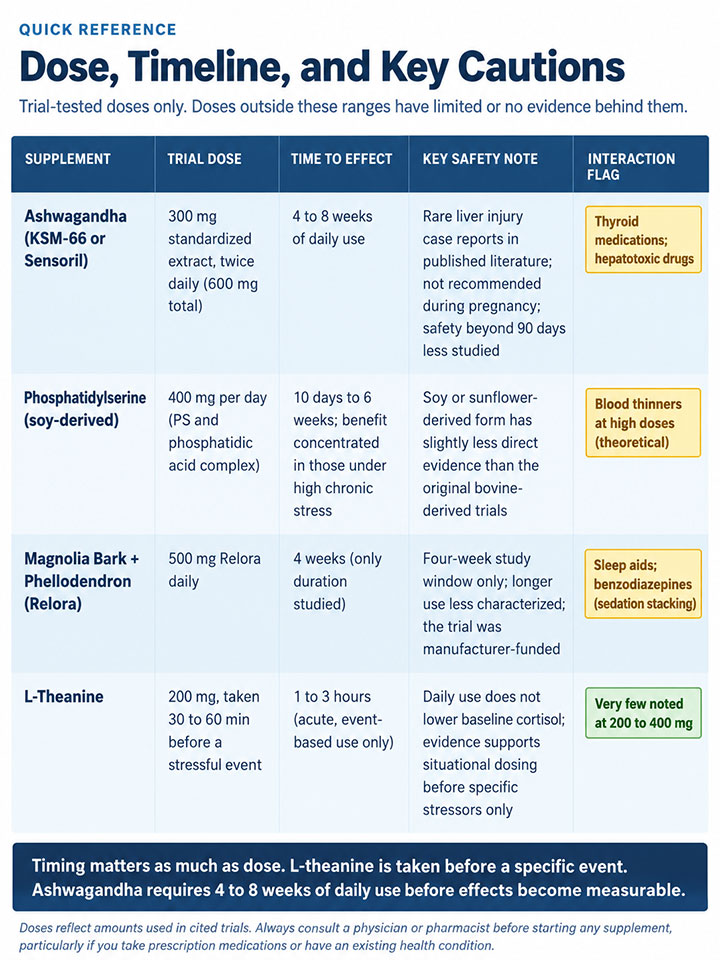
The evidence doesn’t point to one option for every situation. People managing general chronic stress over weeks to months have the strongest case for ashwagandha, at 300 mg of a standardized extract (KSM-66 or Sensoril) twice daily, given its depth of independent replication. Exercise-induced cortisol spikes and slow recovery from training are where phosphatidylserine at 400 mg daily has its most specific evidence.
A single high-stakes event calls for a different approach: 200 mg of L-theanine taken 30 to 60 minutes beforehand has support for moderating the acute cortisol response. Magnolia bark and phellodendron remain a reasonable choice for moderately stressed adults who want a broader mood and cortisol effect, with the manufacturer-funding caveat clearly in view.
The selector tool below matches your specific situation to the option with the most relevant evidence.
What the Evidence Actually Tells You
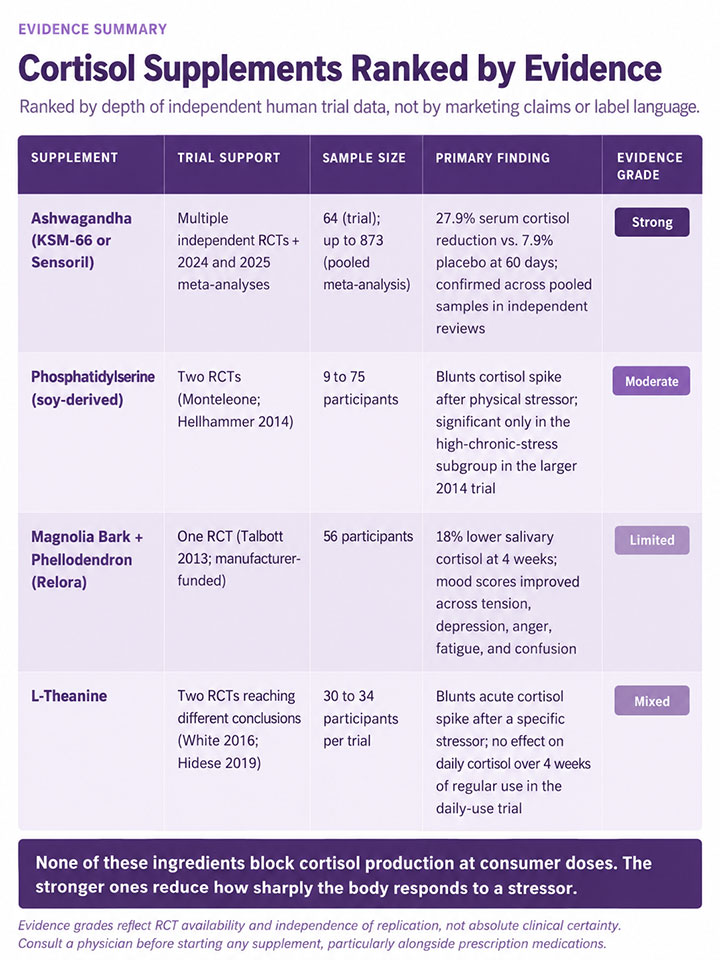
Of the four ingredients here, only ashwagandha has enough trial accumulation across independent groups to hold up under scrutiny, and even that result is narrower than any label admits.
Phosphatidylserine and L-theanine each do something real and specific. Neither does what the broader category implies. Everything else sold under the “cortisol blocker” label is borrowing a pharmacological framing the evidence never provided.
The endocrinologists PBS quoted in February 2026 were right about the broader picture: most people searching for supplements to lower cortisol do not have a cortisol disorder. What they have is a stress load their nervous system is managing imperfectly.
The supplements above may take some of the edge off that. The lifestyle work (consistent sleep, movement, and whatever reliably reduces your actual load) will do more. The research says both things, and neither one cancels the other out.
Frequently Asked Questions
What are the signs that cortisol might be high?
Disrupted sleep (particularly waking between 2 and 4 a.m.), unexplained weight gain around the midsection, slow recovery from exercise, persistent brain fog, a sense of being tired but unable to relax, and increased susceptibility to colds are the symptoms most commonly associated with chronically high cortisol.
None of these confirm an abnormality on their own. If the pattern is significant and affecting quality of life, a physician can order a 24-hour urine free cortisol test or a morning serum cortisol draw to assess whether levels are actually outside the normal range. Supplementing based on a symptom pattern alone, without testing, adds a variable to an unconfirmed problem.
Can cortisol supplements help with weight loss?
Not directly. The link between cortisol and visceral fat is documented in clinical populations with pathologically high cortisol, but the supplements in this article work by moderating the stress response rather than by blocking cortisol-driven fat storage.
The ashwagandha trials that reported body composition changes attributed modest weight effects to downstream factors: better sleep, reduced stress eating, and improved capacity to maintain normal activity levels. If weight loss is the primary goal, the evidence base for sleep, resistance training, and caloric management is considerably stronger than anything in this supplement category.
How long does ashwagandha take to affect cortisol?
The Chandrasekhar trial measured cortisol at day 60 only, not at intermediate points. The Lopresti 2019 trial also ran for 60 days. Most of the individual trials pooled in the 2024 and 2025 meta-analyses ran for 30 to 90 days.
The consistent finding across these studies is that measurable cortisol changes require at least four to eight weeks of daily supplementation. Taking ashwagandha for a few days and expecting a cortisol effect is not consistent with the trial design or the biology the studies were testing.
Are cortisol supplements safe to take long-term?
For ashwagandha, the published RCT evidence extends reliably to about 90 days of daily use. Long-term safety data past that window is limited rather than absent: the studies simply have not run long enough to produce it.
For phosphatidylserine, magnolia bark, and L-theanine at trial-relevant doses, similar constraints apply. Taking periodic breaks and re-evaluating with a physician if use extends for months rather than weeks is the more defensible approach until longer-term data exists.
What is the cortisol cocktail, and does it lower cortisol?
The cortisol cocktail (also called an adrenal cocktail) is a drink popularized on social media. It typically combines orange juice or coconut water with cream of tartar and sea salt. Proponents credit it with cortisol-lowering effects through support of “adrenal fatigue.”
Adrenal fatigue is not a recognized medical diagnosis. The adrenal glands in healthy individuals do not lose the capacity to produce cortisol under stress. The drink supplies vitamin C, potassium, and sodium (nutrients with legitimate roles in general health) and is harmless for most people. No randomized trial has tested it for any effect on cortisol levels.