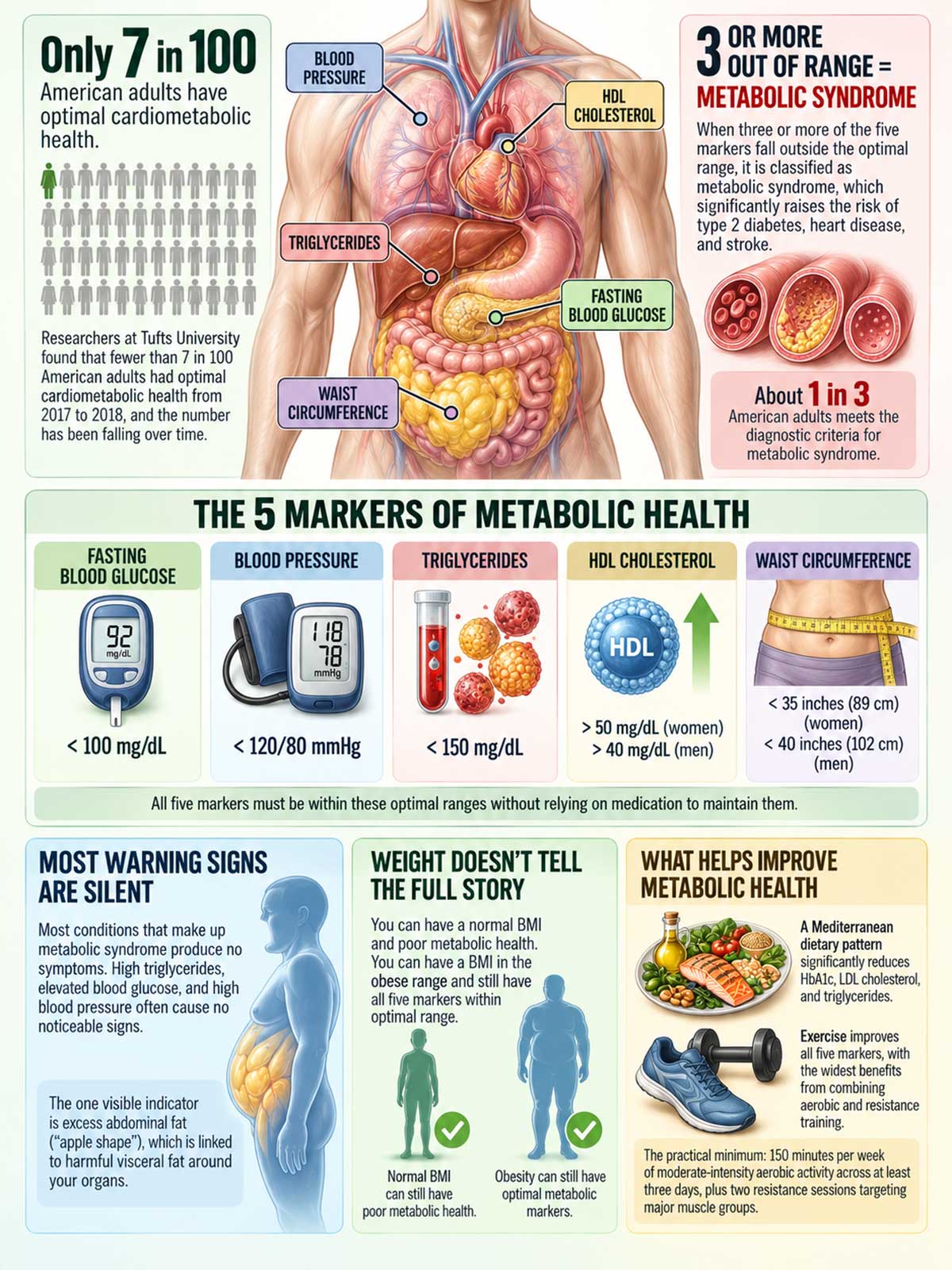
Metabolic problems often develop without obvious warning signs. Five simple numbers can reveal whether your body is actually operating in a healthy range.
The clinical definition of metabolic health has a clause that most doctors don’t mention. If your blood pressure is normal only because you take medication for it, you do not meet the research definition of a metabolically healthy person.
Neither does anyone whose blood sugar or cholesterol stays within range through prescription alone. By that standard, many people who believe they have managed their health out of the danger zone have not left it at all.
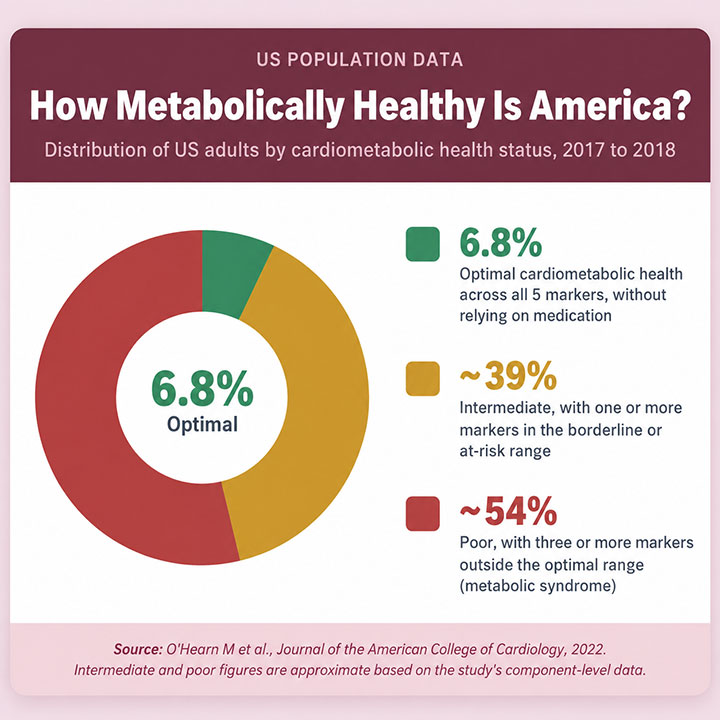
Researchers at Tufts University spent years tracking this across two decades of national health surveys. Their conclusion, published in the Journal of the American College of Cardiology in 2022, was stark: from 2017 to 2018, fewer than 7 in 100 American adults had optimal cardiometabolic health.
Seven in a hundred. And the number had been falling, not rising, across the entire observation period.
What makes that figure hard to absorb is where it leaves the rest of the population. Most people with compromised metabolic health have no idea. The markers that define it (blood sugar, blood pressure, cholesterol, triglycerides, waist circumference) produce no pain, no visible change, and often no conversation with a doctor until something has already gone wrong. This is not a condition that announces itself. That silence is precisely the problem.
The Five Markers That Define Metabolic Health
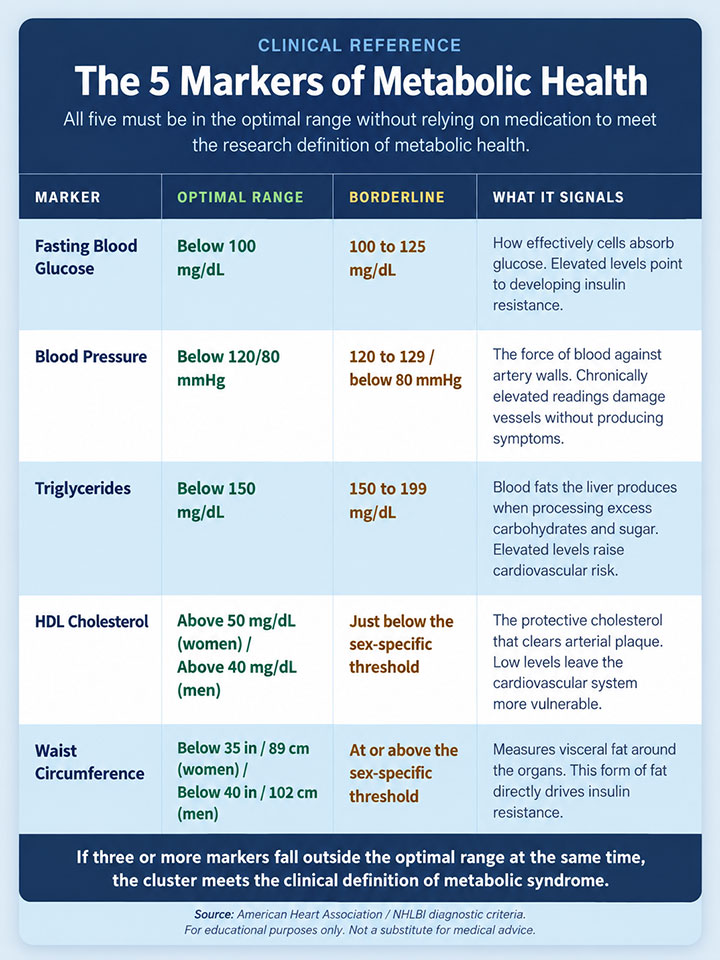
The American Heart Association and the National Heart, Lung, and Blood Institute jointly define metabolic health using five measurable characteristics. No single marker carries more weight than the others.
The risk associated with metabolic syndrome arises when three or more fall outside the optimal range at the same time, and the interaction between elevated markers tends to compound the damage beyond what any one of them would cause independently.
The five markers, with their optimal thresholds, are:
- Fasting blood glucose below 100 mg/dL
- Blood pressure below 120/80 mmHg
- Triglycerides below 150 mg/dL
- HDL cholesterol above 50 mg/dL for women, above 40 mg/dL for men
- Waist circumference below 35 inches (89 cm) for women, below 40 inches (102 cm) for men
The AHA’s clinical guidance is clear that these thresholds represent optimal ranges, not merely “acceptable” ones. Borderline results in two or three categories create a different risk picture than a clean result across all five, even if none of the borderline readings is high enough to trigger a formal diagnosis on its own.
The medication clause deserves attention here. If your blood pressure reads 116/74 because you take a daily antihypertensive, clinical researchers do not count that as a metabolically healthy blood pressure.
The marker needs to be within range unassisted, because medication manages a physiological outcome without necessarily addressing the underlying metabolic state that produced the elevated reading.
Metabolic Health Score Checker
Enter your most recent test results to see how your markers compare to the clinical thresholds for optimal metabolic health.
What Metabolic Syndrome Actually Is
Metabolic health and metabolic syndrome describe opposite ends of the same spectrum. Good metabolic health means all five markers sit within the optimal range without pharmaceutical assistance.
Metabolic syndrome is the clinical label for when three or more markers are out of range simultaneously, and its presence roughly doubles the long-term risk of cardiovascular disease while raising the risk of type 2 diabetes significantly.
About one in three American adults currently meets the diagnostic criteria for metabolic syndrome. That number has been climbing steadily over the past two decades, driven primarily by worsening rates of abdominal obesity and elevated blood glucose, the two components that deteriorated most sharply in the Tufts JACC analysis led by Meghan O’Hearn at the Friedman School of Nutrition Science and Policy.
Metabolic syndrome is not a traditional diagnosis in the sense of a treatable disease. No single medication addresses the full cluster of markers, and clinicians do not prescribe a unified “metabolic syndrome treatment.” It functions as a risk signal, and the medically appropriate response is lifestyle modification, which means the burden of action falls almost entirely on the person who has it, frequently without enough support to know where to start.
Most of the Warning Signs Are Silent
This is what makes the 7% figure particularly difficult to act on at scale. The Mayo Clinic notes that most conditions making up metabolic syndrome produce no symptoms. High triglycerides feel like nothing. Elevated fasting glucose feels like nothing. Blood pressure can sit at 140/90 for years without a headache, chest tightness, or any other signal the body registers consciously.
That is worth sitting with for a moment. The most common way people find out they have poor metabolic health is during a routine blood panel, often years into the process, often framed by a clinician as “a little high, let’s keep an eye on it.” That conversation, or the absence of one, is where the silent part of the disease actually lives.
The one exception is waist circumference. Excess abdominal fat (the pattern clinicians describe as an “apple shape”) is the most consistently visible indicator of poor metabolic health, and it correlates with a form of fat storage that is metabolically distinct from subcutaneous fat: visceral fat, which accumulates around the liver, kidneys, and digestive organs rather than beneath the skin.
Researchers characterizing insulin resistance, the underlying mechanism that drives most poor metabolic health, have described it as a “silent pandemic without typical symptoms”, according to a 2026 review in Molecular Biomedicine, noting that it is “not yet recognized as an independent risk factor in the diagnosis of related diseases” in routine clinical practice.
The practical consequence is that most people developing metabolic dysfunction are not told so. The progression toward metabolic syndrome, and from there toward type 2 diabetes or cardiovascular disease, can span a decade of normal-seeming blood test results.
Why Your Weight Does Not Tell the Full Story
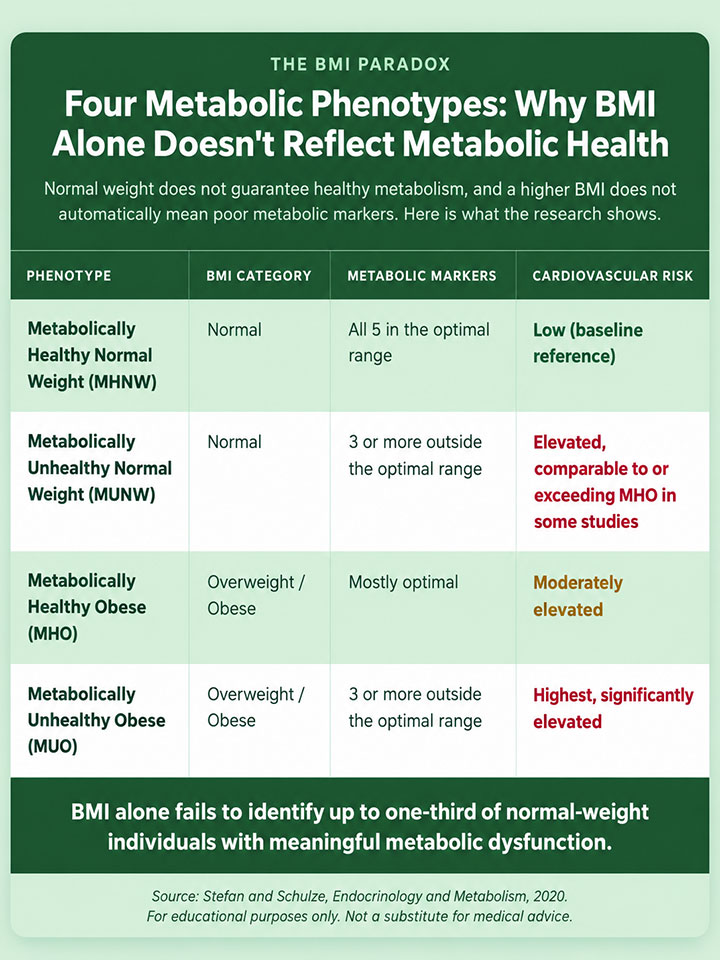
The most counterintuitive finding in metabolic health research is also the one with the clearest practical implications. Body weight (and specifically BMI) is a poor proxy for metabolic status. You can have a normal BMI and poor metabolic health. You can have a BMI that technically qualifies as obese and have fully optimal metabolic markers across all five measures.
Nikolai Stefan and colleagues at the Helmholtz Center Munich and the German Center for Diabetes Research have published extensively on the “metabolically unhealthy normal weight” phenotype, the clinical picture of a person with a healthy BMI who still meets the criteria for metabolic syndrome.
Their 2020 review in Endocrinology and Metabolism summarized the body of evidence: BMI fails to identify up to one-third of normal-weight individuals who carry meaningful metabolic dysfunction.
The inverse also holds. The same review found that a subset of people with obesity maintain a favorable metabolic profile, with researchers attributing this to the location of fat storage rather than total fat mass.
That implication bears restating. The fat that drives metabolic dysfunction is not the fat you can see or measure on a scale. Visceral fat, which sits around the organs and is largely invisible to conventional assessment, is metabolically active in ways that subcutaneous fat is not.
It releases inflammatory compounds and free fatty acids directly into the portal circulation, which reaches the liver first. Even a small accumulation of liver fat can begin disrupting insulin signaling. This is the mechanism behind a phenotype that researchers have nicknamed TOFI: thin on the outside, fat on the inside.
None of this means weight is irrelevant. The five-marker clinical framework provides a more accurate metabolic picture than BMI, at any body size. A lean person can have three markers out of range and no idea. And a heavier person can have all five within optimal range.

Diet for Metabolic Health
What the evidence makes clear, before any discussion of which foods or how much exercise, is that the five metabolic markers are not independent of each other. Improving fasting blood glucose tends to lower triglycerides.
Reducing visceral fat tends to improve blood pressure and HDL at the same time. This matters because it means the question isn’t which marker to target first, but which inputs move the system. Diet is the most direct.
The Mediterranean dietary pattern has the strongest evidence base of any dietary approach for metabolic markers. Not as a branded program, but as a set of principles: a high intake of vegetables, legumes, whole grains, nuts, and olive oil, along with moderate fish and poultry, and limited red meat and processed food.
A 2025 systematic review and meta-analysis of nine randomized controlled trials, published in Nutrition, Metabolism and Cardiovascular Diseases, found that Mediterranean diet interventions significantly reduced HbA1c (a measure of long-term blood sugar control), LDL cholesterol, and triglycerides compared to control diets in adults at elevated risk of type 2 diabetes and cardiovascular disease. The effect sizes were modest and consistent.
The review did not find significant effects on fasting glucose, insulin sensitivity, or HDL in isolation, a useful qualification against expecting any single dietary pattern to dramatically move every marker on its own.
The mechanisms behind the triglyceride and glucose effects are well understood. Soluble fiber from legumes and whole grains slows the rate of glucose absorption after meals, which flattens the blood sugar spike and reduces the insulin demand that drives triglyceride production in the liver. Monounsaturated fats from olive oil and nuts help maintain HDL levels while reducing LDL.
The general reduction in ultra-processed food removes a category of products closely linked to elevated triglycerides and systemic inflammation.
Portion timing also matters, though it is often underemphasized. Front-loading calories earlier in the day, in alignment with the body’s cortisol and insulin rhythms, has been associated with better glucose regulation than calorie-equivalent meals distributed later.
This does not require extreme restriction. It reflects the fact that the same meal eaten at noon and at 10 p.m. produces a different metabolic response.

Strength Training for Metabolic Health
Exercise is the most powerful single intervention in metabolic health, and one of its most useful findings runs counter to what most people assume.
A 2024 meta-analysis of 19 randomized controlled trials, published in Nutrients, found that moderate-intensity aerobic activity produced better HDL improvements than vigorous exercise in people with overweight or obesity.
A brisk walk qualifies. Running harder does not automatically deliver a better outcome for that particular marker.
The full picture of what exercise does to metabolic markers comes from an umbrella review published in Obesity Reviews in 2026, drawing on 12 systematic reviews and 9,639 participants.
Exercise-based interventions significantly improved every one of the five metabolic syndrome components: waist circumference, blood pressure, HDL, triglycerides, and fasting blood glucose.
The aerobic meta-analysis also confirmed meaningful triglyceride reductions, with a standardized mean difference of -0.54, alongside an HDL improvement of +0.33 SMD.
The clearest finding from the umbrella review was about exercise type. Combined aerobic and resistance training produced the broadest improvements across all five markers. Neither aerobic exercise alone nor resistance training alone matched the same breadth of effect. A program that combines cardio with weight work is a different metabolic intervention than either done in isolation.
Resistance training targets metabolic health through a different pathway. Skeletal muscle is the primary site of glucose uptake following a meal, and greater muscle mass improves insulin sensitivity.
This means the body moves glucose out of the bloodstream and into cells without requiring as much insulin. This is the core mechanism behind consistent findings that strength training lowers fasting glucose over time, independent of whether a person loses weight in the process.
The practical minimum the evidence supports: 150 minutes per week of moderate-intensity aerobic activity across at least three days, combined with two resistance sessions targeting major muscle groups.
That volume addresses all five metabolic markers. It does not require specialized equipment or supervision. The gap between zero exercise and that 150-minute baseline produces larger metabolic improvements than any incremental increase beyond it.
Knowing the Numbers Is the First Step
The five-marker framework does something that most health advice doesn’t: it gives the reader a number. It takes a subject that has been made vague by decades of competing dietary advice and turns it into measurable, testable thresholds.
Either your fasting glucose is below 100 or it isn’t. Either your waist circumference falls within range or it doesn’t. The biology is not simple, but the measurement is.
What the Tufts research makes plain is that for most American adults, a significant gap exists between where their markers currently sit and where the research defines optimal metabolic health. Seven percent is not a failure of individual motivation.
It is the predictable result of an environment built around foods that disrupt blood sugar, sedentary work structures, and a medical system that responds to disease rather than to the metabolic signals that precede the disease by years.
That context matters. The five markers are not moral measurements. They are biological signals, and most of them respond to the same evidence-based inputs: more whole food, more movement, less ultra-processed food, and adequate sleep.
What the research cannot do is create the conditions for those changes to happen easily. Knowing where you stand is the beginning of that process. For most people, getting that information requires asking a doctor for a blood panel and a tape measure. It is a small ask, given what it reveals.