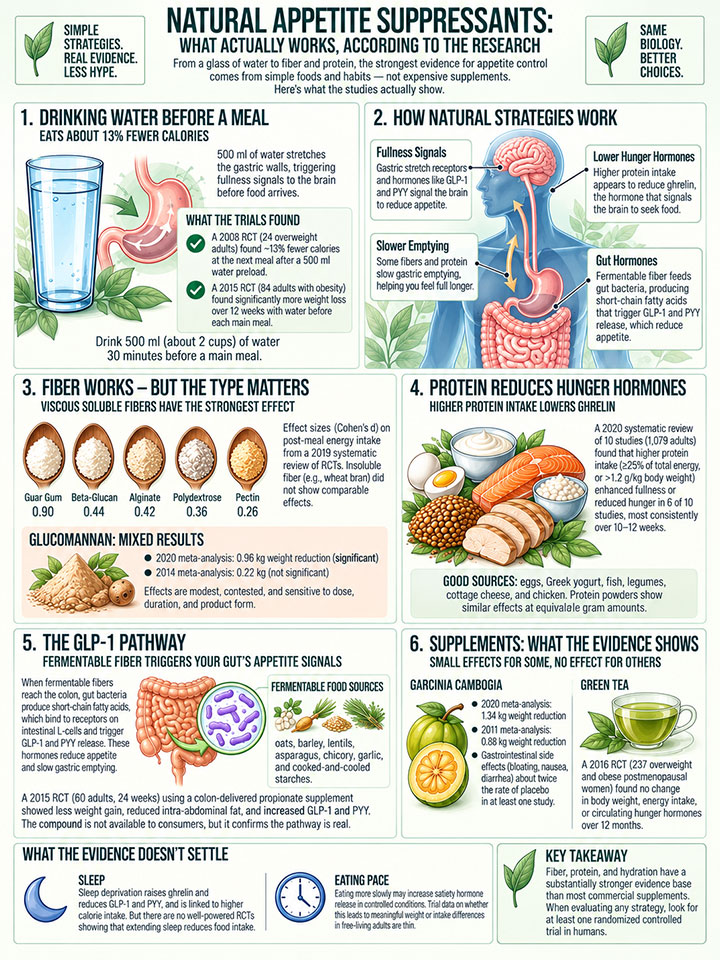
Trying to curb hunger naturally? One research-backed approach required almost no effort, yet participants ate noticeably fewer calories when researchers put it to the test.
Thirty minutes before a meal, researchers handed overweight adults a glass of water. Five hundred milliliters. That was the entire intervention. The group that drank it ate about 13% fewer calories at the meal that followed, and over twelve weeks they lost significantly more weight than the control group, who were simply asked to imagine their stomachs were full.
Two independent randomized controlled trials document that effect. It costs nothing. Most articles ranking for this topic bury it in paragraph nine, if they mention it at all, in favor of supplement categories that sell better and replicate less reliably.
The supplement industry has spent decades making appetite suppression feel complicated. The clinical literature, read carefully, mostly says that the complicated options work less consistently than the boring ones.
This article works through what the evidence actually supports, organized by mechanism: which dietary strategies have consistent human trial data, which supplements have split meta-analytic literature, and which commonly cited options (green tea among them) have a null finding in the best-powered human trial available.
Drinking Water Before a Meal Reduces How Much You Eat
The mechanism is not mysterious. Five hundred milliliters of water in the stomach stretches the gastric walls. This triggers stretch receptors that signal fullness to the brain before food arrives. The question was whether this translates to meaningful calorie reduction in practice.
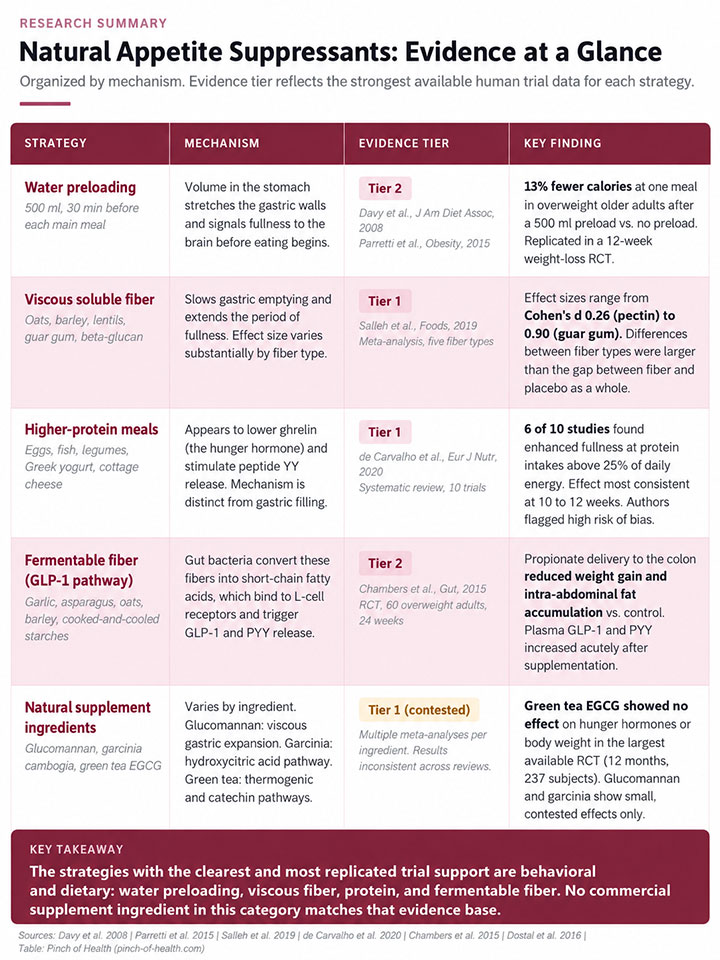
Two independent trials answer that question. Brenda M. Davy and colleagues at Virginia Tech, publishing in the Journal of the American Dietetic Association in 2008, found that 24 overweight older adults ate roughly 13% fewer calories at breakfast after a 500 ml water preload compared to no preload.
The effect held regardless of age, sex, BMI, or habitual water intake. A later trial by Helen Parretti and colleagues in Birmingham, England, published in Obesity in 2015, randomized 84 adults with obesity to water preloading before each main meal or an attention control, and found the preloading group lost significantly more weight at twelve weeks.
The limitation worth noting: the strongest evidence clusters around middle-aged and older adults. Data in younger populations are thinner and less consistent. The effect may be smaller in people whose gastric stretch receptors respond differently to volume without caloric content.
The practical version is simple: drink 500 ml of water about 30 minutes before a main meal. What makes it worth singling out is not the complexity. The evidence for it outlasts most of what the supplement aisle sells for the same purpose.
Which Natural Appetite Strategy Fits You?
5 questions. Evidence-matched results.
Fiber Works, but the Type Determines the Effect
Fiber is the most cited natural appetite suppressant, and the evidence for it is real. It is also more specific than most coverage implies. The appetite-suppressing effect belongs primarily to viscous soluble fibers, not to fiber as a category.
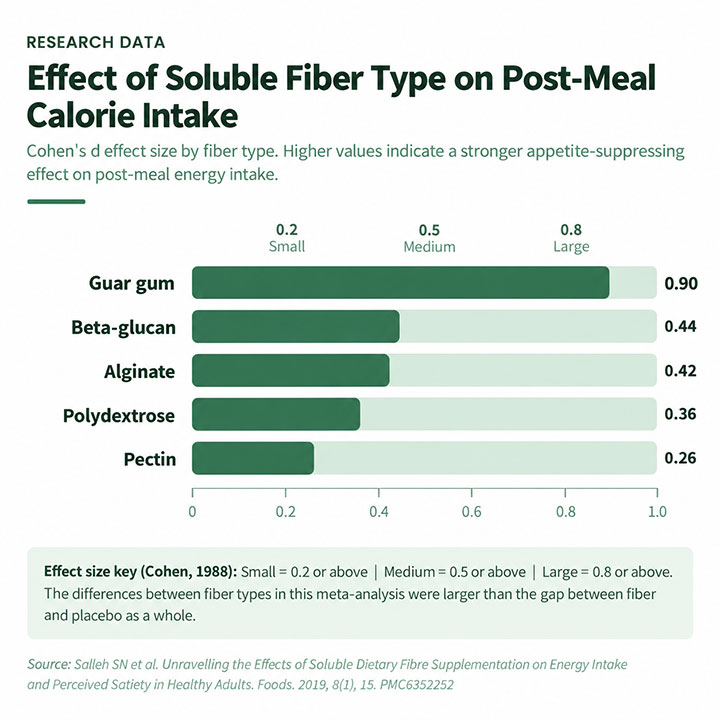
Siti Nurshabani Salleh and colleagues at Universiti Sultan Zainal Abidin pooled randomized controlled trial data for several soluble fiber types and calculated effect sizes on post-meal energy intake.
Their 2019 systematic review in Foods found that guar gum showed the largest effect (Cohen’s d: 0.90), followed by beta-glucan (0.44), alginate (0.42), polydextrose (0.36), and pectin (0.26). The differences between fiber types were larger than the gap between fiber and placebo as a whole. Insoluble fiber, the type in wheat bran, did not show comparable effect sizes in the satiety evidence.
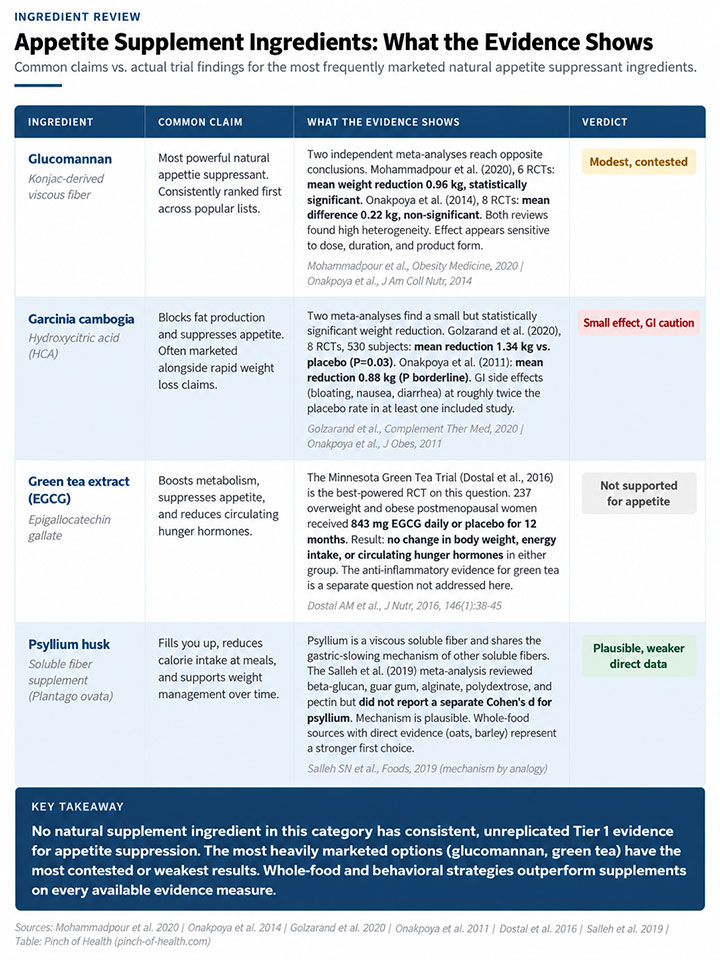
Glucomannan deserves separate attention. It is the most frequently recommended natural appetite suppressant supplement and appears at the top of nearly every list in this category. The meta-analytic evidence for it does not support that confidence.
Saba Mohammadpour and colleagues at Tehran University of Medical Sciences, publishing in Obesity Medicine in 2020, pooled six randomized controlled trials and found a statistically significant weight reduction averaging 0.96 kg.
An earlier systematic review by Igho Onakpoya and colleagues, published in the Journal of the American College of Nutrition in 2014, analyzed eight trials and found a non-significant mean difference of 0.22 kg. Two meta-analyses. The same compound. Opposite conclusions.
The honest reading is that glucomannan’s effects are modest, contested, and sensitive to dose, duration, and the specific product form. It is not the clear-cut recommendation most lists present it as.
Protein and the Hunger Hormone Effect
Something counterintuitive happens when you increase protein intake: your hunger hormone drops. Ghrelin, the peptide that signals the brain to seek food, appears to fall measurably faster in people eating higher-protein diets than in those consuming the same total calories from fat or carbohydrate. The mechanism is separate from anything fiber does. This is not about stretching the stomach.
A 2020 systematic review led by Kathryn M.B. de Carvalho and colleagues, published in the European Journal of Nutrition, pooled ten studies involving 1,079 people with overweight or obesity.
Six of the ten found that higher protein intake (at least 25% of total daily energy, or more than 1.2 g per kilogram of body weight) enhanced fullness or reduced hunger compared to standard protein intake. The effect was most consistent in studies lasting ten to twelve weeks.
The review authors flagged high risk of bias and significant protocol heterogeneity across the included studies. These are real limitations. They explain why protein rarely produces dramatic hunger reduction on its own, and why it works most reliably as one component of a combined approach rather than a standalone strategy.
Among whole foods, eggs, Greek yogurt, fish, legumes, cottage cheese, and chicken provide protein at the density that most trial populations ate. Protein powders at equivalent gram amounts appear to produce similar hunger outcomes. Which means the appetite effect most people attribute to the supplement is likely just the protein.
The GLP-1 Pathway, and Why Fermentable Fiber Is Different
A separate mechanism connects specific fiber types to appetite control, one that runs through the gut’s own hormone system rather than through gastric filling. When fermentable fibers reach the colon, gut bacteria break them down and produce short-chain fatty acids as byproducts.
These bind to receptors on intestinal L-cells, the specialized cells that release glucagon-like peptide-1 (GLP-1) and peptide YY (PYY). Both hormones reduce appetite and slow gastric emptying, and they are the signals that GLP-1 receptor agonist drugs are designed to prolong pharmacologically.
Edward Chambers and colleagues at Imperial College London wanted to know whether this pathway was strong enough to produce measurable effects in free-living humans. Their team developed a supplement that delivered propionate, the short-chain fatty acid with the strongest receptor affinity, directly to the colon.
The engineering was necessary: there is no other way to deliver a colonic fermentation byproduct at clinically useful concentrations through ordinary diet. In a 24-week randomized controlled trial published in Gut in 2015, 60 overweight adults receiving the supplement gained significantly less weight and showed reduced intra-abdominal adipose tissue accumulation compared to the control group. Plasma GLP-1 and PYY also increased acutely after supplementation.
The compound used in that trial is not available to consumers. It matters here as proof that the fiber-to-hormone pathway is real and quantifiable in people, not as a shopping recommendation. The practical version runs through fermentable foods: oats, barley, lentils, asparagus, chicory, garlic, and cooked-and-cooled starches. These support the gut bacteria that produce short-chain fatty acids, which trigger GLP-1 release.
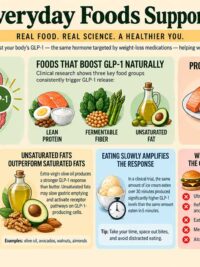
The three food categories with the most direct evidence for activating this hormone system are lean protein, fermentable fiber, and unsaturated fat. The overlap between that list and the foods that have appeared throughout this article is not coincidental.
What the Natural Supplement Evidence Actually Shows
The natural supplement category runs into a consistent pattern. The most heavily marketed options tend to have the thinnest trial evidence, and the ingredients with real (if modest) RCT data are rarely the ones commanding the most retail attention. Two ingredients break far enough from that pattern to be worth examining carefully.
Garcinia cambogia, derived from the rind of a tropical fruit, was widely dismissed after early trials showed mixed results. More recent meta-analytic work tells a more complicated story.
Maryam Golzarand and colleagues, publishing in Complementary Therapies in Medicine in 2020, pooled eight trials across 530 subjects and found an average weight reduction of 1.34 kg compared to placebo.
An earlier systematic review by Igho Onakpoya and colleagues, in the Journal of Obesity in 2011, found 0.88 kg across nine pooled trials. Both effects are small.
Gastrointestinal side effects (bloating, nausea, diarrhea) appeared at roughly twice the rate of placebo in at least one included study. Whether a 1 kg effect size justifies both the cost and the side-effect profile is a judgment each reader has to make for themselves.
Green tea is where the popular narrative and the clinical evidence diverge most clearly. Allison Dostal and colleagues at the University of Minnesota ran the Minnesota Green Tea Trial, a twelve-month randomized controlled trial assigning 237 overweight and obese postmenopausal women to either a decaffeinated green tea extract delivering 843 mg of EGCG daily or a placebo.
Their results, published in the Journal of Nutrition in 2016, showed no change in body weight, energy intake, or circulating hunger hormones over twelve months. The anti-inflammatory and metabolic research on green tea is a separate question. Its effect specifically on appetite is not established.
Understanding how much you eat is one side of energy balance. What your body actually burns across different activities is where the numbers often surprise people most.
What the Evidence Doesn’t Settle
Two factors appear consistently in the appetite literature without the RCT evidence to rank alongside the strategies above. Sleep deprivation reliably raises ghrelin and reduces GLP-1 and PYY in controlled conditions, and the epidemiological links between short sleep and higher calorie intake are robust. What the literature lacks is a well-powered randomized trial showing that deliberately extending sleep duration reduces food intake in otherwise unmodified free-living adults.
Eating pace is in a comparable position. In controlled conditions, consuming the same meal over a longer period appears to increase satiety hormone release by extending the window during which the gut detects incoming nutrients. Trial data on whether this translates to meaningful weight or intake differences in free-living adults are thin.
Both directions are worth acting on. Neither warrants the same confidence as the evidence in the sections above.
That the free, boring interventions hold up better than the expensive, complicated ones is not a surprising finding to anyone who spends time in this literature. It is the default, not the exception. The more useful question is which of the evidence-backed strategies you are not yet applying.