Researchers scanned brains before and after people learned new skills. The biggest surprise wasn’t which exercises worked, it was how quickly some of them did.
Most advice about keeping the brain sharp says to learn something new. Do a crossword. Download a puzzle app.
Brain-imaging research tells a different, less convenient story: the physical changes visible on an MRI scan come from sustained, often demanding practice, not from a few minutes of casual novelty.
Kirk Erickson found that out when his team put 120 older adults through a year of supervised walking. Their hippocampus, the brain region most vulnerable to age-related shrinkage, grew by about 2 percent. A stretching-only control group kept losing volume at the rate you would expect for their age.
That is one study, in one age group, using one type of exercise. It turns out to be the least surprising part of the story.
Juggling changes the brain. So does learning Arabic under time pressure. So does an eight-week meditation course, the kind taught in hospital stress clinics.
None of these require years of practice or professional-level skill. Some produce a measurable change in under two months. This article looks at what actually produced those changes in the people who were scanned, how long it took, and where the evidence is honestly still thin.
The Two Things That Matter Before Any Exercise Does
Skip this section at your own risk. Sleep and aerobic exercise are not on the list of nine because they are obvious. They are mentioned because most of what follows works far less well without them.
A 2011 study in the Proceedings of the National Academy of Sciences enrolled 120 adults aged 55 to 80 in a year-long trial. One group walked briskly three times a week. The control group did stretching and toning instead.
After a year, the walkers had gained about 2 percent more hippocampal volume than the stretchers, who continued losing tissue at the rate typical for their age. The hippocampal growth correlated with rising blood levels of BDNF, a protein that supports the birth of new neurons.
A 2020 review in Frontiers in Aging Neuroscience, cited more than 300 times since publication, compiled the animal and human evidence on exercise and concluded that physical activity reliably raises neurotrophic factors and supports new neural growth well beyond the older-adult populations most often studied. A more recent 2025 review went further, naming aerobic exercise the single most potent neuroplasticity trigger currently supported by the literature.
It doesn’t need to be walking specifically. It needs to raise your heart rate consistently, for months, not weeks.
Sleep does something that the exercise research cannot fully explain on its own. During deep sleep, the brain clears metabolic waste and consolidates the connections built during the day.
Skip sleep, and you are, in effect, building new wiring and then failing to save the file. None of the studies below reported changes in chronically sleep-deprived participants, which is itself a gap worth naming rather than skating past.

Nine Exercises With Brain-Imaging Evidence Behind Them
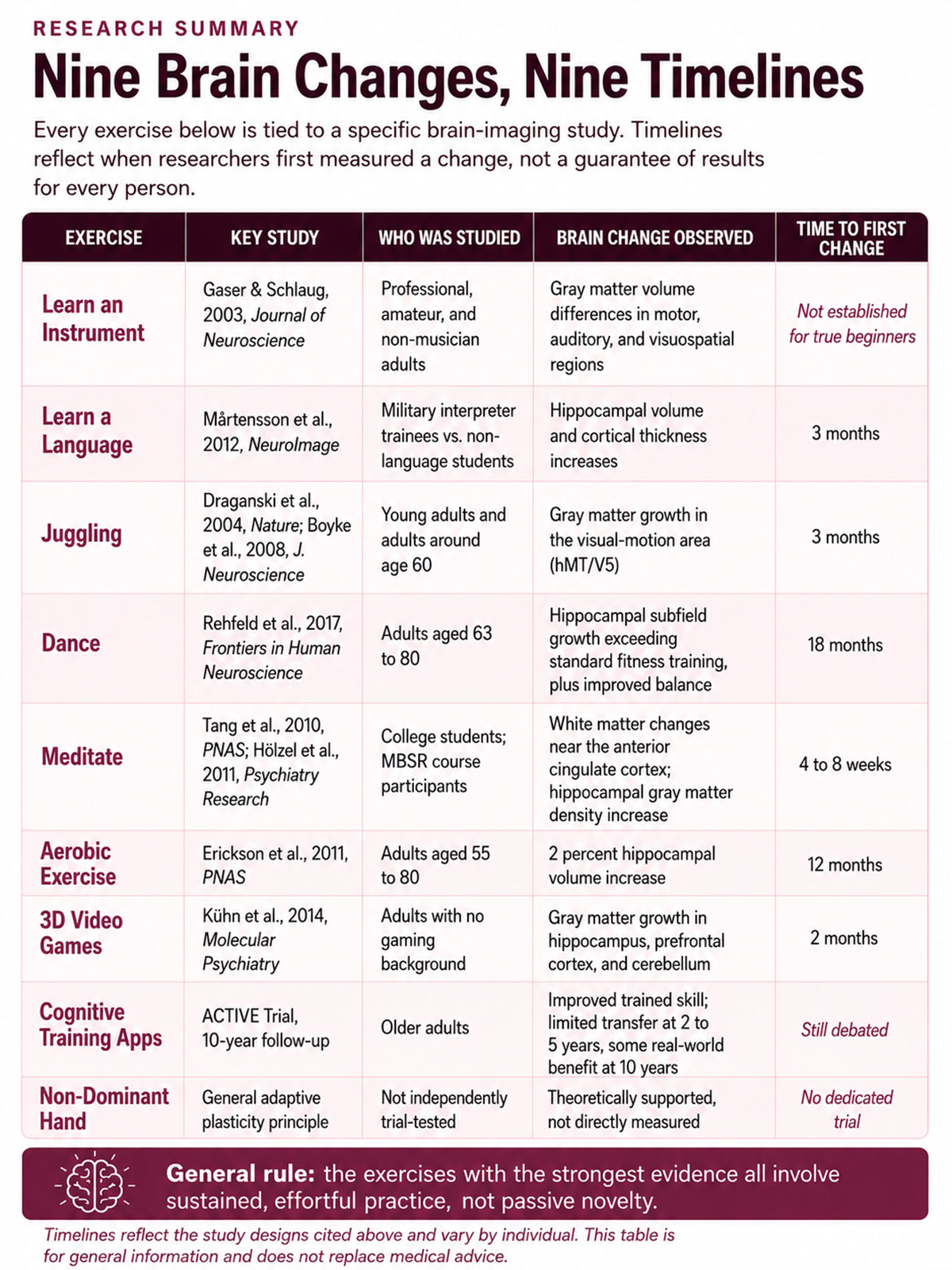
Every entry below is backed by a study that scanned people’s brains before and after they tried something specific. Some of that evidence is strong.
Some of it is a single small trial that deserves a second look before anyone builds a habit around it. Both kinds are included, and the difference is called out directly rather than smoothed over.
1. Learn to Play a Musical Instrument
Christian Gaser and Gottfried Schlaug spent years comparing the brains of professional musicians, amateur musicians, and people who had never played an instrument. Their 2003 study in the Journal of Neuroscience found gray matter volume differences in motor, auditory, and visuospatial regions that scaled with musical status. Professionals showed the largest differences, amateurs came next, and non-musicians showed the least.
Here’s the honest caveat. That study compared people who already differed in musical experience. It did not track true beginners through their first weeks of lessons, so it cannot tell you how quickly a 45-year-old picking up guitar for the first time will see comparable changes.
How fast structural change shows up in genuine beginners is a less settled question than the “musicians have different brains” headline suggests, and most of the imaging work still relies on cross-sectional comparisons rather than tracking someone from zero.
What is well established: the demand on the brain from music comes from combining fine motor control, auditory discrimination, and reading or memorizing patterns at the same time. That combination is rare in daily life, which is likely why it shows up so consistently in imaging studies regardless of instrument.
2. Learn a New Language, Fast
Researchers at Lund University, led by Johan Mårtensson, scanned conscripts at the Swedish Armed Forces Interpreter Academy who were assigned to learn Arabic, Russian, or Dari from scratch. The full program ran 13 months.
The brain scans that matter for this article, though, came at the 3-month mark, when the researchers compared the interpreter trainees against a control group of medicine and cognitive science students who were studying equally hard, but not learning a language.
The 2012 study in NeuroImage found measurable increases in hippocampal volume and in the thickness of language-related cortex, specifically the middle frontal gyrus, inferior frontal gyrus, and superior temporal gyrus, after three months of intensive study.
Students who struggled more with the material showed larger growth in motor-planning regions of the cortex, as if the struggle itself were doing part of the work, separate from whatever fluency came later.
Three months of daily immersion is not a casual Duolingo streak. It was full days of language instruction. A slower, part-time pace will likely produce the same kind of change eventually, given more time.
3. Take Up Juggling
Three months of learning to juggle is enough to change the physical shape of an adult brain. That’s the finding behind Bogdan Draganski’s 2004 study in Nature, one of the most cited papers in this entire field: volunteers who learned a three-ball cascade over three months showed gray matter growth in the mid-temporal area, a region tied to processing complex visual motion.
When the same volunteers stopped practicing, the extra gray matter partly receded within another three months.
A team including Draganski repeated the experiment on people in their 60s and found something worth sitting with. Boyke and colleagues, writing in the Journal of Neuroscience in 2008, reported that older adults learned to juggle more slowly than 20-year-olds but showed gray matter growth in the same visual-motion region, plus additional growth in the hippocampus and nucleus accumbens that the younger group hadn’t shown.
Age slowed the skill acquisition. It did not block the brain change.
To start:
- Use two soft juggling balls or rolled-up socks so drops don’t matter.
- Practice tossing one ball from hand to hand at eye height for five minutes before adding a second.
- Add the second ball only once the first toss feels automatic, aiming for a steady arc rather than speed.
- Expect weeks, not days, before a basic three-ball cascade holds together for even ten seconds.
- Once the cascade holds for a full minute, add a fourth ball or a simple trick to keep testing the same coordination pathways.
4. Trade a Cardio Session for a Dance Class
A team in Magdeburg, Germany, ran an 18-month trial comparing dance training against standard fitness training in adults aged 63 to 80. Both groups trained weekly for the full 18 months. Both groups gained hippocampal volume, specifically in the left CA1, CA2, and subiculum regions, which was itself worth noting since fitness training alone is rarely credited with hippocampal growth over that timeframe.
The dance group pulled ahead in one specific way. The 2017 study in Frontiers in Human Neuroscience found that dancers also gained volume in the CA4 and dentate gyrus subfields, areas the fitness group did not show growth in.
And only the dance group improved on standardized balance testing. Whatever dance adds beyond cardiovascular effort, it appears to come from the demand of memorizing and reacting to changing choreography in real time, not from the aerobic component alone.
5. Meditate, Even Briefly
Two separate research threads land on the same conclusion from different directions, and combining them tells a more complete story than either study alone.
Yi-Yuan Tang’s team found that 11 hours of a mindfulness practice called integrative body-mind training, spread across four weeks, produced measurable improvements in white matter efficiency around the anterior cingulate cortex, a region involved in self-regulation.
That result, published in a 2010 paper in the Proceedings of the National Academy of Sciences, is notable mainly for how little practice it took.
Britta Hölzel’s group at Massachusetts General Hospital ran a longer, more clinical version of the same question. After an eight-week Mindfulness-Based Stress Reduction course, sixteen participants showed increased gray matter density in the left hippocampus, a region tied to learning and emotional regulation, according to a 2011 paper in Psychiatry Research.
A separate, related trial from the same lab, this one published in 2010 in Social Cognitive and Affective Neuroscience, followed 26 stressed adults through the same eight-week course and found that the more a person’s perceived stress dropped, the more their right amygdala gray matter density decreased.
It wasn’t a blanket effect across the group. It tracked individual improvement.
Two labs, two timeframes, two brain regions, one direction of travel. Meditation changes measurable brain structure faster than most people assume, and it does so without requiring an hour a day.
- Sit upright, close your eyes, and set a timer for 10 minutes.
- Focus attention on the physical sensation of breathing, in and out, without trying to control the rhythm.
- When the mind wanders, and it will, notice the wandering and return attention to the breath without judgment.
- Repeat daily, building up gradually toward the roughly 25 minutes a day used in the white matter study above.
6. Force Your Non-Dominant Hand to Work
This one has less dedicated imaging research behind it than the others on this list, and it deserves to be labeled as such rather than dressed up as equivalent evidence. The logic comes from adaptive plasticity, the same mechanism named in the definitional box above: motor cortex adapts to demand, and your dominant hand almost never has to work hard.
Brushing your teeth, stirring a pot, or using a computer mouse with the non-dominant hand forces the motor cortex to build new coordination pathways instead of running the automatic ones. It costs nothing, takes seconds, and stacks easily onto habits you already have.
Just don’t expect it to carry the same weight as three months of language immersion. It is a low-effort supplement to the harder practices above, not a substitute for them.
7. Change Your Route
The hippocampus does more than store memories. It builds cognitive maps of physical space, and that mapping process is one of the more reliable ways to keep the region active without a formal training program.
Taking an unfamiliar route to work, rearranging furniture, or exploring a new part of a familiar city forces the brain to build a new spatial map rather than run an existing one on autopilot. This overlaps mechanically with the hippocampal growth described in the walking, language, and dance sections above, since all three activities also require ongoing spatial orientation. Consider it a way to get more out of the movement you’re already doing, not a separate line item.
8. Play a 3D Video Game
Simone Kühn’s team at the Max Planck Institute recruited adults with no gaming background and had them play Super Mario 64 for about 30 minutes a day over two months. A no-training control group and a group taking self-directed piano lessons served as comparisons.
The 2014 study in Molecular Psychiatry found gray matter increases in the right hippocampus, right dorsolateral prefrontal cortex, and cerebellum in the gaming group specifically, and the hippocampal growth correlated with a measurable shift in how participants navigated space, from an egocentric strategy toward an allocentric, map-based one.
One claim circulating about this research doesn’t hold up under scrutiny. The study did not test a 2D game against Super Mario 64, so no direct evidence exists that two-dimensional games fail to produce the same effect.
What made Mario 64 demanding wasn’t its dimensionality so much as the constant three-dimensional spatial navigation and route-planning it required, and that specific demand hasn’t been isolated and tested against simpler formats.
9. Combine Physical and Mental Effort at Once
Dual-tasking, doing something physical and something cognitively demanding at the same time, shows up repeatedly in current neuroplasticity guidance for a straightforward reason: it approximates real-world demand more closely than either task alone.
Walking while listening to a complex podcast, or cycling on a stationary bike while playing a trivia game, asks the brain to coordinate movement and higher-order thinking simultaneously, the way dance does with choreography and music does with reading notation.
- Pick a low-risk physical activity you can do without much conscious attention, like walking or stationary cycling.
- Add a genuinely demanding mental task, such as a complex podcast or an audiobook that requires following an argument, rather than background music.
Start with 10 minutes and notice when the physical task starts to slip. That slippage is the signal your brain is working to divide attention rather than running on autopilot.
What Actually Kills Neuroplasticity
Heavy, sustained alcohol use is the clearest offender. It damages brain cells directly and blunts the very mechanisms, like BDNF production, that the exercises above depend on.
Chronic sleep deprivation is a close 2nd, since it interferes with the consolidation step that turns a day’s learning into lasting structural change. Chronic, unmanaged stress does a version of the same damage through sustained cortisol exposure, which is part of why the amygdala findings in the meditation section above ran in the opposite direction once stress dropped.
A sedentary lifestyle doesn’t so much kill neuroplasticity as fail to feed it. The brain doesn’t need constant novelty to stay adaptable. It needs periodic real demand, and a body that never gets one rarely provides much of either.
The Reality Check
Two pieces of popular wisdom about brain training deserve more scrutiny than they usually get.
The first is the claim that it takes 21 days to build a new habit. That number traces back to a 1960s self-help book, not a controlled study.
The actual research, a 2010 study in the European Journal of Social Psychology by Phillippa Lally and colleagues, tracked 96 people forming a new daily habit over 12 weeks and found the median time to reach automatic, effortless repetition was 66 days, ranging anywhere from 18 to 254 days depending on the person and the behavior.
More complex habits, like structured exercise, tended to sit at the slower end of that range. Anyone expecting a brain-level change in three weeks is working from a myth, not from data.
The second is the entire premise behind commercial brain-training apps. The Advanced Cognitive Training for Independent and Vital Elderly trial, known as ACTIVE, tested memory, reasoning, and speed-of-processing training in thousands of older adults.
The initial and 2-year results were sobering: participants got measurably better at the specific trained task and showed little transfer to unrelated cognitive skills or daily function. That’s the finding most brain-training skeptics quote, and it’s accurate as far as it goes.
A fuller picture emerged a decade later. A 10-year follow-up on the same participants found that reasoning and speed-of-processing training, specifically, showed some genuine transfer to instrumental activities of daily living, the everyday tasks like managing finances or medications that determine independent living.
Memory training didn’t show the same long-term benefit. The honest summary is that most cognitive training doesn’t transfer, but a narrow subset of it, sustained over a decade, might.
Researchers still don’t agree on why some training transfers and most doesn’t. The clearest example of that disagreement is dual n-back, a working-memory exercise that has spent nearly two decades at the center of the brain-training debate.
A 2008 study in the Proceedings of the National Academy of Sciences reported that dual n-back training raised scores on fluid intelligence tests, the closest thing psychology has to a definition of raw IQ. It became one of the most cited papers in the entire cognitive training field.
A 2016 meta-analysis pooling dozens of replication attempts found that the effect shrinks dramatically, and in many analyses disappears, once study quality and control-group design are accounted for. Neither side of that argument has fully won.
How Long Before You Notice Anything?
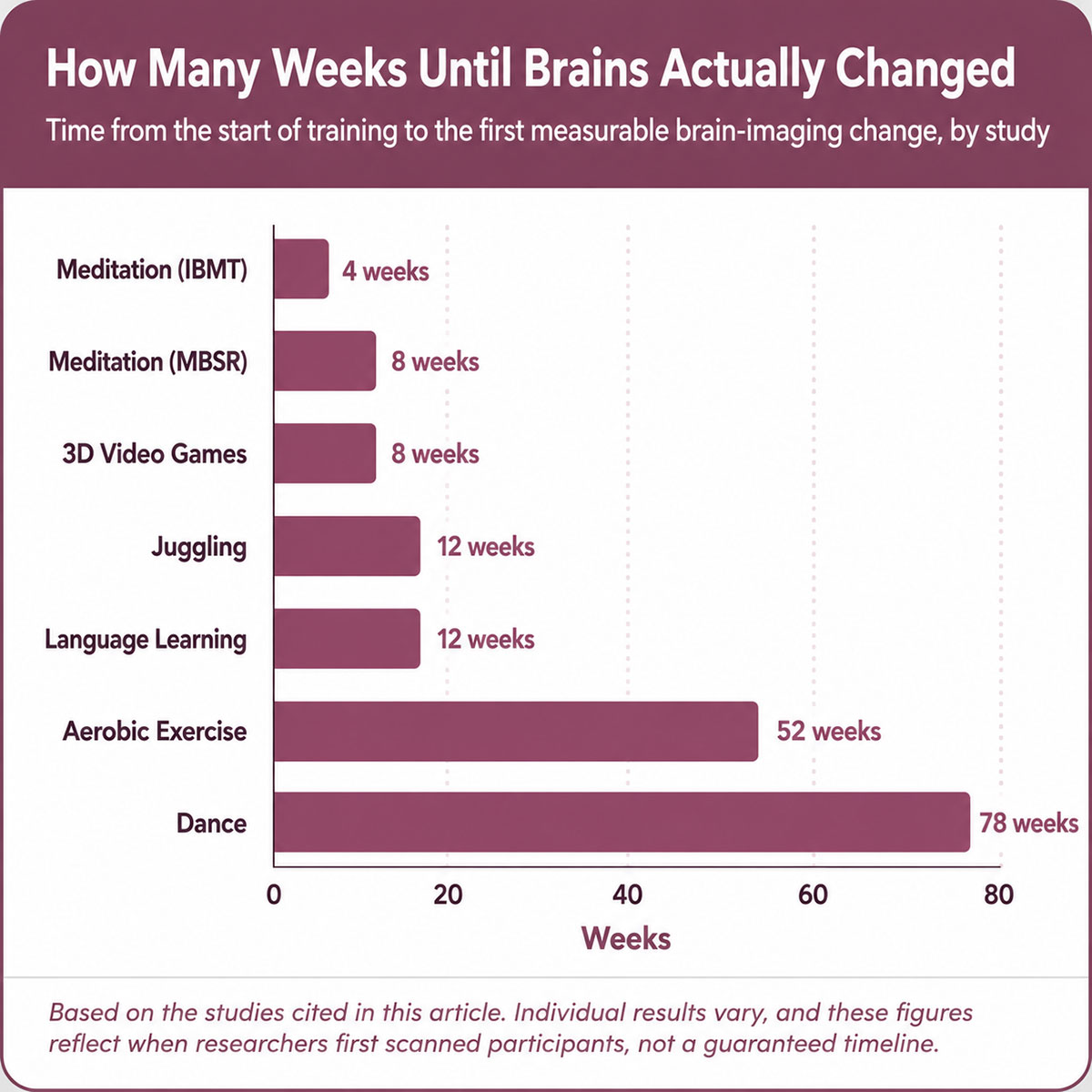
The pattern across every verified study here is the same: skill-based, effortful, sustained practice produces change. Passive novelty, the kind sold by most “brain games,” mostly doesn’t.
Does Neuroplasticity Have a Peak Age?
Yes and no, and the honest answer depends on which kind of plasticity you mean. Developmental plasticity, the wiring that builds the brain’s basic architecture, peaks in early childhood and tapers by early adulthood. That window is largely closed by the time most people reading this were old enough to read.
Adaptive plasticity, the structural change described throughout this article, has no confirmed hard ceiling. Every study cited above, from Erickson’s 55-to-80 age range to Boyke’s juggling seniors, involved adults well past any developmental window, and all of them showed measurable structural change.
The rate slows with age, and the Boyke juggling study captured that slowdown directly. The capacity itself did not disappear.
Signs Your Brain Is Actually Rewiring
Structural change doesn’t announce itself the way sore muscles do, but a handful of subjective signals tend to line up with the studies above. A skill that felt effortful starts to require less conscious attention, the kind of shift Kühn’s video game participants showed when their navigation strategy changed without being told to change it.
Mistakes in a new skill, like a fumbled juggling catch or a mispronounced word, start correcting themselves faster, before conscious thought catches up. And previously exhausting mental effort, like following a conversation in a new language, starts to feel merely tiring instead of overwhelming.
None of these is proof on its own. They’re the subjective experience that tends to accompany the objective brain changes documented above, which is the most honest way to describe them.
A Simple Plan for the Next 90 Days
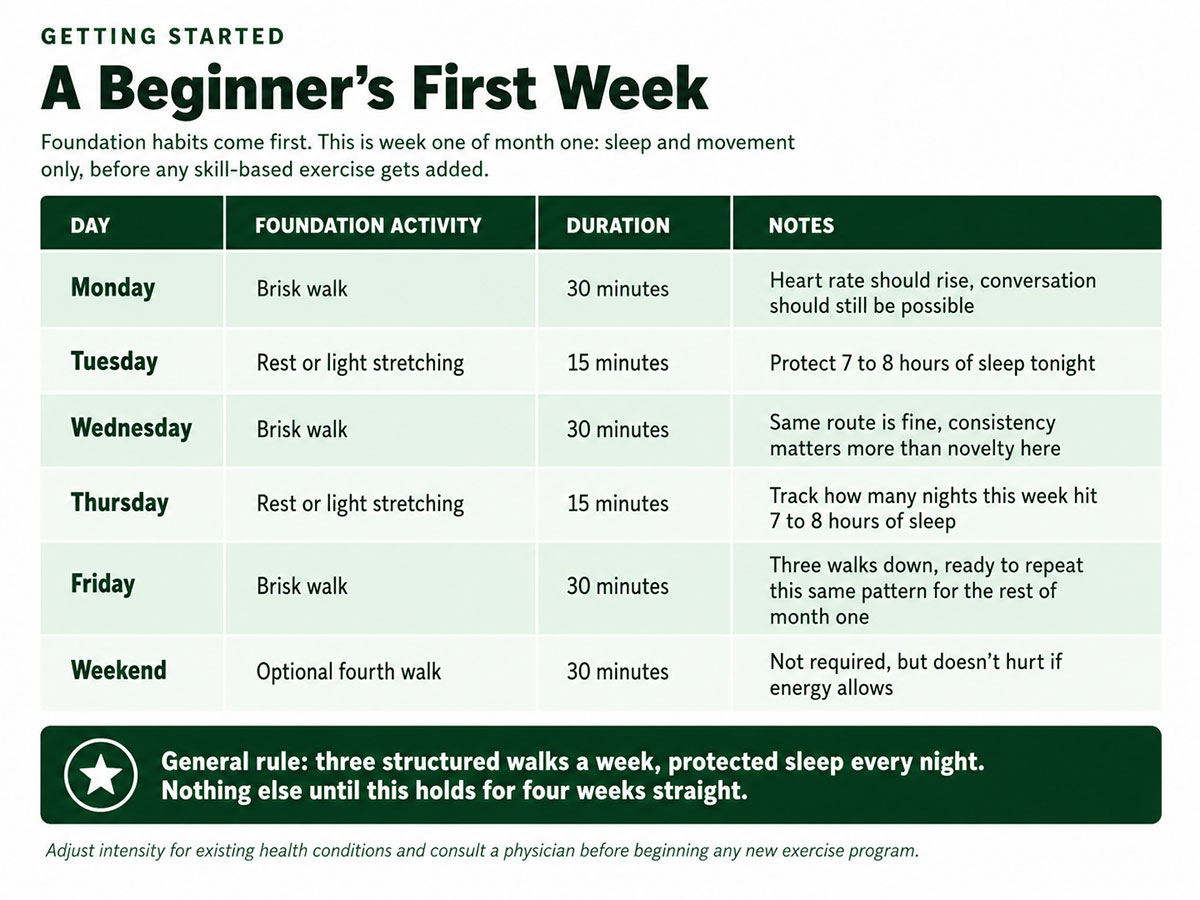
Month one is foundation only. Get consistent aerobic movement three times a week and protect seven to eight hours of sleep. Skip this step and everything after it works less well, per the exercise and sleep research above.
Month two is when you add exactly one skill-based practice from the nine above. Juggling and meditation are the fastest ways to see measurable change, based on the three-month and four-week timeframes in the research.
Resist the urge to add three new skills at once. The habit-formation research above explains why: a new habit needs 66 days on average to become automatic, and splitting attention across several new habits at once tends to stretch that timeline further, not compress it.
If rotating through all nine exercises feels less appealing than mastering one, that instinct has research behind it too.
By month three, the low-cost additions get folded in: the non-dominant hand switch, route changes, dual-tasking during an existing workout. These take almost no extra time and compound on top of whatever skill you added in month two.
What to Eat While You’re Rewiring
None of the studies above tested diet directly, which is worth mentioning rather than presenting a list of “brain foods” that the research didn’t actually examine. What’s reasonably well supported by adjacent nutrition research is that omega-3 fatty acids, found in fatty fish, walnuts, and flaxseed, support the same neural membrane structures that the exercises above are trying to build.
Foods that increase neuroplasticity in a supporting rather than causal role include leafy greens, berries, and foods rich in polyphenols, all of which reduce the oxidative stress that works against neural growth.
None of this replaces the practices above. It supports them.
Try the BDNF Boost Calculator
The exercises above all point back to one shared mechanism: brain-derived neurotrophic factor, the protein that shows up repeatedly in the exercise and sleep research. The calculator below scores five everyday factors (sleep, movement, stress, diet, and skill-building) and estimates where your current routine likely stands.
BDNF Boost Calculator
Five everyday factors that support (or work against) new brain growth
Key Takeaways
- Sleep and aerobic exercise are the foundation that every other exercise on this list depends on, not optional extras.
- Juggling and meditation are the fastest-acting exercises with strong evidence, showing measurable brain change within four to twelve weeks.
- Dance outperforms standard fitness training on hippocampal subfield growth and is the only intervention here shown to improve balance alongside brain structure.
- Commercial brain-training apps mostly don’t transfer to real-world skills, though a narrow subset of training may help a decade later.
- New habits take a median of 66 days to become automatic, not 21, so give any single practice at least two months before judging it.
- Adaptive plasticity has no confirmed age ceiling. Every study cited here involved adults well into their 60s, 70s, and 80s who still showed measurable change.
Conclusion
The advice to “learn something new every day” isn’t wrong so much as imprecise. Nobody in these studies learned something new every day.
Erickson’s walkers walked the same route for a year. Draganski’s jugglers practiced the same three balls for three months. Mårtensson’s interpreters studied the same three languages, day after day, for months, not a rotating cast of new subjects.
What changed their brains was depth applied to one demanding thing, held long enough for the structure underneath to catch up with the effort. That’s a less exciting sentence than most brain-hack headlines promise, and it happens to be the one the imaging data actually supports.
Frequently Asked Questions
Does neuroplasticity ever fully stop?
Not according to the current evidence. It slows with age, and Boyke’s juggling study is the clearest direct demonstration of that slowdown, but no study reviewed here found a hard cutoff.
Do I need to do all nine exercises?
No. The action plan above recommends one skill-based practice at a time, added on top of the sleep and exercise foundation.
Is this different from what “rewiring your brain” videos claim?
Often, yes. Most of that content skips the sample sizes, timeframes, and caveats included throughout this article, which is exactly where a lot of the exaggeration creeps in.